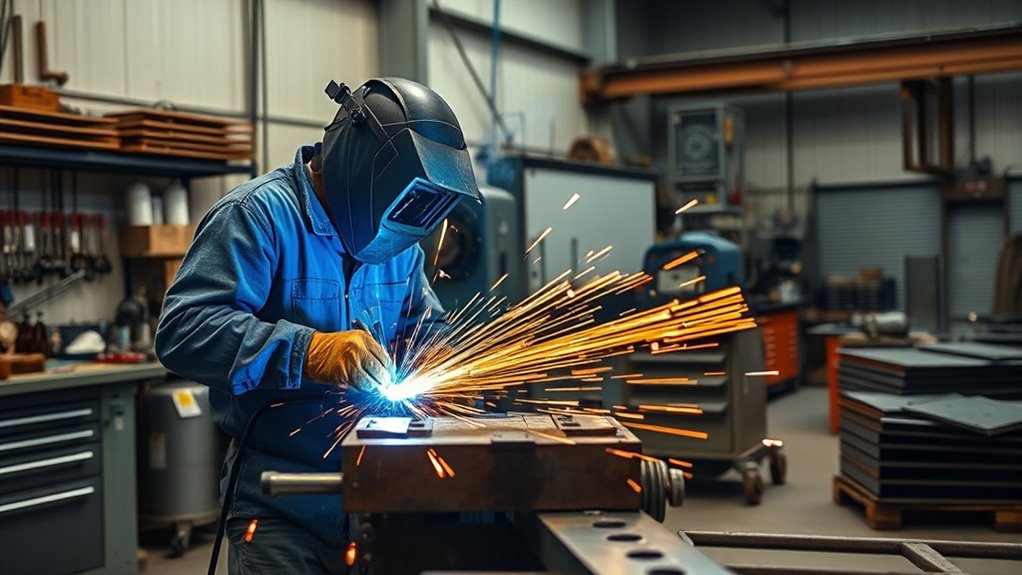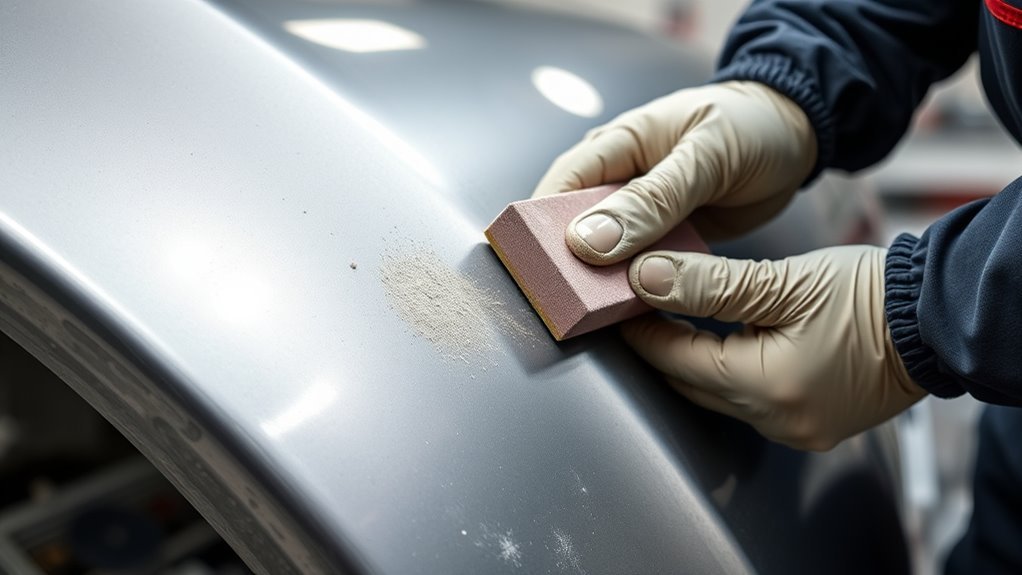
To smooth a weld without over-grinding, use an abrasive that is rated for grinding, remove only the raised bead, and check the joint after every few passes. Keep the grinder moving at the disc manufacturer’s recommended angle, pause before heat builds, and stop as soon as the weld is level. Never sacrifice base-metal thickness for a perfectly invisible seam.
Quick Answer
Clean and inspect the weld, then lower only its high spots with a grinding-rated flap, fibre, or small abrasive disc. Use light, overlapping passes and check flatness with a straightedge. Change to finer grit as the bead approaches the panel, and stop before the surrounding metal becomes thin, hot, discolored, or visibly distorted.
Key Takeaways
- Confirm that the weld is allowed to be ground flush before removing any metal, especially on structural or vehicle repairs.
- Use an abrasive specifically rated for grinding. Do not side-grind with an ordinary cut-off wheel.
- Secure the work, install the correct guard and side handle, and confirm that the disc’s speed rating meets or exceeds the grinder’s speed.
- Work in short, overlapping passes with light pressure, checking heat and flatness frequently.
- Repair cracks, pinholes, porosity, undercut, or low weld areas instead of trying to grind them away.
- Use a hand block or DA sander for cured body filler rather than a metal-grinding flap disc.
At a Glance
| Time Required | 15 minutes to 1 hour, depending on the bead size, material thickness, access, defects, and required finish |
| Difficulty | Moderate; success depends on disc selection, pressure, angle, heat control, and knowing when to stop |
| Tools Needed | 4.5-inch angle grinder, grinding-rated flap or fibre discs, small Roloc-style abrasive for tight areas, straightedge, marker, approved cleaner, clean rags, and suitable safety equipment |
| Cost | Low to moderate if you already own the grinder; most of the cost comes from abrasives, cleaning supplies, filler, primer, and corrosion protection |
Warning: Do not grind a structural, load-bearing, pressure-retaining, suspension, frame, pillar, rocker, seat-belt, roll-cage, or safety-critical weld flush unless the drawing, welding procedure, engineer, or vehicle manufacturer’s repair procedure permits it. Wear safety glasses and suitable face protection, hearing protection, gloves, natural-fiber or flame-resistant clothing, and respiratory protection selected for the actual dust or coating hazard.
Before You Start, Confirm the Weld Can Be Smoothed
A smooth-looking weld is not automatically a sound weld. Before touching the bead, determine what the weld does and how much reinforcement the design requires. Cosmetic butt welds on outer sheet metal are often dressed nearly flush, but fillet welds, plug welds, structural seams, and engineered joints may need to retain a specified profile.
For vehicle repairs, follow the manufacturer’s repair procedure. For fabricated structures, follow the drawing, welding procedure specification, applicable code, or engineer’s direction. Information about fillet weld sizing can help explain why a visible weld profile may be part of the joint’s required strength rather than excess metal.
The stopping point is not “when the bead disappears.” Stop when the permitted weld profile is reached without reducing the thickness of the surrounding metal.
Inspect the Weld for Defects
Clean the joint enough to see its full outline, then inspect it under bright light. Grinding can reveal a defect, but it cannot repair one.
- Cracks: Stop and repair the crack using an approved procedure.
- Pinholes or porosity: Remove contamination and repair the affected area before finishing.
- Undercut: Do not grind the surrounding base metal down to match the low groove.
- Lack of fusion or incomplete penetration: Rework the joint rather than hiding it with filler.
- Low weld areas: Add and blend weld metal when the procedure permits instead of thinning the adjacent panel.
- Excessive distortion: Correct the panel shape before trying to grind the surface flat.
Cleaner welding usually means less finishing. Correct MIG welding settings, steady travel speed, suitable stickout, clean metal, and controlled bead size reduce spatter and excess buildup. Wire diameter alone does not guarantee a low-spatter weld, so treat claims about .035-inch flux-core wire as product- and setup-dependent.
Set Up the Grinder Safely
A 4.5-inch angle grinder gives you useful control on open seams, but the grinder and abrasive must be treated as one matched system. Before use, read the grinder and disc instructions and confirm the following:
- The grinder is unplugged or its battery is removed while installing the accessory.
- The disc type, diameter, arbor, flange, and guard match the grinder.
- The disc’s maximum operating speed is equal to or higher than the grinder’s rated speed.
- The disc has no cracks, chips, moisture damage, heavy wear, contamination, or missing sections.
- The correct guard is installed and positioned between you and the wheel.
- The side handle is installed so you can hold the tool with both hands.
- The workpiece is clamped or otherwise supported on a stable surface.
- Sparks cannot reach fuel, batteries, wiring, glass, upholstery, hoses, paint supplies, dry vegetation, or other flammable materials.
- People nearby are protected from sparks, fragments, noise, and dust.
OSHA requires guarding for portable abrasive-wheel tools and specifies that a right-angle grinder’s guard should sit between the operator and wheel. The abrasive must also be compatible with the grinder’s speed. Review the OSHA portable powered-tool requirements and your equipment manufacturer’s instructions before use.
Note: After installing a new abrasive, keep the guard in place and perform the manufacturer-recommended test operation in a protected direction before touching the work. Stop immediately if the grinder vibrates abnormally, the disc runs out of true, or you hear cracking or irregular contact.
Choose the Right Grinder and Discs
Use the smallest tool that gives you stable access without forcing the disc into an awkward angle. A 4.5-inch grinder is versatile on open weld seams, while a 2- or 3-inch grinder, file belt, or die grinder gives you better control in corners and narrow body lines.
Products Worth Considering
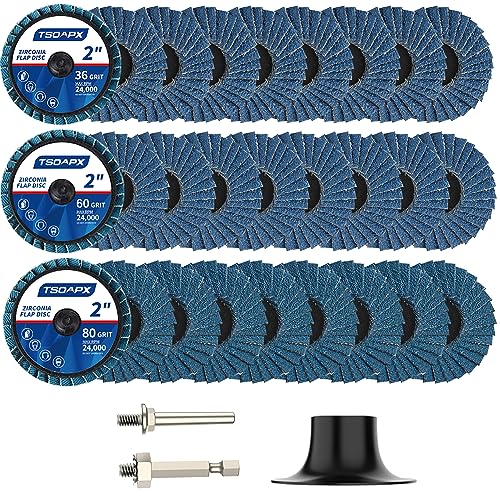
✅【High Performance Zirconia Flap Discs】The TSOAPX Flap Disc Set is equipped with premium zirconia corundum (blue) that is ideal for heavy-duty applications. Compared to traditional alumina, it has a longer lifespan, exceptional anti-clogging performance, high stock removal, and fast cutting capacity.
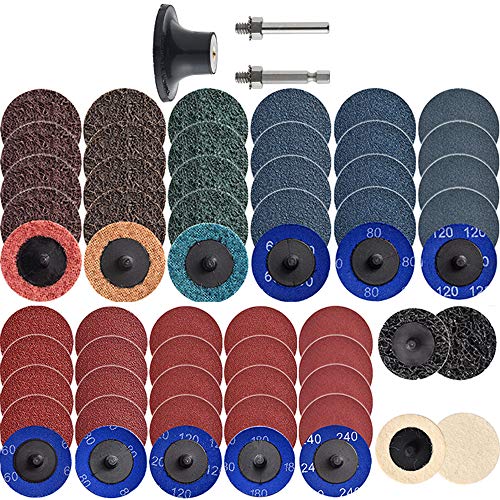
📌25Pcs Aluminium Oxide discs, 15Pcs Nylon SiC sanding discs, 15Pcs Zirconium Oxide discs, 2Pcs Black Strip discs, 2Pcs Compressed Wool discs and 1Pcs 1/4" shank holder, 60Pcs in total.

【What You Will Get】 This 2 in. Roll discs kit comes with 2 pcs 1/4'' disc holders, 70pcs aluminum oxide discs (40#/60#/80#/120#/180#/240#), 15pcs non-woven discs (coarse/medium/fine), 15pcs zirconium oxide discs (60#/80#/120#), 2pcs mini flap disc (40#), 2pcs black sanding discs and 2pcs wool disc. Various sanding discs to meet your various polishing requirements.
Grinder Size Matters
- 4.5-inch angle grinder: Useful for accessible seams and broad, controlled blending.
- 2- to 3-inch grinder: Better for short seams, edges, narrow panels, and confined repairs.
- Air or electric die grinder: Accepts small grinding-rated abrasives for detailed work.
- Abrasive file belt: Reaches channels, corners, and overlap seams with a narrow contact area.
- Hand file: Slow but useful when maximum control matters near an edge or body line.
A small tool is not automatically safer. It must still use a compatible guard or manufacturer-approved protective system, and the abrasive must be rated for the tool’s speed.
Pick the Right Discs
| Abrasive | Best Use | Main Caution |
|---|---|---|
| Flap disc | Controlled weld leveling and blending | Use the labeled working angle and avoid broad contact on thin sheet metal |
| Fibre sanding disc | Fast, precise stock removal with a suitable backing pad | Cuts quickly and can gouge if held still or used with excess pressure |
| Grinding wheel | Heavy bead reduction on thicker work | Often too aggressive for thin automotive panels |
| Roloc-style grinding disc | Tight seams, spot welds, corners, and small repair zones | Keep the backing pad away from sharp edges and use the rated tool speed |
| Cut-off wheel | Cutting and notching with the wheel’s outer edge | Do not use the side for grinding or deburring |
| Combination wheel | Cutting and limited side grinding when expressly permitted | Follow the product label; do not assume every thick cut-off wheel is a combination wheel |
Standard cut-off wheels are designed for cutting on the periphery, not for side grinding. Side pressure can weaken the reinforcement and cause breakage. See Norton’s cutting-versus-grinding safety guidance before selecting an abrasive.
For flat blending, many Type 27 flap discs are intended to work at approximately 0 to 15 degrees, while Type 29 discs commonly work at a steeper angle. Always follow the label for the exact disc. The overview of angle grinder wheel types can help you distinguish accessories, but the abrasive manufacturer’s instructions remain the final authority.
Clean the Weld Before You Grind
Clean the weld so the abrasive cuts metal rather than dragging dirt, loose slag, grease, paint, or rust across the repair. Remove spatter and loose scale with a scraper or suitable wire brush, then use an approved surface cleaner according to its label and safety data sheet. Allow the area to dry completely before producing sparks.
- Remove loose slag, rust, scale, spatter, paint, seam sealer, and contamination.
- Identify galvanized, lead-containing, chromate-containing, or otherwise coated metal before grinding.
- Inspect the front and rear of the joint when access allows.
- Protect nearby glass and finished surfaces from sparks and abrasive particles.
- Confirm that hidden wiring, hoses, fuel lines, insulation, and trim are clear of the spark path.
If a joint was plasma-cut, correct cutting speed and standoff distance can reduce dross and the amount of grinding required before welding. Likewise, clean metal before flux-core welding helps prevent porosity and excessive cleanup.
Note: Galvanized coatings and some paints can create hazardous fumes or dust when heated or ground. Remove coatings only with suitable ventilation, containment, hygiene, and respiratory controls. Keep the grinder away from unknown coatings until you identify the material.
CDC literature associates heated galvanized steel with zinc-oxide exposure and metal fume fever. Review the CDC metal fume fever reference and applicable workplace requirements when galvanized material is involved. Guidance on removing zinc coating should be followed with suitable ventilation and exposure controls.
How to Smooth a Weld Without Over-Grinding
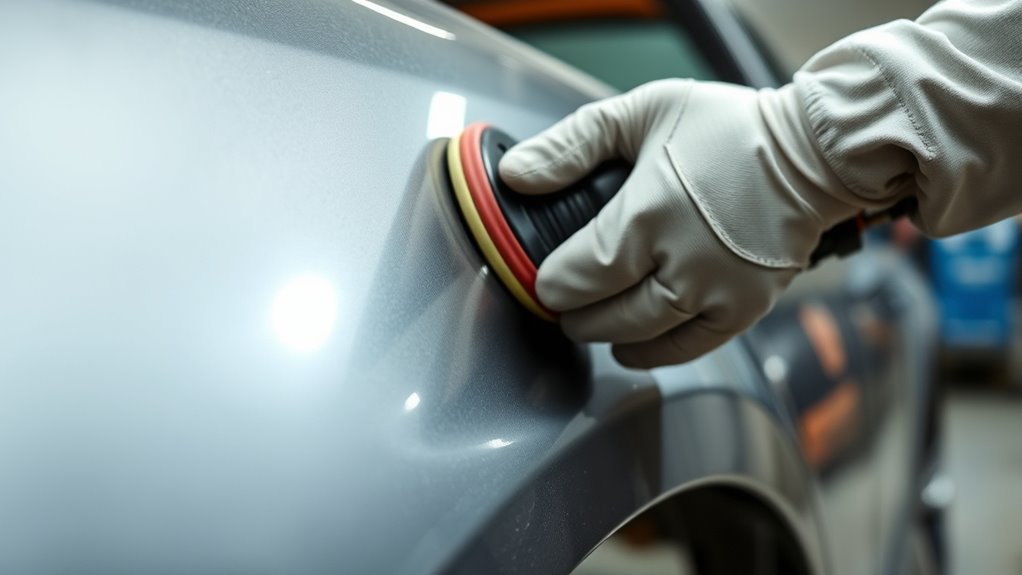
- Confirm the weld may be dressed. Check the drawing, repair procedure, joint type, and required weld profile.
- Clean and inspect the joint. Repair cracks, porosity, pinholes, undercut, or incomplete fusion before cosmetic finishing.
- Mark the high area. Run a permanent marker across the weld and adjacent metal. The remaining ink helps reveal untouched high spots.
- Start with a grinding-rated abrasive. Use a flap, fibre, grinding, or small Roloc-style disc suited to the metal thickness and access.
- Approach at the labeled working angle. Bring the disc to full speed before contact and use the intended working face, not an unsupported edge.
- Lower only the raised bead. Use light, overlapping passes and move away as soon as the abrasive crosses onto the base metal.
- Change direction. Cross-hatch the weld so one travel path does not create a long groove.
- Pause and inspect. Check heat, flatness, distortion, remaining marker, and the weld outline after every few passes.
- Change to finer grit. As the weld approaches the desired level, switch to a less aggressive abrasive rather than reducing pressure on a worn coarse disc.
- Stop at the first level surface. Do not keep grinding merely to remove scratches or make the weld invisible.
- Finish and protect the repair. Sand to the coating manufacturer’s required grit, clean the area, repair minor cosmetic marks if permitted, and restore primer and corrosion protection.
Pro Tip: Reapply marker after each inspection. If ink remains on the surrounding panel but disappears from the bead, you are still cutting the high weld. When the marker begins disappearing evenly across both surfaces, reduce grit and pressure or stop.
Knock Down High Spots With Light Passes
Begin on the highest part of the bead and keep the abrasive contact narrow. Do not lay the full face of a coarse disc across a thin panel. Light contact allows the abrasive to cut without forcing the grinder, while constant movement prevents one area from absorbing all the heat.
Work in short, overlapping passes rather than using an arbitrary fixed distance. The right pass length depends on the panel thickness, bead height, abrasive type, tool speed, and how quickly the metal heats.
Grind a little, stop, inspect, and continue only where the weld is still high.
Check the bead with a straightedge or metal ruler. Place the edge across the seam from several directions. A remaining high spot may make the ruler rock, while a low spot may show as a visible gap. Do not grind the surrounding metal down to correct a low weld.
If the abrasive becomes loaded or stops cutting efficiently, replace it. A worn disc often causes the operator to press harder, which adds heat and makes gouging more likely.
Use Cross-Hatching to Level the Weld
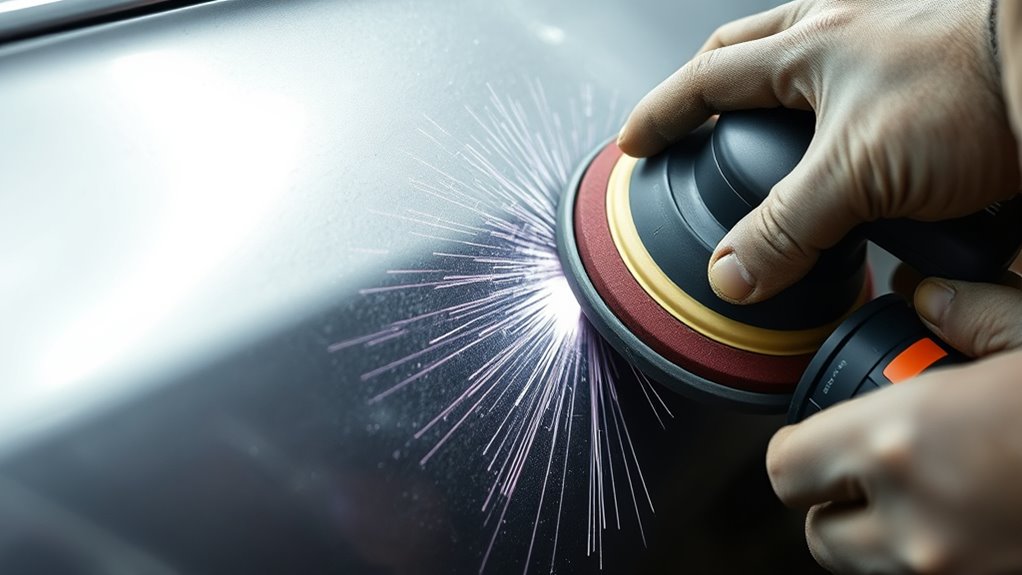
Cross-hatching means changing the grinder’s travel direction so the abrasive approaches the bead from more than one angle. One pass might move diagonally across the seam, while the next crosses it in the opposite direction. This reduces the chance of cutting a single long trough beside the weld.
- Keep each pass centered on the raised weld.
- Change travel direction without twisting or side-loading the abrasive.
- Use both hands and maintain a stable stance.
- Let the grinder reach full speed before contact.
- Lift the abrasive away before changing your body position.
- Check panel alignment and straightedge contact frequently.
Cross-hatching does not mean sweeping a coarse disc broadly across the entire panel. The goal is to distribute the cutting pattern while keeping most of the abrasive action on the remaining high weld.
Wear suitable protective clothing against sparks and hot particles. Natural-fiber or flame-resistant clothing is preferable to garments that can melt when struck by sparks.
Sand the Weld for Final Smoothing
Once the bead is close to level, change from aggressive stock removal to controlled refinement. A 60- or 80-grit grinding-rated abrasive may be appropriate for the early stage, but thin sheet metal or a nearly flush bead may require a finer starting point.
Move to approximately 120 grit or another grit specified by the primer, filler, coating, or adhesive manufacturer. Do not assume that every coating system accepts the same scratch pattern. The final surface should be uniformly keyed without deep grinding grooves, polished patches, or visible thinning.
Keep checking three areas:
- The weld center: It should no longer stand above the permitted profile.
- The heat-affected area: It should not be deeply scratched, blue from excessive grinding heat, or visibly thinned.
- The panel contour: A straightedge should sit consistently without rocking across the seam.
Confirm the wheel speed rating and guard requirements whenever you change accessories. A finer-looking disc is not safe if its diameter, arbor, speed rating, or mounting system is incompatible with the grinder.
Products Worth Considering

【Ceramic Shaped Grain】These flap discs are made with industrial-grade ceramic abrasives, offering double the grinding power and superior heat dissipation. Ceramic discs also last three times longer than zirconia discs and five times longer than aluminum oxide discs.

PREMIUM QUALITY: These angled flap discs, also known as cut off wheels 4 1/2 inch, are constructed with industrial grade premium zirconia abrasive for strength, durability, and extended disc life as it holds up to high temperatures and pressure.

✨【Premium Material】PRETEC flap sanding discs are crafted from high-density premium zirconia abrasive, ensuring strength, durability, and extended disc life. They are designed to withstand high temperatures and pressure for optimal performance.
Prevent Heat, Warping, and Thin Spots
Grinding creates frictional heat, and thin automotive sheet metal can distort before the surface looks severely overheated. Use a sharp abrasive, light pressure, brief contact, and frequent pauses. Spread your passes across the permitted weld area instead of concentrating on one point.
Control Heat Buildup
- Use the least aggressive abrasive that removes the remaining high material efficiently.
- Keep the disc moving at its correct working angle.
- Pause before the panel becomes excessively hot.
- Watch for blue or straw-colored discoloration, smoke, coating damage, or rapid panel movement.
- Allow the metal to cool using the repair method appropriate for the material and panel.
- Do not press harder when a disc stops cutting; replace or clean the abrasive as permitted.
Do not rely on touching hot metal with a bare hand. Gloves can also hide how hot a panel has become. Observe the cutting action, discoloration, distortion, and heat spread, and use suitable temperature-checking practices when the repair procedure requires them.
Avoid Thin Spotting
Thin spotting usually begins when the abrasive crosses off the weld and repeatedly cuts the adjacent base metal. Keep the contact focused on the raised bead, and reduce grit as soon as the weld approaches level.
Stop if you see any of these signs:
- The weld outline begins disappearing unevenly.
- The surrounding metal becomes visibly brighter or more polished than the bead.
- The panel flexes more easily near the seam.
- A straightedge shows a hollow beside the weld.
- The metal edge becomes sharp or feathered.
- The grinder sound changes because the disc is contacting a wider, flatter area.
If the seam is low, do not grind the rest of the panel to match it. Correct the low area with approved metalwork, rewelding, or a suitable cosmetic finishing process.
Handle Tight Corners and Overlap Seams
Tight corners need a smaller grinding-rated abrasive, narrow file belt, carbide burr, or hand file chosen for the material and tool. Do not turn a thin cut-off wheel sideways or use it at a steep angle as a substitute for a grinding disc.
- Use small Roloc-style grinding discs for short seams and spot-weld cleanup.
- Use a narrow abrasive belt for channels and inside corners.
- Use a hand file near fragile edges when power-tool control is limited.
- Keep backing pads, arbors, and burr shanks from contacting the panel.
- Protect adjacent edges with a thin metal shield when practical.
- Inspect overlap seams for remaining sharp edges, gaps, and exposed bare metal.
On an overlap seam, preserve the joint geometry and any required weld reinforcement. Do not blend across the outer panel merely to hide an uneven weld. Improving fit-up, cleanliness, and weld consistency before grinding will reduce the cleanup required.
If the seam begins to distort, stop. Check alignment with a ruler or contour gauge and correct the metalwork before removing more material.
Use Filler for Minor Imperfections
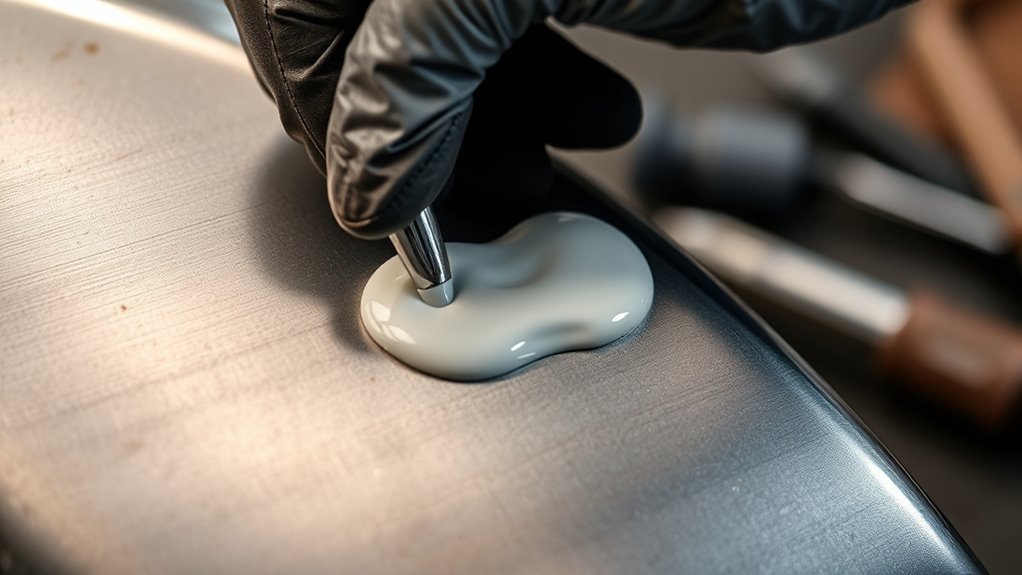
Body filler is for shallow cosmetic imperfections after the weld is sound, stable, and sufficiently level. It must not be used to hide cracks, porosity, incomplete fusion, unsupported gaps, active corrosion, or a structurally inadequate joint.
Prepare the metal according to the filler manufacturer’s instructions. Apply a thin coat and allow it to cure fully. Shape the filler with a hand sanding block or suitable DA sander rather than an angle-grinder flap disc. A block helps maintain the panel contour and makes high and low areas easier to identify.
3M’s collision-repair guidance uses approximately 80-grit abrasive for initial filler shaping, followed by finer stages. Exact grit and cure requirements vary by product, so follow the filler and coating system instructions. See the 3M Small Damage Repair SOP for an example of a staged body-repair process.
| Step | Tool or Material | Purpose |
|---|---|---|
| Inspect | Bright light and straightedge | Confirm the weld is sound and close to level |
| Prepare | Approved cleaner and specified abrasive | Create a clean surface with the required scratch pattern |
| Apply | Body filler | Fill shallow cosmetic imperfections |
| Shape | Hand block or DA sander | Level filler while preserving panel contour |
| Refine | Progressively finer abrasive | Prepare for the specified primer or coating |
Common Mistakes That Ruin a Smooth Weld
- Using a cut-off wheel for side grinding: Standard cut-off wheels lack the lateral strength required for grinding.
- Grinding without checking the repair procedure: A required structural weld profile may be weakened for appearance.
- Removing the guard: This increases exposure to fragments and sparks and may violate the tool instructions or workplace rules.
- Using one abrasive for the entire job: A coarse disc that works well at first can become too aggressive near the final surface.
- Pressing harder on a worn disc: This adds heat and makes gouging more likely.
- Grinding the panel instead of the bead: Broad contact creates a shallow low area around the weld.
- Trying to erase pinholes or undercut: These defects require repair, not more thinning.
- Skipping rear-side inspection: Spatter, damaged coating, sharp edges, or exposed metal may remain behind the panel.
- Using a flap disc on body filler: This can cut low spots quickly and damage nearby metal.
- Stopping only when the weld is invisible: The seam may become dangerously thin before every visual trace disappears.
Troubleshoot Grinding Problems
| Problem | Likely Cause | Correction |
|---|---|---|
| Deep grooves | Too much pressure, coarse grit, steep angle, or dwelling | Reduce pressure, use the labeled angle, change direction, and switch to finer grit sooner |
| Panel waviness | Broad grinding contact or excessive heat | Stop grinding, assess the metalwork, and correct distortion before finishing |
| Disc loads quickly | Grease, paint, filler, soft coating, or unsuitable abrasive | Clean the surface and use an abrasive intended for the material |
| Excess vibration | Damaged disc, incorrect mounting, incompatible accessory, or grinder problem | Stop immediately, disconnect power, and inspect the full setup |
| Weld remains proud | Bead is larger than expected or abrasive is worn | Use a fresh grinding-rated abrasive and continue only on the marked high area |
| Low groove beside weld | Abrasive repeatedly crossed onto the base metal | Stop removing metal and assess whether metalwork, rewelding, or cosmetic filler is permitted |
Safety Check Before You Prime or Paint
Before applying filler, primer, seam sealer, paint, or corrosion protection, complete a final inspection:
- The weld has the profile allowed by the applicable procedure.
- No cracks, pinholes, porosity, undercut, sharp edges, or missed high spots remain.
- The surrounding metal shows no visible thinning or deep grinding tracks.
- The panel contour checks correctly with a straightedge or contour gauge.
- Grinding dust and loose abrasive material have been removed.
- The surface has been cleaned with a product compatible with the coating system.
- The back of the panel has been inspected where accessible.
- Damaged primer, e-coat, seam sealer, or cavity protection will be restored.
Grinding and welding can remove factory corrosion protection, especially on automotive panels and enclosed cavities. Restore the approved primer, seam sealer, paint, and rear-side or cavity protection required by the repair procedure.
Sources
- OSHA 29 CFR 1910.243, Guarding of Portable Powered Tools — portable abrasive-wheel guards and operator protection
- OSHA Tools and Related Equipment Guidance — eye and face protection, wheel inspection, speed compatibility, and guarding
- Norton Abrasives, Safety: Cutting vs. Grinding — why standard cut-off wheels must not be used for side grinding
- Norton Abrasives, Do’s and Don’ts of Flap Discs — flap-disc working angles and safe use
- 3M Small Damage Repair Standard Operating Procedure — surface preparation and body-filler sanding practices
- CDC, Metal Fume Fever — zinc-oxide exposure associated with heated galvanized metal
Frequently Asked Questions
How do you smooth out a weld without weakening it?
Confirm that the weld is permitted to be dressed, then use a grinding-rated abrasive to remove only the raised material. Work in light, overlapping passes, check the surface with a straightedge, change to finer grit near the final level, and stop before the surrounding base metal becomes thin or distorted.
What should you use to smooth welds?
Use a flap disc, fibre sanding disc, grinding wheel, abrasive file belt, or small Roloc-style grinding disc that is rated for the grinder, metal, and operation. Choose the least aggressive abrasive that removes the high weld efficiently, then progress to finer grit for blending.
Can you use a cut-off wheel to grind down a weld?
Do not use the side of an ordinary cut-off wheel for grinding or deburring. Standard cut-off wheels are designed for peripheral cutting and may break when side-loaded. Use a grinding-rated disc instead. A combination wheel may permit limited side grinding only when its label and instructions expressly allow it.
What grit flap disc is best for smoothing welds?
A 60- or 80-grit flap disc is a common starting range for controlled weld leveling, but the correct grit depends on the metal thickness, bead height, disc design, and required finish. Switch to approximately 120 grit or the coating manufacturer’s specified grit as the weld approaches level.
Should a structural weld be ground completely flush?
Not unless the drawing, welding procedure specification, engineer, code, or vehicle manufacturer’s repair procedure permits it. A visible fillet, plug, frame, suspension, pillar, rocker, or other structural weld may need to retain a specified profile and reinforcement.
Can J-B Weld be sanded smooth?
Yes, many J-B Weld epoxy products can be sanded after full cure. Original J-B Weld lists a full cure of 15 to 24 hours, but cure times vary among formulas. Check the exact product label, allow it to cure completely, and begin with a suitable shaping grit before moving finer.
Why are my welds not smooth?
An uneven bead may result from incorrect voltage or amperage, unsuitable wire feed speed, inconsistent travel, excessive stickout, poor fit-up, contamination, unstable shielding, or adding too much filler metal. Correct the welding process first so you do not depend on aggressive grinding to shape every joint.
Should a weld be completely flush before body filler?
A cosmetic weld should be close to the permitted final level, but you should not thin sound metal merely to remove every mark. Repair defects first, stop when the seam is structurally sound and level enough, then use a thin skim of compatible filler for shallow cosmetic imperfections.
Conclusion
To smooth a weld without over-grinding, use the correct grinding-rated abrasive, keep the contact focused on the raised bead, and inspect the surface after every few passes. Change to finer grit before the seam reaches its final level, and stop as soon as the required profile is achieved.
Do not use an ordinary cut-off wheel for side grinding, do not grind structural reinforcement away for appearance, and do not hide weld defects with filler. Finish by checking both sides of the repair, cleaning the metal, and restoring the required primer, sealer, paint, and corrosion protection.