Quick Answer: Stitch Weld Pattern for Heat Control
Last updated: August 8, 2026
[VERIFY: add the real Garage Welding author/byline and applicable welding credentials.]
A stitch weld pattern controls heat by dividing a long weld into short weld segments separated by unwelded gaps or cooling intervals. On thin sheet metal, that approach can reduce localized heat buildup, burn-through, shrinkage, and distortion compared with depositing one long bead in the same area. The exact stitch length and spacing are not universal, however. They must suit the material, joint, welding process, load, drawing, and welding procedure. Never replace a required continuous, structural, pressure-containing, or seal weld with intermittent welds simply to reduce heat.
For manual welding, the most useful controls are tight fit-up, short welds, a planned skip or back-step sequence, appropriate machine settings, adequate cooling, and inspection for fusion. TWI identifies short back-step and skip-weld sequences as effective distortion-control techniques, while Miller recommends intermittent or stitch welding and backing bars to help manage thin-sheet heat. TWI’s distortion-control guidance and Miller’s thin-sheet welding guide provide useful technical references.
How a Stitch Weld Pattern Controls Heat and Warping
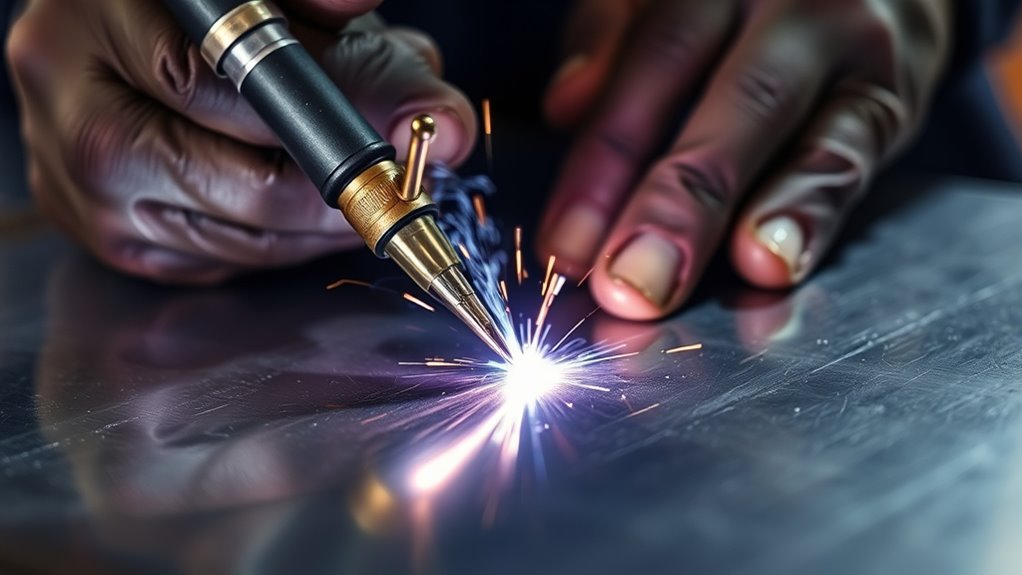
Stitch welding reduces heat concentration by breaking the weld into shorter deposits rather than keeping the arc on one area continuously. The heated metal still expands and contracts, but spreading the welds along the joint gives each area more opportunity to cool before nearby metal receives additional heat.
This matters most on thin sheet because thin material has relatively little stiffness and can move noticeably as the weld zone heats and shrinks. Skip welding, balanced sequencing, proper tacking, and suitable restraint can therefore reduce the amount of distortion that develops. For more background on the mechanism, see the Garage Welding guide to weld distortion and its causes.
A stitch pattern can also reduce the total amount of deposited weld metal when the design allows intermittent welding. TWI recommends minimizing unnecessary weld metal and notes that intermittent welding can be used instead of continuous welding when adequate strength is maintained by the design. TWI’s distortion-by-design guidance explains this principle.
A stitch pattern is a heat-control tool, not a universal weld specification. Weld length, spacing, size, and location must still meet the drawing or approved procedure.
The frequently quoted 4 cm weld followed by a 4 cm gap is one documented Smooth Robotics enclosure example, not a default setting for every joint. Smooth Robotics uses that pattern to illustrate its robotic Stitch feature. Your actual spacing may need to be shorter, longer, staggered, continuous, or omitted entirely depending on the job.
If you’re welding thin material with self-shielded wire, the same heat-control principle can be combined with the process-specific guidance in this thin-metal flux-core welding guide.
Essential Techniques for Mastering Stitch Welding
Reliable stitch welding starts with deciding whether an intermittent weld is permitted. A lower-heat pattern is not useful if it violates the drawing, repair specification, code, OEM procedure, or required sealing function.
- Confirm the weld requirement first: Check the drawing, weld symbol, WPS, repair manual, or engineering requirement. Do not shorten a specified continuous weld without authorization.
- Prepare tight fit-up: Uneven gaps concentrate heat on unsupported edges and increase the risk of burn-through. Tack the work securely before adding longer weld segments.
- Choose a short starting segment: Base the starting length on material thickness, joint geometry, welding process, and a test coupon rather than copying a universal distance.
- Distribute the welds: Move to separated locations along a long seam instead of depositing adjacent sections continuously. TWI describes this as skip welding when short weld lengths are deposited in a predetermined, spaced sequence.
- Allow controlled cooling: Do not continue adding heat to a visibly overheated or moving panel simply to finish faster.
- Inspect each adjustment: Reduced heat is useful only if the weld still has adequate fusion, weld size, and profile.
On thin sheet, a copper or aluminum backing or chill bar can also support the molten pool and carry heat away from the joint when the application allows it. Garage Welding covers this technique in more detail in its guide to using backing with sheet-metal welds.
If you are using flux-core equipment rather than MIG or TIG, process-specific variables still matter. Wire classification, polarity, contact-tip-to-work distance, travel angle, and the manufacturer’s operating range should be set correctly before the stitch pattern is used. See these flux-core welding tips for additional setup guidance.
Troubleshooting Common Stitch Welding Issues
A stitch weld can reduce heat buildup and still produce a poor joint if the individual welds are cold, contaminated, undersized, or badly positioned. Diagnose the defect rather than assuming a longer cooling pause will solve every problem.
| Problem | Likely cause | What to check |
|---|---|---|
| Lack of fusion | Insufficient heat at the joint, excessive travel speed, incorrect gun/electrode angle, long arc, contamination, or poor fit-up | Clean the joint, verify the approved parameter range, correct the angle and travel speed, then test again on matching scrap. |
| Burn-through | Too much heat, excessive arc time, wide gap, slow travel, or unsupported thin edges | Improve fit-up, shorten individual weld time, correct machine settings, and consider suitable backing where permitted. |
| Panel warping | Heat concentrated in one area, long adjacent welds, poor restraint, oversized welds, or an unbalanced sequence | Skip between separated locations, use appropriate tacks and restraint, and stop adding unnecessary weld metal. |
| Porosity or contamination | Dirty material, coatings, oil, moisture, shielding problems, or incorrect consumable handling | Clean the metal and verify shielding, filler, electrode, and consumable requirements for the selected process. |
| Corrosion between stitches | Moisture or contaminants collecting in unsealed gaps | Use the specified corrosion-protection system. Do not assume an intermittent weld provides a sealed joint. |
TWI notes that preventing lack of fusion requires suitable joint preparation and welding parameters that provide adequate penetration without excessive travel speed or an unsuitable arc length. Its lack-of-fusion guidance is a better diagnostic reference than treating weld spacing alone as the cause.
Do not use a 4 cm weld/4 cm gap as a troubleshooting target. That pattern is one Smooth Robotics example. If a drawing specifies a different intermittent-weld length and pitch, or requires a continuous weld, follow that requirement.
How to Set Up a Stitch Weld Pattern for Manual and Robotic Welding
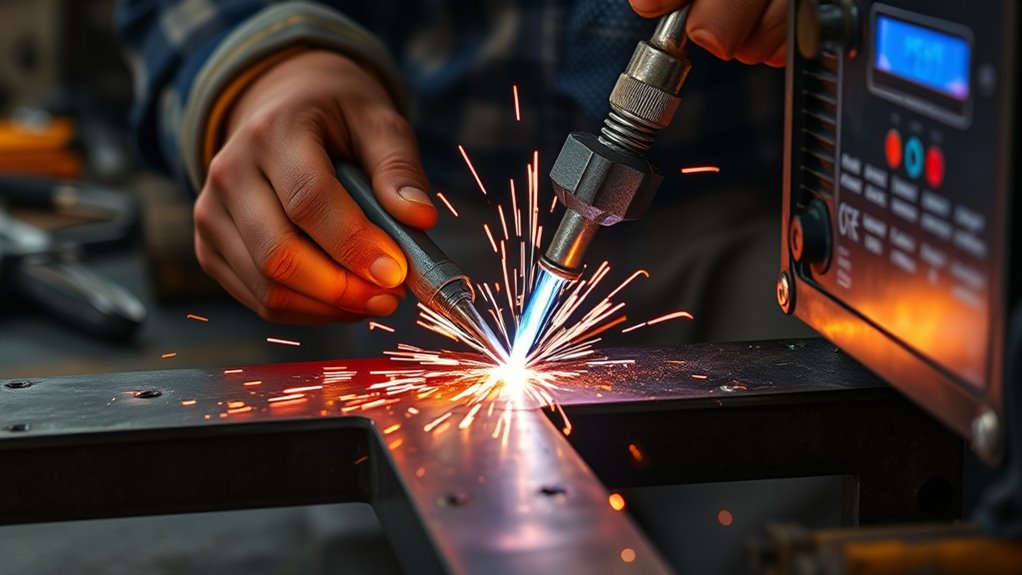
Manual welding machines and SmoothTool robotic software do not use the same stitch-welding controls. On a manual MIG, TIG, flux-core, or stick setup, begin with the machine and consumable manufacturer’s approved settings for the material and thickness. Then use matching scrap to test arc time, travel speed, fusion, distortion, and the amount of cooling needed between locations.
For MIG welding, voltage and wire feed must work together rather than being adjusted as unrelated heat controls. The Garage Welding wire-speed and voltage guide explains the relationship in more detail.
Products Worth Considering

【Synergy & Compact】 HITBOX MIG welder comes with One-Knob intelligent control system. The welding machine automatically compensates and adjusts the welding current,...
SmoothTool Stitch Pattern Settings
SmoothTool is robotic welding software from Smooth Robotics. Its current documentation places Stitch inside the Weaving settings of a Weld node or individual weld segment. That terminology should not be treated as a universal menu found on ordinary welding machines.
Documented SmoothTool controls include:
- Weld End: Controls whether the pattern ends with a weld or a gap.
- Manual Separation: Allows custom separation distances instead of automatic distribution.
- Start Offset: Allows the path to begin with a gap rather than a weld, which can help offset patterns on symmetrical parts.
- Weld Length: Defines the length of an individual weld segment.
- Number of Welds: Sets the number of stitches when automatic distribution is being used.
- Separation Distance: Defines the gap between stitches when Manual Separation is active.
- Airspeed: Controls robot travel speed during non-welding movement between stitches.
- Retraction: Controls torch retraction between stitches.
- Allow Merge: Determines whether the stitch pattern is applied across a continuous merged path or to segments separately.
Smooth Robotics also recommends considering Start Offset for symmetrical welds, Allow Merge for continuous corners or edges, and balancing Retraction and Airspeed for the application. See the current Smooth Robotics Stitch feature documentation before configuring a robotic program.
SmoothTool settings control robot motion and pattern placement. They do not replace the welding procedure, weld-size requirement, power-source settings, or inspection criteria.
Stitch Welding vs Continuous Welding vs Resistance Seam Welding
The best option depends on what the joint must do. Stitch welding and a continuous arc weld are deposition patterns, while resistance seam welding is a different welding process.
| Method | What it does | Typical reason to use it | Main limitation |
|---|---|---|---|
| Intermittent or stitch arc welding | Places separated weld segments along the joint | Reduce unnecessary weld metal and distribute heat when the design permits intermittent welding | Does not create a continuously sealed joint and may not satisfy structural or fatigue requirements unless specifically designed for them |
| Continuous arc welding | Deposits weld continuously along the required joint length | Required continuity, sealing, strength, fatigue performance, or compliance with the drawing/procedure | Can introduce more total weld metal and distortion if the design and sequence are not controlled |
| Resistance seam welding | Uses wheel-shaped electrodes to create a continuous or closely overlapping resistance weld along sheet metal | Mechanized production of sheet-metal seams, including applications requiring a continuous seam | Requires specialized resistance-welding equipment and should not be confused with simply running a continuous MIG/TIG bead |
TWI describes resistance seam welding as a process that feeds sheet between wheel-shaped electrodes and forms a continuous seam through electrical resistance heating. Its seam-welding overview explains why the term should not be used as a synonym for every continuous arc weld.
For an intermittent arc weld, the deciding question is not simply “Which creates less heat?” Ask instead: What weld continuity, weld size, strength, sealing, corrosion protection, and distortion control does this joint require?
Products Worth Considering

Product dimensions: The product has a total length of 93mm, a brush length of 60mm, and a thread of M6. Manual measurements, please allow slight errors.

FR welding Cap:Updated New Functin on Surface(Water Repellent and Oil Resistant) we use the 10oz heavy weight flame resistant cotton duck(canvas) outside and inner material Flame Resistant cotton. More heat and arc resistant ATPV 14 Calories/cm2+8.2 Calories/cm2
Product dimensions: The product has a total length of 93mm, a brush length of 60mm, and a thread of M10. Manual measurements, please allow slight errors.
Best Practices for Better Stitch Welds
The most repeatable stitch welds come from controlling the entire joint rather than focusing only on stitch spacing.
- Practice on matching scrap: Match the material, thickness, joint shape, position, coating condition, filler, and backing as closely as possible.
- Tack before adding heat: Secure alignment and recheck the joint before completing the intermittent pattern.
- Skip around long seams: Avoid adding several hot welds directly beside one another when a spaced sequence is allowed.
- Keep welds no larger than required: Oversized welds add heat, filler, time, shrinkage, and distortion without automatically improving the joint.
- Inspect fusion: A visually neat stitch is not useful if it fails to fuse into both members.
- Recheck dimensions while welding: Measure flatness, alignment, and fit before the joint becomes too rigid to correct easily.
- Follow the process-specific setup: MIG, TIG, FCAW, SMAW, robotic GMAW, and resistance welding each have different parameter requirements.
If the part is structural, load-bearing, safety-critical, pressure-containing, part of a vehicle structure, or governed by a welding code or OEM repair procedure, follow the approved design and procedure instead of creating an intermittent pattern by trial and error.
Additional Resources for Learning Stitch Welding
Use resources that separate general welding principles from equipment-specific controls. The following references cover the main areas involved in stitch welding:
- TWI — Distortion Control by Fabrication Technique: back-step welding, skip welding, tack strategy, welding direction, and distortion control.
- Miller — Welding Sheet Metal With MIG and TIG: thin-sheet heat control, skip welding, fit-up, and backing bars.
- Fronius — Stitch Welding Operating Guidance: stitch welding on light-gage sheets and the role of weld/pause intervals.
- Smooth Robotics — Stitch Feature: SmoothTool-specific Stitch Pattern controls such as Start Offset, Manual Separation, Retraction, Airspeed, and Allow Merge.
For process-specific practice, Garage Welding also has guides covering stick welding thin sheet metal and essential welding fundamentals.
What About Stitch Welding Galvanized Steel?
Intermittent welding may be specified for some galvanized components, but the coating creates an additional safety issue. Heating galvanized steel can generate zinc oxide fumes, which OSHA identifies as a cause of metal fume fever. Welding fumes and coatings must therefore be evaluated and controlled with appropriate ventilation, work practices, protective equipment, and any applicable workplace respiratory-protection requirements.
Do not treat short weld duration as adequate fume protection. Follow the approved procedure for coating removal or preparation and restore required corrosion protection after welding. See OSHA’s welding-fume guidance for hazard information.
Frequently Asked Questions
When to Use Stitch Weld?
Use stitch or intermittent welds when the joint design, drawing, repair procedure, or engineering requirement permits separated weld segments and reducing weld metal or heat concentration is beneficial. Thin sheet, stiffeners, panels, and non-sealed fabrication are common examples. Do not substitute stitch welds for a required continuous, structural, pressure-containing, watertight, or seal weld.
How to Control Heat Input in Welding?
Control welding heat by using the correct process settings, suitable travel speed, proper weld size, tight fit-up, planned weld sequencing, short welds where permitted, and cooling time between separated locations. On thin sheet, backing or chill bars and balanced welding sequences can also help. The objective is not simply to make the weld as cold as possible; each weld still needs adequate fusion.
What Is the Stitch Welding Technique Used For?
Stitch welding is used to place short, intermittent weld segments instead of one continuous weld where the design allows it. It can reduce total deposited weld metal and distribute welding heat, helping control distortion in thin or heat-sensitive fabrication. It does not automatically provide the same sealing or joint continuity as a continuous weld, and the gaps may need corrosion protection.
What Is the Rule of 33 in TIG Welding?
The TIG “Rule of 33” is a high-speed pulse starting point commonly associated with about 33 pulses per second, 33% background current, and 33% pulse width or on-time. It is not a rule requiring a one-second cooling pause for every 3/32 inch of material thickness. The three values are starting settings and may need adjustment for the material, joint, machine, and desired bead characteristics.
Is Stitch Welding the Same as Skip Welding?
The terms are sometimes used loosely, but they can describe different ideas. An intermittent or stitch weld describes separated weld segments in the finished joint. Skip welding usually describes the sequence used to deposit short welds at spaced locations along a seam to distribute heat and shrinkage. A welder can therefore use a skip sequence while creating an intermittent weld, or use a skip sequence while gradually completing a joint that will ultimately become continuous.
Can Stitch Welding Replace a Continuous Weld?
Only when the design or approved procedure allows it. A continuous weld may be required for sealing, pressure containment, fatigue resistance, structural load transfer, corrosion control, or compliance with a drawing or code. Heat control alone is not sufficient justification for changing the specified weld.
Conclusion
A good stitch weld pattern controls heat by combining short weld deposits with deliberate spacing, sequencing, fit-up, restraint, and cooling. The goal is not simply to make the shortest possible weld. Each segment must still achieve the required fusion and weld size, and the finished pattern must comply with the drawing or approved procedure.
For thin sheet, begin on matching scrap, establish stable machine settings, tack the joint accurately, and distribute short welds so heat does not collect in one location. Recheck alignment as the work progresses. If the joint must be continuous, sealed, structural, or procedure-controlled, keep the required weld and manage distortion through sequencing, fit-up, backing, restraint, and the correct welding process rather than deleting required weld length.