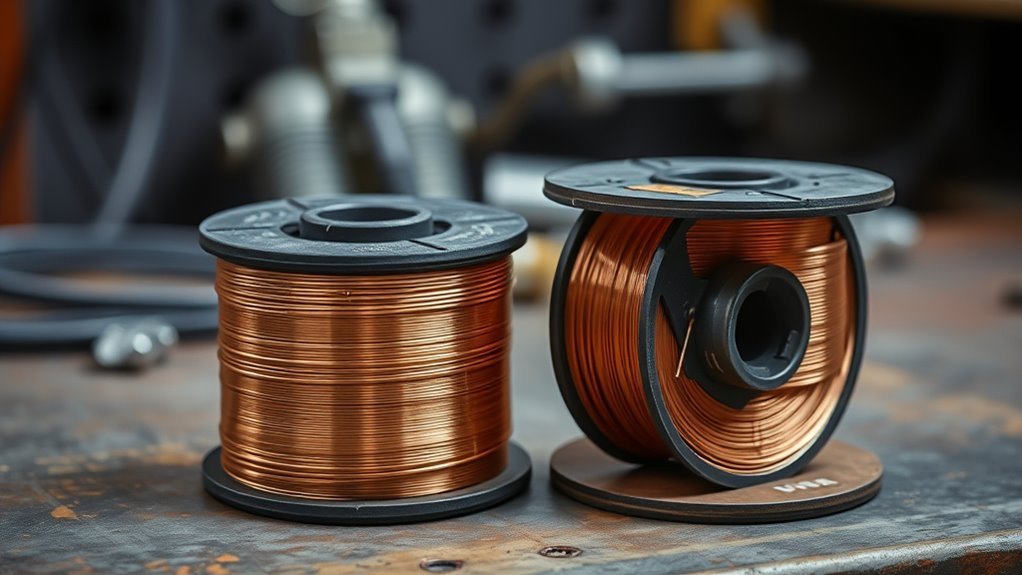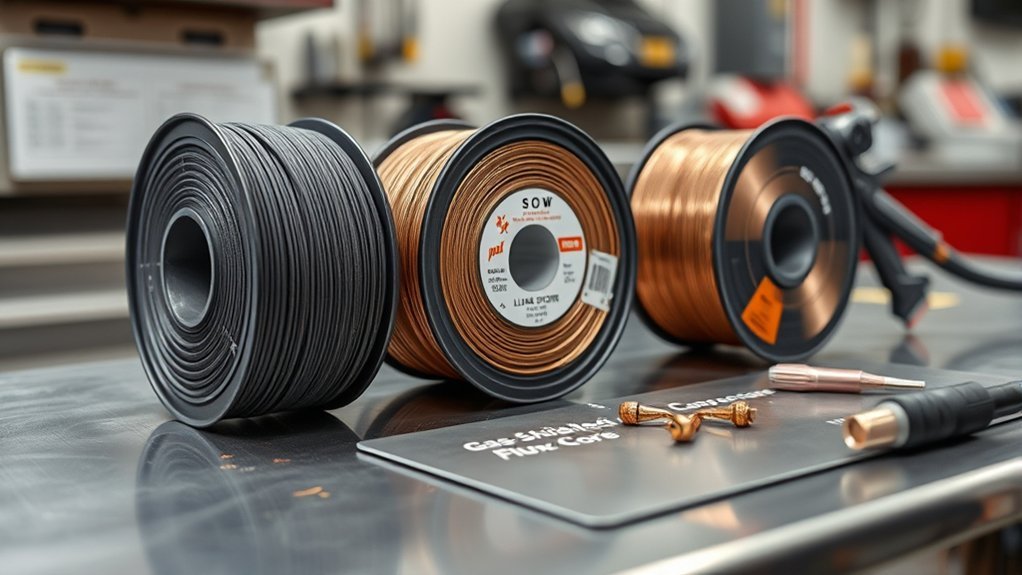
Flux core wire can repair some thicker, non-structural vehicle steel, but it is usually the wrong process for thin outer body skins. Flux-cored wire runs hotter than solid MIG wire and leaves slag that must be removed. For many cosmetic auto body repairs, solid-wire MIG or TIG gives better heat control. When flux core is the only practical option, choose a small-diameter self-shielded wire whose data sheet specifically covers the metal thickness, and follow the vehicle maker’s repair procedure.
Quick Answer
For thin auto-body skins, the best flux-core wire is usually none—solid-wire MIG is easier to control. For non-structural mild steel at least 18 gauge, use .030-inch E71T-GS or E71T-11 only when the wire maker lists that thickness. Use .035-inch wire for thicker patches, and always follow the wire label for polarity.
Key Takeaways
- Flux core is a compromise for thin body panels because it puts more heat into the steel than solid-wire MIG.
- A .030-inch self-shielded E71T-GS wire rated for sheet metal is the most practical flux-core option for suitable non-structural repairs.
- E71T-11 suits general repair and somewhat thicker steel; E71T-1 and E71T-8 products are commonly aimed at heavier fabrication.
- Polarity, gas, usable thickness, stickout, and single- or multi-pass limits come from the exact wire data sheet—not the AWS label alone.
- Clean coatings from the weld zone, use ventilation, protect fuel and electrical systems, and test settings on matching scrap to protect weld quality.
At a Glance
| Time Required | About 15–30 minutes for wire selection, setup, and scrap testing; repair time varies by panel and joint. |
| Difficulty | Intermediate; thin sheet is easy to warp or burn through. |
| Tools Needed | Compatible wire-feed welder, correct drive roll and contact tip, clamps, grinder or wire brush, matching scrap, PPE, ventilation, and a fire extinguisher. |
| Cost | Varies by spool size, consumables, PPE, and whether external shielding gas is required. |
What’s in This Article
- Is Flux Core Right for Auto Body Work?
- What Flux Core Wire Does for Auto Body Work
- Best Flux Core Wire Types for Auto Body Repair
- Self-Shielded Wire vs. Gas-Shielded Wire
- Best Flux Core Wire for Thin Auto Body Panels
- Flux Core Welder Settings for Clean Welds
- Heat Control and Distortion
- Vehicle Welding Safety
- How to Store and Handle Flux Core Wire
- Flux Core Troubleshooting
- How to Choose the Right Wire for Your Repair
- Frequently Asked Questions
Is Flux Core Right for Auto Body Work?
Flux core can work on thicker mild-steel patches, brackets, supports, and some floor or utility repairs when the joint is non-structural and the wire maker approves the thickness. It is less suitable for door skins, quarter-panel skins, roofs, and other thin cosmetic panels. Miller Electric advises against flux-cored wire on thin sheet because the process puts more heat into the base metal; it recommends solid-wire MIG or TIG for better control. See the manufacturer’s sheet-metal welding guidance.
Do not choose a process by panel location alone. Modern vehicles can use mild steel, high-strength steel, ultra-high-strength steel, aluminum, or mixed materials in areas that look similar. Some exterior panels are high-strength steel, so heat limits and approved joining methods can vary by make, model, year, and part. Check the current OEM body repair manual before cutting or welding. I-CAR’s steel repairability guidance explains why material strength changes repair options.
Warning: Do not use general flux-core advice for rails, pillars, rocker reinforcements, crumple zones, suspension mounts, seat-belt anchors, battery enclosures, or other structural and safety-related parts. Use the vehicle maker’s specified wire, process, weld locations, and sectioning procedure.
For a thin cosmetic body panel, the best flux-core choice may be no flux core at all.
What Flux Core Wire Does for Auto Body Work
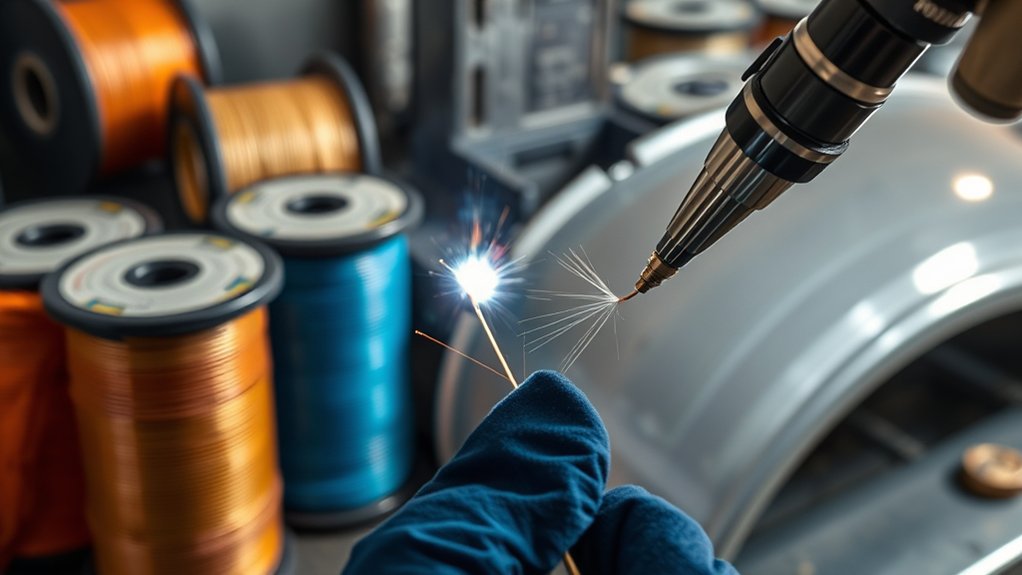
Flux-cored wire provides a continuous electrode, shielding ingredients inside the wire, and a slag layer over the bead. Self-shielded wire does not need a gas bottle, which makes it useful outdoors or in a mobile setup. It can also tolerate light surface contamination better than solid-wire MIG, although clean metal still produces the most reliable result.
The process has a relatively high deposition rate and can provide strong fusion on thicker steel. Those traits help with brackets, heavier patches, and general fabrication, but they work against you on a thin body skin by adding heat quickly. Tight fit-up matters: trying to bridge a gap in thin sheet keeps the arc in one area longer and raises the chance of burn-through.
Flux core has two shielding categories: self-shielded FCAW-S and gas-shielded FCAW-G. “Dual Shield” is a product family and a common shop term for gas-shielded flux-cored welding, not a separate third shielding category. Miller’s flux-cored welding guide explains the two forms.
Wire classification does not make every product suitable for body panels. For example, E71T-8 self-shielded wire is commonly intended for outdoor structural steelwork, not thin cosmetic sheet. Use the product data sheet, not just the classification, to confirm minimum thickness, pass limits, polarity, and position.
Best Flux Core Wire Types for Auto Body Repair
The most useful flux-core choices for vehicle repair are small-diameter self-shielded wires that are specifically rated for sheet metal. Gas-shielded E71T-1 and structural E71T-8 wires may produce excellent welds in their intended applications, but they are generally poor matches for thin outer panels.
| Wire type | Shielding and typical sizes | Best fit in vehicle work | Important limit |
|---|---|---|---|
| E71T-GS | Self-shielded; commonly .030 and .035 inch | The best flux-core candidate for suitable thin-gauge, non-structural mild-steel patches | Product-specific and often single-pass only. Hobart SELF-SHIELD 11GS lists 18 gauge through 3/16 inch. |
| E71T-11 | Self-shielded; available in several diameters | General repair, brackets, and somewhat thicker mild steel when the data sheet permits | Minimum thickness and multi-pass capability vary by product and diameter. |
| E71T-1C/M | Gas-shielded; many products start at .045 inch | Heavy fabrication, frames or equipment only when an approved procedure calls for it | High deposition and heat input make it unsuitable for most body skins. |
| E71T-8 | Self-shielded structural wire | Outdoor structural steelwork—not routine auto-body sheet repair | Do not substitute it for a small-diameter sheet-metal wire. |
The current carbon-steel flux-cored electrode classification standard is AWS A5.20/A5.20M:2025. The classification describes required properties and usability characteristics, but the wire maker’s data sheet still controls the usable gas, polarity, diameter, position, and thickness range.
Before buying wire, confirm that your machine supports the diameter and required output. Check the exact polarity for flux core welding on the spool label or data sheet rather than relying on a machine’s default connection.
Products Worth Considering

E71T-GS GASLESS FLUX CORE WIRE: This AWS E71T-GS self-shielded flux-cored wire delivers smooth, stable welding without external shielding gas. It offers excellent arc stability, consistent feedability and reliable performance, allowing users to produce clean welds with minimal setup work. Its advanced flux formulation enables welding over light rust and mill scale for improved everyday practicality.

E71T-GS FLUX CORE WIRE: This self-shielding, AWS E71T-GS flux-cored wire excels due to its advanced core design, delivering exceptional arc stabilization and high feedability for effortless welding. The core also incorporates powerful deoxidizing agents, ensuring clean, reliable welds even when welding through light rust or mill scale.

Welding Easy and Quick: AWS E71T-GS 030” Flux Core welding wire (The actual Net Weight of Wire is 2LB), no need for shielding gas, install it then you can welding all positions, single and multi pass welding. Great for T-joints, butt welds & lap welds.
Self-Shielded Wire vs. Gas-Shielded Wire
Self-shielded and gas-shielded flux-cored wires differ in portability, operating range, cleanup, and intended work. Both produce slag, and neither should be selected only because the bead may look cleaner.
| Feature | Self-shielded FCAW-S | Gas-shielded FCAW-G |
|---|---|---|
| External gas | Not required | Required; use only the gas listed by the wire maker |
| Wind tolerance | Better for outdoor or drafty work | Wind can disturb gas coverage |
| Common use | Portable repair and general fabrication | Industrial and heavy fabrication |
| Auto-body value | Small .030-inch sheet-rated products can be usable on suitable non-structural steel | Usually too large and hot for outer skins |
| Cleanup | Slag, smoke, and spatter vary by wire and settings | Often smoother with lower spatter, but slag still must be removed |
Some gas-shielded E71T-1 wires run with 100% carbon dioxide, while others also permit a 75% argon/25% carbon dioxide blend. Never assume that 75/25 is correct. The shielding gas is part of the wire’s tested classification and affects arc behavior and weld properties.
For outdoor projects, a small self-shielded product offers the best mobility. This self-shielding capability avoids a gas bottle, but it does not remove the need for clean steel, correct polarity, ventilation, or heat control.
Best Flux Core Wire for Thin Auto Body Panels
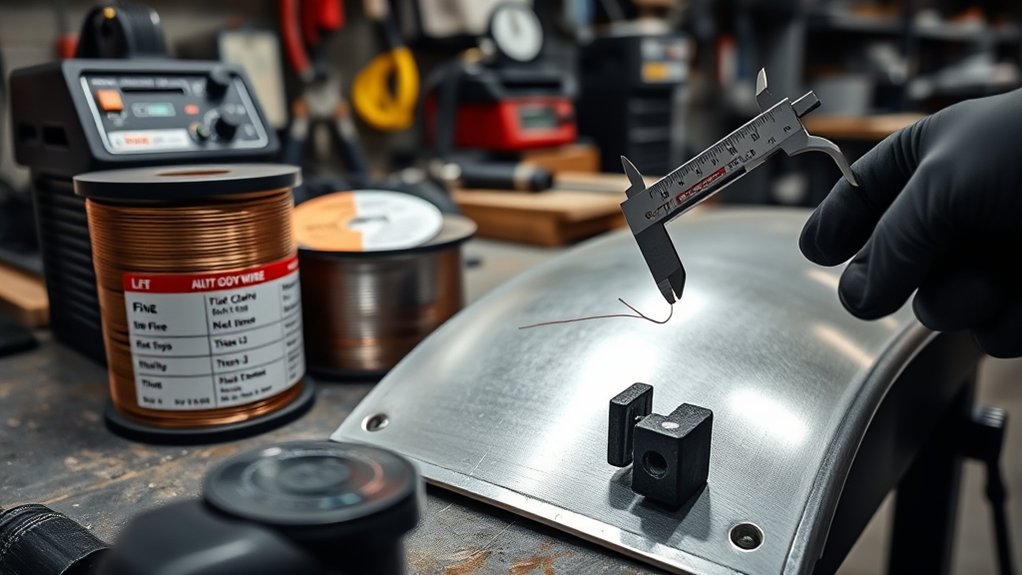
For 20- to 24-gauge cosmetic sheet, use solid-wire MIG or TIG rather than flux core. If the steel is 18 gauge or thicker, the joint is non-structural, and flux core is your only practical process, a .030-inch E71T-GS wire specifically rated for sheet metal is the most controlled choice. Hobart’s SELF-SHIELD 11GS data sheet lists .030- and .035-inch sizes and a base-metal range from 18 gauge to 3/16 inch, with single-pass welding only.
A .035-inch wire deposits more metal and normally needs more heat, so reserve it for thicker patches that fall within the product chart. Do not treat .035 inch as automatically stronger. Strength depends on the wire classification, joint design, fusion, base metal, and approved repair procedure.
| Choice | Benefit | Result |
|---|---|---|
| Self-shielded wire | No gas bottle | Better mobility outdoors |
| .030-inch E71T-GS | Less filler deposition than .035 inch | Best flux-core fit for approved thin-gauge repairs |
| .035-inch wire | More fill and heat | Better suited to thicker patches |
| Clean, tightly fitted steel | Stable arc and less time filling gaps | Lower risk of porosity and burn-through |
| Controlled travel and wire feed speed | Keeps the arc within the product’s working range | More consistent bead shape |
Keep the contact-tip-to-work distance at the wire maker’s recommendation. General flux-core guidance is often around 3/4 inch, while some sheet-metal products use about 1/2 inch. A random “short” stickout can raise current and heat, so copy the data sheet and confirm the result on scrap. A sheet-rated self-shielded flux-cored wire is only suitable when the panel thickness falls inside its stated range.
Warning: Thin auto-body panels can burn through or distort after only a brief arc. Test on matching scrap, use tight fit-up, and stop if the machine cannot run a stable arc at the wire maker’s lowest approved setting.
Products Worth Considering

GASLESS: E71T-11 does not require a shielding gas. The flux core inside the wire acts in place of the shielding gas. This makes the wire very versatile and perfect for mobile jobs, outdoor jobs, and people who do not have access to shielding gas.
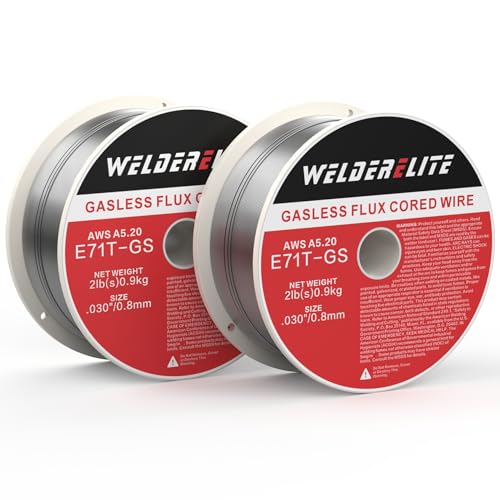
[High-Efficiency Gasless Welding]: WelderElite E71T-GS 0.030'' welding wire is specifically designed for gasless welding, applicable to all positions. It facilitates single or multiple pass welding without the need for shielding gas, ready for use right out of the box, enhancing welding efficiency.

【Easy and Fast Welding】This flux core wire (E71T-GS, actual net weight 2 lbs) requires no shielding gas – just install and start welding. It performs well in all positions and supports both single‑pass and multi‑pass welding, making it ideal for quick repairs on farm equipment, fence posts, or automotive bodywork, even outdoors on windy days.
Flux Core Welder Settings for Clean Welds
There is no safe universal voltage or wire-feed number for auto-body steel. Start with the chart inside the welder or the wire maker’s data sheet, matching wire classification, diameter, joint type, position, and measured metal thickness. Treat the chart as a starting point and make one small change at a time on scrap.
Before tuning the arc, install the correct contact tip and a knurled drive roll, set drive-roll and spool tension according to the machine manual, clean the work-clamp location, and inspect the liner and tip. Poor feeding or a weak work connection can imitate a bad voltage setting.
Voltage and Wire Feed
- Set voltage and wire-feed speed from the exact machine or wire chart.
- Run a short test weld on scrap of the same alloy, coating condition, gauge, and joint design.
- If the arc stubs into the work, check whether wire feed is too high for the voltage. If the arc is long, erratic, or excessively spattery, check whether voltage is too high or wire feed is too low.
- Change only one setting at a time, then inspect bead shape, penetration, spatter, and the back of the panel for overheating.
- Do not raise heat simply to bridge a gap. Correct the fit-up first.
Wire-feed speed largely controls welding current on a constant-voltage wire feeder. Slowing it automatically whenever spatter rises can make the arc less stable. First verify polarity, stickout, contact-tip condition, work connection, and the balance between voltage and wire feed.
Stickout and Travel Speed
Flux-cored wire generally uses a longer stickout than solid-wire MIG. Follow the product data sheet, hold that distance steady, and use a 5- to 15-degree drag angle. Excessive angle can increase spatter and reduce penetration.
| Setting | Possible result | Correction |
|---|---|---|
| Stickout shorter than specified | More current and heat; tip may collect spatter | Return to the data-sheet distance |
| Stickout too long | Unstable arc and poor penetration | Move closer while keeping the specified distance |
| Travel too fast | Narrow bead, undercut, or lack of fusion | Slow slightly without dwelling |
| Travel too slow | Wide bead, excess heat, warping, or burn-through | Increase pace and use shorter tacks |
| 5- to 15-degree drag angle | Controlled slag and bead shape | Maintain the angle and avoid a large pull angle |
On body sheet, avoid one long continuous bead. Use short tacks or skip welds spaced around the joint, allowing heat to spread and the panel to cool between passes.
Gas and Polarity Settings
Set polarity to the exact wire, not to a general rule. Many small self-shielded E71T-GS and E71T-11 wires use direct current electrode negative (DCEN). Forney’s .030-inch E71T-GS, for example, specifies DCEN and single-pass use; see the self-shielded capability review and confirm the current manufacturer label before welding.
Gas-shielded E71T-1 products commonly use direct current electrode positive (DCEP), but the allowed gas and flow range vary. Hobart FabCO Excel-Arc 71 lists .045 inch as its smallest standard diameter and permits 100% carbon dioxide or a 75–80% argon blend with the balance carbon dioxide. That is a heavy-fabrication example, not a recommendation for thin body panels.
- Confirm whether the wire is FCAW-S or FCAW-G.
- Connect DCEN or DCEP exactly as listed.
- For FCAW-G, use only the approved gas and flow range.
- Keep the nozzle, diffuser, contact tip, and liner clean.
- Recheck the label whenever you change brand, classification, or diameter.
Heat Control and Distortion on Auto Body Steel
Thin steel usually fails from too much concentrated heat, poor fit-up, or both. Cut patches accurately so the joint is tight and even. Clamp the panel in its final shape before welding, then place small tacks at widely separated points.
- Make the first tack, then move to the far side of the repair.
- Continue alternating locations instead of welding adjacent spots in sequence.
- Let the panel cool between rounds; do not chase a glowing or expanding edge.
- Use a copper or aluminum backing bar where access and the OEM procedure allow it. A backing bar absorbs heat and supports the puddle.
- Remove slag after every tack before adding the next weld.
- Finish only after the panel remains aligned and the back side shows adequate fusion without excessive heat marks.
Miller recommends skip welding, tight fit-up, and backing bars to reduce burn-through and distortion on thin sheet. Those techniques help with any arc process, but they do not make flux core suitable below the wire’s minimum rated thickness.
Pro Tip: Keep a clean scrap coupon cut from the same replacement panel. Duplicate the joint and clamp setup, then tune the arc and tack sequence on the coupon before touching the vehicle.
Vehicle Welding Safety
Vehicle welding combines arc, fume, fire, electrical, and stored-energy hazards. Wear a welding helmet with the correct shade, safety glasses, flame-resistant clothing, leather gloves, and closed leather footwear. Use local exhaust ventilation that pulls fumes away from your breathing zone without blowing shielding gas away from an FCAW-G arc.
Remove paint, seam sealer, undercoating, adhesive, zinc coating, and contamination from the weld zone using a method approved for the material. Coatings can create toxic fumes, and residue can cause porosity. OSHA requires special ventilation controls for zinc- and lead-bearing materials and warns against allowing chlorinated solvent vapors near welding. Review OSHA 1910.252 welding requirements.
Inspect both sides of the panel. Move or shield carpet, insulation, wiring, hoses, brake and fuel lines, fuel vapor components, airbags, seat-belt pretensioners, and other combustible or heat-sensitive parts. Keep a suitable fire extinguisher ready and check hidden cavities for smoldering material after welding.
Follow the OEM disabling and isolation procedure for the 12-volt battery, supplemental restraint system, high-voltage battery on hybrid or electric vehicles, fuel system, coolant loops, and air-conditioning refrigerant lines. Do not cut, heat, ground through, or weld near an unidentified orange high-voltage cable, battery enclosure, refrigerant line, pressurized component, or fuel container.
Warning: Never weld on or near a fuel tank, battery enclosure, closed cavity, or container that may hold flammable vapor. Stop and obtain the model-specific repair procedure when the material, coating, wiring, or system location is uncertain.
Note: “Clean metal” means bare, sound base metal at the joint—not simply welding through paint, rust, galvanizing, seam sealer, or undercoating because flux core is more tolerant of contamination.
How to Store and Handle Flux Core Wire
Store flux core wire in a clean, dry, enclosed area and leave it in the original sealed package until use. If a cold spool is moved into a warm, humid shop, let the unopened package reach room temperature before opening it. This reduces condensation on the wire.
When a spool will sit unused, remove it from the feeder if practical, place it in a clean resealable bag or container with dry desiccant, and keep it off the floor. Moisture and rust can cause poor feeding, unstable arc behavior, porosity, and contamination inside the liner. The same moisture-control principles discussed for moisture absorption apply, but do not bake or re-dry flux-cored wire unless the manufacturer specifically provides a procedure.
Proper Wire Storage
- Keep spools in original intact packaging until needed.
- Store them off concrete floors and away from doors, wash bays, and temperature swings.
- Return a partially used spool to a clean sealed bag or rigid container.
- Keep the wire covered during long breaks.
- Discard wire with visible rust, physical damage, or contamination.
Do not assume that a home oven can restore wet wire. Some manufacturers state that re-drying is not recommended. Follow the product data sheet.
Safe Wire Handling
Handle the spool by its hub and flanges rather than touching the wire surface. Keep grinding dust, oil, hand cleaner, and moisture away from the wire. Use the correct drive-roll groove and only enough tension to feed smoothly without crushing the tubular electrode.
If feeding becomes erratic, inspect the spool brake, drive-roll alignment, inlet guide, liner, contact tip, and wire condition. Rust does not “spread damage fast,” but it can score consumables, shed debris into the liner, and cause inconsistent electrical contact.
Flux Core Troubleshooting
| Problem | Likely causes | What to do |
|---|---|---|
| Excess spatter | Wrong polarity, voltage/wire-feed mismatch, excessive angle, bad work connection, long or inconsistent stickout | Verify the wire label, clean the clamp point, reset from the chart, and hold a steady 5- to 15-degree drag angle. |
| Burn-through | Panel below the wire’s rated thickness, poor fit-up, excessive heat, slow travel, or long bead | Stop. Improve fit-up, lower settings within the approved range, use spaced tacks and a backing bar, or switch to solid-wire MIG/TIG. |
| Porosity | Paint, rust, oil, damp wire, wind on FCAW-G, wrong gas, or a leaking gas path | Clean to sound metal, replace suspect wire, shield the work from drafts, and check gas type, flow, hoses, and nozzle. |
| Slag inclusion | Welding over slag, poor angle, low heat, or placing overlapping tacks without cleaning | Remove slag to bright metal between tacks and correct the angle and settings. |
| Lack of fusion | Travel too fast, heat too low, arc aimed away from the joint, or contamination | Return to approved parameters, clean the joint, and direct the arc into both edges without dwelling. |
| Birdnesting or erratic feed | Excess drive tension, wrong roll, blocked liner, worn tip, or kinked gun cable | Use a knurled roll, reset tension, straighten the gun cable, and replace damaged consumables. |
How to Choose the Right Wire for Your Repair
Start with the vehicle and joint, not the spool. Identify the vehicle year, make, model, exact part, base-metal type, thickness, coating, and whether the repair is structural. Then read the OEM body repair procedure and the welder and wire data sheets.
- Confirm the approved joining process. If the OEM calls for squeeze-type resistance spot welding, MIG brazing, adhesive bonding, rivets, or a specific GMAW wire, do not substitute flux core.
- Measure the metal. Use .030-inch wire only when the product chart includes that gauge. Use .035 inch when the steel is thicker and the machine chart supports it.
- Choose shielding for the work area. FCAW-S is more practical outdoors; FCAW-G needs protected gas coverage.
- Check classification and product limits. Confirm single- or multi-pass use, position, polarity, gas, amperage range, and minimum thickness.
- Match the alloy. Carbon-steel E71T classifications are not stainless-steel filler metals. Stainless repair requires a compatible stainless wire and an approved procedure.
- Check the machine. Verify output, duty cycle, drive roll, liner, contact tip, polarity connections, and spool capacity.
- Prove the setup on scrap. Test bead shape, fusion, distortion, and cleanup before welding the vehicle.
Understanding the main types of flux core wire helps, but the exact product sheet is the final authority. Careful selection reduces spatter and rework without making unsupported promises about “stronger” penetration.
Pro Tip: Keep a small scrap piece from the same panel nearby so you can test heat, wire speed, stickout, and bead shape before every new setup.
Frequently Asked Questions
Are There Different Types of Flux Core Wire?
Yes. Flux-cored wire is either self-shielded FCAW-S or gas-shielded FCAW-G. Within those categories are many AWS classifications and product-specific formulations. E71T-GS and E71T-11 are common self-shielded choices; E71T-1 is commonly gas-shielded. “Dual Shield” refers to gas-shielded flux-cored products, not a third shielding method.
Can You Weld an Auto Body With Flux Core?
You can use flux core on some non-structural mild-steel repairs when the wire maker and vehicle maker permit it. It is usually a poor choice for thin cosmetic skins because it adds heat and leaves slag. Use solid-wire MIG or TIG for thin sheet unless an approved procedure says otherwise.
Which Is Better, .030 or .035 Flux Core Wire?
For approved thin-gauge work, .030 inch offers less deposition and is easier to control than .035 inch. Use .035 inch for thicker patches that fall within the wire and machine charts. Diameter alone does not determine weld strength.
What Is the Difference Between E71T-1 and E71T-8?
E71T-1 is commonly a gas-shielded flux-cored classification used for structural and general fabrication. E71T-8 is a self-shielded classification commonly used for outdoor structural work. Neither classification is a default choice for thin auto-body skins; check the exact product and OEM repair procedure.
Why Does Flux Core Wire Cause So Much Spatter?
Common causes include wrong polarity, a poor voltage and wire-feed balance, excessive travel angle, inconsistent stickout, a weak work connection, worn consumables, dirty steel, or damp and rusty wire. Reset from the product chart and correct setup faults before changing settings at random.
Is Flux Core Better Than MIG for Body Panels?
Usually no. Solid-wire MIG is cleaner and easier to control on thin sheet, while flux core adds more heat and requires slag removal. Flux core is more useful when wind makes shielding gas impractical or when the steel is thick enough for a sheet-rated self-shielded wire.
Can You Flux-Core Weld Galvanized Auto-Body Steel?
Some E71T-GS products are designed for galvanized sheet, but zinc still creates hazardous fumes and can contaminate the weld. Follow the OEM procedure, remove coating from the weld zone as directed, use effective local exhaust ventilation, and restore corrosion protection after the repair.
Conclusion
The best flux core wire for auto body work is a small-diameter, self-shielded product that is explicitly rated for the metal you are repairing. For suitable 18-gauge-and-thicker, non-structural mild steel, .030-inch E71T-GS is often the most manageable flux-core option; E71T-11 can suit general repair when its data sheet covers the job. For thinner cosmetic skins, use solid-wire MIG or TIG instead. Confirm the OEM procedure, match polarity and settings to the exact wire, control heat with spaced tacks, store the spool dry, and protect yourself from fumes, fire, fuel, and vehicle electrical hazards.
Sources
- Miller Electric — Successfully Welding Sheet Metal With MIG and TIG — process choice, tight fit-up, skip welding, and backing bars.
- Miller Electric — Flux-Cored Welding: The Basics for Mild Steel — FCAW-S versus FCAW-G, setup, wire sizes, stickout, and drag angle.
- Hobart Brothers — SELF-SHIELD 11GS Data Sheet — E71T-GS sheet-metal range, diameters, DCEN, and single-pass restriction.
- Hobart Brothers — FabCO Excel-Arc 71 Data Sheet — E71T-1 shielding gases, DCEP, diameters, and heavy-fabrication applications.
- American Welding Society — A5 Filler Metal Standards — current AWS A5.20/A5.20M:2025 classification standard.
- OSHA — 29 CFR 1910.252 — welding fire prevention, PPE, ventilation, zinc, lead, and solvent hazards.