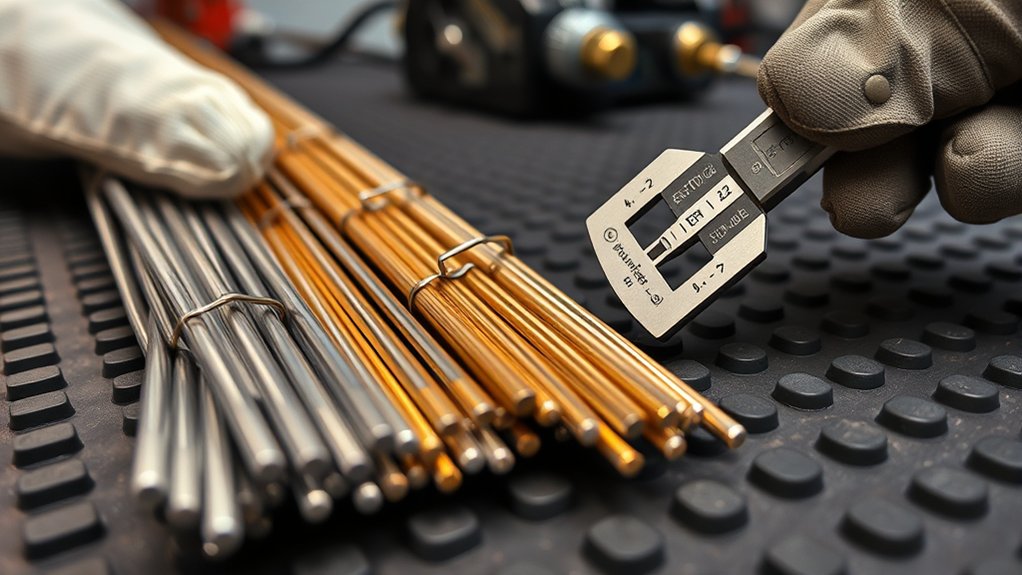
The right TIG filler rod depends on the exact base alloy, the joint design, the part’s operating temperature, and whether the repair carries a structural or crash-safety load. Common choices include ER70S-2 for mild steel and many normalized 4130 tube assemblies, ER308L for 304 stainless, ER309L for stainless-to-carbon-steel joints, and ER4043 or ER5356 for compatible aluminum alloys. The label on the metal and the approved repair procedure matter more than bead appearance.
Quick Answer
Use ER70S-2 for clean mild steel and many normalized 4130 tube jobs, ER308L for 304 stainless, ER309L for stainless-to-carbon steel, ER409Nb for matching 409 exhaust parts, and ER4043 or ER5356 for compatible aluminum. Verify the alloy and approved procedure before welding any structural, suspension, restraint, or crash-related part.
Key Takeaways
- Identify the base alloy before choosing filler; appearance and magnet response are not enough.
- ER70S-6 tolerates mill scale and light contamination better than ER70S-2, but TIG joints should still be cleaned to bright metal.
- ER70S-2 and ER80S-D2 are common 4130 choices, but the welding procedure determines which one is acceptable.
- Use ER308L for 304 stainless, ER316L for 316, ER347 for 321/347, and ER409Nb for matching 409 exhaust material.
- Choose aluminum filler by alloy, temperature, strength, anodizing, and corrosion requirements—not by color alone.
- Silicon bronze used with a TIG torch is usually a brazing process and is not an automatic substitute for a structural fusion weld.
Warning: Do not weld an automotive frame, roll cage, suspension mount, seat-belt anchor, battery enclosure, high-voltage component, or crash structure from a general filler chart alone. Verify the VIN, model year, base material, OEM repair manual, sanctioning-body rule, and qualified welding procedure. Keep welding heat away from fuel vapors, airbags, batteries, electronic modules, hidden trim, seam sealer, and high-voltage wiring.
What’s in This Article
- What TIG Filler Rod Should You Use?
- Identify the Base Metal First
- Understanding TIG Filler Classifications
- ER70S-2 vs ER70S-6 for Mild Steel
- Best TIG Rod for 4130 Chromoly
- 308L Filler Rod for Stainless Steel
- Other Stainless Fillers Used on Cars
- When to Use 309L on Dissimilar Metals
- 4043 vs 4047 Aluminum TIG Rod
- When 5356 Is the Better Aluminum Choice
- Nickel Filler Rods for High-Heat Repairs
- Copper and Silicon Bronze TIG Rods
- How to Match TIG Rod to Automotive Metal
- What Size TIG Filler Rod Should You Use?
- Filler Storage and Contamination Control
- TIG Filler Rod Troubleshooting
- Quick TIG Filler Rod Reference Chart
- Frequently Asked Questions
- Conclusion
- Sources
What TIG Filler Rod Should You Use?
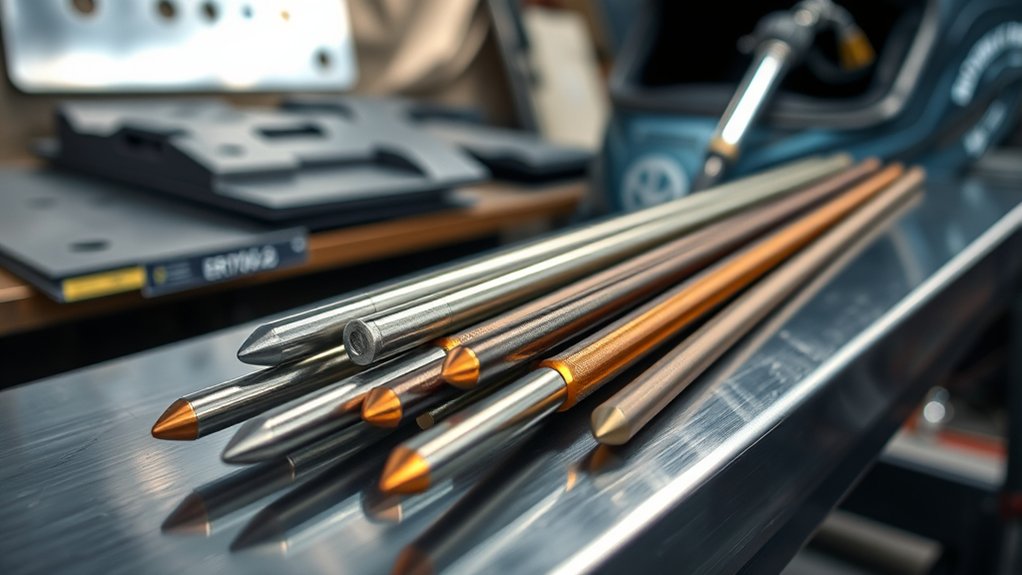
Start with the base-metal grade and the work the finished joint must perform. The filler must be compatible with the parent alloy, but matching the alloy name is not always the same as matching every element in its chemistry. Some procedures deliberately use an under-matching filler to gain ductility or reduce cracking risk.
For clean mild steel, ER70S-2 is a common TIG choice. ER70S-6 offers more silicon and manganese deoxidizers, which can improve wetting and tolerate more mill scale than ER70S-2. For normalized 4130 tubing, ER70S-2 is widely used, while ER80S-D2 may be specified when higher weld-metal strength is required.
For stainless steel, ER308L commonly matches 304 and 304L. ER309L is commonly used when joining austenitic stainless steel to carbon steel. Automotive exhaust systems may also use 409, 409Ti, 321, or 316 stainless, so ER308L is not the correct answer for every stainless part.
For aluminum, ER4043 is a common general-purpose aluminum-silicon filler for compatible 6xxx and cast alloys. ER5356 can provide better anodized color matching, ductility, toughness, and shear strength in compatible joints. Neither filler is correct for every aluminum grade.
Note: Filler selection does not correct a poor joint design, excessive gap, contaminated surface, missing root shielding, incorrect heat input, or an unsuitable base-metal combination. Treat the filler chart as a starting point, then confirm the manufacturer’s data sheet and the applicable welding procedure.
Identify the Base Metal First
Do not choose filler from the part’s appearance alone. Automotive parts may be low-carbon steel, 4130, advanced high-strength steel, boron steel, galvanized steel, 304 stainless, 409 stainless, 5xxx aluminum, 6xxx aluminum, cast aluminum, cast iron, cast steel, copper, or a nickel alloy.
Use the best identification source available:
- Check the OEM body-repair or service manual using the vehicle’s VIN and model year.
- Look for alloy stamps, tube markings, casting numbers, supplier certificates, or engineering drawings.
- Confirm whether the part is heat treated, coated, plated, anodized, or bonded with structural adhesive.
- For custom fabrication, check the material certificate and the project’s welding procedure specification.
- When the alloy cannot be confirmed, stop and identify it before making a safety-related weld.
A magnet can separate many aluminum and austenitic stainless parts from carbon steel, but it cannot identify the exact grade. Spark testing and hardness testing may offer clues, but they should not replace material records for a critical repair.
Understanding TIG Filler Classifications
AWS filler classifications describe the filler type and chemistry. Current classification standards include AWS A5.18/A5.18M for carbon-steel electrodes and rods, AWS A5.9/A5.9M for stainless filler, and AWS A5.10/A5.10M for aluminum filler.
In a classification such as ER70S-2:
- ER identifies material that can be supplied as an electrode or rod.
- 70 identifies the minimum tensile-strength class in thousands of pounds per square inch under the classification’s test conditions.
- S identifies solid wire or rod.
- -2 identifies a particular chemistry and deoxidizer package.
Aluminum labels such as R4043 or ER5356 identify the alloy composition rather than using the carbon-steel strength-number format. Always read the full package label because similar-looking bare rods can have very different chemistry.
ER70S-2 vs ER70S-6 for Mild Steel
Both ER70S-2 and ER70S-6 can produce sound mild-steel TIG welds, but they are not identical.
| Characteristic | ER70S-2 | ER70S-6 |
| Deoxidizers | Triple-deoxidized with zirconium, titanium, and aluminum in addition to silicon and manganese | Higher silicon and manganese levels |
| Typical TIG use | Clean mild steel, tubing, brackets, and controlled-puddle fabrication | General fabrication where stronger wetting and greater scale tolerance are useful |
| Puddle and bead | Controlled puddle with less tendency to leave heavy silicon islands | Fluid puddle, strong toe wetting, and a flatter bead profile |
| Surface condition | Use on properly cleaned metal | More tolerant of mill scale, rust, or light contamination, but cleaning is still required for dependable TIG work |
Lincoln describes ER70S-2 as a triple-deoxidized TIG rod. Its ER70S-6 products use higher silicon and manganese levels to improve wetting and tolerate more mill scale.
Do not treat deoxidizers as permission to weld through paint, grease, heavy rust, zinc, undercoating, seam sealer, or unknown plating. Remove contamination far enough from the joint that heat cannot pull it into the puddle.
Products Worth Considering

ER70S-6 TIG WELDING ROD: The main alloying elements of ER70S - 6 welding wire are C, Mn, Si, etc. Moderate carbon content ensures weld strength. Mn and Si, as deoxidizers and alloying elements, enhance weld's mechanical properties, crack resistance, toughness and strength

ER70S-6 is a gas shield copper coated carbon steel welding rod for fabrication of mild steel.

ER70S-6 is a gas shield copper coated carbon steel welding rod for fabrication of mild steel.
Best TIG Rod for 4130 Chromoly
ER70S-2 is a common filler for normalized, thin-wall 4130 tubing used in motorsports and automotive fabrication. It provides a ductile weld deposit and is often chosen instead of matching 4130 chemistry when the assembly will remain in the as-welded condition.
ER80S-D2 is another established option. It contains manganese and molybdenum and provides a higher-strength weld deposit. ESAB lists both ER70S-2 and ER80S-D2 for TIG welding chromoly tube.
The right choice depends on:
- The condition and strength level of the 4130 base metal.
- Tube wall thickness and joint restraint.
- Whether the assembly will receive post-weld heat treatment.
- The required strength, elongation, and fatigue performance.
- The applicable OEM, engineering, sanctioning-body, or code requirement.
ER70S-6 may produce an acceptable weld under a qualified procedure, but it should not replace the specified 4130 filler simply because it is available in the shop. Matching 4130 filler also should not be substituted casually because its properties may depend on controlled preheat and post-weld heat treatment.
Warning: Roll cages, tube chassis, suspension structures, and competition vehicles may have mandatory filler, process, inspection, and welder-qualification rules. Follow the current rulebook and drawing rather than a general online recommendation.
Products Worth Considering

ER308L STAINLESS STEEL: ER308L is a low-carbon stainless steel TIG welding rod for general-purpose welding where moderate corrosion resistance and cryogenic performance are required.

Premium Material: Crafted from high-grade stainless steel, ER308L rods ensure superior strength & durability for professional welding work

ER4043 TIG WELDING ROD: ER4043 is a 5% silicon -containing aluminum and silicon alloy welding rod. It has high silicon content, good liquidity, and strong heat resistance
308L Filler Rod for Stainless Steel
ER308L is the common TIG filler for 304 and 304L stainless steel. The low-carbon composition reduces the risk of chromium-carbide precipitation compared with higher-carbon filler, helping the joint retain corrosion resistance when heat input is controlled.
Typical automotive uses include 304 stainless exhaust tubing, brackets, tanks, trim, and fabricated intake or cooling components. ER308L is not automatically correct for every stainless alloy.
For stainless tubing, protect the back of the joint when root oxidation would reduce corrosion resistance or disrupt exhaust flow. An argon back purge is commonly used on full-penetration stainless exhaust welds. A correct filler cannot repair a heavily oxidized or “sugared” root.
Other Stainless Fillers Used on Cars
Automotive stainless parts include more than 304:
- 316 or 316L stainless: Use ER316L when the base material and service environment require the added molybdenum and improved pitting resistance.
- 321 or 347 stainless: ER347 is a stabilized filler commonly used for these heat-resistant stainless grades.
- 409 or 409Ti stainless: ER409Nb is designed for matching ferritic stainless material used in many automotive exhaust systems. Lincoln identifies ER409Nb as a TIG rod for 409 and 409Ti automotive exhaust applications.
- Stainless to carbon steel: ER309L is a common transition filler, subject to the joint design and service conditions.
Do not assume a factory exhaust is 304 because it is corrosion resistant. Many original-equipment systems use 409-series ferritic stainless, which can attract a magnet and develops surface discoloration differently from polished 304.
When to Use 309L on Dissimilar Metals
ER309L is commonly used to join austenitic stainless steel to mild or low-alloy carbon steel. Its higher chromium and nickel content helps the diluted weld metal retain a suitable stainless structure and lowers the cracking risk compared with using an ordinary carbon-steel filler.
Automotive examples may include a stainless exhaust component joined to a carbon-steel flange, a stainless bracket attached to mild steel, or a stainless repair insert in a compatible mixed-metal assembly.
Use ER309L with these limits:
- Confirm both base metals before welding.
- Check whether galvanic corrosion will occur in the service environment.
- Control dilution and heat input.
- Use an accurate fit-up and suitable joint design.
- Do not assume ER309L can join every stainless, tool steel, cast iron, nickel alloy, or unknown metal.
ER309L can bridge austenitic stainless and carbon steel, but the joint may still fail at the weaker base metal, the heat-affected zone, or a poorly designed transition.
4043 vs 4047 Aluminum TIG Rod
ER4043 and ER4047 are aluminum-silicon fillers. ER4043 contains roughly 5% silicon and is a widely available general-purpose choice for compatible 3xxx and 6xxx alloys and many aluminum castings. ER4047 contains more silicon, giving it greater fluidity, a lower melting range, and lower shrinkage.
Choose between them by base-alloy compatibility and joint behavior. ER4047 may help a crack-sensitive casting or thin section by improving flow and reducing shrinkage stress. It does not replace proper cleaning or shielding-gas protection.
4043 Versus 4047: Key Differences
| Characteristic | ER4043 | ER4047 |
| General role | Common general-purpose aluminum-silicon filler | Higher-silicon filler for greater fluidity and lower shrinkage |
| Typical priorities | Availability, clean appearance, low hot-cracking sensitivity, and general repair | Castings, thin sections, smooth flow, reduced distortion, and crack-sensitive joints |
| Porosity | Does not prevent hydrogen porosity | Does not prevent hydrogen porosity |
| Anodized color | Usually appears darker than 5356 after anodizing | Usually selected for flow and shrinkage behavior rather than a matching anodized color |
Castings and Porosity
ER4043 or ER4047 may suit a compatible aluminum casting, but the casting alloy must still be identified. Cast aluminum can retain oil, coolant, moisture, and combustion residue inside its pores. Heating can drive those contaminants into the weld pool.
Hydrogen is the main cause of aluminum weld porosity. Common hydrogen sources include:
- Oil, grease, paint, cutting fluid, and other hydrocarbons.
- Moisture on the base metal or filler.
- Hydrated aluminum oxide.
- Contaminated shielding gas or leaking gas lines.
- Air drawn into the shielding envelope by drafts or an excessive torch angle.
The Hobart Aluminum Welding Guide explains that porosity forms when hydrogen is absorbed by molten aluminum and becomes trapped during solidification.
Clean the casting mechanically and with an aluminum-compatible solvent, allow the solvent to evaporate, use dry filler, and remove oxide with a dedicated stainless-steel brush immediately before welding. Severely oil-soaked castings may need controlled cleaning cycles before a sound repair is possible.
Best Use Cases for 4043 and 4047
- ER4043: General repairs on compatible 3003 and 6xxx aluminum, brackets, sheet, extrusions, and many castings.
- ER4047: Compatible castings, thin sections, leak repairs, and joints where higher fluidity and lower shrinkage are useful.
- ER4943: A possible higher-strength aluminum-silicon alternative when the engineering specification permits it.
- ER5356: Compatible 5xxx or 6xxx parts where anodized color, ductility, toughness, or greater shear strength is a priority.
Hobart reports that 4043/4943 and 5356 together account for more than 85% of aluminum filler use, but the finished part’s alloy and operating conditions still control the choice.
When 5356 Is the Better Aluminum Choice
ER5356 is an aluminum-magnesium filler. On compatible 5xxx and 6xxx base metals, it can provide higher shear strength, ductility, toughness, and better resistance to crack propagation than ER4043. It also gives a closer color match on many parts that will be anodized.
ER5356 is not suitable for every aluminum joint. For 5xxx base metals containing more than about 2.5% magnesium, 5356 is commonly required and 4043 should not be used. For prolonged elevated-temperature service above 150°F/65°C, Hobart advises using an approved alternative rather than 5356.
Anodizing Color Match
ER5356 usually produces a closer color match to 5xxx and 6xxx aluminum after anodizing. ER4043 commonly anodizes darker because of its silicon content, leaving a visible weld line even when the bead was blended before finishing.
Choose 5356 when:
- The base alloy is compatible.
- The finished part will be anodized.
- A closer weld-to-base-metal color is required.
- The operating temperature stays within the filler’s approved range.
Anodizing color is only one selection factor. Do not trade away crack resistance, corrosion performance, or temperature suitability solely to hide the weld.
Higher-Strength Aluminum Welds
ER5356 can provide higher filler-metal shear strength and greater toughness than ER4043 in compatible joints. That does not mean a welded 6061-T6 assembly retains the original T6 strength everywhere.
Welding heats and softens the heat-affected zone beside the bead. The weakest area may be in that softened base metal rather than in the deposited filler. Joint geometry, weld size, heat input, travel speed, temper, and any approved post-weld heat treatment all affect the finished assembly.
Use the required engineering design or structural welding procedure for frames, trailers, suspension parts, wheels, battery enclosures, and other loaded aluminum components.
Marine and Trailer Use
ER5356 is common in compatible marine and trailer fabrication because it works well with many 5xxx and 6xxx aluminum alloys and offers useful strength, toughness, and anodized color matching.
Before using it, confirm:
- The exact base alloy and magnesium content.
- The expected salt, chemical, and road-deicing exposure.
- The sustained operating temperature.
- Whether the joint will be anodized or coated.
- The required weld size and inspection method.
Do not use 5356 as a default for an exhaust-adjacent aluminum part that will remain above 150°F/65°C for long periods. Use the filler named by the engineering specification or filler-selection chart.
Pro Tip: Keep one stainless-steel brush for aluminum only. Store it away from steel brushes and grinding dust. Brush immediately before welding, and do not touch the cleaned joint or filler tip with bare hands.
Nickel Filler Rods for High-Heat Repairs
Nickel-alloy filler is used when the base metal or service environment requires high-temperature strength, oxidation resistance, corrosion resistance, or a carefully controlled dissimilar-metal transition.
ERNiCr-3 is intended for compatible nickel-chromium alloys and selected joints between nickel alloys, stainless steel, and carbon or ferritic steel. It should not be treated as a universal rod for every exhaust manifold, heat shield, or unknown casting. Lincoln’s nickel-alloy filler range separates ERNiCr-3 from other nickel, nickel-molybdenum, and nickel-chromium-molybdenum fillers because their applications differ.
A cracked manifold may be gray cast iron, ductile iron, cast steel, stainless steel, or a nickel alloy. Each material needs different preparation, heat control, filler, cooling practice, and inspection. Cast-iron repair may use a dedicated nickel cast-iron filler under a proven procedure, but that does not make ERNiCr-3 the correct rod.
Identify the casting first. If the repair is safety critical, highly restrained, or repeatedly heat cycled, use a qualified procedure or replace the component.
Copper and Silicon Bronze TIG Rods
ERCu filler is used for compatible copper and deoxidized-copper joints. Copper conducts heat rapidly, so thick parts may require controlled preheating and greater heat input than a similar steel joint.
ERCuSi-A is silicon bronze. When used with a TIG torch on steel, stainless, copper, brass, bronze, galvanized sheet, or mixed metals, the process is usually TIG brazing rather than conventional fusion welding.
Copper Rod Applications
Copper filler may be used for:
- Compatible copper electrical conductors and terminals.
- Copper tubing or fabricated copper components.
- Thermal components where conductivity matters.
- Decorative and restoration work on known copper alloys.
Clean oxide, oil, plating, and insulation residue before welding. Match the filler to the copper alloy because brass, bronze, pure copper, and copper-nickel do not use one universal rod.
Silicon Bronze Use
Silicon bronze melts at a lower temperature than steel. That lower heat can reduce warping on thin panels and makes it useful for brackets, trim, coated sheet, decorative work, and selected dissimilar-metal joints.
Miller describes this process as TIG brazing: the filler melts and wets the joint while the base metals are not normally melted through as they would be in a fusion weld.
The lower heat is useful, but it also means the joint should not be assumed to match the strength, fatigue behavior, or crash performance of a steel fusion weld.
Dissimilar Metal Joining With Silicon Bronze
ERCuSi-A can braze combinations such as mild steel, stainless, galvanized steel, copper, brass, bronze, and some cast iron when the joint design and service conditions suit brazing.
- Remove oil, paint, rust, and loose coating from the joint.
- Use enough heat to wet the joint without excessively melting the base metal.
- Maintain a close, consistent fit so the filler can flow through the joint.
- Test the procedure on matching scrap before repairing the finished part.
- Do not use TIG brazing as an unapproved substitute on a chassis, roll cage, suspension, steering, seat, restraint, or crash structure.
Silicon bronze is valuable for low-distortion joining, but it is not a universal answer for mixed metals.
How to Match TIG Rod to Automotive Metal
Use this decision order:
- Identify the exact base metal. Check the OEM manual, drawing, material stamp, or certificate.
- Identify the part’s function. Decide whether it is cosmetic, fluid carrying, heat exposed, fatigue loaded, structural, or crash related.
- Check compatibility. Confirm that the filler is approved for both base metals.
- Check temperature and corrosion exposure. Exhaust heat, saltwater, road chemicals, coolant, and anodizing can change the best choice.
- Check the required mechanical properties. Tensile strength alone does not describe ductility, toughness, shear strength, fatigue life, or heat-affected-zone behavior.
- Follow the procedure. Use the filler, preheat, interpass temperature, shielding, purge, and inspection requirements in the approved WPS or repair manual.
For a noncritical clean mild-steel bracket, this process may lead to ER70S-2 or ER70S-6. For a 304 stainless exhaust, it may lead to ER308L and an argon back purge. For a 6061 aluminum bracket, it may lead to ER4043, ER4943, or ER5356 depending on strength, finish, temperature, and engineering requirements.
What Size TIG Filler Rod Should You Use?
The filler should be large enough to build the required weld without forcing you to feed continuously, but small enough that each dab melts into the puddle without chilling it.
| Rod Diameter | Typical Starting Use | What to Watch |
| 0.030–0.045 in. / 0.8–1.2 mm | Very thin sheet, small edges, and low-amperage cosmetic work | Small rod melts quickly and may require frequent feeding |
| 1/16 in. / 1.6 mm | Common automotive sheet, tubing, brackets, and exhaust work | A practical general-purpose size for many shop jobs |
| 3/32 in. / 2.4 mm | Thicker plate, larger fillets, castings, and higher-amperage aluminum | Can chill a small puddle or create oversized deposits on thin metal |
| 1/8 in. / 3.2 mm | Heavy sections and large weld deposits under an established procedure | Usually too large for ordinary automotive sheet and thin tubing |
Step down in size when the rod repeatedly freezes or chills the puddle. Step up when the rod disappears before it builds the required bead and you cannot feed it smoothly enough. Joint gap and weld size matter as much as base-metal thickness.
Filler Storage and Contamination Control
Even the correct filler classification can produce a poor weld when the rod is dirty, mixed with another alloy, or exposed to moisture.
- Keep each classification in a labeled, closed tube.
- Do not store loose stainless, mild-steel, aluminum, nickel, and bronze rods together.
- Keep filler off oily benches and away from grinding dust.
- Cut off a contaminated end rather than dipping it back into the puddle.
- Use separate brushes and abrasives for stainless and aluminum.
- Keep aluminum filler dry and allow cold material to reach shop temperature before opening its container if condensation is possible.
- Retain lot identification and certificates when traceability is required.
Do not use coat hanger wire, fence wire, unlabeled gas-welding rod, or random scrap as filler. Unknown wire may contain coatings, excessive carbon, lead, zinc, or alloying elements that cause porosity, cracking, toxic fumes, or unpredictable mechanical properties.
TIG Filler Rod Troubleshooting
| Problem | Likely Causes | Corrective Check |
| Porosity in aluminum | Moisture, oil, hydrated oxide, gas leak, draft, or contaminated filler | Clean and dry the metal and rod; check gas purity, lines, cup, flow, and torch angle |
| Cracks beside a 4130 weld | Excessive hardness, restraint, wrong filler, poor fit, or uncontrolled cooling | Stop welding and review the complete procedure, material condition, heat control, and joint design |
| Black soot on aluminum | Surface contamination, poor shielding, excessive torch angle, or inadequate oxide removal | Clean again and inspect gas coverage and torch technique |
| Gray or crusted stainless root | Inadequate back purge or excessive heat | Improve root shielding, seal purge dams, reduce oxygen entry, and control heat input |
| Steel bead will not wet at the toes | Low heat, long arc, poor cleaning, oversized filler, or incorrect torch angle | Shorten the arc, verify amperage, clean the joint, and try a smaller rod |
| Glassy silicon islands on steel | Silicon-rich filler such as ER70S-6 | Remove deposits before painting or making another pass when required by the procedure |
Quick TIG Filler Rod Reference Chart
Use this chart as an initial selector. It does not replace an OEM repair manual, engineering drawing, filler-manufacturer chart, or qualified welding procedure.
| Base Metal or Joint | Common Starting Choice | Important Limit |
| Clean mild steel | ER70S-2 | Clean to bright metal; verify structural requirements |
| Mild steel with mill scale or light rust | ER70S-6 | Greater tolerance does not eliminate the need for cleaning |
| Normalized 4130 tubing | ER70S-2 or ER80S-D2 | Use only the filler and heat procedure approved for the assembly |
| 304 or 304L stainless | ER308L | Use root shielding where oxidation would harm the joint |
| 316 or 316L stainless | ER316L | Confirm the base grade and corrosion environment |
| 321 or 347 stainless | ER347 | Common on heat-exposed stainless parts |
| 409 or 409Ti stainless exhaust | ER409Nb | Use low heat and the approved procedure |
| Austenitic stainless to carbon steel | ER309L | Not universal for every dissimilar-metal combination |
| Compatible 6xxx aluminum | ER4043, ER4943, or ER5356 | Choose by strength, anodizing, temperature, and procedure |
| 5xxx aluminum with more than about 2.5% magnesium | ER5356 or another approved 5xxx filler | Do not substitute ER4043 |
| Compatible cast aluminum | ER4043 or ER4047 | Identify the casting alloy and remove hydrogen sources |
| Pure or deoxidized copper | ERCu | Copper alloy and conductivity affect heat requirements |
| Low-heat brazing of compatible metals | ERCuSi-A | TIG brazing is not an automatic structural-weld substitute |
| Compatible nickel-chromium alloys or approved dissimilar joints | ERNiCr-3 or the specified nickel filler | Do not use as a generic cast-iron manifold rod |
Frequently Asked Questions
Is 4043 or 5356 better for cast aluminum?
ER4043 is a common starting choice for many compatible aluminum-silicon castings because it flows well and has low hot-cracking sensitivity. ER4047 may be chosen when greater fluidity and lower shrinkage are useful. ER5356 should be used only when it is compatible with the identified casting alloy and the service requirements.
Which is better, 6011 or 6013?
E6011 and E6013 are stick-welding electrodes, not TIG filler rods. E6011 is commonly chosen for deeper penetration, less-than-perfect steel, and out-of-position repair. E6013 is commonly used on clean sheet and light fabrication where a smoother bead and easier slag removal are priorities.
How do you choose a TIG filler rod?
Identify the exact base alloy, determine the part’s load, temperature, corrosion, and finish requirements, then use the filler specified by the OEM manual, engineering drawing, manufacturer chart, or qualified welding procedure. Do not select filler by bead color or rod availability alone.
What is the rule of 33 in TIG welding?
The “rule of 33” is not a recognized AWS filler-metal selection rule. The phrase may be used as informal shop shorthand, but it should not replace the machine manual, filler data sheet, qualified welding procedure, joint drawing, or required code.
Can you use MIG wire as TIG filler?
Clean, traceable bare solid wire can sometimes be hand-fed as TIG filler when its AWS classification, chemistry, and diameter match the job. Do not use flux-cored wire, unknown wire, damaged wire, or contaminated spool ends. Labeled straight TIG rod is easier to handle and provides better traceability for critical work.
What size TIG filler rod should you use?
Use a rod that melts smoothly without chilling the puddle. A 1/16-inch rod is a practical starting size for many automotive sheet, tubing, exhaust, and bracket jobs. Use smaller rod on very thin material and larger rod on heavy sections or larger fillets.
What TIG filler should you use on 409 stainless exhaust?
ER409Nb is the matching TIG filler commonly specified for 409 and 409Ti ferritic stainless exhaust material. ER309L may be used for a suitable transition between stainless and carbon steel, but it should not automatically replace ER409Nb on a matching 409-to-409 joint.
Should you use 4043 or 5356 on 6061 aluminum?
Both may be compatible with 6061. ER4043 is easy to weld and has low hot-cracking sensitivity. ER5356 offers better anodized color matching and can provide greater shear strength and toughness. Avoid 5356 where the completed part will experience prolonged service above 150°F/65°C unless the approved procedure specifically permits it.
Safety Disclaimer: This article is for general information and does not replace professional welding training, an OEM repair manual, engineering approval, code requirements, or qualified inspection. Remove combustible trim and coatings from the heat zone, provide effective ventilation, wear appropriate welding PPE, isolate vehicle electrical systems as directed by the manufacturer, and never weld near fuel vapor or an energized hybrid/EV high-voltage system.
Conclusion
The best TIG filler rod is the one approved for the known base alloy, joint design, operating temperature, corrosion exposure, and required mechanical performance. ER70S-2 covers many clean mild-steel and normalized 4130 tube jobs, while ER80S-D2 may be required by a higher-strength 4130 procedure. ER308L, ER316L, ER347, ER409Nb, and ER309L cover different stainless applications rather than one universal stainless solution.
For aluminum, ER4043, ER4047, ER4943, and ER5356 each solve different compatibility, cracking, strength, temperature, and finish problems. Identify the alloy, clean the joint and filler, use the correct shielding or purge method, and follow the approved procedure. That approach prevents more failures than choosing a rod only because it produces an attractive bead.
Sources
- AWS A5.18/A5.18M:2025 — carbon-steel electrode and rod classifications.
- AWS A5.9/A5.9M:2022 — bare stainless-steel electrode and rod classifications.
- AWS A5.10/A5.10M:2023 — aluminum and aluminum-alloy filler classifications.
- Hobart Aluminum Welding Guide — 4043, 4047, 4943, and 5356 selection, elevated-temperature limits, welded properties, and porosity control.
- ESAB TIG Welding Chromoly Tube: Best Practices — ER70S-2 and ER80S-D2 guidance for chromoly tubing.
- Miller TIG Brazing With Silicon Bronze — process limits and suitable uses for ERCuSi-A.