Using a TIG foot pedal well is about more than pressing harder for more heat. The pedal lets you raise, hold, and taper amperage while you watch the weld pool. Set the machine correctly first, use the pedal with smooth ankle movement, and adjust heat before the puddle gets too wide, too dull, or starts to sink.
Quick Answer
To use a TIG foot pedal for better heat control, set the machine’s maximum amperage first, then use light, steady pressure to start the puddle and small ankle movements to fine-tune heat. Use about 1 amp per 0.001 inch of metal thickness as a starting point, then adjust by puddle size, travel speed, and material response.
Key Takeaways
- The foot pedal controls amperage only within the maximum range you set on the TIG welder.
- Start with a common rule of thumb: about 1 amp per 0.001 inch of material thickness for many DC TIG jobs, then tune from the weld pool.
- A puddle that spreads, sinks, or undercuts usually needs less pedal, faster travel, or better filler timing.
- Use preflow to shield the arc start and post-flow to protect the hot tungsten and weld crater as they cool.
- Practice on scrap before welding the part so your foot, torch hand, and filler hand work together smoothly.
At a Glance
| Time Required | 10-20 minutes of setup and scrap practice before welding the actual joint |
| Difficulty | Moderate, because you must coordinate pedal pressure, torch angle, filler timing, and travel speed |
| Tools Needed | TIG welder with foot pedal, argon cylinder, regulator/flowmeter, tungsten, filler rod, clean scrap, PPE, and a grounded workpiece |
| Cost | Usually no extra cost if your TIG machine already has a working pedal; replacement pedals vary by machine brand and connector type |
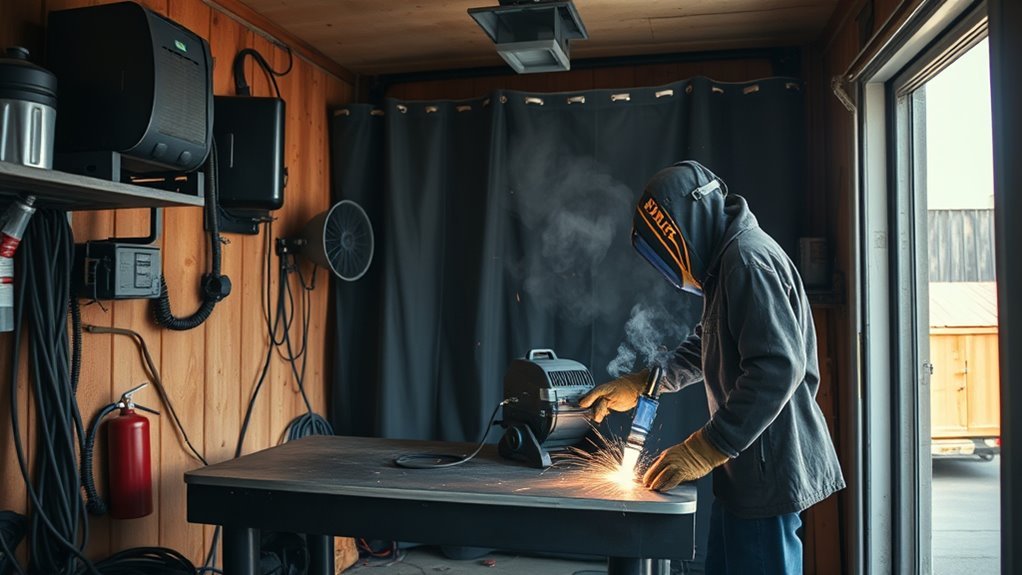
Warning: TIG welding uses an electric arc, shielding gas, hot metal, and intense light. Wear a properly rated welding helmet, gloves, flame-resistant clothing, and eye protection, keep flammables away, use ventilation, and follow your welder manual and applicable OSHA welding, cutting, and brazing guidance.
How to Use the TIG Foot Pedal for Optimal Heat Control
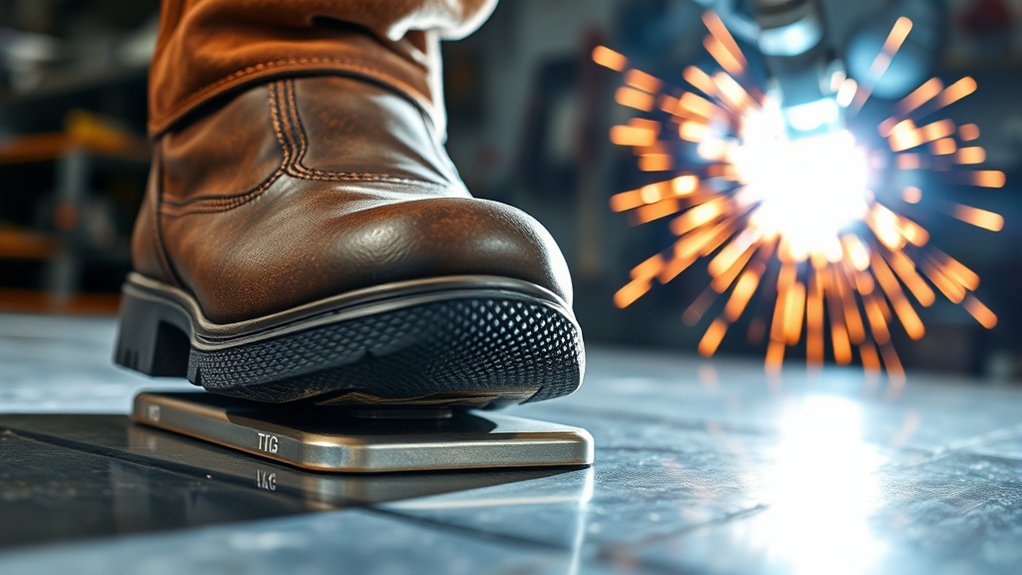
A TIG foot pedal works as a remote amperage control. On most machines, the amperage knob sets the maximum output, and the pedal lets you move from low amps up to that maximum while you weld. This gives you better heat control than a fixed torch switch, especially when the joint heats up near the end of the weld.
Start by setting a safe upper amperage limit. A useful starting point for many DC TIG welds on steel or stainless is about 1 amp per 0.001 inch of material thickness. For example, 0.090-inch material often starts near 90 amps. Treat this as a starting point, not a rule that works for every joint. Aluminum on AC, outside corners, thick heat-sinking parts, and poor fit-up may need different settings.
Before striking an arc, clean the joint, sharpen or prepare the tungsten correctly, select the right cup, and choose the correct filler rod. Miller Electric’s tungsten selection and preparation guide is a useful reference for matching tungsten type and preparation to the welding job.
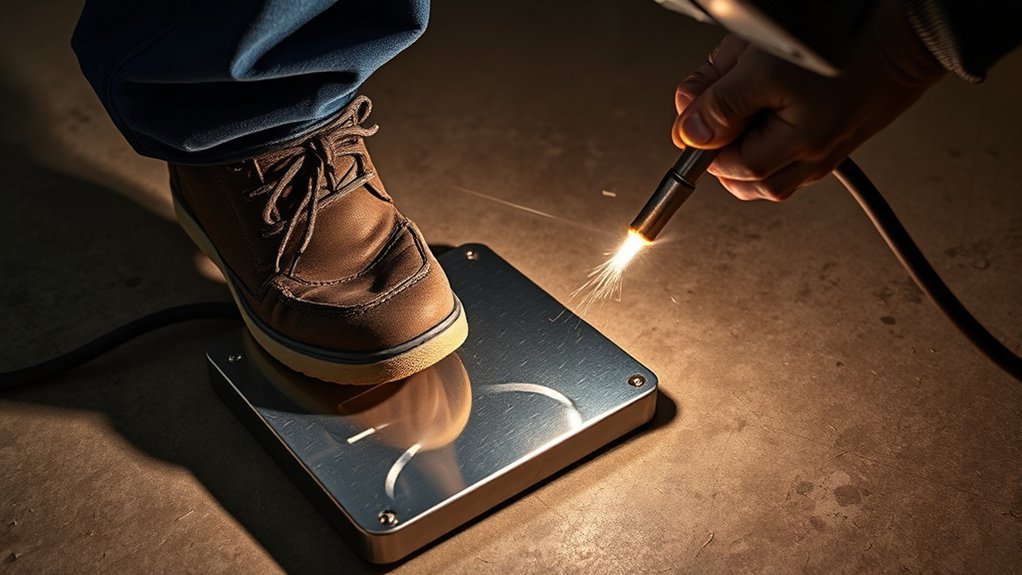
Place your heel on the floor and use your ankle to roll onto the pedal. Avoid pushing with your whole leg. Smooth ankle movement helps you bring the puddle in gently, hold a steady bead, and taper off at the end without leaving a crater crack.
Pro Tip: Set your maximum amperage slightly higher than you expect to need, then use only part of the pedal range during most of the weld. This gives you extra heat for starts, tacks, or heavy spots without forcing you to weld at full pedal all the time.
Set Your Machine Before Using the Pedal
The pedal cannot fix a poor setup. Before you weld, confirm these settings and conditions:
- Remote mode: Make sure the machine is set to foot-pedal or remote amperage control if your welder requires it.
- Maximum amperage: Set the top amperage high enough to start the puddle, but not so high that a full pedal press instantly overheats the joint.
- Polarity: Use DCEN for most steel and stainless TIG work. Use AC for most aluminum and magnesium TIG work, unless your welding procedure says otherwise.
- Shielding gas: Pure argon is the common starting gas for many TIG jobs. Do not confuse TIG shielding gas choices with cutting gases used in other processes, such as the gas type used for plasma cutting.
- Gas coverage: Check cup size, gas lens condition, flowmeter setting, and drafts around the weld area.
- Tungsten and filler: Match tungsten size and filler rod to the base metal, joint, and amperage range.
- Work clamp: Attach the ground clamp to clean metal so the arc starts reliably.
- Scrap test: Run a short bead on matching scrap before welding the finished part.
Techniques for Controlling Amperage With Your TIG Foot Pedal
Good TIG pedal control starts with watching the puddle, not the pedal. Press down enough to start a small shiny puddle, then back off slightly once the joint is wet and moving. As the metal heats up, you will usually need less pedal to keep the same puddle size.
| Pedal Technique | How to Use It | What to Watch |
|---|---|---|
| Gentle start | Ease into the pedal until the arc starts and the puddle forms. | A small, bright puddle that wets both edges. |
| Hold steady | Keep the pedal nearly still once the puddle size is correct. | Even bead width and steady ripples. |
| Feather down | Back off as the part heats up or the puddle spreads. | Less undercut, less sagging, and better edge control. |
| Add a short boost | Press slightly more for a cold tack, thicker area, or heavy heat sink. | The puddle catches up without boiling or widening too much. |
| Taper out | Slowly release the pedal at the end while adding a final dab of filler if needed. | A filled crater instead of a pinhole or crack. |
If the puddle gets too wide, shiny, and fluid, reduce pedal pressure or increase travel speed. If the puddle stays tight, dull, or refuses to wet both sides of the joint, add a little pedal, slow your travel, or check cleaning and fit-up. Heat control also depends on torch angle, arc length, and filler timing, not pedal pressure alone.
Note: Keep a tight arc length. If the torch is too far from the work, the arc spreads out, shielding gets weaker, and the pedal may feel harder to control.
Products Worth Considering

APPLICATION: Applicable to various types of TIG Welding Machine, such as YESWELDER TIG-200P ACDC/ TIG-205P/ YWT-200DC welders

Wide Compatibility: This TIG welding foot pedal switch is specially designed for ARCCAPTAIN TIG welders, compatible with TIG200, TIG200P, TIG200P ACDC, TIG205 Pro, and TIG205P Pro. Note: Not compatible with MIG205MP.
Preflow and Post Flow Settings Explained
Preflow starts the shielding gas before the arc begins. A common starting range is 1-2 seconds. This helps purge air from the cup area and gives the tungsten and weld start a cleaner gas shield before the arc lights.
Post-flow keeps shielding gas moving after the arc stops. This protects the hot tungsten and the end of the weld while they cool. If post-flow is too short, the tungsten can discolor or oxidize, and the weld crater may show contamination. If it is much longer than needed, you waste argon.
For thin, low-amperage practice welds, a short post-flow may be enough. For higher amperage, larger tungsten, stainless steel, titanium, or any job where the tungsten stays red hot after the arc stops, use more post-flow. Proper shielding gas flow matters just as much as timing because drafts, poor cup position, or too much flow turbulence can still pull air into the weld zone.
What You Shouldn’t Do With the Foot Pedal

Do not stomp on the pedal to force the weld to start faster. A sudden full-amp blast can overheat thin metal, widen the puddle, and leave undercut before you have time to react. Press smoothly, form the puddle, then settle into the amperage the joint actually needs.
Do not set the machine’s max amperage far above the job unless you have enough pedal control to manage it. A 200-amp max setting on thin sheet gives you very little room for error. Lower the max setting until the pedal range feels controllable.
Do not stare at your foot or think of the pedal as a separate task. Keep your eyes on the leading edge of the puddle. Your foot should react to what the puddle is doing. Other processes, such as flux core welding, use different heat-control habits, so do not carry every technique over to TIG.
Do not snap off the pedal at the end of the weld. Taper down slowly to fill the crater and prevent a small end crack. If your machine has downslope or crater-fill settings, learn how they interact with the foot pedal.
Practice Drills for Better Foot Pedal Control
Use scrap metal that matches your real part. Run short beads without filler first, then add filler after your foot control improves.
- Pedal-only drill: Set a safe amperage limit and practice rolling from low to half pedal without striking an arc. This builds ankle control.
- Puddle-size drill: Start a puddle, hold it the same width for 1 inch, then taper off. Repeat until the bead width is consistent.
- Heat-soak drill: Run a 3-inch bead and reduce pedal pressure as the coupon heats up. Try to keep the puddle the same size from start to finish.
- Crater-fill drill: At the end of each bead, add a small filler dab and slowly release the pedal. Inspect the crater for pinholes or cracks.
These drills train your foot to respond before the weld gets too hot. They also make it easier to coordinate filler rod, torch angle, and travel speed during real joints.
How to Troubleshoot Common TIG Foot Pedal Issues
If your TIG weld looks inconsistent, do not blame the pedal right away. Check the machine setup, tungsten, gas coverage, work clamp, and your body position. Use this troubleshooting guide to narrow the problem.
| Problem | Likely Cause | Fix |
|---|---|---|
| Arc starts too hot | Maximum amperage is set too high or you are pressing too fast. | Lower max amps and roll into the pedal gradually. |
| Puddle keeps widening | The part is heat-soaked, travel is too slow, or pedal pressure is too high. | Back off the pedal, increase travel slightly, and add filler at the right time. |
| Puddle will not wet in | Too little heat, dirty metal, poor fit-up, or arc length too long. | Clean the joint, tighten arc length, slow down, or add pedal gradually. |
| Pedal feels jumpy | Foot position is unstable, pedal is not calibrated, or connector is loose. | Plant your heel, inspect the cable and plug, and check the welder’s remote settings. |
| Black or gray weld area | Poor shielding, drafts, contamination, or too short post-flow. | Check argon flow, cup position, gas lens, work cleanliness, and post-flow time. |
| Crater crack at the end | Pedal released too fast or crater was not filled. | Taper off slowly and add a small final filler dab before ending the arc. |
Good proper amperage control matters in every arc-welding process, but TIG makes heat changes more visible because you can watch the puddle respond in real time. If the pedal still does not respond correctly after checking your technique, stop and inspect the foot pedal cable, plug, machine settings, and manual.
Products Worth Considering

Innovative smart connector for TIG torch
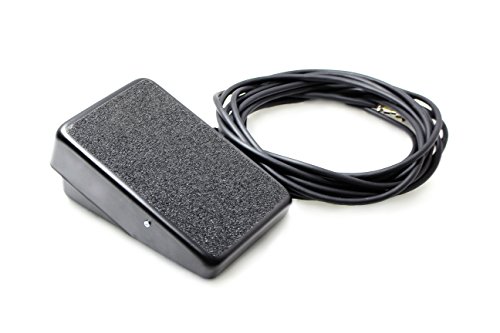
6-Pin TIG Amptrol Foot Pedal: Replacement foot control (amptrol) built for Lincoln TIG welders that use a 6-pin connector, giving you responsive amperage control at your feet.

Not for MTS Welders or EVERLAST PA160STH (2013-2017): Please contact Everlast to verify compatibility.
Frequently Asked Questions
How do you control heat with TIG welding?
Control TIG heat by setting the right maximum amperage, keeping a tight arc, watching the puddle, and using the foot pedal to add or reduce current as the joint heats up. If the puddle spreads too much, back off the pedal or increase travel speed. If it will not wet in, add heat gradually or slow down.
What is the 1 amp per 0.001 inch rule in TIG welding?
The 1 amp per 0.001 inch rule is a starting estimate for many TIG welds. For example, 0.125-inch material often starts near 125 amps. It is not a fixed law. Joint type, fit-up, material, tungsten size, shielding gas, travel speed, and AC/DC settings can change the final amperage you need.
How much does SpaceX pay TIG welders?
SpaceX welder pay depends on the exact job posting, location, shift, experience level, certifications, and overtime. For broader context, the U.S. Bureau of Labor Statistics lists the 2024 median pay for welders, cutters, solderers, and brazers at $51,000 per year, or $24.52 per hour. Always check the current SpaceX job listing for the most accurate range.
What are two benefits of using a foot pedal in the GTAW process?
The two main benefits are real-time amperage control and smoother starts and stops. You can add heat to start the puddle, reduce heat as the part warms up, and taper down at the end to reduce crater defects.
Should you TIG weld with the pedal fully pressed?
Not usually. Full pedal means you are using the maximum amperage set on the machine. Use full pedal only when the joint actually needs that much heat. For most beads, you should work within the middle of the pedal range and make small adjustments as the puddle changes.
Why does my TIG weld get too hot near the end?
The workpiece stores heat as you weld, so the same pedal position can become too hot later in the bead. Back off the pedal gradually, keep travel steady, and add filler consistently to control the puddle as the metal heat-soaks.
Conclusion
Mastering the TIG foot pedal comes down to setup, smooth pressure, and steady observation. Set a sensible maximum amperage, start the puddle gently, adjust from the weld pool instead of guessing, and taper out at the end. With clean metal, correct tungsten, proper shielding gas, and regular scrap practice, you will gain better heat control and produce cleaner, more consistent TIG welds.
Sources
- Miller Electric: Selection and Preparation Guide for Tungsten Electrodes — supports tungsten selection and preparation guidance.
- OSHA: Welding, Cutting, and Brazing Standards — supports welding safety, PPE, and regulatory context.
- U.S. Bureau of Labor Statistics: Welders, Cutters, Solderers, and Brazers — supports wage context and workplace hazard information.
- The Effects of Process Parameters on Melt-pool Oscillatory Behaviour in Gas Tungsten Arc Welding — supports the importance of process parameters and molten pool behavior in GTAW.