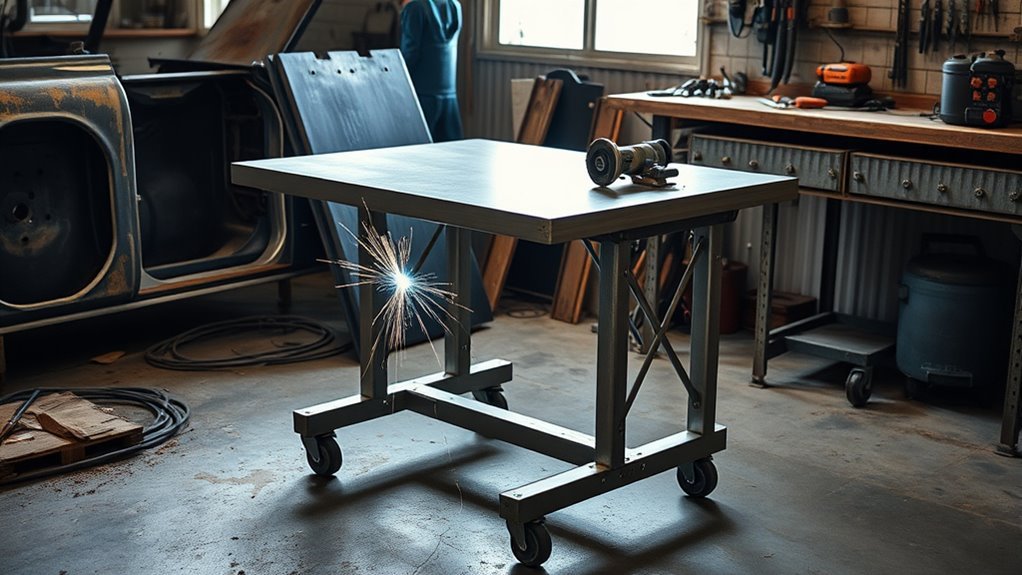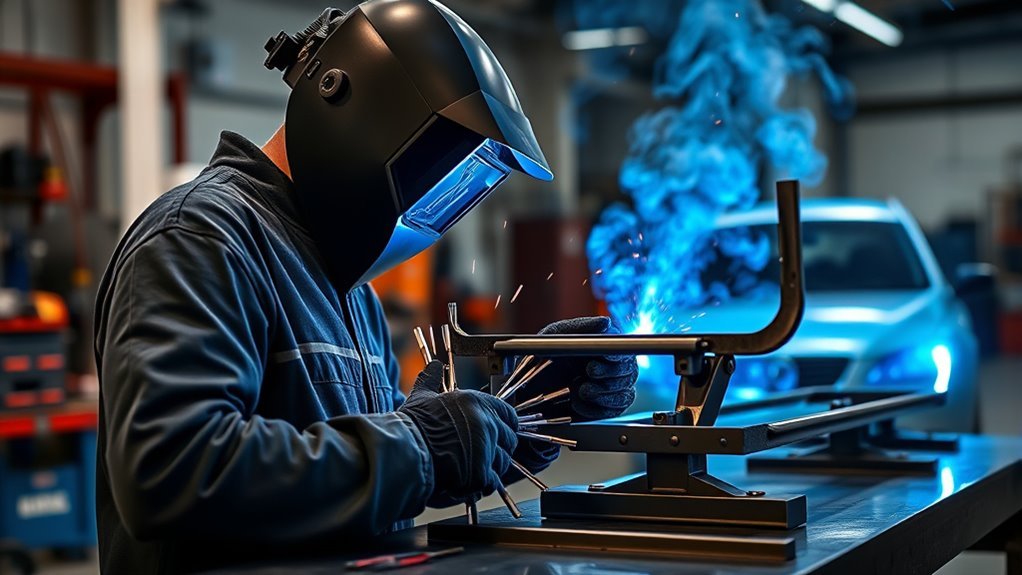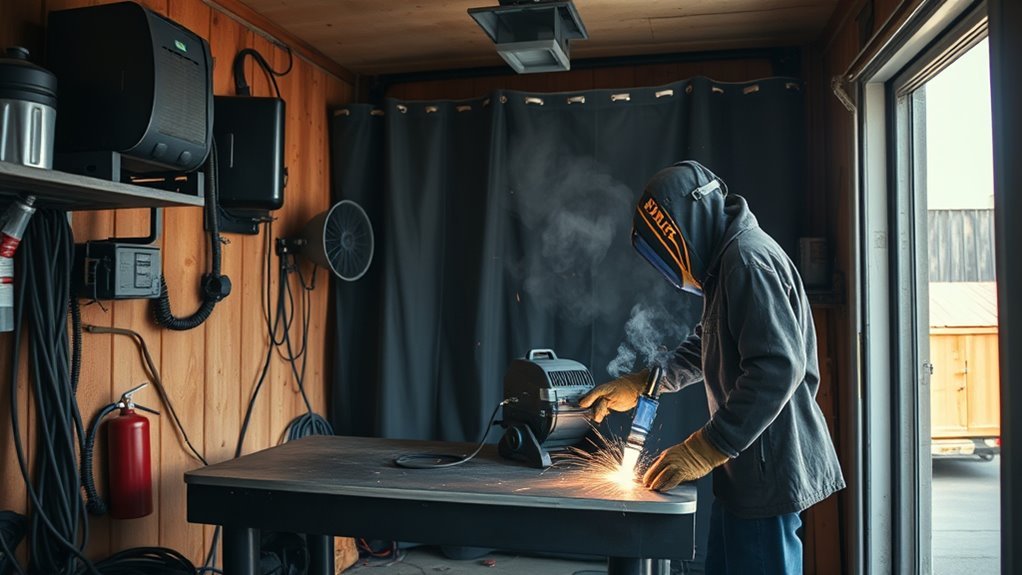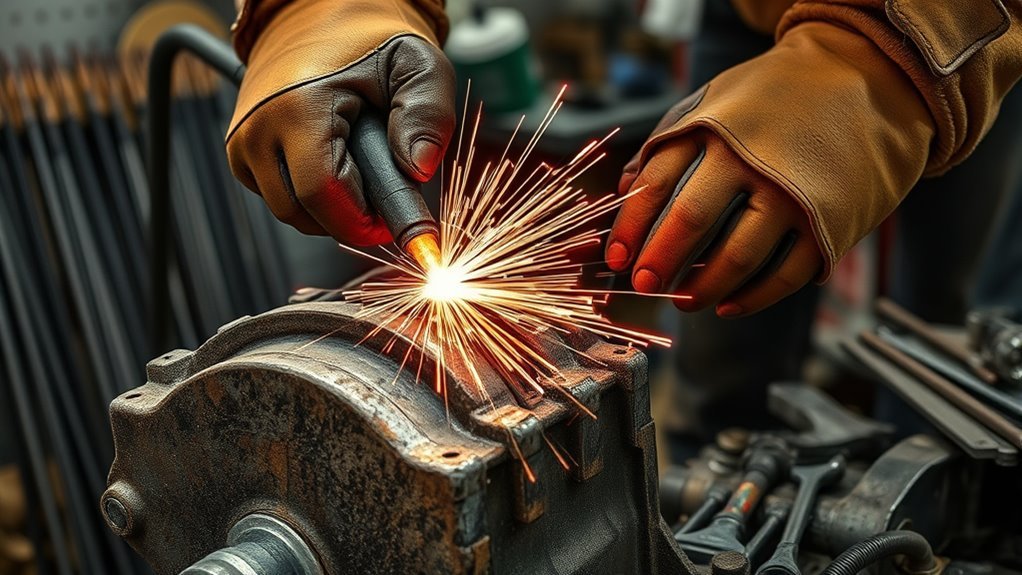
Welding cast iron automotive parts is possible, but it is not as forgiving as welding mild steel. Cast iron has high carbon content, low ductility, and a strong tendency to crack when it is heated or cooled too fast. For most noncritical repairs, the safest approach is careful cleaning, controlled preheat, nickel-based filler, short weld beads, light peening, and slow cooling. Safety-critical parts should be replaced or repaired by a qualified welding professional.
Quick Answer
To weld cast iron automotive parts, clean the casting deeply, preheat many gray cast iron repairs to about 400°F-600°F, use a nickel-based cast iron filler, weld short 1-inch beads at low heat, peen lightly while warm, and cool the part slowly in dry sand or insulation.
Key Takeaways
- Cast iron cracks easily because its carbon-rich structure does not stretch much as it heats and cools.
- Nickel-based filler is usually a better repair choice than ordinary steel electrodes for cast iron.
- Short weld beads, low heat input, and slow cooling matter more than speed.
- Do not DIY-weld brake, steering, suspension, or other safety-critical automotive parts.
At a Glance
| Time Required | 1-4 hours for a small repair, plus slow cooling time |
| Difficulty | Advanced DIY to professional, depending on the part |
| Tools Needed | Welder, nickel cast iron filler, grinder, wire brush, degreaser, temperature sticks or IR thermometer, clamps, PPE, dry sand or welding blanket |
| Cost | Usually $20-$100 for filler and supplies if you already own the welding equipment |
Warning: Do not weld brake, steering, suspension, wheel, hitch, or other safety-critical automotive castings unless you are qualified and following an approved repair procedure. Replacement is often safer than welding when failure could cause loss of vehicle control.
Understanding Welding Cast Iron Properties
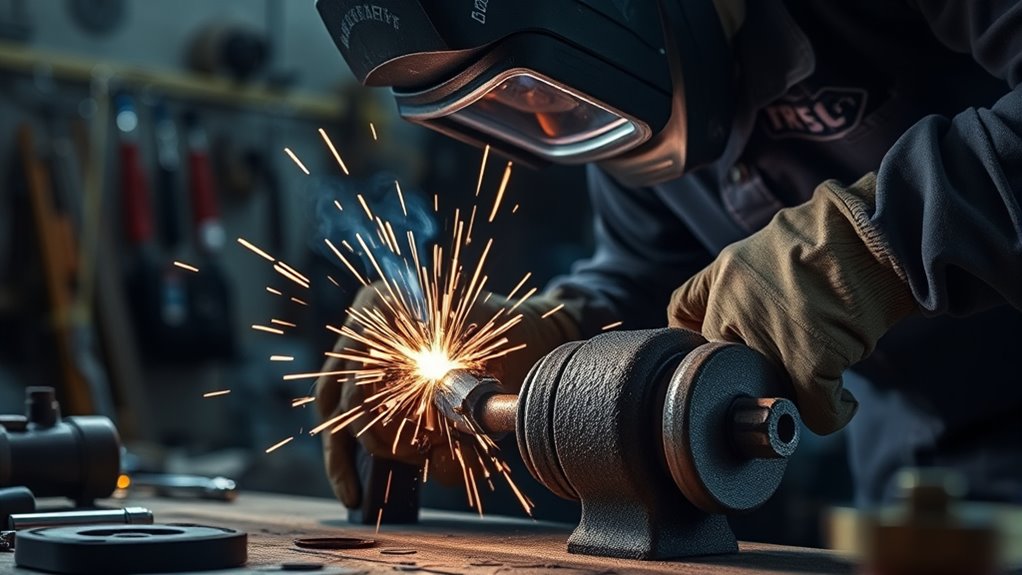
Cast iron is an iron-carbon alloy with much more carbon than mild steel. Many common cast irons contain more than 2% carbon, and that carbon often appears as graphite flakes or nodules in the metal structure. This is why cast iron machines well and handles compression well, but it can crack suddenly under tensile stress.
Gray cast iron is the most common type you will meet in automotive repairs, especially in older manifolds, housings, brackets, blocks, and machine bases. It can often be repaired if the crack is not in a safety-critical area. Ductile iron is tougher, but it still needs controlled heat. White cast iron is very hard and brittle, and it is usually a poor welding candidate.
Cast iron repairs fail most often from trapped oil, fast cooling, too much weld heat, the wrong filler metal, or welding a part that should have been replaced.
The goal is to reduce thermal shock. You do that by bringing the whole repair area up to a controlled temperature, welding in short sections, and letting the part cool slowly. For many gray cast iron repairs, a preheat range around 400°F-600°F is a practical starting point. Large, thick, or high-value parts may need a written procedure and professional heat control.
When to Weld, Braze, or Replace the Part
Before you strike an arc, decide whether welding is the right repair. Cast iron welding is best for noncritical parts where a small crack, broken ear, or worn surface can be restored without putting people at risk.
- Weld it when the part is noncritical, accessible, cleanable, and thick enough to accept a groove and filler.
- Braze it when you need lower heat input and the part does not need to be machined like base metal after repair.
- Cold stitch it when heat could distort the casting, such as on some engine blocks or rare parts.
- Replace it when the part is safety-critical, badly oil-soaked, thin, heavily cracked, or already failed in several areas.
Note: Engine blocks, cylinder heads, manifolds, and housings can hide oil, coolant, and carbon in the pores of the casting. If contamination keeps coming to the surface during preheat, stop and clean again before welding.
Common Challenges in Welding Cast Iron Parts
Welding cast iron presents unique challenges because the material is hard, carbon-rich, and less ductile than steel. The biggest problems are cracking, porosity, hard weld deposits, poor fusion, and distortion.
High Carbon Content
Cast iron’s carbon content gives it useful wear resistance and compressive strength, but it also makes the heat-affected zone brittle. When you weld too hot or cool too quickly, the area beside the bead can become hard and crack-prone.
Use a filler made for cast iron. Nickel 99 rods are often chosen when machinability matters. Nickel 55 rods are often used when the repair needs more strength and the deposit does not have to machine as easily. TIG nickel filler can also work when you need fine control on small, clean parts.
Cracking Risks
Cracks form when the weld area expands and shrinks faster than the surrounding casting. The risk increases when the part is cold, thick, dirty, restrained, or welded with long beads.
To lower the risk:
- Preheat evenly: warm the area around the repair, not just the crack edge.
- Use short beads: keep each weld segment about 1 inch or less.
- Control interpass temperature: do not let the part swing from hot to cold between passes.
- Peen lightly: tap the bead while it is still warm to help reduce shrinkage stress.
- Cool slowly: bury the part in dry sand, lime, or an insulating blanket after welding.
Heat Management Techniques
Heat management is the core skill in cast iron welding. Use temperature sticks, a contact thermometer, or an IR thermometer to confirm the casting temperature instead of guessing by color.
For many small to medium gray cast iron automotive repairs, preheat around 400°F-600°F is enough to reduce thermal shock. Avoid overheating the casting. Higher temperatures can be used in some controlled procedures, but they should not be treated as a universal DIY rule.
Pro Tip: If the casting is too large to heat evenly with your setup, do not chase the crack with more amperage. Use a professional shop with an oven, proper temperature control, and inspection equipment.
Prepare Effectively for Welding Cast Iron
Preparation decides whether the repair has a chance. Cast iron often holds oil, rust, paint, coolant, and carbon in its surface pores. Any of these can cause porosity or a weak bond.
- Remove the part when possible. Welding on the vehicle increases fire, fume, and access problems.
- Degrease the casting. Use a suitable solvent, then wipe until the rag comes away clean.
- Strip paint, rust, and carbon. Grind or wire-brush at least 1 inch beyond the repair area.
- Find the full crack. Use good lighting, dye penetrant, or careful grinding to expose the ends.
- Stop-drill crack ends. Drill a small hole at each crack end to reduce crack growth during welding.
- Grind a V-groove. Open the crack enough for filler to reach the root, but do not remove more metal than needed.
- Dry the part. Preheat gently to drive out moisture and oil before final welding heat.
Thoroughly clean the cast iron surface before welding. Rust, oil, paint, and coolant trapped in the pores can cause porosity and weak fusion.
Products Worth Considering

Cast Iron Rust Remover: The Lodge Rust Eraser is a compact, abrasive rust eraser that restores cookware and other cast iron pieces with precision rust removal
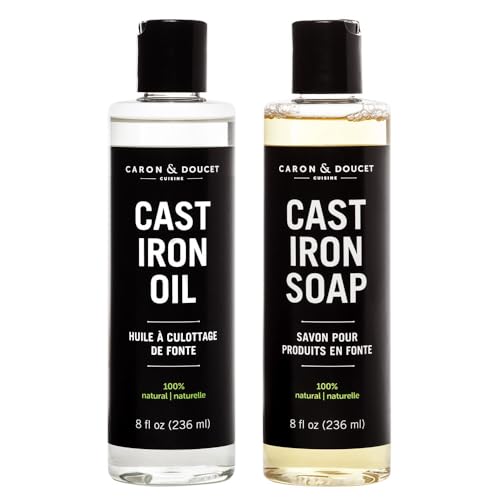
CLEANS CAST IRON | Includes our Cast Iron Soap unlike detergent based soaps, this soap is formulated with 100% natural plant-based oils & free of sulfates, phosphates, parabens & petrochemicals! Gentil on cast iron seasoning & on your hands!

Nickel 55 ENiFe-CI Cast Iron Stick Electrodes
Choose the Best Welding Technique for Cast Iron
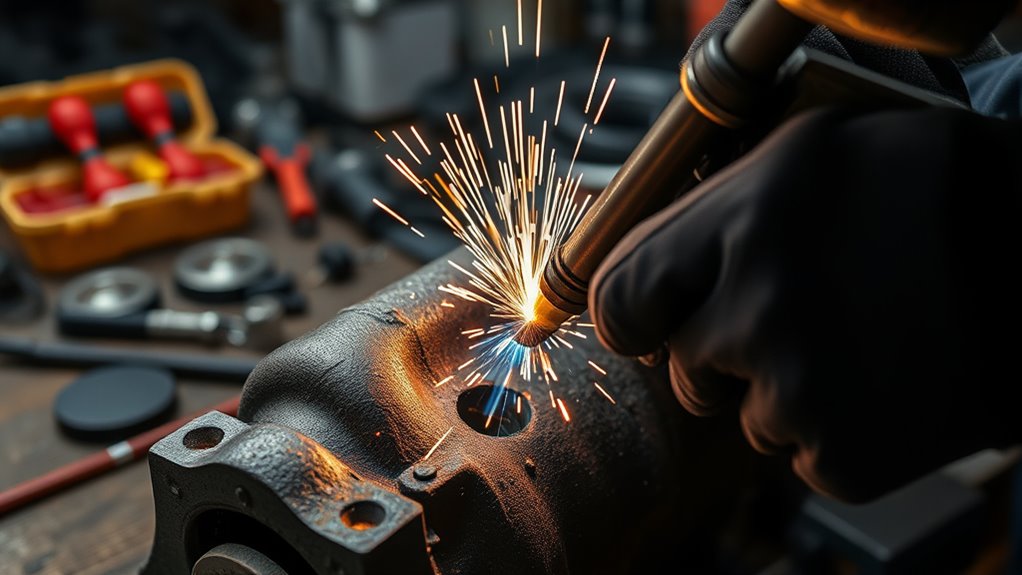
The best welding technique depends on the part, crack size, casting type, and whether the repair must be machined afterward. Stick welding and TIG welding are common choices because they give you good control over filler selection and heat input.
| Method | Best Use | Main Caution |
| Stick welding with nickel rod | Thicker brackets, housings, manifolds, and general cast iron repair | Use short beads and low amperage to limit heat buildup |
| TIG with nickel filler | Small, clean, precise repairs | Requires very clean metal and careful heat control |
| MIG with suitable nickel wire | Limited shop use where the correct wire and procedure are available | Ordinary steel MIG wire is not a good default for cast iron |
| Brazing | Lower-heat repair where fusion welding may cause cracking | The joint is not the same as a fusion weld and must match the service load |
| Cold stitching | Cracks in blocks, heads, and large castings where heat distortion is a concern | Requires layout accuracy and the right pins or locks |
Products Worth Considering

Material: The package includes ENi-CI 6pcs 12'' in length 3/32'' in diameter Welding Electrode Rods

Premium Specification: Package includes 10 Pcs ENiFe-CI welding electrodes, size 1/8" diameter × 14" length, ready for immediate industrial and maintenance use.
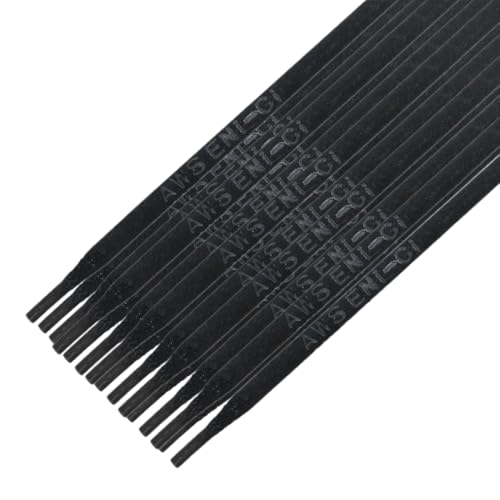
Package Includes: 15Pcs ENi-CI Cast Iron Welding Electrode Rods, 12'' Length, 3/32'' Diameter, ready for immediate industrial & maintenance use.
Step-by-Step Welding Sequence
Once the part is clean, grooved, and preheated, keep the repair controlled and patient.
- Set low amperage. Use the lowest setting that gives stable fusion with your selected rod or filler.
- Tack the ends. Place small tacks to hold alignment without overheating one spot.
- Weld short segments. Run beads about 1 inch long, then stop.
- Peen gently. While the bead is still warm, tap it with a rounded hammer to help reduce shrinkage stress. Do not strike hard enough to dent or crack the casting.
- Move around the repair. Do not stack heat in one place. Let heat spread evenly through the casting.
- Brush or chip between passes. Remove slag and inspect each bead before continuing.
- Maintain temperature. Reheat as needed so the part does not cool sharply between passes.
- Finish slightly proud if machining is planned. Leave enough weld metal for final shaping.
Avoid long continuous beads. They pull hard on the surrounding cast iron as they shrink. Short beads give you more control and reduce the chance of a crack forming beside the weld.
Cooling and Cleaning After Welding
After welding cast iron, the cooling process is just as important as the weld itself. Do not cool the part with water, compressed air, or a cold metal bench. Rapid cooling can trigger new cracks in the heat-affected zone.
Use one of these slow-cooling methods:
- Bury the part in dry sand.
- Wrap the part in a welding blanket or ceramic insulation.
- Place the part in a warm oven or controlled cooling box if available.
- Let large castings cool for several hours or overnight.
When the part reaches room temperature, clean the weld area and inspect it. Look for hairline cracks, pinholes, undercut, poor fusion, and leaks. For oil, coolant, or exhaust parts, use dye penetrant or a pressure/leak test when the repair needs to seal.
Troubleshooting Common Cast Iron Weld Problems
| Problem | Likely Cause | Fix |
| Crack beside the bead | Too much heat, poor preheat, fast cooling, or high restraint | Stop, grind out the defect, preheat more evenly, use shorter beads, and cool slower |
| Porosity | Oil, paint, rust, coolant, or moisture in the casting | Clean deeper, bake out contamination, and re-weld only after the surface stays clean |
| Hard weld that will not machine | Wrong filler, too much dilution, or fast cooling | Use a machinable nickel filler and slow the cooling rate |
| Leak after repair | Incomplete fusion, pinholes, or a crack that extends beyond the groove | Reinspect with dye penetrant, grind out defects, and repair only if the part is still safe to use |
Stay Safe While Welding Cast Iron Parts
Welding cast iron can expose you to hot metal, slag, UV radiation, electrical hazards, fumes, and fire risk. Work in a well-ventilated area and use local exhaust when possible. Welding fumes are made of metals and may contain manganese, so avoid breathing smoke from the weld area.
Wear a welding helmet with the correct shade, safety glasses, flame-resistant clothing, leather gloves, hearing protection when grinding, and closed leather footwear. Keep a fire extinguisher nearby. Move flammable material away from the work area, and remember that sparks can travel through cracks, floor openings, and nearby clutter.
On automotive parts, remove oil, grease, fuel residue, and paint before heating. Do not weld on a closed container, fuel tank, or part that may hold flammable vapor. Disconnect nearby electronics when welding on a vehicle, and protect wiring, hoses, glass, trim, and painted panels from sparks and heat.
Frequently Asked Questions
Do you need a special welder to weld cast iron?
You do not always need a special welder, but you do need the right filler, heat control, and preparation. A stick welder with nickel cast iron rods or a TIG welder with nickel filler is a common choice. The part matters more than the machine. Safety-critical automotive parts should be handled by a qualified repair shop or replaced.
Can you use 7018 to weld cast iron?
E7018 is a low-hydrogen steel electrode, but it is not the best default choice for cast iron. It can create a hard, less machinable deposit and may increase cracking risk on some repairs. For most cast iron automotive repairs, use a nickel-based cast iron electrode unless a qualified procedure says otherwise.
What is the best welding method for cast iron?
Stick welding with nickel cast iron rods is often the most practical method for thicker repairs. TIG welding with nickel filler is useful for small, clean, precise work. Brazing or cold stitching may be better when you need lower heat or when the casting is too risky to fusion weld.
Why is cast iron so hard to weld?
Cast iron is hard to weld because it contains high carbon, has low ductility, and reacts poorly to fast temperature changes. The weld area expands when hot and shrinks as it cools. If that movement is not controlled with preheat, short beads, and slow cooling, cracks can form.
Should you preheat every cast iron automotive part before welding?
Most cast iron welding repairs benefit from preheat because it lowers thermal shock. For many gray cast iron repairs, about 400°F-600°F is a common working range. Small cold-weld techniques exist, but they still require short beads, cooling pauses, and careful stress control.
Can you weld an exhaust manifold made from cast iron?
Yes, some cast iron exhaust manifolds can be welded, but they must be cleaned, grooved, preheated, and cooled slowly. Manifolds are exposed to repeated heat cycles, so a rushed weld often cracks again. If the manifold is thin, badly warped, or cracked in several places, replacement may be better.
Conclusion
Successful cast iron welding depends on control. Clean the automotive part until the metal is sound, decide whether welding is safer than replacement, preheat evenly, use nickel-based filler, weld short beads, peen lightly, and cool the casting slowly. If the part carries steering, braking, suspension, towing, or occupant-safety loads, do not treat it as a normal DIY weld. Use a qualified repair procedure or replace the part.
Sources
- OSHA Welding, Cutting, and Brazing Hazards and Solutions — supports welding hazard, PPE, and work-practice safety guidance.
- OSHA 29 CFR 1910.252 General Requirements — supports fire prevention, combustible clearance, extinguishing equipment, and fire watch guidance.
- CDC/NIOSH Welding Fumes and Manganese — supports fume and manganese exposure cautions.
- University of Cambridge Metallurgy of Cast Irons — supports cast iron structure and material behavior background.