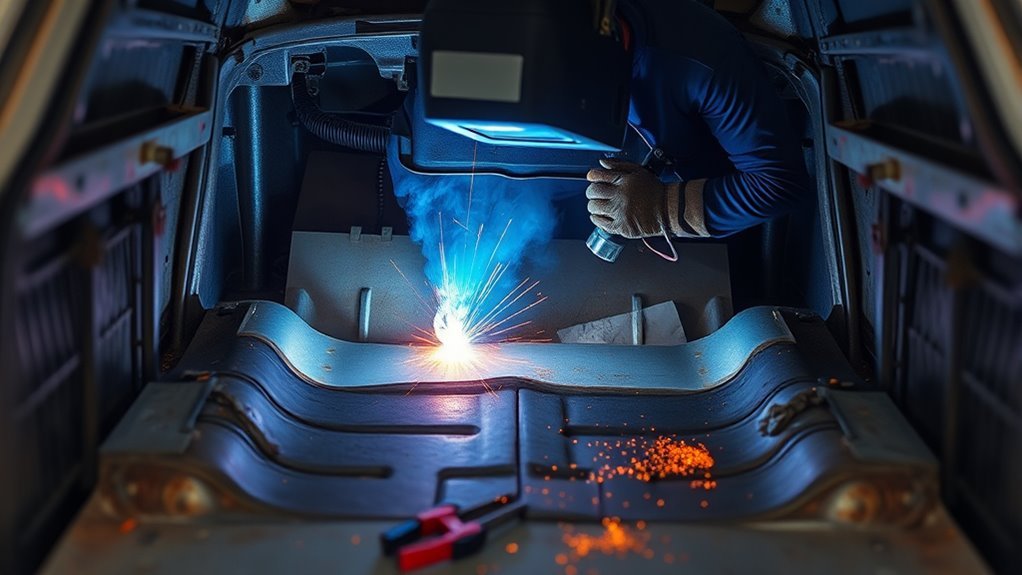
Welding a firewall patch is more than a cosmetic rust repair. The panel separates the engine bay from the cabin, carries brackets and pass-throughs, and may connect to structural areas around the cowl, floor, pedals, or steering column. Start with the vehicle maker’s body repair information, remove every trace of weak metal, and confirm that the location is approved for repair. Then fit a matching steel patch, weld it with controlled MIG tacks, restore the primer and seam sealer, and inspect both sides before reassembly.
Quick Answer
To weld a firewall patch, first confirm the repair method in the vehicle’s body manual. Remove rust to sound steel, copy the original metal thickness and shape, fit the patch tightly, and close the seam with short, spaced MIG tacks. After grinding only the high spots, epoxy-prime, seam-seal, coat, and inspect both sides.
Key Takeaways
- Check the vehicle-specific repair procedure before cutting. Firewall materials, sectioning limits, weld types, and corrosion-protection steps vary by vehicle.
- Cut back to sound steel. Do not weld over rust, paint, phosphoric-acid residue, seam sealer, undercoating, foam, oil, or adhesive.
- Match the original material and thickness, copy beads and bends, and keep the joint gap tight and even.
- Use brief, spaced tacks and cooling pauses. Do not run a long continuous bead across thin firewall sheet metal.
- Restore corrosion protection in the correct product order, usually epoxy primer first, then seam sealer and compatible topcoats, unless the product and OEM procedure state otherwise.
- Treat rust near pedal, steering-column, cowl, rocker, floor, or major mounting areas as a structural repair that may require a qualified collision-repair technician.
At a Glance
| Time Required | Several hours for a small, accessible patch; longer when brackets, wiring, insulation, HVAC parts, or hidden corrosion require extra disassembly |
| Difficulty | Intermediate to advanced sheet-metal and vehicle repair |
| Tools Needed | Vehicle body manual, MIG welder, matching wire and gas, cut-off tool, grinder, wire brush, sheet-metal tools, clamps or clecos, copper backer, PPE, fire extinguisher, epoxy primer, seam sealer, and compatible coatings |
| Cost | Low to moderate for materials if you already own the equipment; much higher when structural assessment, major disassembly, or professional collision repair is required |
| Joint and Weld Method | Use only the joint, weld process, spacing, and sectioning method approved for that vehicle and location |
| Main Risks | Hidden fire, damaged electronics or SRS parts, toxic fumes, burn-through, panel distortion, weak fusion, missed corrosion, and poor sealing |
Decide Whether the Firewall Is Safe to Repair
Before you touch a grinder, identify the vehicle, model year, repair location, panel material, and factory construction. Modern bodies may use mild steel, high-strength steel, ultra-high-strength steel, galvanized coatings, adhesives, foams, and layered joints in the same area. The correct repair may be a small patch, a partial panel replacement, or complete replacement. I-CAR advises checking vehicle-specific OEM repair information because material repairability and approved methods vary.
Stop and get a qualified collision-repair assessment when rust reaches the steering-column support, pedal mounting area, brake-booster mount, major cowl joint, A-pillar, rocker, floor reinforcement, suspension-related structure, or another OEM-designated no-repair area. Also stop if you cannot identify the metal, reach both sides, remove nearby combustibles, or restore the original corrosion protection.
Warning: A firewall repair can affect occupant protection, pedal and steering support, fire resistance, sealing, and cabin air quality. This guide does not replace the vehicle maker’s body repair manual. Do not improvise a patch in a structural or restricted repair zone.
Prep the Firewall for Welding
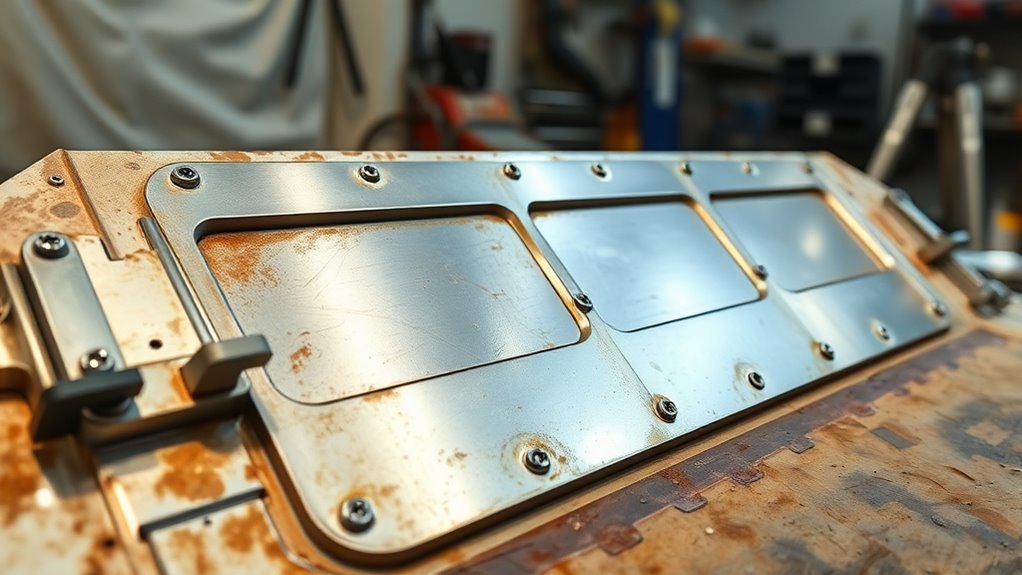
Inspect the area from the engine bay and cabin side. Look for rust, cracks, pinholes, old filler, failed seam sealer, heat damage, soft metal, and corrosion hidden behind insulation, sound deadening, brackets, wiring clips, pedals, HVAC parts, grommets, or foam. Probe suspect steel with a pick or small screwdriver. Sound steel should not flake, tear, or collapse under light pressure.
Remove enough trim and equipment to expose both sides of the repair. Follow the vehicle maker’s shutdown procedure for the battery, supplemental restraint system, high-voltage system on hybrid or electric vehicles, and any modules near the work. Move wiring, hoses, brake parts, fuel or vapor lines, insulation, carpet, foam, adhesives, and plastic parts away from heat and sparks. Do not rely on a welding blanket to protect a combustible item that can be removed.
Inspect the welder, work lead, torch, gas hose, extension cord, grinder, and cutting tools before use. Replace damaged insulation, loose connections, cracked guards, or worn cables. A broader cutting and cable safety checklist can help you catch equipment faults before hot work starts.
Strip paint, undercoating, seam sealer, adhesive, rust treatment, oil, and corrosion from the weld zone until you have clean, bright, sound metal. Vacuum dust and wipe away grease with a compatible cleaner that has fully evaporated before welding. Do not weld over chlorinated cleaner residue. If the vehicle uses coated or galvanized steel, use the OEM procedure and review proper surface preparation for coated steel.
A strong firewall patch starts with three things you cannot see in the finished repair: sound base metal, the correct OEM repair method, and full access to both sides.
Warning: Welding sparks can travel into seams, insulation, carpet, foam, and cavities. Keep a suitable extinguisher within reach, use a fire watch when needed, inspect both sides during the job, and continue checking for smoldering material for at least 30 minutes after hot work. OSHA’s welding and cutting requirements describe fire-prevention and fire-watch duties.
Use local exhaust ventilation that pulls fumes away from your breathing zone without blowing away the MIG shielding gas. Welding and heating old coatings can release hazardous fumes, so remove coatings before hot work and use respiratory protection only as part of a proper hazard assessment and respirator program. The NIOSH welding-fume guidance explains why ventilation and exposure control matter.
Wear safety glasses under a correctly shaded welding helmet, hearing protection, welding gloves, sturdy footwear, and flame-resistant clothing. Avoid synthetic fabric that can melt. See this guide to protective clothing for arc welding for a practical PPE overview.
Cut Out Rust and Trace the Patch
Mark the smallest practical repair area that still reaches sound steel. Keep the cut shape simple when the OEM procedure allows it, but do not leave thin, deeply pitted, or perforated metal just to make the patch smaller. Check seams, flanges, brackets, and the backside because corrosion often spreads farther than the visible hole.
Use masking tape to establish a clean cut line, then remove the damaged steel with a cut-off wheel, body saw, air saw, or another controlled tool. Protect everything behind the cut. Work in short passes, stop before the tool reaches hidden components, and avoid cutting into a reinforcement or second panel.
After removal, deburr the opening, vacuum metal chips, and inspect the newly exposed edge. Extend the cut if the steel is still weak. Removing only loose surface rust is not enough for a welded seam; rust and scale in the fusion zone can contribute to contamination and porosity. This article on whether you can coat over remaining rust also explains why rust removal and surface condition matter before refinishing.
Do not apply phosphoric acid, rust converter, primer, paint, or seam sealer to the immediate weld zone before MIG welding unless the vehicle maker and product instructions specifically call for a compatible weld-through material. If you use a rust treatment outside the weld zone, neutralize or remove it as directed and let the surface dry completely.
Note: Foam fillers, cavity wax, seam sealer, and sound deadening can hide behind a panel and become a fire hazard during cutting or welding. I-CAR recommends identifying and removing these materials before repair, then restoring them at the correct stage.
Products Worth Considering


LONGEST LASTING:The 3 cut off wheel features a metal center and 1/16" thickness. 25 pieces cutting disc for metal & stainless steel meet ANSI safety requirements

THIN-PROFILE PRECISION: Designed for clean, accurate cuts on metal, steel, stainless steel, aluminum, pipes, tubes, and flat sheets with a 6" diameter, 0.045" thin kerf and 7/8" arbor for minimal material loss. Built for craftsmen and DIY enthusiasts
Shape the Patch for a Tight Fit
Use masking tape, poster board, thin cardboard, or pattern paper to copy the opening. Transfer the pattern to sheet steel that matches the original panel’s material and thickness. Do not choose a gauge by guesswork. Measure an undamaged area when practical and confirm the specification in the body repair manual.
Cut the blank slightly oversized, then trim it a little at a time. Use tin snips, aviation snips, a cut-off wheel, a body saw, or a plasma cutter only when you can control the heat and protect the vehicle. Deburr every edge before test-fitting.
Copy the original shape, including bends, steps, beads, ribs, and flanges. A flat patch forced over a formed firewall can oil-can, pull the surrounding metal, or interfere with brackets. Use a hammer and dolly, bead roller, brake, vice, pliers, or simple forming blocks to reproduce the contour.
If the original firewall is stainless steel or another unusual alloy, do not substitute mild steel. Use the correct filler, shielding gas, and dedicated tools. This guide to avoiding stainless-steel contamination explains why clean, dedicated tools matter, although the OEM process still controls the vehicle repair.
Test-fit often from both sides. The patch should sit flush without force, preserve nearby openings, and maintain a small, even joint gap only if the approved weld procedure requires one. Wide or uneven gaps make burn-through and distortion much harder to control.
Choose the Right Patch Metal and Joint
There is no universal “best” firewall joint. The right choice depends on the vehicle, steel grade, panel stack, access, original construction, and OEM repair procedure. Do not replace a factory bonded, spot-welded, brazed, or layered joint with a generic butt weld just because it looks cleaner.
| Joint | When It May Be Used | Main Concern |
| Butt joint | A flush patch where the OEM permits sectioning and edge-to-edge GMA welding | Requires accurate fit, correct gap, full fusion, and strict heat control |
| Lap or flange joint | Only where the OEM procedure or original construction calls for an overlap | Can trap moisture unless the mating surfaces and edges receive the specified corrosion protection |
| Plug weld | Replacing factory spot welds when the OEM allows GMA plug welds | Hole size, number, spacing, penetration, and flange preparation must follow the repair procedure |
Generic advice about the maximum fillet weld size does not replace vehicle-specific weld dimensions. Use the approved hole size, spacing, joint design, and welding process for the exact repair.
Pro Tip: Cut two coupons from steel that matches the patch and original panel. Test the exact joint, wire, gas, and settings before welding the vehicle. Break or bend the sample after it cools so you can check fusion instead of judging the weld only by appearance.
Products Worth Considering

【Designed For Automotive Repair Work】Spot weld panel chisel Designed for automotive body repair work, precisely removes auto body spot welds and easily separates metal panels. It is suitable for a wide range of bodywork, include accident repairs, vehicle dismantling, door and fender replacement, and the separation of welds on frames and chassis, ensuring efficient performance to meet your needs.

Separates Spot Welded Panels.

J-B Weld Muffler Seal: MufflerSeal is an iron reinforced paste designed to seal mufflers, pipe joints and exhaust systems. MufflerSeal can resists up to 700 F.
Check Brackets and Alignment Before Final Welds
Fit every bracket, grommet, reinforcement, pedal support, steering-column part, HVAC housing, cowl piece, and nearby tab that depends on the repaired area. Confirm hole locations, clearances, and panel shape before the first permanent tack. A patch can look correct by itself and still place a bracket several millimeters out of position.
Hold the patch with clamps, magnets used away from the arc, clecos, or temporary screws placed where the approved repair allows them. Check the seam from both sides. The patch should not rock, spring outward, or require heavy clamp pressure to sit flush.
Measure the opening, test the patch, refit the attached parts, and check the seam again. Heat will lock in a bad fit faster than grinding can fix it.
Weld Firewall Patches Cleanly
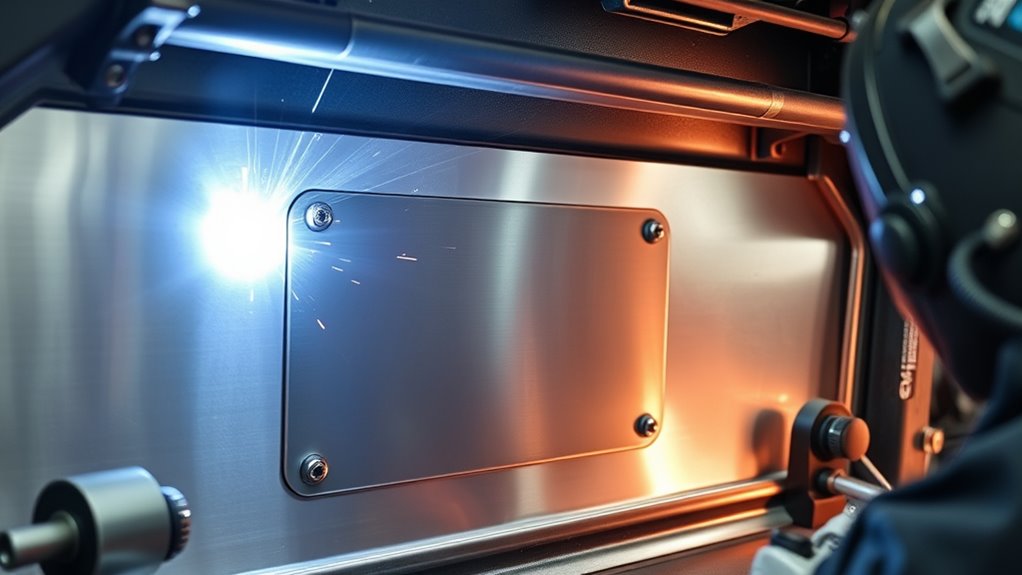
Use the welding process specified by the body repair manual. For an older mild-steel firewall where gas-shielded MIG is permitted, set up the welder with the correct polarity, wire, shielding gas, contact tip, and work-lead connection. Put the work clamp on clean metal as close to the repair as practical, while following any OEM precautions for electronics and modules.
Flux-cored wire usually creates more spatter, slag, and cleanup on thin automotive sheet metal, so gas-shielded MIG is often easier to control when the repair procedure allows it. Beginners can review these flux-core preparation basics, but they should not assume flux core is approved for a firewall repair.
Start with widely spaced tacks that lock the patch in alignment. Recheck the fit after the first few tacks because weld shrinkage can pull the patch. Add more tacks in a balanced pattern, moving to a cool area each time. Let the metal lose its visible heat before returning to the same zone.
For a permitted butt-welded patch, connect the tacks gradually with brief trigger pulls rather than a long continuous bead. The goal is complete fusion and a closed seam without overheating the panel. Do not lower voltage or amperage so far that the weld sits on top with poor fusion. Use the scrap test and welder chart as the starting point, then adjust for a crisp, controlled tack that penetrates both edges.
A clean copper backing bar can support the molten pool and reduce burn-through where you can place it safely. It does not correct a wide gap, weak base metal, or an unapproved joint. Remove the copper and inspect the backside whenever access allows.
Prevent Warping While You Weld
Thin sheet metal distorts because welding heats a small area that shrinks as it cools. You cannot eliminate all shrinkage, but you can reduce it with accurate fit-up, short weld time, balanced tack placement, strong clamping, and full cooling pauses. Do not preheat a generic firewall patch or quench it with wet cloths unless a vehicle-specific procedure requires that method. Water near electrical welding equipment also creates avoidable hazards and rapid cooling can make distortion harder to predict.
Heat Control
- Practice on matching scrap before touching the vehicle.
- Keep the joint tight and even so you do not spend extra arc time bridging gaps.
- Use brief tacks with enough energy for fusion, not a cold, piled-up bead.
- Jump around the patch instead of completing one side at a time.
- Let each area cool naturally before adding the next tack nearby.
- Check panel shape with a straightedge or contour gauge as the seam closes.
- Stop when the panel begins to pull, oil-can, or discolor across a growing area.
Tack and Cool
Place the first tacks at opposing points to hold alignment. Add tacks midway between them, then continue dividing the open spaces. This balanced pattern spreads shrinkage around the patch. Keep the torch angle and stickout consistent, and clean the nozzle when spatter begins to disturb gas flow.
Do not “chase” an open seam in one direction. As the patch becomes nearly continuous, let it cool fully and inspect for missed spots. Close only the remaining pinholes or short gaps. Excessive re-welding adds heat without improving the repair.
Troubleshoot Firewall Patch Welds
| Problem | Likely Cause | Safe Correction |
| Burn-through | Wide gap, weak edge, long arc time, poor torch control, or incorrect settings | Stop and cool. Trim weak metal if needed, refit the gap, use a copper backer where permitted, and rebuild with brief tacks |
| Porosity | Rust, paint, oil, chemical residue, poor gas coverage, wind, or a dirty nozzle | Remove the defective weld to clean metal, correct the contamination or gas problem, and reweld |
| Weld sits high with little fusion | Settings too cold, poor work-lead contact, excessive stickout, or incorrect technique | Correct the setup and prove penetration on matching scrap before continuing |
| Panel warps or oil-cans | Too much heat in one area, forced fit, poor tack sequence, or excessive grinding heat | Stop welding, let the panel cool, reassess alignment, and use proper metal-finishing methods rather than adding more weld |
Common Welding Mistakes to Avoid
Do not weld over paint, rust, seam sealer, undercoating, oil, adhesive, foam, or rust-treatment residue. Do not assume every firewall is mild steel. Do not use a continuous bead on thin sheet, fill a large gap with wire, or keep adding heat to a burn-through hole.
Do not grind the seam paper-thin just to make it disappear. A flat-looking repair can be weak if you remove the weld or surrounding base metal. Also avoid sealing the patch before you inspect the backside, pinholes, panel fit, and corrosion-protection needs.
Grind and Inspect the Weld
Let the panel cool, then remove only the weld height that interferes with fit or finish. Use a small abrasive, controlled file, or flap disc with light pressure. Keep the tool moving and pause often so grinding heat does not distort the panel.
Inspect the seam in bright light from both sides. Look for pinholes, cracks, porosity, undercut, incomplete fusion, missed edges, and excessive thinning. A light placed behind the seam can reveal holes, but it does not prove weld strength. Where the repair procedure requires a specific quality check, use that method.
Refit brackets and components before coating. Confirm that fastener holes, studs, grommet openings, pedal travel, steering-column clearance, wiring routes, and HVAC housings still align. Correct metalwork now, not after seam sealer cures.
Seal and Rustproof the Repair
Welding destroys factory coatings around the seam, so the repair is not finished until you restore corrosion protection. The exact sequence depends on the vehicle maker and the products you use. In many collision-repair systems, the welded metal is cleaned and epoxy-primed before seam sealer is applied. Some direct-to-metal sealers are exceptions, but you must follow their technical data sheet.
I-CAR’s seam-sealer guidance notes that substrate preparation depends on the product, and many two-part seam sealers are intended for corrosion-resistant primer unless the sealer is specifically approved for bare metal. For example, the 3M Heavy-Bodied Seam Sealer technical data sheet calls for compatible primed or prepared painted surfaces.
Inspect Hidden Rust Again
Before applying primer, inspect the repair perimeter, backside, flanges, cavities, and bracket interfaces one more time. Remove any remaining active corrosion that falls within the approved repair area. Do not trap rust converter, sanding dust, moisture, or welding debris under coatings.
If corrosion extends into a closed cavity or beyond the safe repair boundary, stop and reassess. Covering it with seam sealer will not stop a failing panel.
Epoxy Prime the Repair
Clean and dry the metal as required by the coating maker. Apply a compatible two-part epoxy primer to the bare steel and heat-affected area when the OEM and product system call for it. Cover weld edges, plug-weld areas, and the backside you can reach. Respect flash times, film thickness, temperature limits, and cure time.
Do not apply acid-etch primer directly under a seam sealer unless the sealer maker specifically allows that combination. Product compatibility matters more than a generic coating order.
Seam Seal Both Sides
Apply automotive seam sealer to every repaired seam and factory-sealed joint disturbed during the work. Match the original function and coverage, and seal both sides where the OEM procedure requires access. Tool the bead into the edge so it is continuous, without gaps, bubbles, or thin spots.
| Check | What to Do |
|---|---|
| Joint edge | Cover the full repaired seam and any disturbed factory-sealed area |
| Bead surface | Keep it smooth, continuous, and free from skips or air pockets |
| Hidden side | Seal accessible openings and backside seams required by the OEM procedure |
| Product order | Follow the seam sealer and primer technical data sheets |
Restore Cavity Protection and Topcoats
After the seam sealer reaches the specified stage, apply compatible topcoat, undercoating, sound deadening, or cavity wax where the body manual requires it. Do not spray cavity wax into a hot seam or before paint and sealer cure. Keep drains, threaded holes, grounds, connectors, and grommet seats clear.
Replace any removed foam, insulation, clips, heat shields, or barriers with approved materials and in the original locations. The finished repair should block water, fumes, heat, noise, and debris without creating a new moisture trap.
Final Check Before Reassembly
Inspect the engine-bay and cabin sides after all coatings have cured. Look for pinholes, missed sealer, exposed metal, sharp edges, loose spatter, blocked drains, damaged wiring, scorched insulation, and coating that has lifted from poor preparation.
Reinstall grommets, harnesses, pedals, brackets, HVAC parts, insulation, heat shields, and firewall-mounted components in their original positions. Replace damaged grommets or seals. Confirm that wiring cannot rub on the patch and that moving pedals or steering parts have full clearance.
Use a controlled water test only after the coating system has cured and only where water will not harm electrical or interior components. Check the cabin for moisture. With the vehicle operating in a ventilated area, also check for unusual fumes, heat, noise, warning lights, or component interference. Do not drive the vehicle if the repair affects pedal, steering, brake, fuel, restraint, or high-voltage systems until those systems have been inspected and restored correctly.
After the first drive and again after rain or washing, inspect the patch for moisture, rattles, lifted sealer, coating damage, or movement around brackets. A durable firewall repair is welded, protected, reassembled, and verified.
Frequently Asked Questions
What is the golden rule when welding a firewall patch?
Follow the vehicle-specific repair procedure and weld only clean, sound, correctly identified metal. Good fit-up, proven settings, heat control, fire prevention, backside access, and restored corrosion protection all matter. Cleanliness alone is not enough if the joint or material is not approved for repair.
What is one of the most difficult materials to TIG weld?
Reactive metals such as titanium are demanding because hot metal must be protected carefully from oxygen and contamination. That comparison does not determine how you should repair a firewall. Most approved automotive patches use a process and filler selected for the vehicle’s identified steel and repair procedure.
Is MIG or TIG better for a firewall patch?
Use the process approved by the vehicle maker. Gas-shielded MIG is common for permitted mild-steel sheet repairs because it is fast and practical for spaced tacks. TIG offers precise heat and filler control but needs more skill and may add too much total heat if used slowly. Neither process overrides OEM repair restrictions.
Can you use flux-core wire on a firewall patch?
Only when the vehicle repair procedure permits it and you can control the process on that metal. Self-shielded flux core usually produces more heat, spatter, slag, and cleanup than gas-shielded MIG on thin automotive sheet. For many mild-steel patch repairs, gas-shielded MIG is easier to control.
How do you seal firewall holes?
Use the repair method suited to the hole. Rust damage may require an approved welded steel patch. Factory pass-throughs need correctly sized automotive grommets, plugs, or seals rated for the location. After metal repair, restore primer, seam sealer, topcoat, and cavity protection so heat, fumes, water, and noise cannot enter the cabin.
Can you weld a firewall patch without removing the dashboard?
Sometimes, but only when you can expose and protect the cabin side, remove nearby combustibles, follow the battery and SRS shutdown procedure, inspect for fire, and restore coatings behind the patch. If wiring, insulation, HVAC parts, pedals, modules, or foam block safe access, remove more interior parts before welding.
Should a firewall patch be butt welded or lap welded?
Use the joint shown in the vehicle’s repair information. A butt joint can provide a flush repair and fewer overlapping moisture traps when sectioning is allowed. A lap, flange, or plug-welded joint may be required at factory overlaps or brackets. Seal and protect every approved overlap exactly as specified.
What gauge steel should you use for a firewall patch?
Match the original panel’s material and thickness. Do not rely on a universal gauge because firewall construction varies by vehicle and location. Check the body repair manual and measure an undamaged area when the procedure allows. A thicker or thinner patch can change fit, weld behavior, stiffness, and load transfer.
Does seam sealer go over bare metal or primer?
Follow the seam sealer technical data sheet and the OEM corrosion-protection procedure. Many two-part automotive seam sealers are applied over cured epoxy or another approved corrosion-resistant primer. Some products are approved for direct-to-metal use. Do not assume every sealer uses the same substrate or coating order.
How can you check a firewall patch for pinholes?
Inspect both sides under bright light and place a light behind the seam to reveal visible holes. After the coating system cures, use a careful water test where it will not damage electronics or trim. A light or leak test finds openings, but it does not prove weld penetration or structural quality.
Conclusion
A lasting firewall patch begins with the right repair decision, not the welder trigger. Confirm the OEM method, remove corrosion to sound steel, match the panel, protect both sides from fire, and prove your settings on scrap. Close the seam with controlled tacks, grind conservatively, then restore primer, seam sealer, coatings, and cavity protection in the correct order. Refit every bracket and pass-through, inspect for leaks and heat damage, and do not put the vehicle back on the road until the repair is safe, sealed, and fully verified.
Sources
- OSHA 29 CFR 1910.252, General Requirements for Welding, Cutting, and Brazing — fire prevention, fire watch, ventilation, and hot-work precautions
- NIOSH, Welding Fumes and Manganese — welding-fume hazards and exposure-control guidance
- I-CAR, Steel Repairability — checking OEM material and vehicle-specific repair requirements
- I-CAR, When to Apply Corrosion Protection During the Repair Process — removing and restoring seam sealer, foam, and cavity protection
- I-CAR, Back-to-Basics: Seam Sealer — substrate preparation and product-dependent sealer application
- 3M Heavy-Bodied Seam Sealer Technical Data Sheet — approved substrates and application guidance