Vertical welding is harder than flat welding because gravity pulls the molten weld pool toward the floor. You can still make a sound vertical weld when you match the direction, process, filler metal, settings, and travel technique to the joint. The goal is to keep the puddle small, tie into both sides, and let each section freeze before you move higher.
Quick Answer
To weld in the vertical position, clean and clamp the joint, choose vertical up for most thicker or strength-critical work, and use vertical down only when the process, filler metal, and welding procedure allow it. Keep a tight arc or correct stick-out, use controlled heat, pause at the toes, and cross the center without letting the puddle grow.
Key Takeaways
- Vertical up usually provides better sidewall fusion and penetration on thicker steel, while vertical down is mainly used for thinner material or an approved procedure.
- Do not use one angle or one heat reduction for every process. Follow the machine chart, filler-metal data sheet, and welding procedure specification when one applies.
- Keep the puddle small. Use stringer beads or a narrow weave, pause briefly at both toes, and move across the center without dwelling.
- E6010 is a fast-freezing cellulosic stick electrode. E7018 is a low-hydrogen electrode and must be stored and handled as its manufacturer directs.
- Ventilation, fire prevention, electrical safety, eye protection, flame-resistant clothing, gloves, and suitable boots are part of the welding setup, not optional extras.
At a Glance
| Time Required | About 30 to 60 minutes for setup and a short practice session; production time depends on joint size, process, and number of passes |
| Difficulty | Intermediate; beginners should practice on scrap before welding a finished part |
| Tools Needed | Suitable welder, approved electrode or wire, work clamp, hand tools, cleaning tools, measuring tools, ventilation, welding screen, and complete PPE |
| Cost | No fixed cost; consumable, shielding-gas, abrasive, and PPE costs vary by process and project |
What’s in This Article
- Understanding Vertical Welding Basics
- Key Tools and Materials Needed for Vertical Welding
- Prepare Your Workspace for Successful Vertical Welding
- Pick the Best Welding Method for Your Vertical Joints
- Step-by-Step Guide to Vertical Welding Techniques
- Process-Specific Vertical Welding Techniques
- Overcoming Common Vertical Welding Challenges
- Troubleshooting Vertical Welding Techniques
- Frequently Asked Questions
- Conclusion
- Sources
Last updated: July 20, 2026
Warning: This guide is for general training and practice. Load-bearing structures, pressure parts, vehicle safety components, pipelines, and code work may require an approved welding procedure, specified filler metal, inspection, and a qualified welder. Never weld a used tank, drum, or sealed container unless it has been professionally cleaned, tested, vented, and cleared for hot work.
Understanding Vertical Welding Basics
In the vertical position, the weld axis runs mostly up and down. A vertical groove weld is commonly called a 3G position, while a vertical fillet weld is commonly called a 3F position. The joint may be welded upward or downward, but those directions do not give the same result.
Vertical Up vs. Vertical Down
Vertical up, or uphill welding, starts at the bottom and moves upward. It is normally the safer choice when you need penetration and sidewall fusion on thicker material. The welder builds a small shelf of solidifying metal and places the next part of the bead on that shelf.
Vertical down, or downhill welding, starts at the top and moves downward. The faster travel speed can reduce penetration and heat input, which may help on thin sheet or when burn-through is a concern. It can also cause lack of fusion if the arc runs over the puddle instead of melting the joint faces.
| Direction | Typical Use | Main Risk |
|---|---|---|
| Vertical up | Thicker steel, multi-pass welds, and work that needs stronger tie-in | A puddle that is too hot or too large can sag and trap slag |
| Vertical down | Thin material and procedures specifically approved for downhill travel | Shallow penetration or lack of fusion from excessive travel speed |
Note: Direction is not a personal preference on critical work. The drawing, welding procedure specification, code, filler-metal data sheet, or employer may require vertical up and may prohibit vertical down.
Why the Puddle Is Harder to Control
Gravity pulls the molten weld pool downward before it freezes. Too much heat, a long arc, excessive stick-out, a wide weave, or slow travel can make the puddle sag. Too little heat or excessive travel speed can create poor fusion. You need enough energy to melt both joint faces without creating more liquid metal than you can support.
Good preparation starts with surface cleaning. Remove oil, paint, rust, moisture, mill scale, and dirt from the weld zone. Clean metal makes the arc more stable and lowers the chance of porosity, slag inclusions, and poor fusion.
A controlled vertical weld is built at the joint faces. Pause long enough to fuse each toe, then cross the center before the puddle becomes too large.
Select the filler metal for the base metal, process, joint, position, and required properties. For stick welding, E6010 and E7018 are not interchangeable. E6010 has a forceful, fast-freezing arc and is commonly used with DCEP. E7018 is a low-hydrogen electrode used for sound, ductile weld metal, and many products are intended for vertical-up rather than vertical-down welding. Proper fillet weld sizing also matters because a neat bead can still be undersized or oversized for the joint.
Key Tools and Materials Needed for Vertical Welding
Vertical welding requires the same core equipment as flat welding, but you need better access, steadier body support, and stricter puddle control. Gather everything before you strike the arc so you do not stop midway through a pass.
Products Worth Considering
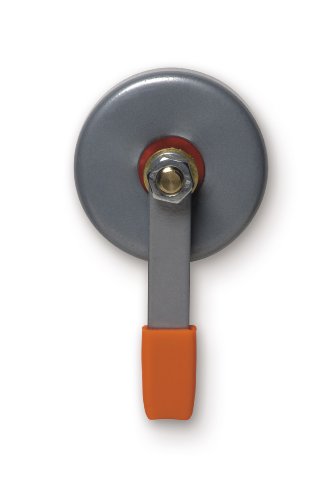
Allows you to ground your work piece with ease.
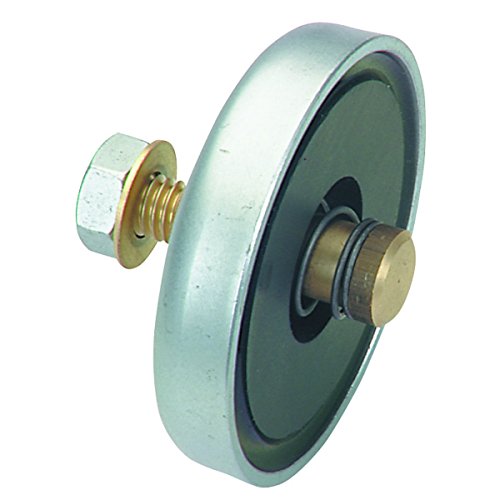
No matter where you’re welding, you can ground your weld fast with this handy magnetic welding block. A high powered magnetic base sticks to ferrous metal, making it perfect for pipe and pieces that are difficult to clamp.

Streamlined Magnetic Welding Ground Setup:Easily set your magnetic welding ground point without delays. Improve workflow and welding speed with this quick-to-place welder ground clamp on any metal surface
Key Tools for Vertical Welding
- Welding power source and leads: Use a machine that supports the selected process, polarity, electrode, wire, and output range.
- Electrode holder or welding gun: Inspect insulation, connections, contact tips, liners, nozzles, and strain relief.
- Work clamp: Attach it to clean metal as close to the weld area as practical.
- Clamps and magnets: Hold fit-up and stop the parts from shifting as they heat.
- Cleaning tools: Use a dedicated wire brush, chipping hammer for slag, files, and an angle grinder when needed. Follow safe procedures when you use an angle grinder.
- Measuring and inspection tools: Keep a square, straightedge, gap gauge, fillet gauge, flashlight, and marker nearby.
- Ventilation and fire-control equipment: Use local exhaust or suitable ventilation, welding screens, and the required extinguisher or fire-watch equipment.
Essential Materials Required
| Material | Purpose | What to Check |
|---|---|---|
| Electrode, solid wire, flux-cored wire, or filler rod | Provides filler metal and, for some processes, shielding or slag | Classification, diameter, base-metal compatibility, position, polarity, shielding gas, and storage requirements |
| Shielding gas, when required | Protects the arc and molten pool from the atmosphere | Correct gas and flow range, leak-free connections, and protection from drafts |
| Clean base metal and practice coupons | Creates a stable test setup before the final joint | Same alloy, thickness, joint type, and position as the actual work when possible |
| Personal protective equipment | Protects against arc rays, sparks, hot metal, fumes, and noise | Condition, fit, coverage, lens shade, flame resistance, and task suitability |
Safety Equipment Necessities
Wear a welding helmet with a suitable filter shade, safety glasses with side protection, welding gloves, flame-resistant long sleeves and pants, and sturdy leather boots. Clothing should cover exposed skin and should not have open pockets, cuffs, or synthetic layers that can melt. Wearing flame-resistant welding clothing helps reduce injuries from sparks, slag, and radiant heat.
Use hearing protection when grinding, chipping, or welding in a noisy area. Use respiratory protection only as part of a proper program when ventilation and other controls do not adequately control exposure.
Prepare Your Workspace for Successful Vertical Welding
Set up the work area before you energize the machine. Position the joint so you can see the puddle, brace your hands or arms without touching hot or live parts, and complete a dry run from start to finish.
Proper Ventilation Setup
Place local exhaust close enough to capture fumes without pulling shielding gas away from the arc. Keep your head out of the plume. General room airflow may not be enough in a small room, a partitioned area, indoors on galvanized metal, or in a confined space. OSHA’s welding ventilation requirements call for mechanical or local exhaust controls in several of these conditions.
Remove coatings when the job specification allows it and identify the metal before heating it. Galvanized coatings produce zinc-containing fumes, and stainless steel can create chromium-containing fumes. Follow the safety data sheets, exposure-control plan, and applicable workplace rules. Read the specific precautions before welding galvanized steel.
Warning: Never use oxygen for ventilation. Do not weld in a confined space without the required hazard assessment, ventilation, atmospheric controls, attendant, rescue provisions, and permit procedures.
Organize Your Tools and Control Fire Hazards
Clear combustible material from the welding area or protect it with suitable fire-resistant guards. OSHA requires added precautions and a fire watch in specified conditions, including appreciable combustibles within 35 feet of the work. A required fire watch must have suitable equipment, know how to raise an alarm, and remain after hot work long enough to detect smoldering fire.
Keep cables and hoses away from walkways, sharp edges, hot metal, and the weld path. Check the machine, holder, gun, cables, connectors, cylinder restraint, regulator, and work lead. Keep an extinguisher nearby only when you are trained and the fire can be safely handled.
Ensure Safety Equipment and Protect Other People
- Inspect PPE: Replace cracked lenses, torn gloves, damaged clothing, and worn footwear.
- Install screens: Protect nearby people from arc rays while leaving enough space for airflow.
- Mark hot metal: Do not leave a freshly welded part where someone can touch or move it unknowingly.
- Check electrical safety: Keep gloves and the work area dry, inspect insulation, and make sure the welding-machine frame and connections meet the manufacturer’s instructions and applicable rules.
- Protect against falls: Use approved fall protection when the vertical joint is on a platform, scaffold, ladder area, or elevated structure.
Pick the Best Welding Method for Your Vertical Joints
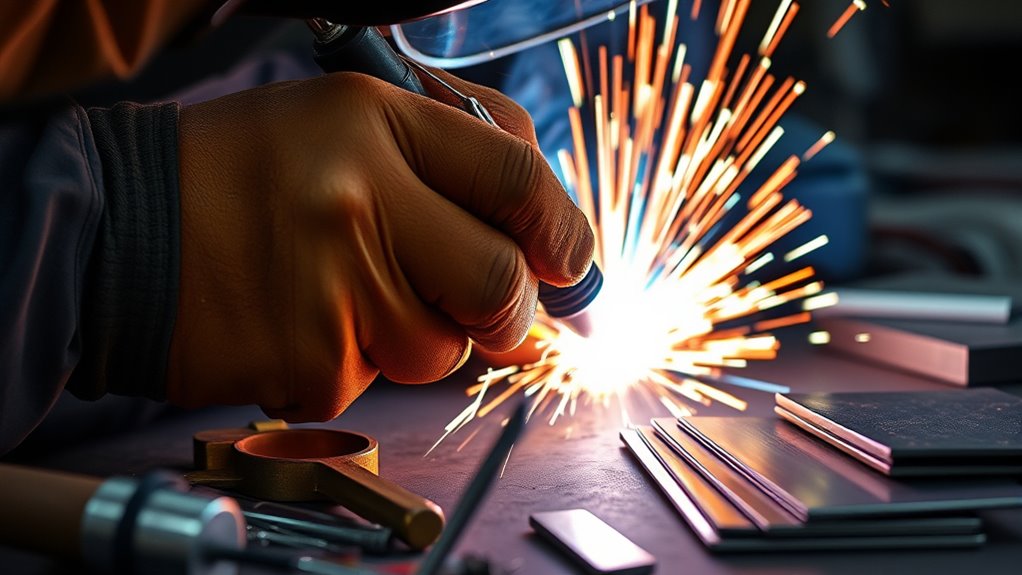
The best process depends on the base metal, thickness, joint design, access, environment, required productivity, and the governing welding procedure. Do not choose only by which machine is easiest to use.
| Process | Why It Works Vertically | Main Limit |
|---|---|---|
| SMAW or stick | Portable, useful outdoors, and offers electrodes with different puddle and penetration characteristics | Slag must be controlled and removed between passes; electrode choice and storage matter |
| GMAW or MIG | Continuous wire and good visibility; short-circuit transfer can be used in all positions | Sensitive to dirty metal, drafts, wrong voltage-to-wire-speed balance, and excessive stick-out |
| FCAW or flux-core | Good deposition and out-of-position options when the wire classification permits vertical welding | Slag, fumes, wire-specific polarity, shielding requirements, and stick-out must be managed |
| GTAW or TIG | Precise heat and filler control for clean, high-quality work | Slow, sensitive to contamination and drafts, and demanding on hand control |
For MIG and flux-core welding, do not lower voltage and wire feed speed blindly. Use the door chart, filler-metal data sheet, or approved procedure as the starting point, then adjust one variable at a time. Voltage mainly affects arc length and bead profile, while wire feed speed strongly affects current in constant-voltage MIG systems. Correct flux-core stick-out and gun technique also help keep the arc stable.
Products Worth Considering
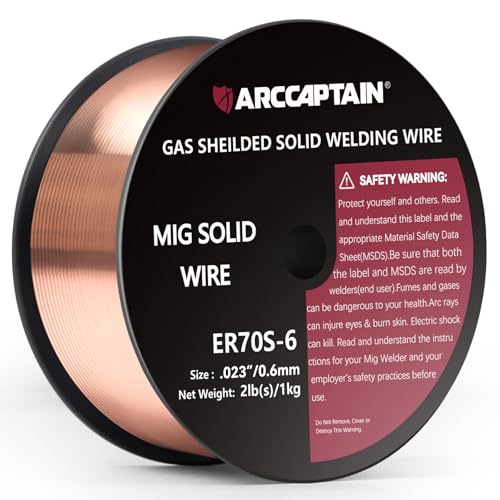
High-quality: ARCCAPTAIN's ER70S-6 mig welding wire .023" meets industry standards(Net Weight: 2lbs), ensuring consistent performance, superior strength. With its smooth feeding and stable welding parameters, you can achieve optimal penetration, high deposition rates, and exceptional overall welding performance.

High-quality: ARCCAPTAIN's ER70S-6 mig welding wire .030" meets industry standards(Net Weight: 10lbs), ensuring consistent performance, superior strength. With its smooth feeding and stable welding parameters, you can achieve optimal penetration, high deposition rates, and exceptional overall welding performance.

Commonly used for general shop applications with poor fit-up
Step-by-Step Guide to Vertical Welding Techniques
Use this sequence for a practice vertical-up joint. The exact bevel, root opening, filler metal, polarity, preheat, interpass temperature, and pass sequence must come from the drawing, manufacturer, or welding procedure when those controls apply.
- Identify the base metal and coating: Confirm what you are welding and remove oil, moisture, paint, rust, and scale from the weld zone.
- Prepare the joint: Make the bevel, root face, root opening, and fit-up match the required joint design. Do not guess on structural or pressure work.
- Clamp and tack: Hold alignment securely. Place sound tacks where they can be fused into the weld or remove and repair them as the procedure requires.
- Select the process and filler: Check classification, diameter, position, polarity, shielding gas, and storage instructions.
- Set the machine: Start from the machine chart, consumable data sheet, or WPS. Run a test bead on matching scrap and tune in small steps.
- Plan your body position: Complete a dry run. Support your hands, keep the puddle visible, and make sure cables cannot pull the gun or holder.
- Start a small puddle: Establish fusion at the root or both toes before moving upward.
- Hold the process-specific angle: Do not use one universal 10- to 15-degree angle. For vertical-up stick welding, a small push angle may be used; wire-process gun angles depend on the wire and procedure.
- Keep a tight arc or correct stick-out: A long arc or excessive stick-out reduces control and can increase spatter, porosity, and undercut.
- Pause at the toes: Hold briefly at each joint face, cross the center smoothly, and avoid dwelling in the middle.
- Keep the weave narrow: Use a stringer or small zig-zag, triangle, reverse-V, or step pattern only when it improves tie-in. Do not make a wide decorative weave.
- Fill the crater and stop safely: Finish the end of the bead without leaving a deep crater. Mark the part as hot.
- Clean and inspect: Remove slag between passes and check bead profile, toe fusion, undercut, overlap, cracks, porosity, and trapped slag.
Pro Tip: Practice on a coupon made from the same alloy and thickness, in the same vertical direction, with the same joint and consumable. A flat test bead will not show whether your vertical settings and movement are under control.
Process-Specific Vertical Welding Techniques
Vertical Stick Welding
For SMAW, keep the arc tight. Miller recommends an arc length near the diameter of the electrode core as a starting point and a 0- to 15-degree push angle for vertical-up work. On thinner material, a stringer bead may be enough. On thicker joints, use a narrow weave, pause at the sides, and keep the arc in the leading part of the puddle.
E6010: This cellulosic electrode has a forceful, deep-penetrating arc and a puddle that freezes quickly. It can be used for vertical-up or vertical-down techniques when the product, machine, and procedure permit it. Many E6010 products specify DCEP.
E7018: This is a low-hydrogen electrode, not a fast-freezing cellulosic rod. Use a smooth arc and controlled weave rather than a long whip. Keep low-hydrogen electrodes dry and follow the manufacturer’s exposure, storage, and redrying limits. Many E7018 product data sheets exclude vertical-down welding.
Use a reliable stick welding amperage chart only as a starting reference. The electrode brand, diameter, polarity, joint, and position still control the correct working range.
Vertical MIG Welding
Short-circuit transfer can be used in all positions and is common for thinner material. Pulsed MIG may also support out-of-position work when the machine, filler metal, gas, and procedure are designed for it. Conventional spray transfer creates a fluid, high-energy puddle and should not be assumed suitable for vertical work.
- Keep contact-tip-to-work distance consistent.
- Use the recommended shielding gas and protect the arc from drafts.
- For vertical up, pause at the toes and cross the center without building a large shelf.
- For approved vertical down on thin steel, keep the arc at the leading edge and travel fast enough to avoid outrunning fusion.
- Balance voltage and wire feed speed instead of reducing both by an arbitrary percentage.
Vertical Flux-Core Welding
Check the wire classification before using it out of position. Some wires are limited to flat and horizontal welding. Polarity, shielding gas, contact-tip-to-work distance, and travel angle are wire-specific, so follow the manufacturer’s data sheet.
For vertical up, Miller describes a slight weave and a small gun-angle drop from perpendicular for its mild-steel flux-core guidance. Keep the slag behind the arc and pause at the joint faces. Clean every pass fully before adding the next bead.
Vertical TIG Welding
TIG gives you direct control of the arc and filler, but it demands clean metal and steady coordination. Keep the arc short, add small amounts of filler at the leading edge, and move before the puddle becomes too wide. Protect the shielding gas from drafts and keep the tungsten clean. Use pulse, a smaller filler rod, or a sequence of short controlled additions only when the material and procedure support it.
Overcoming Common Vertical Welding Challenges
Most vertical-welding problems come from a puddle that is too large, poor access, incorrect settings, or weak tie-in at the toes. Watch the edges of the puddle more than the center.
Control Heat Without Losing Fusion
Do not treat “lower heat” as a complete setting. If the puddle sags, first check arc length or stick-out, travel speed, electrode or wire size, and weave width. Reduce output in small steps only after those items are under control. If the bead sits on the surface or the toes do not melt in, you may be traveling too fast, using too little energy, or aiming at the puddle instead of the base metal.
Use Stringers or a Controlled Weave
A straight stringer bead is often best on thinner material and narrow joints. When a weave is needed, keep it small. Miller’s stick-welding guidance recommends limiting side-to-side movement to about twice the electrode-core diameter, then using multiple passes when more width is required. Pause at both sides and move steadily across the middle.
Clean Between Passes and Handle Restarts
Remove slag, silicon islands, spatter, and loose oxide before the next pass. Grind defective tacks, starts, stops, or trapped slag back to sound metal when required. Stagger starts and stops on multi-pass work instead of stacking every restart in one place.
Inspect Before Calling the Weld Finished
Look for cracks, incomplete crater fill, undercut, overlap, porosity, slag inclusions, irregular width, and missed sidewall fusion. Confirm the bead size and contour with a gauge when dimensions matter. Visual appearance alone cannot prove internal fusion, so critical work may require additional inspection under the governing code or procedure.
Good joint preparation and adequate welder output help, but machine size does not replace correct procedure, fit-up, or technique.
Troubleshooting Vertical Welding Techniques
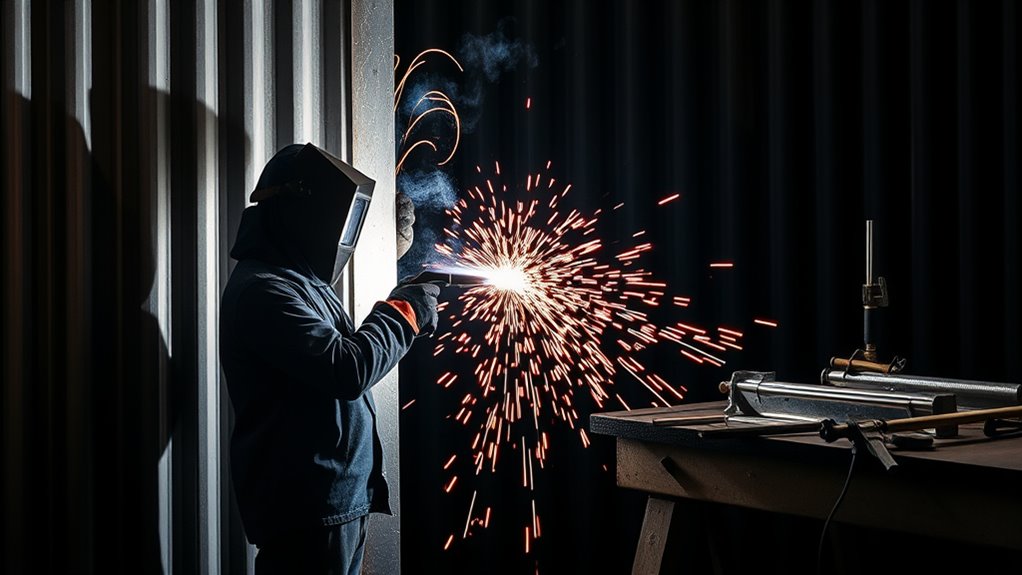
Read the puddle while you weld, then use the finished bead to confirm the cause. Change one item at a time so you know what fixed the problem.
| Problem | Likely Causes | What to Change |
|---|---|---|
| Sagging or dripping | Puddle too large, long arc, excessive stick-out, wide weave, too much output, or travel too slow | Tighten the arc, correct stick-out, narrow the weave, move slightly faster, use a smaller consumable, or reduce output in small steps |
| Undercut | Excessive voltage or arc length, fast travel, wrong angle, or no pause at the toes | Shorten the arc, correct the angle, reduce travel slightly, and pause briefly at each toe |
| Lack of fusion or cold lap | Travel too fast or too slow, output too low, poor cleaning, bad joint prep, or arc aimed into the puddle | Aim at the joint faces, correct travel, clean to sound metal, improve fit-up, and raise output only as needed |
| Excess spatter | Long arc, incorrect voltage-to-wire-speed balance, wrong polarity, contamination, poor gas coverage, or worn consumables | Verify polarity and gas, clean the joint, correct arc length or stick-out, and tune the machine from the recommended starting range |
| Slag inclusions | Slag running ahead, poor toe angle, wide weave, low heat at the sidewall, or incomplete cleaning | Keep slag behind the arc, tighten the pattern, pause at the toes, and clean every pass completely |
| Porosity | Oil, rust, moisture, damp electrodes, drafts, gas leaks, blocked nozzle, or excessive stick-out | Clean and dry the joint, protect gas coverage, repair leaks, clean the nozzle, and replace or properly condition consumables |
| Burn-through | Material too thin for the settings, large root gap, slow travel, or excessive heat input | Improve fit-up, reduce output, increase travel, use a smaller consumable, or use an approved vertical-down or stitch technique for thin material |
Frequently Asked Questions
What is the best way to do a vertical weld?
Clean and clamp the joint, follow the correct procedure and filler-metal data, practice on matching scrap, and keep a small puddle. For vertical up, pause at the toes and cross the center without dwelling. Inspect and clean each pass before continuing.
What is the vertical position of welding?
The weld axis runs mostly up and down. A vertical groove-weld test position is commonly called 3G, and a vertical fillet-weld test position is commonly called 3F. The weld may travel upward or downward if the process and procedure allow it.
When welding vertically, do you start from the top or bottom?
Start at the bottom for vertical-up welding, which is commonly used on thicker material and work that needs stronger tie-in. Start at the top only for an approved vertical-down technique, often used on thinner material where lower penetration is acceptable.
What is the hardest position to weld in?
Many welders find overhead welding harder because the puddle and sparks are directly above them. Vertical welding is also demanding because gravity pulls the puddle downward. Difficulty depends on the process, joint, access, material, and the welder’s training.
Why does my vertical weld sag?
The puddle is probably too large. Common causes include a long arc, excessive stick-out, wide weave, slow travel, a large electrode or wire, or too much output. Correct those items one at a time and keep the puddle small.
Should I weave or use stringer beads for vertical welding?
Use a stringer when it gives full fusion and the correct bead size. Use a narrow weave only when you need extra width or sidewall control. Wide weaves hold more molten metal, increase heat input, and make slag control harder.
Can E7018 be welded vertical down?
Do not assume it can. Many common E7018 products are recommended for all positions except vertical down. Check the exact manufacturer’s data sheet and the welding procedure. E7018 is normally used vertical up when vertical welding is required.
How do I know whether a vertical weld is strong enough?
Check the specified weld size, profile, toe fusion, and visible defects. A smooth surface does not prove internal fusion or strength. Critical joints may require a qualified procedure, welder qualification, and nondestructive or destructive testing.
Conclusion
Strong vertical welding comes from matching the process and direction to the joint, then controlling puddle size from start to finish. Clean the metal, secure the fit-up, use the approved filler and polarity, follow the recommended setting range, and focus on both toes of the weld. Practice on matching scrap before important work, and stop when safety, material identity, procedure, or inspection requirements are uncertain.
Sources
- OSHA 29 CFR 1910.252, General Requirements — fire prevention, eye protection, ventilation, coated metals, confined spaces, and hot-metal warnings
- OSHA 29 CFR 1910.254, Arc Welding and Cutting — arc-welding equipment, installation, grounding, operation, and maintenance
- Miller, Basic Welding Positions — vertical-up and vertical-down direction and process suitability
- Miller, Five Steps to Improving Stick Welding Technique — arc length, vertical-up angle, travel speed, and weave width
- Miller, Flux-Cored Welding Basics — vertical-up and vertical-down flux-core guidance
- Lincoln Electric, Storing and Redrying Electrodes — low-hydrogen electrode handling and storage