A muffler-to-pipe weld has to survive heat cycles, vibration, moisture, and road impact. The repair starts before you strike an arc: confirm that the surrounding metal is still solid, identify the material, support the vehicle correctly, and create a close-fitting joint. This guide walks you through the full process, including MIG setup, burn-through prevention, leak testing, troubleshooting, and final corrosion protection.
Quick Answer
To weld a muffler to an exhaust pipe, identify the metal, clean both pieces to bright metal, align the joint, tack it in four places, and use short MIG welds with settings matched to the measured thickness. Let each weld cool, then inspect and leak-test the joint outdoors before applying any sealant or coating.
Key Takeaways
- Replace metal that flakes, crumbles, or stays paper-thin after cleaning.
- Keep thin exhaust-tube edges square and tightly fitted instead of grinding away thickness with a deep bevel.
- For mild steel, .023- or .024-inch ER70S-6 wire and 75/25 argon-carbon dioxide are practical starting choices.
- Use short tacks and skip around the joint so one area does not absorb all the heat.
- Correct weld defects before using paste or sealant, and never seal a factory muffler drain hole.
At a Glance
| Time Required | About 1 to 3 hours, depending on access, corrosion, fit-up, and whether the exhaust must be removed |
| Difficulty | Intermediate; overhead thin-metal welding is not a good first practice project |
| Tools Needed | MIG welder, suitable wire and gas, grinder, clamps, measuring tools, work light, inspection mirror, rated vehicle supports, fire extinguisher, and welding PPE |
| Cost | Low to moderate if you already own the welding equipment; replacement parts, gas, consumables, and professional labor vary |
What’s in This Article
- Before You Weld a Muffler
- What You’ll Need to Weld a Muffler
- Choose the Right Process, Wire, and Gas
- How to Prep a Muffler and Exhaust Pipe
- Best Tools for Muffler Welding
- How to Weld a Muffler in Tight Spaces
- Steps to Weld a Muffler to an Exhaust Pipe
- How to Prevent Burn-Through on Thin Exhaust Metal
- Muffler Weld Troubleshooting
- How to Test Muffler Welds for Leaks
- How to Seal and Protect Exhaust Welds
- When to Replace Instead of Weld
- Common Muffler Welding Mistakes to Avoid
- Frequently Asked Questions
- Conclusion
- Sources
Before You Weld a Muffler
Inspect the complete repair area before choosing welding. Remove loose scale and probe the surrounding pipe gently. If cleaning exposes several holes, a long paper-thin section, cracking around a hanger, or a crumbling muffler shell, replace the damaged component instead of chasing the rust with weld metal.
Confirm that the replacement muffler has the correct inlet diameter, outlet diameter, flow direction, rotation, and hanger position. A direct-fit muffler may use factory-style clamps and may not require welding. Walker also recommends checking the condition of adjoining parts, the muffler’s inlet and outlet orientation, and its clearance from the vehicle body before final installation.
Identify the base metal before selecting wire. Mild or aluminized steel, 304 stainless steel, 316 stainless steel, and mixed stainless-to-mild-steel joints require different filler choices. A magnet, manufacturer documentation, markings, and the appearance of a freshly ground area can provide clues, but do not guess when the material is part of an expensive stainless system.
Warning: Never work beneath a vehicle supported only by a hydraulic jack. Use rated ramps, a locked vehicle lift, or jack stands positioned at approved lifting points, then chock the wheels. Stop if you smell fuel or find a leaking fuel line, damaged brake line, exposed high-voltage cable, oily undercoating, or another material that sparks could ignite.
Follow the vehicle maker’s service information before welding on an installed exhaust. Welding-equipment manuals commonly advise disconnecting the battery cables and placing the work clamp close to the weld to reduce long electrical paths through vehicle components. Hybrid and electric vehicles can require additional high-voltage isolation steps that should only be performed by trained personnel.
Move or shield wiring, hoses, plastic clips, fuel lines, brake lines, insulation, and underbody coatings near the work. Keep a suitable fire extinguisher within reach. OSHA hot-work guidance requires fire hazards to be removed or protected and calls for continued fire monitoring when hidden or nearby combustibles could smolder after welding.
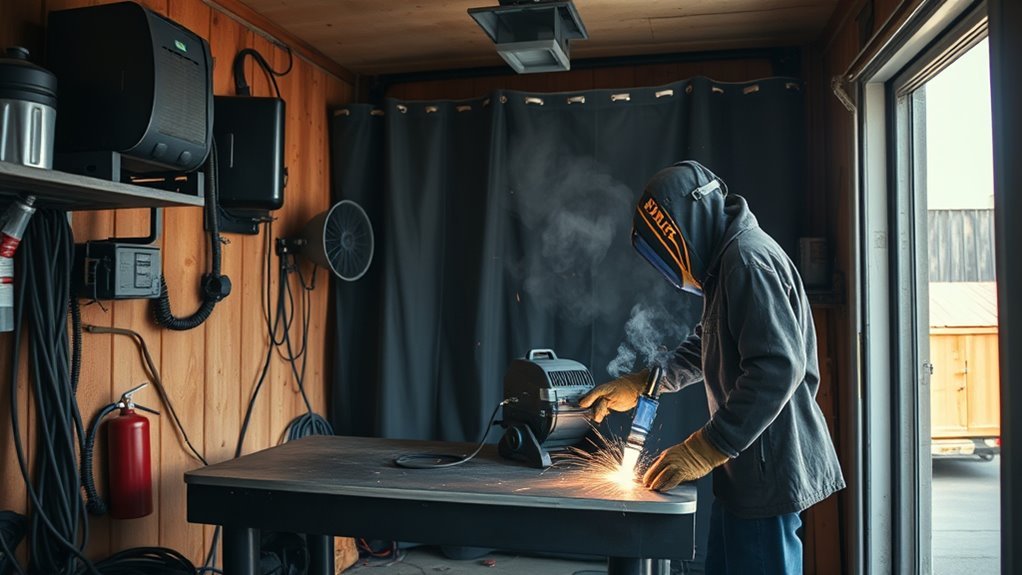
Provide cross-ventilation or local fume extraction without blowing shielding gas away from the arc. Do not run the vehicle in an attached garage, even with the main door open. The CDC warns that a small exhaust leak can allow carbon monoxide to build up inside a vehicle or enclosed space.
What You’ll Need to Weld a Muffler
Set up the complete work area before you crawl under the vehicle or remove the exhaust section. Proper preparation reduces repeated trips, rushed decisions, and alignment errors.
- Compact MIG welder that supports gas-shielded short-circuit welding on light-gauge steel
- .023- or .024-inch ER70S-6 solid wire for typical mild-steel exhaust tubing
- 75% argon and 25% carbon dioxide shielding gas for mild-steel MIG welding
- Material-matched stainless wire and approved shielding gas when welding stainless parts
- Grinder, clean abrasive disc, file, deburring tool, and wire brushes
- Dedicated stainless-steel brush and abrasives when working on stainless
- Caliper, sheet-metal gauge, marker, straightedge, and tape measure
- Exhaust stands, locking pliers, Vise-Grip-style clamps, or welding clamps
- Correctly sized sleeve or connector when the joint design requires overlap
- Bright work light and inspection mirror
- Automotive smoke machine or another controlled exhaust-leak tester
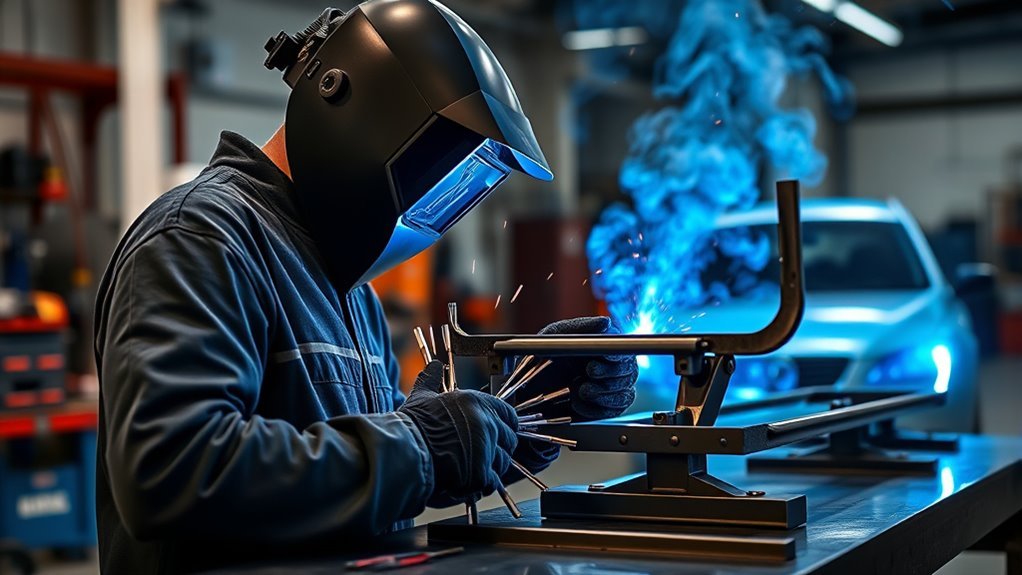
- Welding helmet, safety glasses, leather gloves, flame-resistant clothing, and hearing protection
- Rated vehicle supports, wheel chocks, welding blanket, and suitable fire extinguisher
- Exhaust-rated sealant and high-temperature coating only when suitable for the material and location
For mild steel, Miller recommends small-diameter wire for light-gauge automotive work and lists 75/25 argon-carbon dioxide as a practical all-around shielding gas. Use the chart inside your welder as the starting point because settings change with thickness, wire diameter, joint style, welding position, and gas.
Choose the Right Process, Wire, and Gas
MIG welding is the most practical process for many mild-steel muffler repairs because short-circuit transfer offers good control and lets you make brief tacks around a thin joint. TIG can produce excellent results on a removed stainless section, but it is slower and harder to control overhead. Stick welding normally puts too much heat into ordinary muffler tubing.
| Joint Material | Practical Filler Choice | Important Notes |
|---|---|---|
| Mild steel to mild steel | .023- or .024-inch ER70S-6 solid wire | Use DCEP polarity and 75/25 argon-carbon dioxide unless the wire or welder maker specifies otherwise. |
| 304 or 304L stainless to the same material | ER308L or ER308LSi | Use dedicated stainless tools and a shielding gas approved for the wire and transfer mode. |
| 316 or 316L stainless to the same material | ER316L or the filler specified by the component maker | Do not substitute mild-steel wire if corrosion resistance matters. |
| Stainless steel to mild steel | ER309L or ER309LSi is commonly used | The mild-steel side will still remain the more corrosion-prone part of the joint. |
| Unknown or heavily coated material | Identify the material before welding | Coatings can contaminate the weld and create hazardous fumes when heated. |
For more detail on stainless consumables and contamination control, review this guide to MIG welding 304 stainless steel. Do not use a carbon-steel brush or abrasive that has already touched mild steel on a stainless exhaust.
A small multi-process machine can be convenient, but the number of modes does not prove that it will weld thin exhaust tubing well. Check whether the machine supports gas-shielded MIG, small wire, stable low-end output, and compatible consumables rather than relying only on a claim such as three welding modes.
Note: Self-shielded flux-core wire handles outdoor wind better than gas-shielded MIG, but it usually creates more heat, spatter, and cleanup. It is not the easiest choice for very thin muffler tubing.
Products Worth Considering

High-quality: ARCCAPTAIN's ER70S-6 mig welding wire .030" meets industry standards(Net Weight: 10lbs), ensuring consistent performance, superior strength. With its smooth feeding and stable welding parameters, you can achieve optimal penetration, high deposition rates, and exceptional overall welding performance.

ER308L WIRE: A low-carbon stainless steel wire engineered to minimize intergranular carbide precipitation. This enhances corrosion resistance without the need for stabilizers, making it ideal for critical applications.

E71T-GS FLUX CORE WIRE: This self-shielding, AWS E71T-GS flux-cored wire excels due to its advanced core design, delivering exceptional arc stabilization and high feedability for effortless welding. The core also incorporates powerful deoxidizing agents, ensuring clean, reliable welds even when welding through light rust or mill scale.
How to Prep a Muffler and Exhaust Pipe
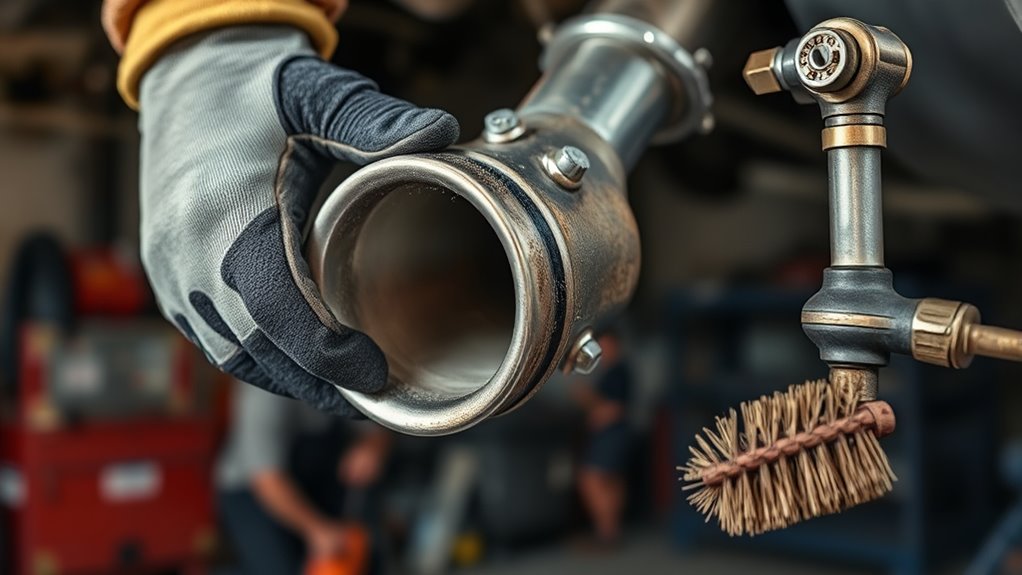
Start by cleaning the muffler neck and pipe beyond the full weld area. Remove rust, paint, oil, road salt, exhaust residue, metallic coating, and old sealant until the arc will reach bright, solid base metal. Also clean the exact spot where the work clamp will connect.
Trim damaged ends back to metal that keeps its shape when lightly pressed or scraped. Cut thin tubing square, then deburr the inside and outside. A deep bevel removes the edge thickness you need to resist burn-through. Only thicker replacement parts that need additional root penetration should receive a controlled bevel.
On thin exhaust tubing, clean metal, a square edge, and close fit-up matter more than an aggressive bevel.
Choose the joint style before cutting:
- Slip-fit or lap joint: One pipe fits over the other or over a correctly sized sleeve. This joint is easier to align and gives you more metal under the weld area.
- Butt joint: The pipe ends meet edge to edge. Keep the gap small and even because wide gaps invite burn-through.
- Sleeved butt repair: A short internal or external sleeve supports thin edges when the system design and clearances allow it.
Dry-fit the complete exhaust before tacking. Confirm muffler inlet and outlet orientation, tailpipe position, hanger alignment, axle and suspension clearance, and space around the vehicle floor. Do not force the pipe into position and expect the weld to hold the stress.
Mark the pipe and muffler with alignment lines across the joint. If hangers or brackets block torch access, loosen or remove the exhaust section rather than welding blind. Use dedicated stainless brushes and clean abrasives for stainless components.
Best Tools for Muffler Welding
A compact MIG gun with a clean, correctly sized nozzle is usually easier to position around an exhaust than a bulky gun. An angled or flexible torch neck can help, but use only parts approved for the gun and current level. No single neck angle works for every vehicle.
Keep these access and control tools nearby:
- A bright, low-profile work light that does not sit in the spark path
- An inspection mirror for viewing the top and rear of the seam
- Locking clamps that hold alignment without covering the weld
- A welding blanket or metal shield for nearby hoses, wiring, and undercoating
- A clean copper welding spoon or backing bar when the back of the joint is reachable
- A caliper or sheet-metal gauge for selecting the machine-chart setting
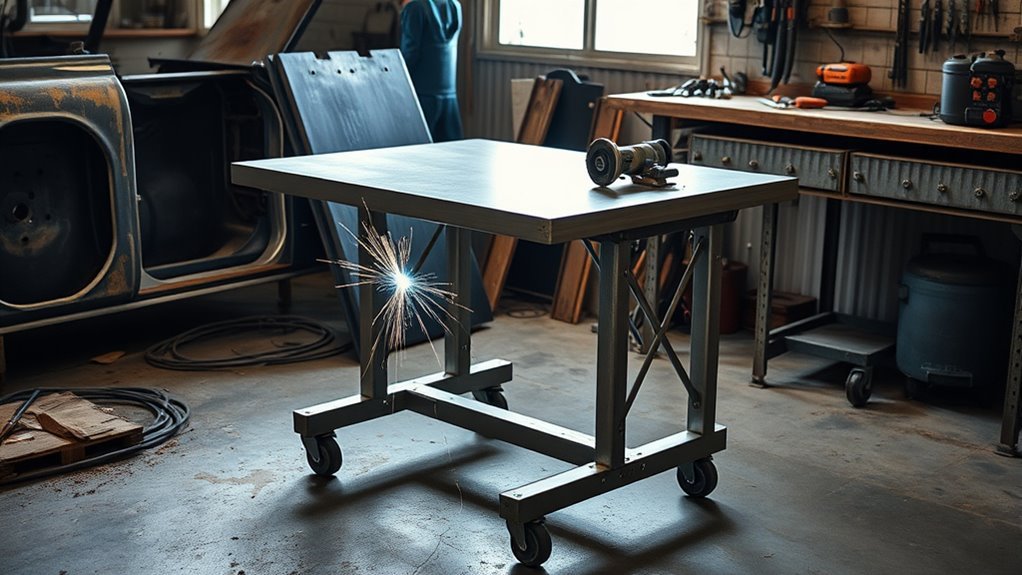
- An exhaust stand so the system cannot swing after the first tack
The welding return connection is commonly called a ground clamp, but its job is to complete the welding circuit. Clamp it to clean metal on the exhaust part or another approved point as close to the repair as practical. Do not let the welding current find a path through bearings, hinges, wiring, or electronic components.
Inspect the contact tip, liner, nozzle, cable, and work lead before welding. Irregular wire feeding makes thin-metal control much harder and can turn a correct setting into repeated stubbing or burn-through.
Products Worth Considering

Direct replacement for Miller Millermatic M-25 Mig Welding Gun Torch Stinger 15ft 250 Amp,Replace Miller Part # 169598

160Amp MIG welding gun, with an 8.2FT (2.5M) overall length, is engineered as a direct replacement for TOOLIOM TL-MIG-180-PRO MIG Welder

A brand new 150Amp 10ft Replacement Mig gun for YESWELDER MIG-205DS Welder.
How to Weld a Muffler in Tight Spaces
Do not treat poor access as a normal part of the job. You need to see the seam, hold a consistent contact-tip distance, and move without touching fuel lines, brake lines, wiring, insulation, or the vehicle floor.
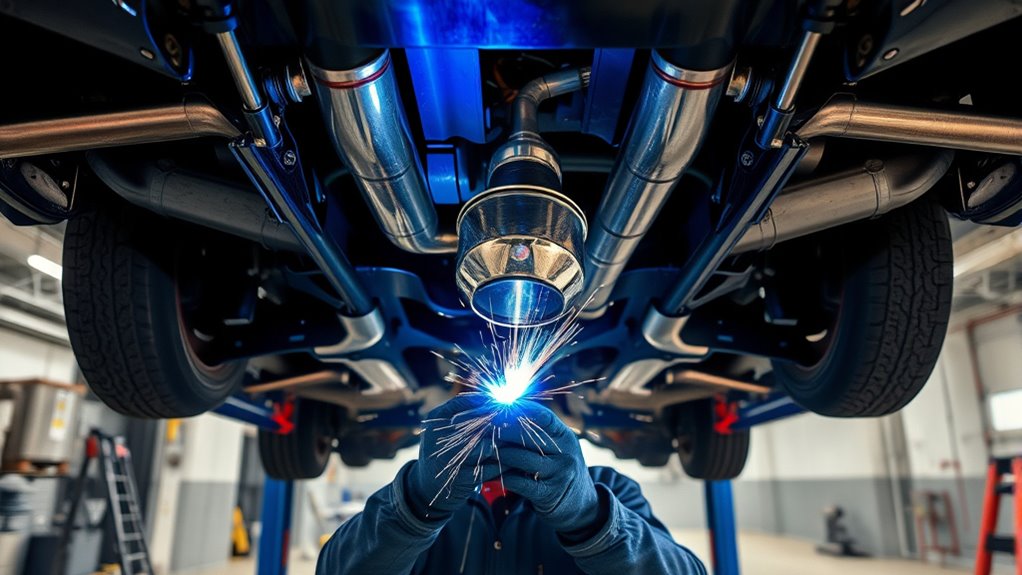
If the upper half of the joint is hidden, support the system and lower or remove the affected section. A bench-level weld is usually easier to inspect, less likely to burn nearby components, and safer than welding overhead while relying on a mirror alone.
Accessing Hard-to-Reach Welds
Mock up the complete system and mark its installed rotation before removing it. This prevents you from making a neat bench weld that points the muffler, tailpipe, or hangers in the wrong direction.
- Photograph the original hanger and pipe positions before disassembly.
- Mark the muffler body and pipe with matching alignment lines.
- Check that clamps can be removed after tacking.
- Leave enough room to inspect the full circumference of the joint.
- Move heat-sensitive parts or install a suitable shield before welding.
When only a small section is inaccessible, tack the visible positions first, remove the assembly without breaking alignment, and complete the seam on the bench.
Tools for Tight Welding
A smaller compatible nozzle, approved angled torch neck, inspection mirror, and slim locking clamps can improve access. Keep the wire stickout consistent and avoid extending it excessively just to reach the seam.
Wind can strip shielding gas from the weld pool after you remove the exhaust and work outdoors. Move to a ventilated indoor welding area or install a proper wind screen. These flux-core welding preparation tips explain the different setup, but self-shielded wire remains a difficult choice on very thin exhaust tubing.
Pro Tip: If you cannot see where the wire enters the joint, stop and change the access. A mirror can confirm alignment, but it should not replace direct control of the torch and puddle.
Steps to Weld a Muffler to an Exhaust Pipe
Estimated total time: 1 to 3 hours, depending on access, corrosion, disassembly, and fit-up.
- Inspect the repair area. Replace any pipe or muffler section that remains flaky, deeply pitted, cracked, or paper-thin after cleaning.
- Secure the vehicle and exhaust. Chock the wheels and use rated stands, ramps, or a locked lift. Support the exhaust independently so it cannot fall or rotate.
- Follow the vehicle’s electrical procedure. Review the service information, disconnect the battery or electronic modules where specified, and keep the welding return path short.
- Identify and match the material. Select mild-steel or stainless filler and the shielding gas recommended for that wire and process.
- Trim and clean the joint. Cut to solid metal, leave thin edges square, deburr them, and remove contamination from the weld and clamp areas.
- Dry-fit and align the system. Check muffler flow direction, rotation, hanger position, tailpipe location, and underbody clearance.
- Clamp the joint. Hold the seam tight and even without placing a clamp where it blocks the gun.
- Set the welder from the chart. Select the actual material thickness and wire diameter. Confirm DCEP for solid-wire MIG, then test the setting on matching scrap.
- Tack at opposite points. Place small tacks near the 12, 6, 3, and 9 o’clock positions, checking alignment after each pair.
- Complete the seam in short sections. Skip between opposite areas instead of running one continuous bead around the pipe. Let the joint cool naturally between stitches.
- Inspect and correct the weld. Look for holes, undercut, tall cold beads, cracks, pinholes, and areas where the weld did not tie into both sides.
- Test for leaks. Use a controlled smoke test with the engine off or perform a brief outdoor cold-start inspection from a safe position.
- Protect the repair. Correct defects first, then use approved sealant or high-temperature coating where suitable. Recheck for smoldering material before leaving the work area.
Warning: Do not weld near a fuel leak, open fuel-system component, oily undercoating, plastic line, damaged battery, high-voltage cable, or combustible debris. Do not modify or bypass a catalytic converter or another regulated emissions component.
How to Prevent Burn-Through on Thin Exhaust Metal
Burn-through usually starts with weak metal, a wide gap, too much heat, poor torch control, or wire that is too large for the job. Correct fit-up before trying to solve the problem with machine settings alone.
- Use .023- or .024-inch solid wire when the machine supports it.
- Use the welder’s chart for the measured thickness rather than guessing at voltage and wire speed.
- Practice on scrap of the same material, thickness, joint shape, and welding position.
- Use short-circuit transfer and brief trigger pulls instead of a long continuous bead.
- Skip to the opposite side of the pipe after each short weld.
- Keep a steady contact-tip distance and a small push angle when access allows.
- Use a clean copper backing tool behind the seam when it can be positioned safely.
- Replace edges that keep disappearing as soon as the arc reaches them.
Do not simply reduce both voltage and wire-feed speed together. Too little voltage can leave a tall bead sitting on the surface, while too little wire speed can make the arc unstable. Too much wire speed can make the wire stab into the joint. Adjust from a chart-based starting point and change one control at a time.
MIG settings are also different from stick-welding amperage settings. Do not transfer a stick amperage number to a wire-feed process.
Pro Tip: Place one small tack, move to the opposite side, and inspect the joint before continuing. If the edge starts to sag or open, stop and let it cool instead of trying to fill the growing hole immediately.
Muffler Weld Troubleshooting
| Problem | Likely Cause | Correction |
|---|---|---|
| Edge opens into a hole | Metal is too thin, the gap is too wide, or heat is concentrated in one spot | Stop, cool the joint, trim back to solid metal, improve fit-up, use smaller wire, and add a backing tool or sleeve if suitable. |
| Pinholes or porosity | Rust, oil, coating, exhaust residue, wind, blocked nozzle, or poor gas coverage | Grind out the defect, clean again, check gas flow and hoses, shield drafts, clean the nozzle, and re-weld. |
| Tall, narrow bead with poor tie-in | Voltage is too low, travel is too fast, or the arc is aimed at only one side | Return to the chart, test on scrap, and direct the arc into both edges of the seam. |
| Wire repeatedly stubs into the metal | Wire speed is too high for the voltage, stickout is inconsistent, or feeding is restricted | Balance wire speed and voltage, inspect the tip and liner, and maintain a steady gun distance. |
| Heavy spatter | Dirty metal, incorrect polarity, poor gas, excessive stickout, or unbalanced settings | Verify DCEP for solid wire, clean the joint, shorten the stickout, and confirm the gas and chart settings. |
| Crack appears after cooling | Wrong filler, excessive joint stress, contamination, or an unsupported exhaust | Remove the crack, verify the material and filler, realign the system, and repair damaged hangers before re-welding. |
| Muffler touches the body or hangs crooked | The assembly was welded before final rotation and hanger alignment were checked | Cut or release the joint as needed, realign the complete system, and tack opposite points before finishing. |
How to Test Muffler Welds for Leaks
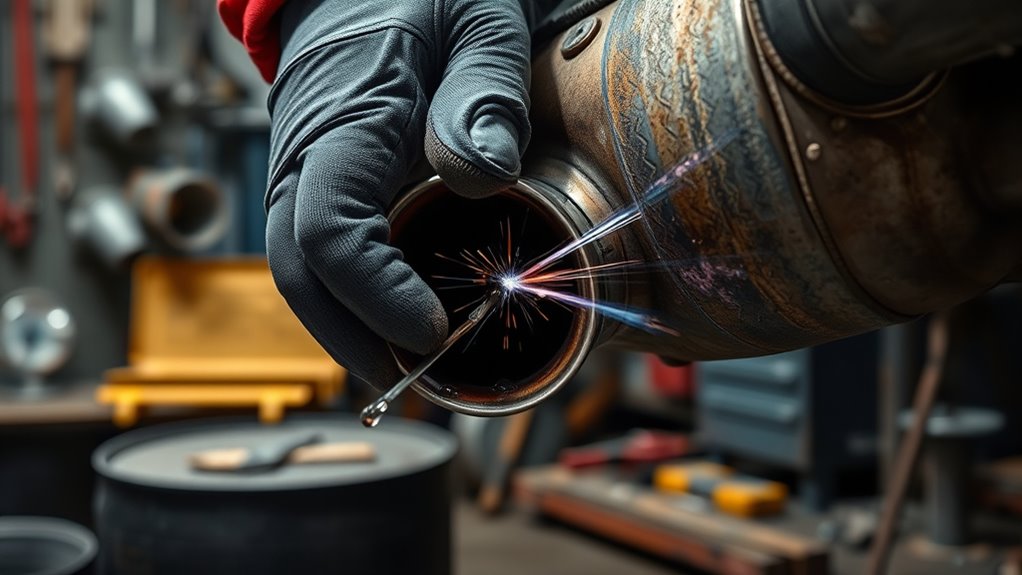
Allow the joint to cool, then inspect the entire circumference with a bright light and mirror. Look for pinholes, dark soot trails, cracks, unfilled craters, and sections where the weld sits on one edge without joining the other.
Engine-Off Smoke Test
A purpose-built automotive smoke machine provides the most controlled check. Connect it according to the tester’s instructions with the engine off and the exhaust cool. Watch the welded seam, nearby clamps, muffler seams, and adjoining joints for escaping smoke.
Do not apply uncontrolled shop-air pressure to a sealed exhaust system. Excess pressure can damage weak components or disconnect hoses and plugs.
Outdoor Engine Test
If you do not have a smoke machine, perform a brief cold-start test outdoors. Stay clear of moving parts and hot surfaces. Listen for ticking, hissing, or puffing and hold a light strip of tissue near, but not against, the joint to reveal escaping pulses.
Do not fully cover the tailpipe with your hand. Do not crawl beneath a running vehicle supported by portable stands, and do not run the engine in an attached garage. The CDC warns that even a small exhaust leak can allow carbon monoxide to accumulate inside the vehicle.
Wear proper personal protective equipment while inspecting and correcting the repair. Exhaust parts can become hot within moments of starting the engine.
Warning: Stop using the vehicle if exhaust odor enters the cabin, anyone experiences headache or dizziness, or the repaired joint continues to leak. Move to fresh air and have the complete exhaust system inspected.
How to Seal and Protect Exhaust Welds
A sound weld should not depend on paste to hold the muffler and pipe together. If inspection reveals porosity, a crack, or lack of fusion, grind the defect back to clean metal and re-weld it. Sealant should not hide a weak joint.
An exhaust-rated paste may be appropriate for a slip connection, clamp joint, or another use listed by its manufacturer. For example, J-B Weld states that its Exhaust System Sealant is intended for gaps, seams, and pipe connections and is temperature resistant to 850°F. Follow the exact preparation, set time, curing procedure, and location limits on the product label.
- Apply sealant only after the welded joint has passed visual inspection.
- Do not smear paste over active cracks, loose metal, or incomplete fusion.
- Do not block a factory muffler drain hole.
- Keep sealant and paint away from oxygen sensors, electrical connectors, flexible joints, and moving parts.
- Allow the product to cure exactly as its manufacturer directs.
After leak testing, remove loose spatter and clean the surrounding bare mild steel. Apply a high-temperature coating that is approved for exhaust use and compatible with the base metal. Several light coats usually cover edges more evenly than one heavy coat. Stainless steel may not need paint, but it still needs appropriate cleaning after welding.
Self-shielded wire, including products such as Forney 42300 flux-core wire, resists wind better than gas-shielded MIG. However, its added heat and spatter make it a poor first choice for thin muffler tubing when a controlled solid-wire process is available.
Note: Exhaust cement, epoxy, tape, and repair wrap are different products with different temperature and structural limits. Use only a product specifically approved for the exact part and repair type.
When to Replace Instead of Weld
Welding is not the right answer when the remaining metal cannot carry the load or provide a stable edge. Replace the affected component when:
- The pipe crumbles or tears while you clean it.
- Several pinholes appear around the original leak.
- The muffler shell is swollen, delaminated, or deeply rusted around its seams.
- A hanger has torn a large section from the muffler or pipe.
- The flex pipe is cracked or separating.
- The catalytic converter, oxygen-sensor bung, or another emissions component is damaged.
- The system has already received several overlapping patches.
- The correct pipe diameter, material, or safe welding access cannot be confirmed.
Use a professional exhaust shop when the repair sits close to the fuel tank, brake system, high-voltage components, plastic body panels, or hidden underbody insulation. A shop can also expand tubing, make a close-fitting sleeve, and weld a removed assembly in a controlled position.
Common Muffler Welding Mistakes to Avoid
Many muffler weld failures begin before the arc starts. Avoid these common problems:
- Welding over rust, paint, metallic coating, oil, soot, or old exhaust cement
- Beveling thin tube until the edge becomes easier to burn away
- Trying to bridge a wide, uneven butt-joint gap with weld metal
- Using ER70S-6 mild-steel wire on stainless without considering corrosion and compatibility
- Guessing at voltage and wire speed instead of using the welder’s chart
- Running one continuous bead around thin exhaust tubing
- Welding before checking muffler flow direction, rotation, hangers, and body clearance
- Placing the work clamp far from the repair or on dirty metal
- Welding blind beside wiring, fuel lines, brake lines, or undercoating
- Using paste to hide porosity or incomplete fusion
- Blocking a factory drain opening
- Testing for leaks by completely sealing the tailpipe
- Leaving the area without checking for smoldering insulation or debris
If the metal disappears during preparation or the finished assembly remains under tension, stop and replace or refit the part. More weld metal will not turn a weak foundation into a dependable repair.
Frequently Asked Questions
What type of welding is used for mufflers?
Short-circuit MIG welding is commonly used for mild-steel mufflers because it gives you good control on thin tubing. TIG is useful for clean stainless parts on a bench. Stick welding and self-shielded flux-core usually add more heat than ordinary muffler tubing can tolerate easily.
Can I weld my exhaust myself?
You can weld an exhaust if you already have thin-metal welding experience, the correct vehicle supports, good ventilation, fire protection, and clear access to the full joint. Practice on matching scrap first. Use an exhaust shop when the metal is severely rusted or the repair is close to fuel, brake, electronic, or high-voltage components.
What welding wire should I use for a muffler?
For typical mild-steel tubing, .023- or .024-inch ER70S-6 solid wire is a practical choice. For 304 stainless, use a compatible stainless filler such as ER308L. For 316 stainless, use the filler specified for 316. Stainless-to-mild-steel joints commonly use ER309L or ER309LSi.
Will J-B Weld hold up on an exhaust?
Do not treat every J-B Weld product as interchangeable. The company sells purpose-made exhaust sealants, pastes, and wraps with specific temperature and repair limits. An approved exhaust product may seal a gap or connection, but it should not be used to conceal a weak weld or replace badly rusted structural metal.
Do you need to remove the muffler before welding?
You do not always need to remove it, but removal is usually better when you cannot see or reach the upper part of the seam safely. Mark the muffler rotation and pipe alignment before removal so you can complete the weld on a bench without changing the installed position.
Can you weld a rusty muffler?
You can weld only after removing the rust and reaching metal that remains solid. If the pipe keeps flaking, new holes appear, or the muffler shell feels thin over a wide area, replace the component. Welding over rust traps contamination and usually produces porosity or another short-lived failure.
Can I use flux-core wire on an exhaust pipe?
It is possible, especially outdoors where wind disrupts shielding gas, but self-shielded flux-core generally produces more heat and spatter. That makes burn-through and cleanup harder on light-gauge exhaust tubing. Gas-shielded MIG with small solid wire is usually easier to control.
Can you weld a stainless muffler to a mild-steel pipe?
Yes, if both parts are sound and you use a dissimilar-metal filler suited to the alloys. ER309L or ER309LSi is commonly chosen for stainless-to-mild-steel joints. The mild-steel pipe will still be more likely to rust, so protect it after welding.
Should I disconnect the battery before welding an exhaust?
Follow the vehicle manufacturer’s service procedure. Many welding-equipment manuals advise disconnecting both battery cables before vehicle welding and positioning the work clamp close to the weld. Some vehicles require additional steps for control modules, backup power, hybrid systems, or high-voltage batteries.
How do I know whether the muffler weld is leak-free?
Inspect the cooled seam under bright light, then use a purpose-built automotive smoke machine with the engine off. You can also perform a brief outdoor cold-start check while listening and watching from a safe position. Do not fully block the tailpipe or run the vehicle in an attached garage.
Conclusion
A dependable muffler weld starts with solid metal, the correct filler, safe vehicle preparation, and close fit-up. Keep light-gauge edges square, support the complete exhaust, tack opposite points, and finish the seam with short welds that spread heat around the joint.
After cooling, correct every visible defect and confirm the repair with a controlled leak test. Use exhaust-rated sealant or high-temperature coating only for its approved purpose. When corrosion extends beyond a small repair area, replacing the pipe or muffler is safer and usually lasts longer than adding another patch.
Sources
- OSHA 29 CFR 1910.252: Welding, Cutting, and Brazing — ventilation, PPE, combustible control, extinguishing equipment, and fire-watch precautions
- CDC: Carbon Monoxide Poisoning Basics — vehicle exhaust leaks, garage operation, and carbon-monoxide risk
- Miller: MIG Basics for Automotive Welding Repair — wire size, shielding gas, polarity, machine settings, and automotive technique
- Miller: Successfully Welding Sheet Metal with MIG and TIG — small-wire selection and heat control on thin metal
- Walker Exhaust: Exhaust System Installation Problems — component condition, cutoff position, muffler rotation, fitment, and clearance
- J-B Weld: Exhaust System Sealant — approved sealant uses, temperature rating, set time, and curing directions