Choosing between laser welding and MIG welding for auto body repair is not just a question of which process is stronger or faster. The right choice depends on the vehicle material, the joint design, the repair location, the equipment you have, and the OEM repair procedure for that exact vehicle. Laser welding can give very clean, precise welds in controlled conditions, while MIG welding remains one of the most practical choices for many collision-repair and fabrication jobs.
Quick Answer
Laser welding is best for precise, low-distortion joints when the shop has approved equipment, strong fixturing, and trained operators. MIG welding is usually more practical for everyday auto body repairs, plug welds, patch panels, and varied material thicknesses. For structural repairs, always follow the OEM repair procedure.
Key Takeaways
- Laser welding gives a narrow weld, focused heat, and low distortion, but it needs tight fit-up, strict safety controls, and expensive equipment.
- MIG welding, also called GMAW, uses a continuous wire electrode and shielding gas, making it flexible and common in body shops.
- Laser welding is often stronger and cleaner only when the joint is designed for it and the process is controlled.
- MIG welding is easier to adapt to patches, plug welds, thicker brackets, and general repairs, but it adds more heat and spatter.
- Never replace an OEM-specified weld, rivet, adhesive, or spot weld with another process unless the vehicle maker allows it.
Laser Welding vs. MIG Welding at a Glance
| Best Use | Laser welding: precise, repeatable joints on thin panels and controlled assemblies. MIG welding: patch panels, plug welds, brackets, general fabrication, and many shop repairs. |
| Heat Control | Laser welding concentrates heat into a smaller area. MIG welding spreads more heat into the panel, so technique matters more on thin sheet metal. |
| Equipment Cost | Laser systems cost far more and need safety controls. MIG welders are cheaper, easier to service, and more common in repair shops. |
| Skill Requirement | Laser welding needs process control, joint fit-up, laser safety training, and approved procedures. MIG welding is easier to learn but still requires test welds and inspection. |
| Repair-Shop Fit | MIG is usually the more realistic choice for small and mid-size body shops. Laser welding fits specialized shops, controlled production, and approved advanced repairs. |
Warning: Auto body welding affects crash performance. Before welding any structural part, check the OEM repair manual, identify the metal, confirm allowed attachment methods, protect electronics, remove fire hazards, and make test welds on matching scrap when required.
What Is Laser Welding and How Does It Work in Auto Body Repair?
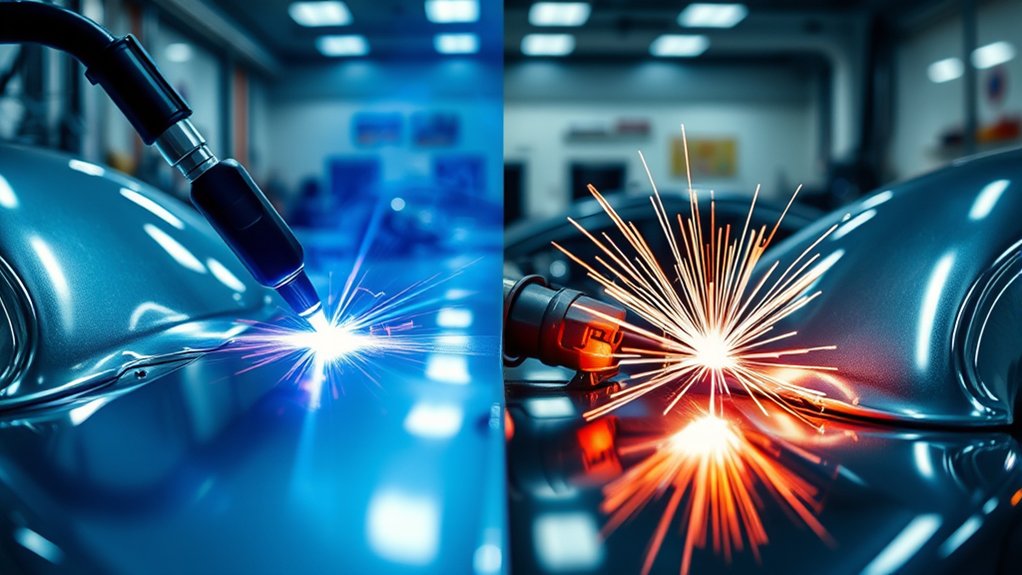
Laser welding uses a focused beam of light to melt a narrow area at the joint. Because the heat is concentrated, the weld can be small, clean, and precise. This is why laser welding is common in automotive manufacturing for roof seams, body-in-white assemblies, tailored blanks, and other repeatable joints where the parts can be clamped and aligned accurately.
In repair work, the same benefits can matter on visible panels and thin sheet metal. A well-controlled laser weld can reduce warping, shrink the heat-affected zone, and leave less cleanup than a typical arc weld. That does not mean it is automatically the best choice for every repair. Laser welding is sensitive to joint gap, surface coatings, zinc, paint, contamination, beam focus, travel speed, and shielding gas.
Many laser systems used for metal joining are high-powered industrial tools. They require controlled work areas, the correct eyewear for the wavelength, beam containment, training, and a safety plan for reflections. This is especially important around shiny sheet metal, aluminum, and stainless parts.
What Is MIG Welding in Auto Body Repair?
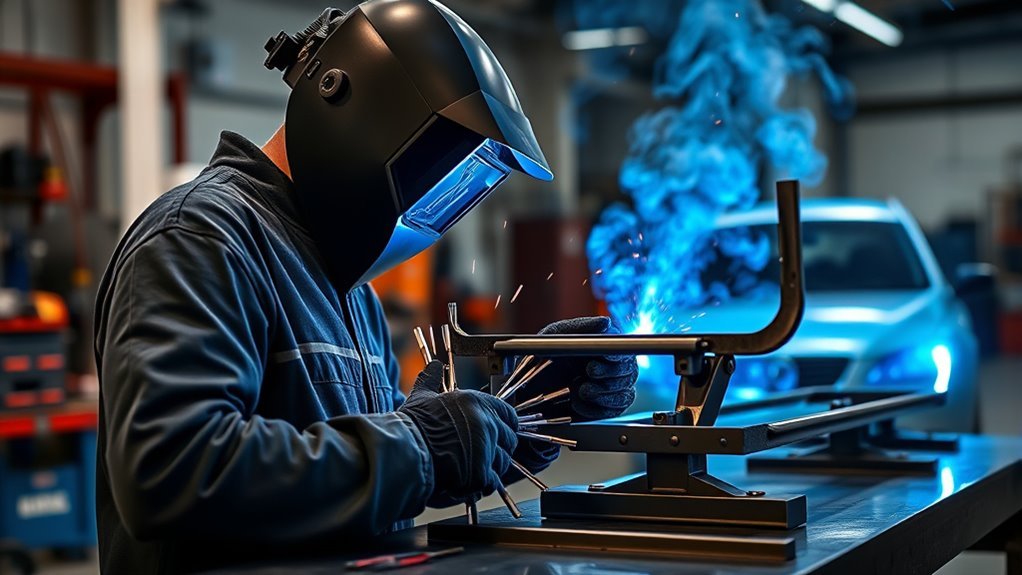
MIG welding is the common shop name for gas metal arc welding, or GMAW. It uses a continuously fed wire electrode, shielding gas, and an electric arc to melt the wire and base metal together. In auto body work, MIG is popular because the equipment is widely available, the process is flexible, and it can be used for plug welds, patches, brackets, sectioning joints, and many non-cosmetic repairs.
For thin auto body panels, MIG welding usually needs careful heat control. You may use tack welds, short stitches, cooling time between welds, correct wire size, clean metal, and the right voltage and wire-feed settings. Too much heat can warp a panel, burn through sheet metal, or damage corrosion protection behind the joint.
MIG welding can also create spatter, porosity, undercut, lack of fusion, and excess weld buildup if the setup is wrong. That is why practice coupons and destructive test welds are common before welding a repair area. A strong-looking bead is not always a strong weld.
Pro Tip: On thin panels, do not chase a long continuous MIG bead unless the procedure calls for it. Short welds, correct spacing, and cooling time help control panel distortion.
Precision and Heat Control: Laser Welding vs. MIG Welding
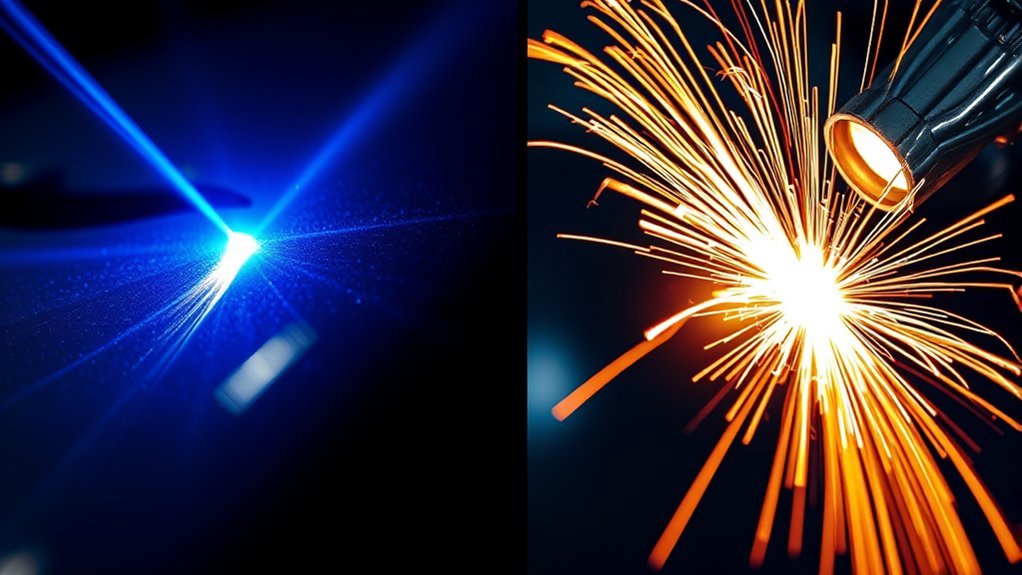
Laser welding wins on precision when the parts fit correctly. The focused beam places heat into a narrow area, so the weld bead is usually smaller and the surrounding panel sees less heat. This helps when you need a clean seam, less grinding, and better control on thin sheet metal.
MIG welding spreads heat over a wider area. That can be useful when you need filler metal, bridge a small gap, or weld a bracket or thicker section. It can also be a disadvantage on outer body panels because heat buildup can cause warping, oil-canning, and extra finishing work.
| Feature | Laser Welding | MIG Welding |
| Weld size | Narrow and precise | Wider bead with more filler |
| Heat input | Highly concentrated | Broader and easier to overheat |
| Fit-up tolerance | Needs tight alignment | More forgiving with filler wire |
| Cleanup | Often low if settings are correct | More grinding and spatter cleanup |
Weld Strength: Which Process Makes the Stronger Joint?
Neither process is automatically stronger in every auto body repair. Weld strength depends on the base metal, joint design, penetration, heat input, surface preparation, shielding, operator skill, and whether the repair follows the approved procedure.
Laser welding can produce a narrow, deep weld profile for its heat input. That can be an advantage on thin automotive steel when the joint is designed for laser welding and the parts are clamped tightly. It can also reduce distortion, which helps preserve part shape and fit.
MIG welding uses filler wire, which helps when the joint has a gap or when you need to build a plug weld. A properly set MIG weld can be strong and reliable, especially on mild steel and many approved collision-repair joints. The risk is that poor settings can leave a bead sitting on top of the metal without full fusion.
Penetration Differences
Laser welding focuses energy into a small spot, so it can achieve a deep, narrow fusion zone when the setup is correct. MIG welding normally creates a wider bead and a wider heat-affected zone. That broader heat can be helpful on some joints but harmful on heat-sensitive panels.
For auto body work, the goal is not maximum penetration at all costs. The goal is the right penetration for the material stack, without burn-through, cracking, or changing the properties of high-strength steel. On modern vehicles, too much heat can weaken some structural steels or damage nearby coatings and adhesives.
Strength Under Stress Conditions
A weld in a crash structure must handle more than a simple pull test. It may need to absorb energy, control deformation, and work with adhesives, spot welds, rivets, or reinforcements around it. That is why OEM repair procedures matter more than a general “laser vs. MIG” rule.
The strongest auto body repair is not the prettiest bead. It is the weld or joining method that matches the vehicle maker’s approved repair procedure, material, location, and corrosion-protection steps.
Speed and Production Efficiency
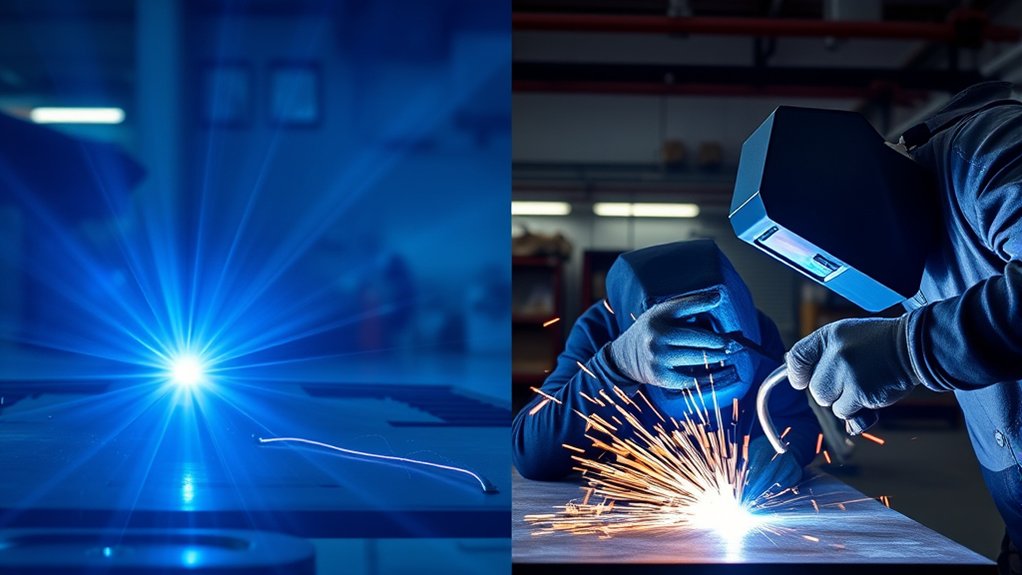
Laser welding can be very fast in production because robots, fixtures, and repeatable joints let the beam move quickly with little cleanup. This is one reason automakers use laser welding and laser brazing on selected factory seams.
In a repair shop, speed changes. You still have to remove trim, protect electronics, clean the joint, test the process, fit the parts, control fire risks, and inspect the weld. If the shop does not already have approved laser equipment and training, MIG welding is usually faster to set up for ordinary repairs.
Cycle Time in the Real World
On a production line, laser welding can reduce cycle time because the joint is repeatable and the equipment is automated. In collision repair, one damaged vehicle may have bent flanges, coatings, adhesive residue, panel gaps, or limited access. Those issues can erase the speed advantage.
Post-Weld Cleanup
Laser welding often needs less grinding when the seam is clean and controlled. MIG welding can need more cleanup because of spatter and weld buildup. But cleanup is only one part of the job. You also need corrosion protection, seam sealer, primer, cavity wax, and any refinishing steps required by the repair procedure.
Cost Comparison: Is Laser Welding Cheaper Than MIG?
Laser welding is usually more expensive upfront. The machine, safety enclosure or controlled work area, eyewear, fume control, training, maintenance, and fixturing can make it a major investment. It can become cost-effective in high-volume production or specialized repair environments where the same type of weld is repeated often.
MIG welding is much cheaper to buy and easier to support. Wire, gas, contact tips, nozzles, and replacement parts are widely available. For many body shops, MIG is the more practical choice because it handles a wide range of jobs without the cost and safety demands of an industrial laser system.
The best cost decision depends on the work mix. A shop doing everyday panel replacement and small repairs may get better value from a quality MIG welder, squeeze-type resistance spot welder, and OEM information access. A specialized shop doing advanced materials or production-style work may justify laser equipment if the jobs support it.
Which Welding Method Fits Your Auto Body Materials Best?
Material choice is one of the biggest factors in this decision. Modern vehicles use mild steel, high-strength steel, ultra-high-strength steel, galvanized steel, aluminum, magnesium in some cases, and mixed-material structures. One welding process cannot safely replace every joining method.
- Mild steel panels: MIG welding is often practical for patches, plugs, and sectioning joints when allowed by the repair procedure.
- Galvanized steel: Both processes need careful cleaning and fume control. Zinc coatings can affect weld quality and create hazardous fumes.
- High-strength steel: Heat control is critical. Some parts may require specific spot welds, rivets, adhesive bonding, or complete replacement instead of MIG welding.
- Aluminum panels: MIG welding can work with the correct aluminum setup, spool gun or push-pull gun, wire, shielding gas, and cleaning process. Laser welding can work in controlled setups but is less common for general shop repair.
- Mixed-material joints: Do not guess. These may use rivets, adhesives, clinching, bolts, or special OEM methods rather than fusion welding.
Note: If the vehicle maker calls for squeeze-type resistance spot welding, structural adhesive, rivets, or a specific weld size and location, do not substitute MIG or laser welding unless the procedure allows it.
Products Worth Considering

Comprehensive Dent Repair Solution: All-in-one solution for automotive dent repair in any capacity, VEVOR Dual Pro stud welder is designed to work on both steel and aluminum automotive panels, and equipped with tools and accessories to facilitate a seamless, thorough repair that exudes professional quality.

Professional Dent Removal: VEVOR Stud Welder Dent Puller offers a fast and efficient solution for removing dents from aluminum car body panels, all while providing precise dent pulling and controlled force for a professional-grade dent repair every time.

Comprehensive Car Repair Solution: Includes a dent puller repair tool, continuous ejector, and washers, perfect for seamless car body repair and dent removal.
Joint Preparation and Fit-Up
Laser welding and MIG welding both fail when the joint is dirty, poorly fitted, or overheated. Before welding, remove paint, seam sealer, rust, undercoating, adhesive residue, oil, and moisture from the weld area. Keep bare metal exposure as small as practical, then restore corrosion protection after the weld.
Laser welding needs especially tight fit-up because the beam is narrow. If the gap is too large, the weld may not bridge the joint without filler. MIG welding is more forgiving because the wire adds filler metal, but too large of a gap still causes burn-through, weak fusion, or excess buildup.
Clamps, backing bars, panel alignment tools, and test coupons help prevent problems. For structural joints, make test welds on the same metal stack and inspect them before welding the vehicle.
Safety: Fumes, Fire, Eye Protection, and Laser Hazards
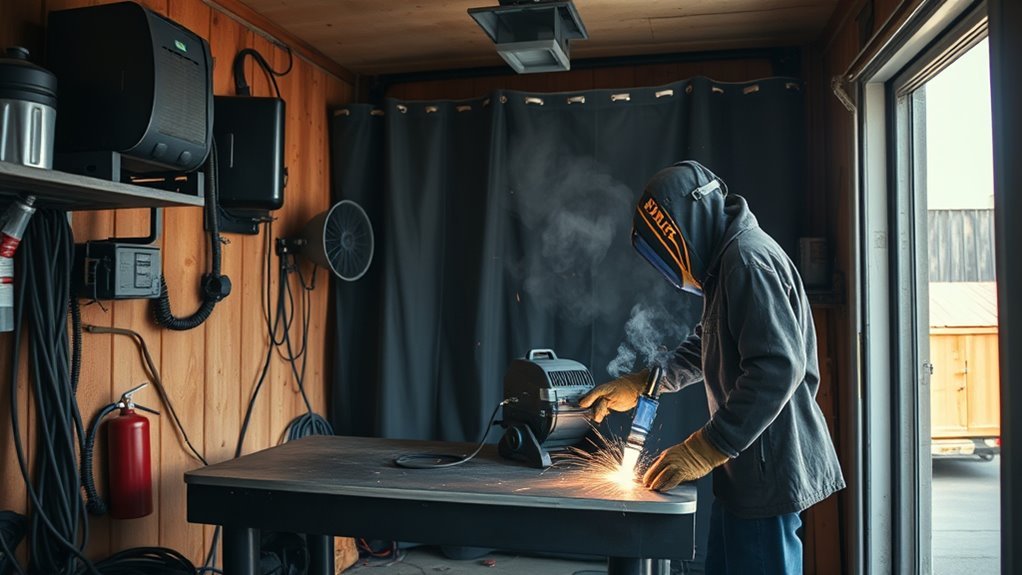
Both welding methods can injure you if you treat them casually. MIG welding creates arc light, heat, sparks, fumes, and shielding-gas risks. Laser welding adds beam hazards, reflection hazards, and strict eyewear requirements based on the laser wavelength and power.
- Protect your eyes and skin: Use the correct welding helmet or laser eyewear, gloves, flame-resistant clothing, and face protection.
- Control fumes: Use local exhaust ventilation when possible, especially around galvanized steel, coated panels, stainless steel, and confined spaces.
- Prevent fire: Move combustibles away, cover nearby parts with welding blankets, keep an extinguisher ready, and check hidden cavities after welding.
- Protect the vehicle: Disconnect or protect electronics as required, keep sparks away from glass and trim, and follow EV high-voltage safety procedures when working near battery systems.
- Respect laser reflections: Shiny metal can reflect dangerous light. Use beam containment, controlled areas, interlocks, and trained operators.
OSHA’s welding rules require basic fire precautions, guarding or removing nearby fire hazards, proper eye protection, and suitable fire-extinguishing equipment. NIOSH also warns that welding fumes can contain metals such as manganese and that confined-space welding can raise exposure risk.
Choosing the Right Welding Method for Your Auto Body Repair Needs
Use MIG welding when the repair procedure allows it, the material is suitable, and you need a flexible process for plug welds, patch panels, brackets, or general fabrication. It is the more realistic choice for most small shops and DIY-capable non-structural repairs, as long as you have the skill, PPE, and settings to avoid burn-through and weak welds.
Use laser welding when the repair or production setup calls for a precise, low-distortion weld and you have the right equipment, safety controls, fit-up, and training. It can be excellent for clean seams and repeatable work, but it is not a shortcut around OEM repair procedures.
For structural auto body repairs, the best answer is often not “laser or MIG.” It may be squeeze-type resistance spot welding, MIG brazing, rivet bonding, adhesive bonding, part replacement, or a specific mix of methods. The vehicle maker’s repair information should decide the method.
Products Worth Considering
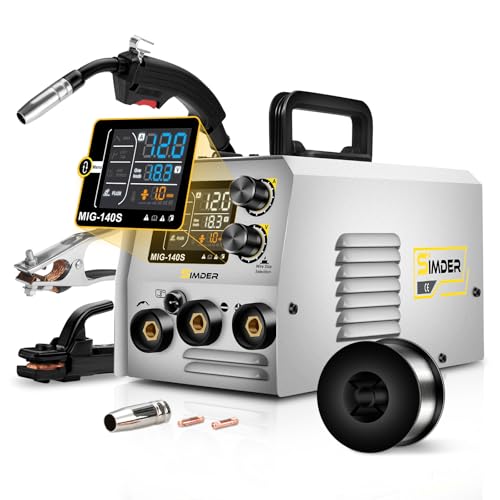
THREE-PROCESS WELDING STATION BUILT FOR FIRST-TIME USERS - Flux Core MIG, Lift TIG and Stick in one machine, so you can find the process that fits your projects without buying three separate welders. Runs on a standard 110V household outlet or 220V for heavier work - no electrician, no special wiring. Welds carbon steel, low-alloy steel, stainless steel, titanium, copper and cast iron
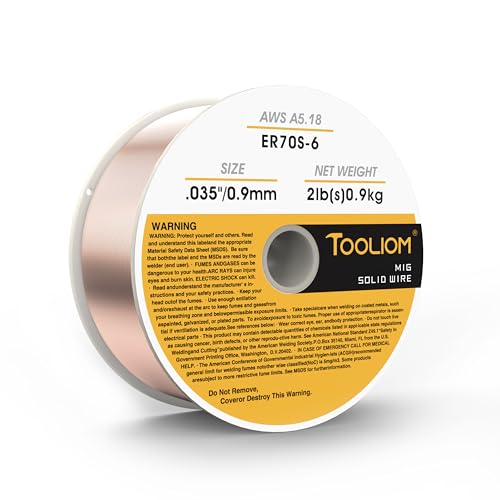
High-quality:Tooliom's .035" ER70S-6 MIG Welding Wire (2lb spool) meets all industry standards for consistent strength and performance. Enjoy smooth feeding, stable arcs, optimal penetration, and high deposition rates—everything you need for exceptional welds

Package Includes: 10ft mig gun + 1pcs nozzle +1pcs diffuser + 6 tips (.023", .030", .035" - two of each size). This mig gun uses the same consumables as the Tweco Mini/#1. 21-50 nozzle, 35-50 diffuser, 11-series contact tip.
Inspection and Finishing After Welding
After welding, inspect the joint before covering it. Look for porosity, cracks, undercut, burn-through, poor fusion, missing plug-weld fill, and excessive grinding. A smooth surface does not prove the weld is strong, so use test coupons and destructive tests when the repair procedure calls for them.
Once the weld is accepted, restore corrosion protection. That may include epoxy primer, weld-through primer where specified, seam sealer, cavity wax, and refinishing materials. Skipping this step can lead to rust behind the repair, even if the weld itself is sound.
Frequently Asked Questions
What welder is best for auto body repair?
For many auto body repairs, a quality MIG welder is the most practical choice because it is affordable, flexible, and widely used for plug welds, patch panels, and fabrication. For structural repairs, the best welder is the one approved by the OEM repair procedure, which may be MIG, spot welding, MIG brazing, or another joining method.
What is the main disadvantage of laser welding?
The main disadvantages are high equipment cost, strict safety requirements, tight fit-up needs, and limited practicality in many repair shops. Laser welding can make excellent welds, but it is less forgiving than MIG welding when panels are misaligned, contaminated, or poorly clamped.
Is laser welding as strong as MIG welding?
Laser welding can be as strong as, or stronger than, MIG welding when the joint is designed for laser welding and the process is controlled. MIG welding can also be very strong when the settings, penetration, and filler metal match the repair. Strength depends on the whole procedure, not the process name alone.
Can I use laser welding instead of MIG on a car panel?
Only if the repair procedure allows it and you have the correct equipment, training, and safety controls. Do not substitute laser welding for MIG, spot welds, rivets, or adhesives on a structural repair unless the vehicle maker approves that method.
Why is MIG welding so common in body shops?
MIG welding is common because the equipment is available, the process is flexible, and technicians can use it on many approved repair tasks. It works well for plug welds, patches, brackets, and mild-steel repairs when the setup and technique are correct.
What safety risks should auto body welders manage?
Auto body welders need to manage fumes, fire, arc light, burns, noise, compressed gas, coatings, fuel systems, airbags, electronics, and EV high-voltage systems. Laser welding adds beam and reflection hazards, so it needs a controlled area, correct eyewear, and trained operators.
Conclusion
Laser welding and MIG welding both have a place in auto body work, but they solve different problems. Laser welding is the better fit for precise, low-distortion, controlled joints where the equipment and training support it. MIG welding is usually the more practical choice for everyday body shop repairs because it is flexible, affordable, and widely accepted in many approved procedures.
The safest answer is to start with the vehicle maker’s repair procedure, not with the machine you prefer. Match the joining method to the material, location, joint design, and inspection requirement. When you do that, both laser welding and MIG welding can produce clean, safe, long-lasting repairs.
Sources
- OSHA 1910.252: Welding, Cutting, and Brazing General Requirements — backs fire prevention, eye protection, and hot-work safety guidance.
- CDC/NIOSH: Welding Fumes and Manganese — backs fume and manganese exposure guidance.
- MillerWelds: MIG Welding Basics — backs MIG process basics, wire feed, shielding gas, and setup context.
- TWI: Laser Welding — backs laser welding principles, advantages, and limitations.
- eCFR 21 CFR 1040.10: Laser Products — backs laser product safety and control requirements.
- Bevilacqua et al., 2025: Laser Beam Welding Simulation Study — backs short cycle time, small heat-affected zone, and automation context for laser welding.