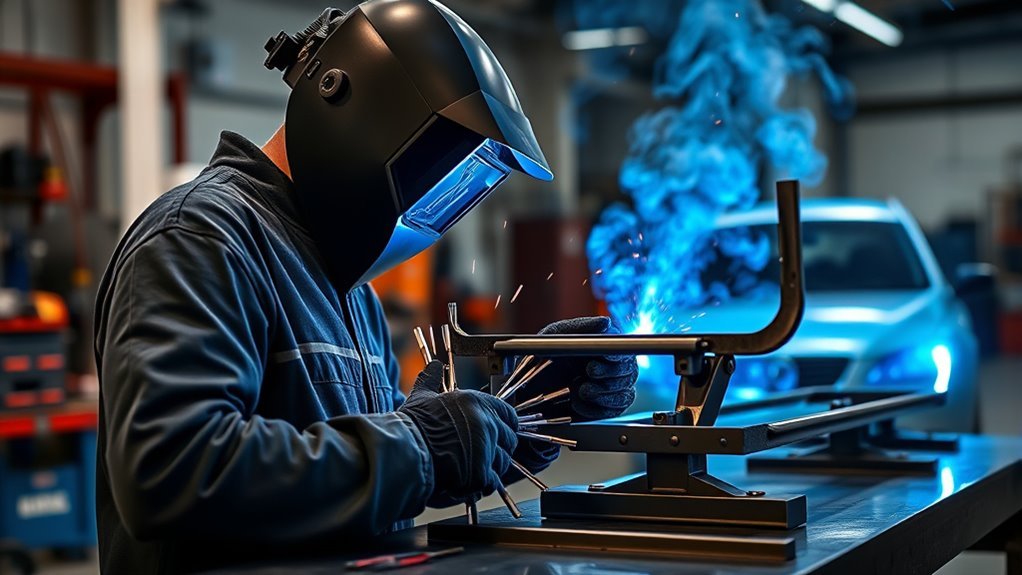
Pulse MIG welding uses controlled peak and background current to help you weld thin auto body panels with a steadier arc, lower average heat, and less spatter than a poorly tuned conventional MIG setup. It is most useful when you need clean plug welds, short stitch welds, or small seam repairs on thin steel, stainless steel, or aluminum panels without overheating the surrounding metal.
Quick Answer
Pulse MIG is worth using for auto body work when you need tight heat control on thin panels. It pulses current high enough to transfer a droplet, then drops to a cooler background current, which helps reduce burn-through, warping, spatter, and grinding when the welder is set correctly.
Key Takeaways
- Pulse MIG lowers average heat input by alternating between peak and background current, so it is easier to control thin sheet metal.
- It can reduce spatter and cleanup, but results depend on the machine program, wire, gas, surface prep, and your technique.
- Use machine-specific settings as your starting point. Do not treat one amp or wire-speed range as universal for every panel.
- Always follow the vehicle maker’s repair procedure before welding high-strength or ultra-high-strength steel parts.
At a Glance
| Best Use | Thin auto body panels, patch panels, plug welds, stainless trim repairs, and aluminum body work when your machine supports the right pulse program. |
| Difficulty | Moderate. Easier heat control than standard MIG, but settings and travel speed still matter. |
| Tools Needed | Pulse-capable MIG welder, correct wire, shielding gas, clean contact tip, PPE, clamps, copper backing if needed, grinder, and test coupons. |
| Cost | Higher than basic MIG. It pays off fastest when you do frequent panel repair, aluminum work, stainless work, or production-style collision repairs. |
What Is Pulse MIG Welding
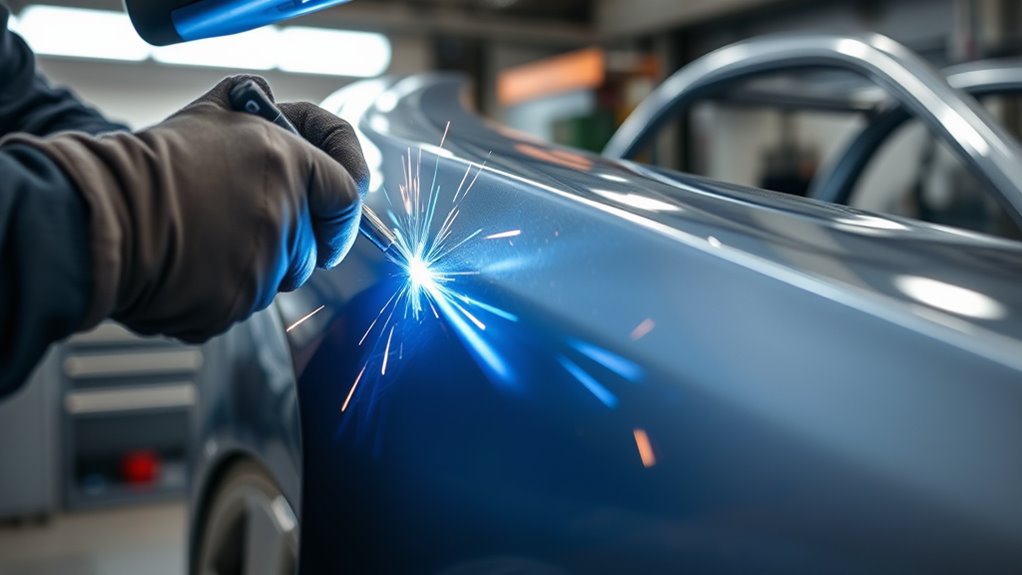
Pulse MIG welding is a controlled gas metal arc welding process that uses a repeating high-current peak and low-current background cycle. The peak current transfers filler metal into the joint, while the lower background current keeps the arc lit and allows the weld pool to calm down between pulses.
That cycle gives you tighter control over the weld pool than a constant high-energy arc. On thin automotive sheet metal, that helps reduce burn-through, limit panel distortion, and keep the bead smaller. The process can also produce cleaner welds with less spatter, which means less grinding after the repair.
Pulse MIG is not magic. It works best when the metal is clean, the fit-up is tight, and the machine is set for the exact wire, gas, and panel thickness you are welding.
You can use pulse MIG on mild steel, stainless steel, and aluminum when the welder has the right program and you match the wire and shielding gas to the material. Compared with TIG, it is usually faster and easier to repeat on production repairs, though TIG can still be better for small visible welds where maximum hand control matters. This is why understanding how MIG welding differs from TIG welding helps you choose the right process for the repair.
Specialized double-pulse modes can also improve bead appearance. On aluminum, double pulse can create a stacked, more uniform look that approaches a TIG-style finish, but the weld still depends on correct prep, travel speed, and heat control.
How Pulse MIG Welding Works
At its core, pulse MIG cycles between two current levels. The high peak current pinches and transfers a small droplet of wire into the weld pool. The lower background current keeps the arc stable without adding as much heat as a constant high-current spray transfer.
This measured cycle helps stabilize the arc and control droplet transfer. Instead of forcing you to fight a hot, fluid puddle, the machine delivers heat in timed bursts. That makes the arc easier to place on panel edges, plug weld holes, lap joints, and thin patch seams.
Advanced waveform control is what makes modern pulse MIG useful. Some welders let you adjust pulse frequency, arc length, trim, inductance, crater fill, hot start, or burnback. Others hide those controls inside a synergic program where you choose the material, wire diameter, gas, and thickness while the machine calculates the rest.
For thin panels, the goal is not maximum penetration. The goal is controlled fusion with the least heat needed to make a sound joint. That is why pulse MIG can reduce the risk of warping compared with a hotter process, especially when you combine it with good technique and short weld intervals. Similar heat-control habits also matter when you learn how to MIG weld 304 stainless steel.
Why Pulse MIG Works on Thin Panels
Thin automotive sheet metal punishes excess heat. Too much heat can blow holes through the panel, pull edges out of alignment, shrink the weld zone, and create oil-canning that is hard to correct. Pulse MIG helps because it reduces average heat while still giving each droplet enough energy to transfer cleanly.
Lower Heat Input
Heat input is affected by current, voltage, travel speed, and process efficiency, so no single setting works for every job. TWI explains heat input and arc energy as measures of energy supplied per unit length, which is why travel speed and electrical settings both matter during welding. TWI’s heat input guidance is a useful reference when you are comparing welding processes.
With pulse MIG welding, you can often keep the average heat lower than a hotter spray-transfer setup. That helps you join thin materials without collapsing the edge of the panel. You still need short welds, good fit-up, and cooling time, but the pulse cycle gives you a wider control window.
Controlled Droplet Transfer
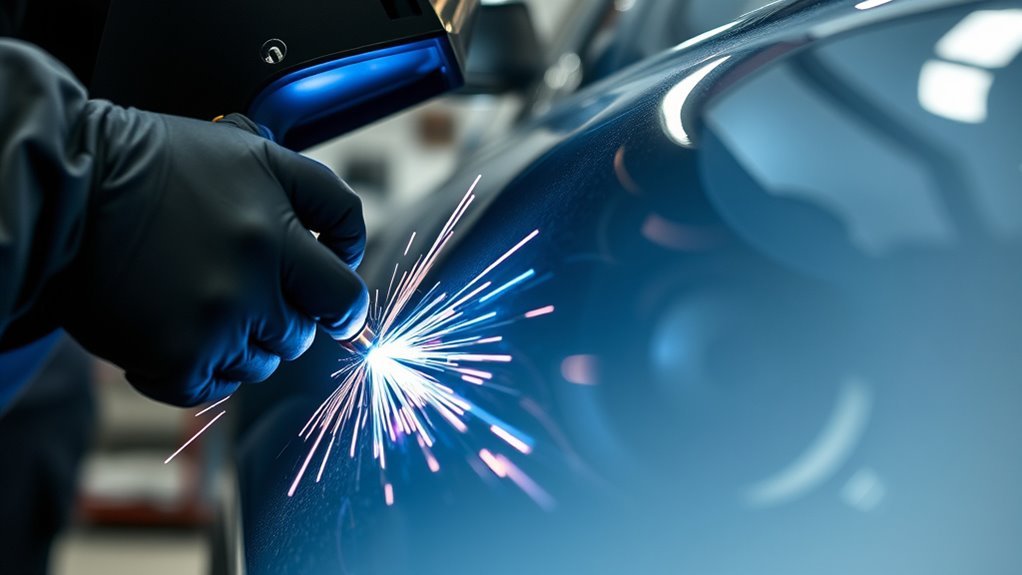
Pulse MIG’s controlled droplet transfer is one of its main advantages. The background current maintains the arc while the peak current transfers the droplet. That helps reduce random spatter and gives you a tighter arc cone.
The practical benefits are simple:
- Cleaner starts and stops when the crater fill is adjusted correctly.
- Less spatter around plug welds and patch seams.
- Better puddle control on thin edges and lap joints.
This helps you place small welds more accurately, which matters when you are repairing panels that will later need filler, primer, paint, or corrosion protection.
Less Warping On Panels
Panel warping usually comes from too much heat concentrated in one area. Pulse MIG helps, but your technique matters just as much as the machine. Use short tacks, move around the panel, and let the metal cool before connecting the welds.
| Factor | Pulse MIG effect | Result |
|---|---|---|
| Heat input | Lower average heat when set correctly | Less warping |
| Arc stability | More controlled transfer | More consistent fusion |
| Spatter | Usually reduced | Less cleanup |
This controlled profile is especially useful on aluminum and stainless steel, two materials that can punish poor heat control. You still need correct gas, correct wire, and clean surfaces. Proper joint design also matters, and proper fillet weld sizing helps keep welds strong without adding unnecessary heat.
Pulse MIG vs. Conventional MIG
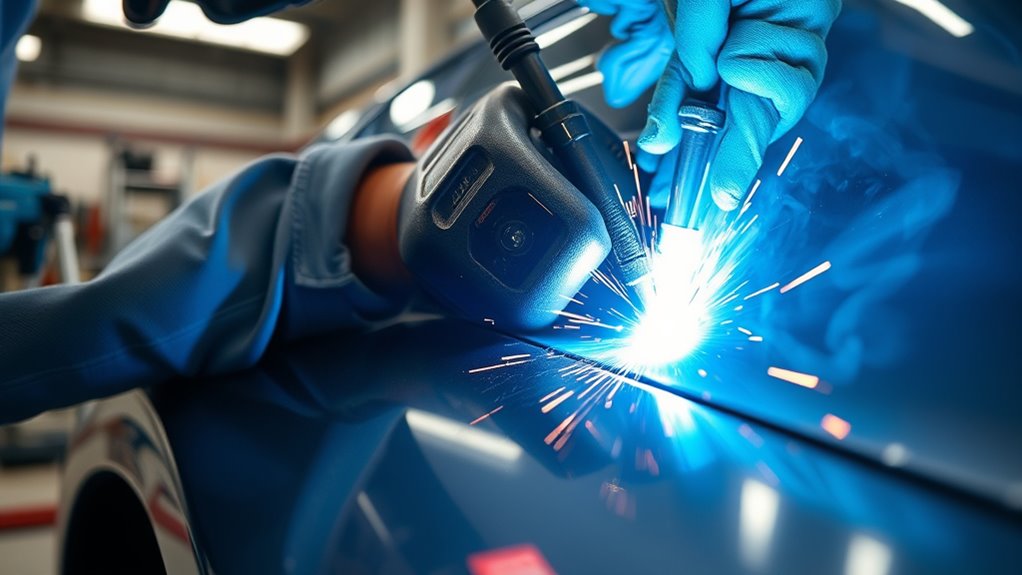
Pulse MIG and conventional MIG can both work on auto body panels, but they behave differently. Conventional short-circuit MIG is common, affordable, and effective on thin steel when tuned well. Pulse MIG costs more, but it gives you a more controlled metal transfer and can make thin, visible, or heat-sensitive repairs easier.
Products Worth Considering

5-in-1 MIG Welder: This 250A 5-in-1 pro mig welder supports various functions - MIG Pluse, gasless MIG, gas MIG, MMA, and Lift TIG. The innovative pulse welding function provides fast, high-quality, low-spatter welds and better thermal control than traditional MIG welders, allowing perfect welds at lower temperatures.

ADVANCED DOUBLE PULSE MIG FOR ALUMINUM & STEEL: This professional MIG welder features both single and double pulse MIG modes, delivers optimized thermal control for superior weld bead aesthetics and reduced spatter. The MIG250DP effortlessly welds aluminum, mild steel, stainless steel, and carbon steel.

5-in-1 MIG Welder: This 200A 5-in-1 pro mig welder supports various functions - MIG Pluse, gasless MIG, gas MIG, MMA, and Lift TIG. The innovative pulse welding function provides fast, high-quality, low-spatter welds and better thermal control than traditional MIG welders, allowing perfect welds at lower temperatures. (Note: Aluminum welding torch is not included and needs to be purchased separately ; Lift TIG torch not included)
Heat Control Differences
Conventional MIG can be set up for low-heat short-circuit transfer, but it can also become unstable if voltage, wire speed, stickout, or travel speed are wrong. Pulse MIG gives the machine more control over droplet transfer, which can make the arc smoother and easier to repeat.
- Pulse MIG can lower average heat compared with hotter transfer modes.
- Short-circuit MIG is cheaper and still works well for many steel patch repairs.
- Pulse MIG becomes more valuable on aluminum, stainless steel, and thin panels where cleanup time matters.
For auto body work, this means pulse MIG can reduce rework, but it does not replace good panel preparation or good welding habits.
Spatter And Cleanup
Spatter is one of the clearest differences you may notice. With a well-set pulse program, droplet transfer is smoother, so there is usually less spatter around the bead. That can reduce grinding, preserve nearby panel edges, and lower the risk of thinning the repair area with a disc.
Do not expect zero cleanup on every weld. Dirty metal, wrong gas, too much stickout, a worn contact tip, or poor ground contact can still cause spatter and porosity. Pulse MIG gives you a better starting point, not a free pass.
Thin Metal Performance
Thin sheet metal needs small, controlled welds. Pulse MIG helps you place those welds with less heat spread, especially when you use short tacks and move around the panel. That is why it is useful for patch panels, fenders, quarter-panel sections, door skins, and plug welds where appearance and distortion control matter.
- Lower average heat helps preserve panel shape.
- Controlled transfer helps maintain a smaller puddle.
- Cleaner arcs can reduce finishing time.
Conventional MIG can overheat thin metal if you try to run long beads. Pulse MIG helps, but you should still avoid continuous welds on exterior panels. Stitch weld, skip around, and cool the metal between passes. For related basics, review how to MIG weld thin metal without burning through.
Best Metals for Pulse MIG Repair
Pulse MIG works best on metals that benefit from controlled heat input and stable metal transfer. In auto body work, that usually means mild steel, stainless steel, and aluminum. Each material needs its own wire, gas, and setup.
| Metal | Pulse MIG fit | Important setup note |
|---|---|---|
| Mild steel | Excellent for thin patch panels and plug welds | Use clean steel, correct ER70S-type wire, and a steel pulse or short-circuit program. |
| Stainless steel | Useful for cleaner bead control and lower distortion | Use stainless wire and proper shielding gas. Control fumes and heat tint. |
| Aluminum | Very useful when the welder supports aluminum pulse programs | Use 100% argon, correct aluminum wire, clean oxide, and often a spool gun or push-pull gun. |
| Galvanized steel | Possible only with proper preparation and ventilation | Remove zinc coating around the weld area and control fumes. |
| UHSS / boron steel | Only if the OEM repair procedure allows it | Do not guess. Some parts must not be welded or heated during repair. |
Warning: Before welding structural or high-strength vehicle parts, check the OEM repair procedure. Some modern steels lose strength when heated, and some collision parts require replacement, spot welding, brazing, or adhesive bonding instead of MIG welding.
On stainless steel, pulse MIG can help create a cleaner bead and reduce distortion, but stainless welding fumes need respect. OSHA notes that chromium in stainless steel can convert to hexavalent chromium during welding, which is hazardous. Use ventilation, respiratory protection when required, and proper surface cleaning. This is similar to the heat and contamination control needed for stainless steel TIG welding settings.
On aluminum, pulse MIG can improve arc stability and bead appearance, but only if the wire feeds smoothly. A push-pull gun or spool gun can prevent wire feeding problems, especially with soft 4043 or 5356 aluminum wire.
Safety Before Pulse MIG Welding
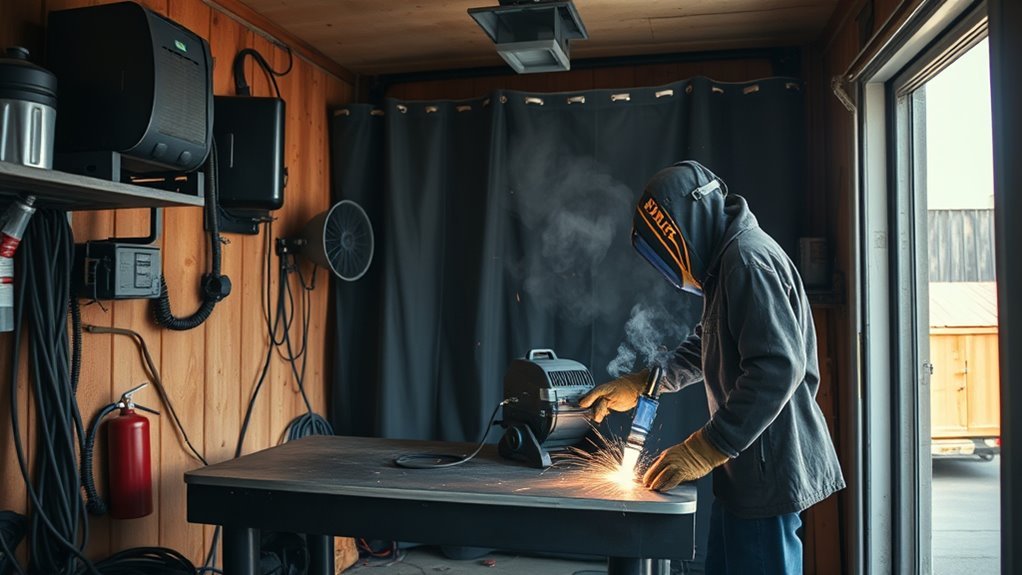
Pulse MIG may run cleaner than a rough conventional setup, but it is still welding. You are dealing with arc radiation, hot metal, sparks, fumes, shielding gas, fire risk, and electric shock risk. Wear a welding helmet with the correct shade, leather gloves, flame-resistant clothing, hearing protection when grinding, and eye protection during cleanup.
OSHA says welding fumes can contain metals such as aluminum, chromium, copper, iron, manganese, nickel, and zinc, along with gases from shielding and the welding process. OSHA’s welding fume fact sheet also explains that ventilation, work position, and local exhaust can reduce exposure.
Warning: Never weld on or near fuel lines, batteries, undercoating, foam, upholstery, seam sealer, or unknown coatings until the area is safely prepared. Keep a fire extinguisher nearby and inspect both sides of the panel for smoldering material after welding.
Galvanized and zinc-coated panels need extra care. OSHA’s welding standard includes specific ventilation requirements for zinc-bearing materials. OSHA 1910.252 is a key safety reference for welding, cutting, brazing, ventilation, and fire prevention. Grind the zinc coating away from the weld zone where the repair procedure allows it, keep your head out of the plume, and use local exhaust ventilation whenever possible.
Double Pulse MIG for Smoother Seams
Double pulse MIG adds a second modulation pattern to the welding cycle. Instead of one steady pulse rhythm, the machine alternates between higher and lower pulse groups. This changes heat and deposition in a controlled pattern, which can smooth the bead profile and create a more uniform ripple.
Double pulse is most useful when bead appearance matters, especially on aluminum. It can also help control heat on thin material when the machine program is correct.
- It can reduce cleanup by keeping the bead more uniform.
- It can help limit distortion by controlling heat between pulse groups.
- It can improve appearance on aluminum seams and visible joints.
You still need the correct contact tip, gas flow, wire, and torch angle. Small process details matter, much like matching tip size to amperage matters in plasma cutting.
Pro Tip: When testing double pulse on aluminum, run test beads on scrap from the same panel thickness before touching the vehicle. Adjust trim or arc length only after the wire feeds smoothly and the metal is fully clean.
Pulse MIG Setup Checklist for Auto Body Panels
Good pulse MIG welding starts before you pull the trigger. Use this checklist before welding a visible or structural panel.
- Confirm the repair method. Check the OEM repair procedure for the exact panel, steel type, and attachment method.
- Clean the metal. Remove paint, primer, rust, adhesive, seam sealer, zinc coating where allowed, and oil from the weld zone.
- Match wire and gas. Use steel wire for mild steel, stainless wire for stainless, and aluminum wire with 100% argon for aluminum.
- Set the correct program. Choose the welder’s material, wire diameter, gas mix, and thickness setting before fine-tuning trim or arc length.
- Check consumables. Use the correct drive rolls, liner, contact tip, nozzle, and gun setup for the wire.
- Clamp tightly. Poor fit-up creates gaps, burn-through, and weak fusion.
- Run test welds. Use scrap with the same thickness and joint style before welding the car.
Surface preparation is especially important on coated steel. If the panel is galvanized, review safe prep habits for MIG welding galvanized steel before you weld.
Pulse MIG Settings for Thin Auto Panels
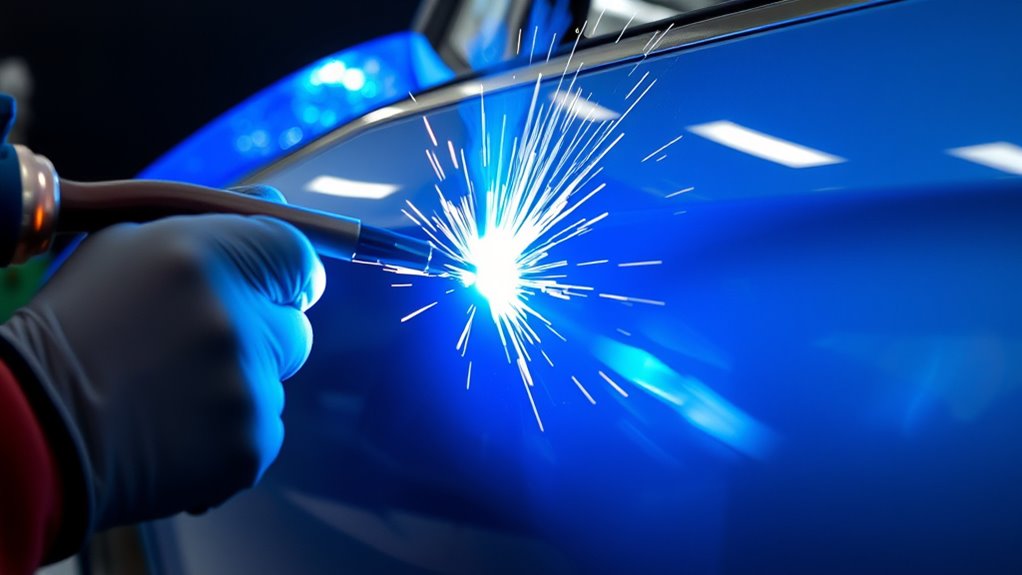
There is no universal pulse MIG setting for every thin auto panel. The right setup depends on panel thickness, wire size, shielding gas, joint type, and your machine’s pulse program. Use the chart inside your welder’s door or the manufacturer’s manual first, then fine-tune on scrap.
| Material | Common starting approach | What to watch |
|---|---|---|
| Thin mild steel | Use the steel pulse or thin-sheet program with small-diameter wire and the gas recommended by the machine maker. | If the bead sits high, add a little heat or slow down. If the edge melts back, reduce heat or weld shorter tacks. |
| Stainless steel | Use stainless wire, correct gas, and a stainless pulse program when available. | Watch heat tint, distortion, and fume control. |
| Aluminum | Use 100% argon, aluminum wire, correct drive rolls, and a spool gun or push-pull gun if needed. | Clean oxide, keep a steady travel speed, and avoid birdnesting. |
| Plug welds | Set for enough fusion into the lower panel, then test by peeling or sectioning a practice weld. | Look for full tie-in around the hole without burning the edge away. |
Many pulse MIG welders use trim, arc length, or material thickness controls instead of showing peak and background current directly. That is normal. Set the program first, then adjust one control at a time.
For thin panels, use short welds rather than long beads. Tack the panel, skip to a different area, let the metal cool, and continue. If the puddle grows too wide, increase travel speed, reduce trim, or shorten your weld time. If the bead is cold and sitting on top, slow down slightly or increase heat in small steps.
For basic wire and voltage relationships, this MIG welding wire speed and voltage chart can help you understand what the machine is adjusting, even though pulse programs may automate some of those settings.
Thin Panel Technique That Prevents Burn-Through
Pulse MIG helps, but technique prevents most panel damage. The safest approach is to treat thin auto body welding as a series of controlled tacks, not one long bead.
- Start with clean, tight metal. Gaps make burn-through more likely.
- Use short tacks. Weld for a moment, stop, then move to another area.
- Skip around. Spread heat across the panel instead of stacking heat in one spot.
- Cool naturally. Let the panel cool between passes. Avoid quenching hot steel unless the repair procedure specifically allows it.
- Use copper backing when possible. Copper can support an open edge or small gap because weld metal does not readily fuse to it.
- Inspect both sides. Check for penetration, porosity, burn-through, and heat damage on the backside.
Note: Do not run a continuous seam on a visible outer panel unless the repair procedure calls for it. Short, spaced welds are usually safer for panel shape and paint-ready bodywork.
Troubleshooting Pulse MIG Welds
If the weld does not look right, fix the cause before you continue. Grinding bad welds after the fact can thin the panel and hide defects.
| Problem | Likely cause | Fix |
|---|---|---|
| Burn-through | Too much heat, large gap, slow travel, or long weld time | Shorten welds, tighten fit-up, lower trim, move faster, or use copper backing. |
| Porosity | Dirty metal, poor gas coverage, zinc, paint, moisture, or draft | Clean the joint, check gas flow, block drafts, replace contaminated wire, and prep coatings safely. |
| Excessive spatter | Wrong program, bad ground, worn tip, too much stickout, or dirty panel | Select the correct pulse program, clean the ground point, replace the tip, and shorten stickout. |
| Cold bead sitting high | Too little heat, fast travel, or poor fit-up | Increase heat slightly, slow down, improve fit-up, and test again on scrap. |
| Soot on aluminum | Contamination, poor cleaning, wrong gas, or long arc | Use 100% argon, clean oxide, check gas flow, and reduce arc length. |
| Wire feeding issues | Wrong drive rolls, liner drag, soft aluminum wire, or incorrect tension | Use correct rolls, clean liner, reduce tension, or switch to a spool gun or push-pull gun. |
How to Choose a Pulse MIG Welder
To choose a pulse MIG welder for auto body work, focus on control, support, and the materials you actually repair. A basic pulse feature is not enough if the machine does not have good thin-steel, stainless, or aluminum programs.
- Look for synergic pulse programs. These simplify setup by matching wire, gas, material, and thickness.
- Check low-end control. Thin auto panels need stable arc behavior at low output.
- Confirm aluminum support. If you weld aluminum, make sure the machine supports a spool gun or push-pull gun.
- Check wire feeder quality. A smooth feeder matters as much as the pulse waveform.
- Review consumable availability. Tips, liners, drive rolls, and gun parts should be easy to buy.
- Choose support over gimmicks. A reputable brand with manuals, parts, and warranty support is safer than a feature list with poor documentation.
Brands such as Lincoln Electric, Miller, ESAB, Fronius, and other professional welding manufacturers offer pulse MIG models, but the best choice depends on your budget, power supply, material mix, and repair volume. If you only weld occasional mild-steel patches, a well-tuned conventional MIG may be enough. If you do aluminum, stainless, or frequent thin-panel repairs, pulse MIG becomes easier to justify.
Products Worth Considering

7 in 1 Welding Machine: The multi-function welding machine included Gas/Solid Wire MIG,Pulse MIG, Gasless Flux Core MIG, Stick/MMA, Spot welding, Lift TIG, spool gun compatible (tig gun and spool gun not included,WP-17V-35,LBT150).
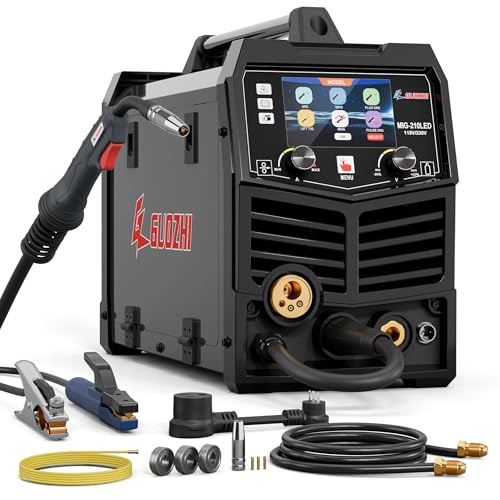
【 8 IN 1 Multi-functions Welder】: GZ GUOZHI welding machine offers 8 processes: Gas MIG, MAG, Flux Core MIG, Pulse MIG, MMA/Stick, LIFT TIG, Spot Welding, Spool Gun compatible (tig torch and spool gun not included). Aluminum can be welded by using pulse MIG or a special spool gun.

6-IN-1 Aluminium MIG Welder Kit: Experience true multi-process flexibility. The MIG/Pulsed MIG/Flux Core/Spool Gun MIG/Lift TIG/Stick welder delivers professional-grade performance across the board. Compatible with spool gun and Lift TIG torch (both sold separately) for specialized applications, this powerhouse handles everything from thin-gauge aluminum to thick structural steel with ease. Your 1LB flux core welding wire and welding gloves is included—just load and weld
Is Pulse MIG Worth It for Auto Body Work?
Pulse MIG is worth it if you value lower cleanup time, better control on thin panels, and smoother results on aluminum or stainless steel. It is less compelling if you only weld occasional mild-steel patches and already have a conventional MIG that you can tune well.
The added cost makes the most sense for collision shops, restoration work, fabrication businesses, and serious DIY builders who regularly weld thin panels. You may save time through fewer blow-through repairs, less grinding, cleaner plug welds, and better repeatability.
The downside is complexity. Pulse MIG welders cost more, and you still need to understand wire, gas, fit-up, travel speed, and repair procedures. A pulse machine will not fix dirty metal or poor technique.
Frequently Asked Questions
What are the advantages of pulsed MIG welding?
Pulsed MIG welding gives you better control over heat and droplet transfer. On auto body panels, that can mean less burn-through, less warping, less spatter, cleaner beads, and less grinding when the metal is clean and the machine is set correctly.
What is the best type of welder for auto body work?
A MIG welder is usually the most practical choice for auto body work because it is fast, repeatable, and effective on thin steel. A pulse MIG welder is better when you need more heat control, cleaner welds, or better aluminum and stainless performance. TIG is still useful for small precision welds, and resistance spot welding may be required by some OEM procedures.
What are the disadvantages of pulse MIG?
Pulse MIG costs more than basic MIG, requires a pulse-capable machine, and can take longer to learn. It also depends on correct wire, gas, software programs, and machine calibration. If the metal is dirty or the wrong program is selected, weld quality can still suffer.
Is pulsed MIG worth the money?
Yes, pulsed MIG can be worth the money if you weld thin panels, aluminum, stainless, or high-visibility seams often. It is harder to justify for occasional steel patch work unless you want the extra control and cleaner finish.
Can pulse MIG weld 24-gauge sheet metal?
It can, but only with the right machine, wire, fit-up, and technique. Use the welder’s thin-sheet program, test on matching scrap, make short tacks, and avoid long beads. If the panel has gaps or contamination, burn-through is still likely.
Do you need special gas for pulse MIG?
Often, yes. Steel, stainless steel, and aluminum use different shielding gases. Many steel pulse programs use argon-rich mixes, aluminum commonly uses 100% argon, and stainless may need a stainless-specific blend. Always match the gas to the machine program and wire.
Conclusion
Pulse MIG welding gives you more control where thin auto body metal is least forgiving. By pulsing between peak and background current, it can reduce average heat, steady the arc, limit spatter, and help protect panel shape. The best results still come from clean metal, tight fit-up, correct wire and gas, test welds, short stitch technique, and safe ventilation.
Use pulse MIG as a control tool, not a shortcut. When you are welding a fender, patch panel, plug weld, or aluminum seam, think of the arc as a metronome: measured, consistent, and tuned to keep the panel flat while the repair stays strong.
Sources
- TWI — Heat input and arc energy — supports the discussion of current, voltage, travel speed, and welding heat input.
- OSHA — Welding, Cutting, and Brazing — supports general welding safety, hazards, and standards references.
- OSHA Fact Sheet — Controlling Hazardous Fume and Gases during Welding — supports fume, ventilation, chromium, zinc, and work-practice safety guidance.
- OSHA 29 CFR 1910.252 — General welding requirements — supports fire prevention, ventilation, eye protection, and zinc-bearing material precautions.