In automotive repair, a weak structural weld can change how a vehicle carries normal road loads and manages energy in a later collision. Structural welding may be required on frame rails, unibody rails, pillars, rockers, crossmembers, floors, roof rails, and mounting reinforcements, but the repair is safe only when it follows the current vehicle-specific procedure.
This is advanced collision-repair work, not a general fabrication job. Before choosing a welder or preparing a joint, identify the vehicle by VIN, confirm the material and part construction, find the approved sectioning or replacement procedure, and verify every required weld, rivet, adhesive, sealer, measurement, scan, and calibration operation.
Quick Answer
An automotive structural weld is required only when the vehicle-specific OEM repair procedure calls for welding a load-bearing or crash-management part. Confirm the VIN, material strength, sectioning location, attachment method, weld size, and weld count first. If the procedure says replace, rivet-bond, spot-weld, or do not section, follow it.
Key Takeaways
- Use the VIN and current OEM repair information to identify the material, replacement boundary, joint design, attachment method, and corrosion-protection steps.
- Do not assume that MIG, TIG, spot welding, plug welding, brazing, rivets, or adhesive can substitute for one another.
- Replace control arms, struts, steering links, springs, and similar suspension parts unless the vehicle maker expressly authorizes a repair.
- Make practice welds on matching test coupons and destructively test them before welding the vehicle.
- Inspect dimensions, weld quality, coatings, electronics, alignment, scans, and any required ADAS calibrations before releasing the vehicle.
At a Glance
| Time Required | Varies by vehicle and damage. Allow separate time for OEM research, disassembly, measuring, test welds, welding, cooling, inspection, corrosion protection, scans, and calibrations. |
| Difficulty | Advanced professional repair. Structural vehicle welding is not a beginner or DIY task. |
| Tools Needed | Current OEM repair information, approved measuring or fixture equipment, the specified welder and attachments, matching test coupons, clamps, fume extraction, welding PPE, fire protection, inspection tools, and approved corrosion-protection materials. |
| Cost | Varies widely. OEM information access, approved welding equipment, measuring systems, adhesives, rivets, consumables, scans, alignment, and calibration may all affect the repair cost. |
What’s in This Article
- What Makes a Structural Weld Required?
- How Do You Confirm the OEM Repair Plan?
- Which Vehicle Parts Need Structural Welding?
- When Should You Not Weld a Vehicle Part?
- What Safety Steps Come Before Welding?
- How Do You Prep Metal for a Strong Weld?
- Which Welding and Joining Processes Are Used?
- What Is the Structural Welding Workflow?
- What AWS Standards Apply to Structural Welds?
- How Do You Inspect a Structural Weld?
- What Mistakes Weaken Auto Structural Welds?
- Frequently Asked Questions
- Conclusion
- Sources
What Makes a Structural Weld Required?
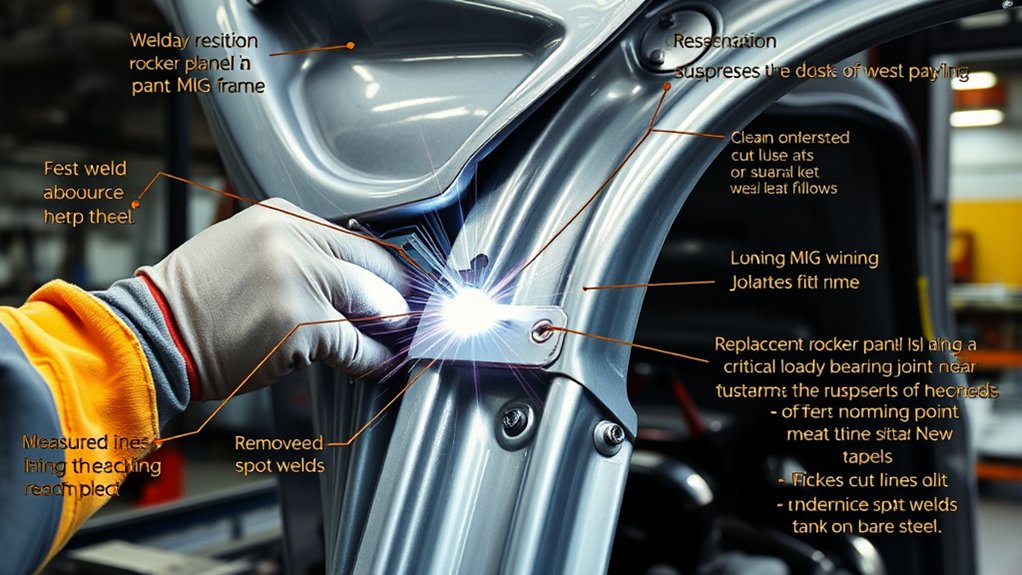
A structural weld is part of a repair to a component that carries vehicle loads, controls body or chassis geometry, supports a restraint or suspension mounting point, or helps manage collision energy. The important question is not whether a bead can be placed on the metal. The question is whether the vehicle maker permits welding at that location and specifies how the joint must be made.
Modern vehicles may combine mild steel, advanced high-strength steel (AHSS), ultra-high-strength steel (UHSS), press-hardened steel, aluminum, castings, composites, structural adhesive, rivets, and factory spot welds in one body. Material strength, thickness, coatings, internal reinforcements, and heat sensitivity can change within a few inches.
High heat can soften, harden, crack, or distort some materials. It can also enlarge the heat-affected zone and change the way a repaired section deforms in a collision. That is why the repair must restore the approved load path rather than merely create a bead that looks large or smooth.
The correct automotive weld is not the one that looks strongest. It is the attachment method the vehicle maker validated for that exact part, material, and repair location.
Cast iron welding is a separate specialty. Do not apply general cast iron welding techniques to a frame, unibody rail, suspension mount, or crash structure unless the vehicle maker identifies the component and publishes an approved procedure.
Warning: Structural welding affects crash performance, restraint mounting, alignment, and road safety. Do not weld a critical vehicle part without current OEM instructions, suitable training, approved equipment, matching test welds, and a documented inspection plan.
How Do You Confirm the OEM Repair Plan?
Start with the vehicle identification number. Confirm the model year, body style, wheelbase, drivetrain, powertrain, production date, and any construction differences that apply to the damaged area. Similar-looking models can use different steel grades, reinforcements, adhesives, or sectioning limits.
Retrieve the current vehicle-specific body repair manual, workshop manual, collision-repair procedure, service bulletin, and applicable position statements. The I-CAR OEM Technical Information Matrix can help locate the repair resources published by each vehicle maker.
Before cutting or welding, document the answers to these questions:
- Is the damaged part repairable, partially replaceable, or complete-replacement only?
- Is sectioning permitted at the proposed location?
- What material and tensile strength are used in each layer?
- Are internal reinforcements, patches, foam, adhesive, or wiring hidden behind the joint?
- Must the replacement occur at factory seams?
- Is the approved attachment method STRSW, MAG plug welding, butt welding, MIG brazing, rivets, adhesive, or a combination?
- What weld diameter, spacing, count, sequence, wire, gas, and machine settings are required?
- Which dimensions and control points must be measured before, during, and after installation?
- Which seam sealers, primers, cavity waxes, foams, and corrosion coatings must be restored?
- Are pre-repair scans, post-repair scans, wheel alignment, initialization, or ADAS calibrations required?
Where no published procedure exists, do not invent a sectioning location or substitute a familiar welding method. Escalate the repair decision through the vehicle maker’s technical support channel, the shop’s qualified repair planner, or an engineer responsible for the work.
Which Vehicle Parts Need Structural Welding?
Structural attachment methods commonly appear on parts that create the vehicle’s load-carrying body or frame. Depending on the design, these may include:
- Body-on-frame rails, crossmembers, brackets, and approved reinforcement sections
- Unibody front and rear rails, aprons, upper rails, and rail extensions
- A-, B-, C-, and D-pillars, rocker panels, roof rails, and door-ring reinforcements
- Floor, tunnel, cowl, wheelhouse, and rear-body structural sections
- Seat, seat-belt, child-restraint, and airbag mounting reinforcements
- Engine, transmission, subframe, steering, and suspension mounting areas
- Approved bumper, hitch, or commercial-body attachment structures
A damaged mounting area may require structural repair, but that does not mean the component bolted to it should be welded. Control arms, struts, springs, steering links, knuckles, hubs, and similar suspension or steering parts are normally replaced when bent, cracked, heated, or previously welded unless the OEM publishes a specific repair.
Outer panels require the same careful distinction. A welded or bonded roof panel may be part of a structural roof system. A bolt-on fender is usually cosmetic. A door may contribute to side-impact protection, but it is normally serviced as an assembly rather than welded into the body structure. Identify the exact part instead of labeling every panel “structural.”
General information about maximum fillet weld size can help explain weld geometry, but a generic fillet-size rule must never replace the weld dimensions, nugget diameter, plug-hole size, spacing, or joint profile specified by the vehicle maker.
When Should You Not Weld a Vehicle Part?
Do not weld merely because replacing the full part takes longer. Welding is inappropriate when the procedure requires complete replacement, prohibits sectioning, calls for a different attachment method, or identifies a material that cannot tolerate the proposed heat input.
Replacement is commonly the safer choice when:
- The part is made from press-hardened or ultra-high-strength steel and the OEM prohibits straightening or sectioning.
- The proposed cut passes through a reinforcement, mounting point, crush initiator, tailored blank, hydroformed section, or multi-layer joint.
- The component is cracked, torn, kinked, stretched, thinned, heavily corroded, or previously repaired outside an approved location.
- The service part must be installed at factory seams.
- The damaged item is a suspension, steering, wheel, brake, spring, or restraint component without an approved repair procedure.
- The repair would place heat near a high-voltage battery, fuel system, electronic module, pyrotechnic device, or composite part that cannot be protected or removed as required.
- The shop lacks the specified welder, rivet equipment, adhesive, measuring system, training, or test capability.
The material-strength and repairability guidance from I-CAR explains why stronger steels often have tighter straightening and replacement limits. Always use the current vehicle-specific instructions for the final decision.
What Safety Steps Come Before Welding?
Complete a hot-work risk assessment before grinding, cutting, brazing, or welding. The exact shutdown process varies by vehicle, so follow the OEM sequence rather than relying on a universal battery-disconnect routine.
- Record diagnostic trouble codes and complete any required pre-repair scan before power is removed.
- Shut down and isolate the 12-volt system as directed. Follow the specified wait time before working near SRS components.
- On a hybrid or electric vehicle, have a properly trained person disable and verify the high-voltage system according to the OEM procedure.
- Remove a high-voltage battery, electronic module, pyrotechnic device, fuel component, or other heat-sensitive part when the procedure requires it.
- Inspect both sides of the weld area for fuel lines, brake lines, refrigerant lines, wiring, airbags, seat-belt pretensioners, foam, seam sealer, insulation, carpet, trim, glass, and undercoating.
- Remove or shield combustible materials and maintain an appropriate fire extinguisher and fire watch.
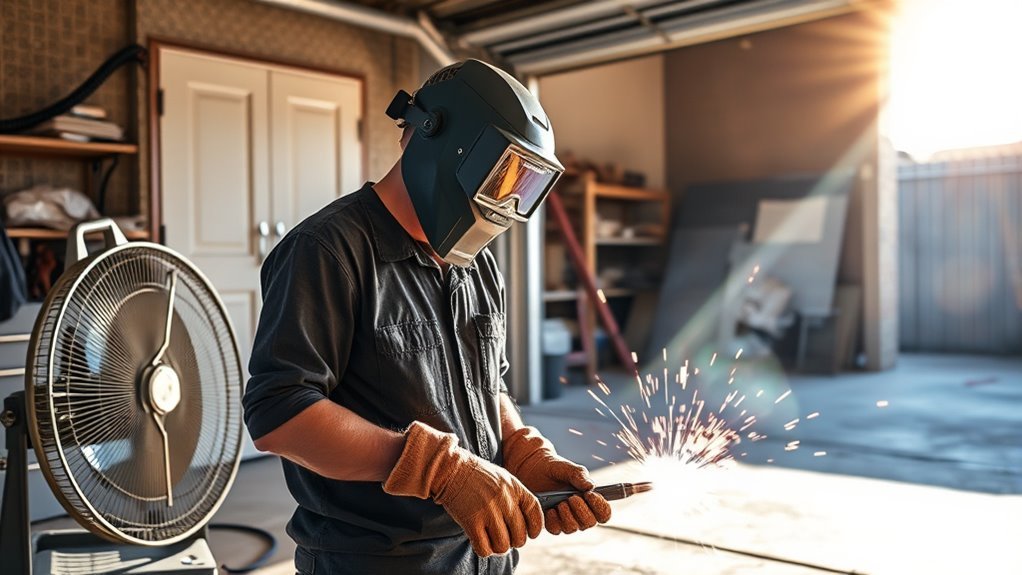
- Use welding curtains, eye and skin protection, hearing protection, gloves, suitable clothing, local exhaust ventilation, and any required respiratory protection.
- Keep the work clamp close to the weld on the same panel or assembly whenever the procedure permits. Do not route welding current through bearings, hinges, modules, wiring, or sensitive electronics.
- Route welding cables away from computers, sensors, high-voltage cables, and harnesses.
I-CAR’s battery-disconnect guidance explains common electronic-protection steps, but the vehicle maker’s current procedure remains the controlling source.
Warning: Grinding or welding zinc-coated, painted, stainless, or contaminated metal can create hazardous fumes. Use effective local exhaust ventilation and the respiratory protection required by the shop’s exposure assessment and applicable safety rules.
How Do You Prep Metal for a Strong Weld?
Good preparation begins after the repair plan, measurements, power-down steps, and disassembly are complete. Clean and prepare only the areas required by the attachment method. Excessive grinding can thin the base metal, remove protective coatings unnecessarily, or change the fit of a tightly controlled joint.
Products Worth Considering

Adjustable 3/4 x 20.5" air belt file for cleaning, weld prep and material removal on tubing or any radiused work piece

Heavy-Duty Needle Scaler Air Tool Built to Last: The needle scaler air tool is precision-built with a reengineered needle spring and strengthened steel housing for maximum durability in industrial use. Delivering up to 4800 blows per minute, this pneumatic needle scaler maintains consistent power and long service life, reducing downtime and maintenance costs. The heat-treated needles resist bending and wear, while the rubber-faced throttle valve ensures tight internal sealing for reliable performance under heavy-duty cleaning conditions.

Sbestily Abrasives 2" quick change zirconia curved flap discs are used to clean weld lines and weld splatter, finishing, polishing, deburring, and other abrasive operations.
Clean Surface Preparation
Remove rust, scale, oil, grease, dirt, moisture, paint, seam sealer, and damaged coating from the weld zone as directed. Use dedicated stainless brushes and tools for aluminum to prevent cross-contamination. Do not use chlorinated cleaners near welding heat.
Cleaning guidance for mild steel before welding is useful for general shop work, but automotive parts may also have e-coat, galvanizing, aluminum-silicon coating, adhesive, foam, or conversion coating that requires a method-specific procedure.
Dry the joint completely. Moisture and contamination can cause porosity, unstable arc behavior, spatter, poor wetting, and incomplete fusion.
Joint Fit-Up and Beveling
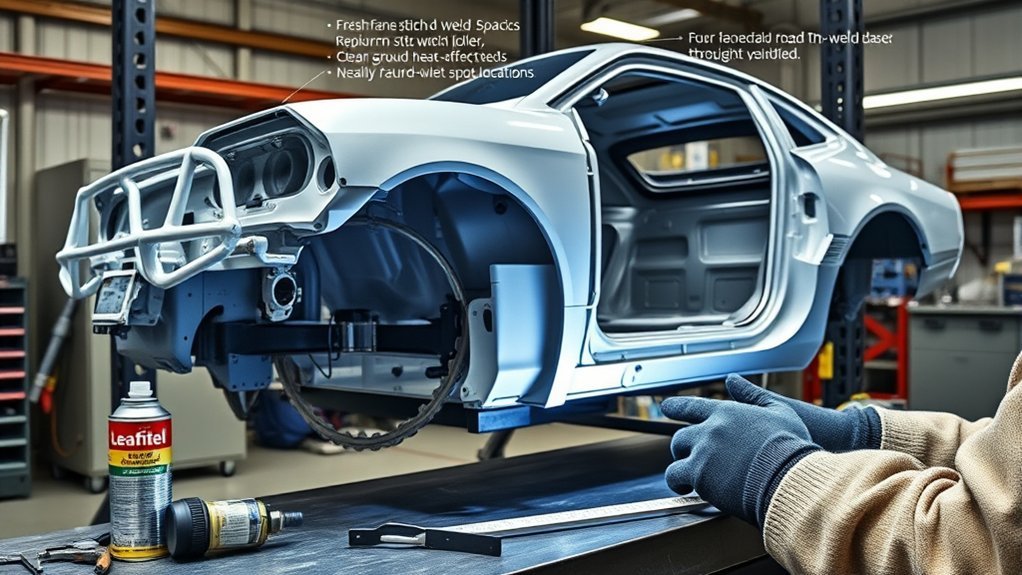
Set the vehicle to the required dimensions before final fitting. Use the specified bench, frame rack, fixture, datum points, or three-dimensional measuring system. Trial-fit adjacent bolt-on panels, glass, subframes, suspension parts, and closures when they affect the final geometry.
Use the exact joint design shown in the procedure. It may call for an open butt joint, butt joint with backing, lap joint, plug weld, factory-seam replacement, flange weld, rivet-bonded joint, or resistance spot weld. Do not apply a universal 30–45-degree bevel or a 1/4-inch thickness threshold to automotive structures.
Control the root gap, overlap, backing-strip dimensions, flange width, plug-hole diameter, and clamp pressure. A joint that is too tight can limit penetration, while an excessive gap can cause burn-through, shrinkage, and distortion.
Coatings and Corrosion Protection
Coating preparation depends on the joining process. Some STRSW procedures call for approved zinc-rich weld-through primer on bare mating surfaces. MAG plug welding, butt welding, and MIG brazing may require a different treatment and may prohibit weld-through primer in the weld zone.
Honda’s current welding and sectioning guidance, for example, specifies different primer treatment for STRSW and MAG operations. This illustrates why “remove all zinc” and “always use weld-through primer” are both unsafe blanket rules.
After welding, restore every coating removed or damaged by the repair. Depending on the procedure, this can include epoxy primer, seam sealer, adhesive, cavity wax, underbody coating, paint, foam, and corrosion protection on the back side of the joint.
The process used to remove zinc coating from galvanized steel must be limited to the area and method the repair procedure identifies. Avoid unnecessary coating removal and control zinc-containing fumes.
Pro Tip: Prepare matching test coupons at the same time as the vehicle joint. Use the same metal thickness, layer stack, coating preparation, wire, gas, tip condition, access, machine settings, and welding position that the vehicle repair will use.
Which Welding and Joining Processes Are Used for Frame Repairs?
No single process is best for every frame or unibody repair. The correct method is the one listed in the current repair procedure. A late-model replacement can require more than one attachment method on the same part.
Products Worth Considering

Professional Dent Removal: VEVOR Stud Welder Dent Puller offers a fast and efficient solution for removing dents from steel car body panels, all while providing precise dent pulling and controlled force for a professional-grade dent repair every time.

Highly Durable Design: The shell of stud welder kit is made of high-quality ABS body, has good stability under high temperature conditions, withstand temperature of 93-118℃, and the movement is pure copper electrode. This welder stud kit is wear-resistant, strong and sturdy.

Professional Dent Removal: VEVOR Stud Welder Dent Puller offers a fast and efficient solution for removing dents from car body, all while providing precise dent pulling and controlled force for a professional-grade dent repair every time.
Squeeze-Type Resistance Spot Welding
Squeeze-type resistance spot welding, or STRSW, passes current through clamped panel layers to create a weld nugget. It can reproduce many factory spot welds while limiting the heat-affected zone. The procedure may specify electrode shape, access, squeeze force, current, weld time, panel stack, primer, and minimum nugget size.
Dress and maintain the electrode tips as required. Make practice welds, peel or destructively test the coupons, and confirm the nugget size before welding the vehicle. Automatic machine settings do not remove the need to verify the weld.
MIG or MAG Plug and Butt Welding
Body shops often use the term MIG for gas metal arc welding. When the shielding gas contains an active gas such as carbon dioxide, MAG is the more precise term. OEM manuals may use either term, so follow the terminology and equipment requirements in the procedure.
MAG plug welds can replace specified factory spot welds when access prevents STRSW or when the repair procedure calls for them. Butt welds may be approved at a defined sectioning location and prohibited elsewhere.
- Use the specified plug-hole diameter, spacing, number, and sequence.
- Match the approved wire strength and diameter to the material requirement.
- Use the specified shielding-gas composition and flow.
- Set voltage, wire feed, inductance, pulse mode, and travel speed using test coupons.
- Confirm fusion to the lower layer without excessive burn-through or heat spread.
- Control skip sequence and cooling to limit shrinkage and distortion.
A general MIG wire-speed and voltage chart can provide a starting point on ordinary fabrication steel. It cannot replace OEM settings, welder-specific testing, pulse requirements, wire-strength requirements, or destructive coupon tests.
MIG Brazing, Rivet-Bonding, and Adhesives
MIG brazing melts a silicon-bronze filler while limiting melting of the steel base material. Some manufacturers use it at specific high-strength-steel joints to reduce heat input. It is not interchangeable with fusion welding unless the repair procedure says so.
Aluminum and mixed-material structures may use self-piercing rivets, blind rivets, flow-form screws, structural adhesive, aluminum plug welds, or combinations of these methods. Use only approved fasteners, adhesives, surface preparation, cure conditions, and installation equipment.
TIG for Precision Repairs
Tungsten inert gas welding offers precise arc and filler control, but that does not make it automatically suitable for vehicle structures. TIG can produce more concentrated heat and slower travel than an approved production-style attachment method. On high-strength automotive steel, that heat can create an unacceptable heat-affected zone.
Use TIG only when the OEM repair manual, commercial-vehicle body-builder manual, engineer, or governing welding procedure expressly permits it for the exact material and joint. The same restriction applies to stainless work. General information about stainless-steel welding and heat input does not establish an approved automotive repair.
What Is the Structural Welding Workflow?
- Identify the vehicle. Record the VIN, model, body configuration, production information, powertrain, and relevant options.
- Research the complete repair. Retrieve the current OEM procedures, material map, sectioning limits, attachment methods, measuring points, corrosion steps, scans, and calibrations.
- Disassemble and inspect. Expose all damaged layers and inspect hidden reinforcements, adhesives, wiring, fuel parts, SRS components, and heat-sensitive materials.
- Measure and correct geometry. Establish approved dimensions before cutting and confirm that the structure is stable on the required rack or fixture.
- Disable and protect vehicle systems. Follow OEM instructions for the 12-volt system, SRS, high-voltage system, fuel system, electronics, and nearby components.
- Prepare the service part and joint. Transfer the approved cut location, preserve required flanges and reinforcements, drill the specified plug holes, and prepare coatings by process.
- Make and test practice welds. Use matching coupons and the actual welder, wire, gas, tips, settings, position, and layer stack. Destructively test the samples and adjust the process before welding the vehicle.
- Install and remeasure. Clamp or fixture the part, verify gaps and control points, and trial-fit related panels or assemblies.
- Complete attachments in sequence. Follow the required weld, rivet, adhesive, and cure sequence while controlling heat and distortion.
- Inspect the repair. Check every joint, weld count, weld size, nugget or plug quality, penetration, distortion, and vehicle dimension against the procedure.
- Restore corrosion protection. Apply the approved primer, adhesive, seam sealer, cavity wax, foam, undercoating, and refinish materials.
- Reassemble and verify systems. Complete required scans, initializations, alignment checks, roadworthiness inspections, and ADAS calibrations before release.
What AWS Standards Apply to Structural Welds?
The vehicle-specific OEM repair procedure is normally the primary technical authority for passenger-vehicle collision repair. An AWS code may apply when a contract, engineer, commercial body-builder manual, fleet specification, law, or other governing document requires it.
- AWS D1.1/D1.1M:2025-AMD1 covers welded structures made from commonly used carbon and low-alloy constructional steels.
- AWS D1.2/D1.2M covers aluminum structural welding when that code is specified.
- AWS D1.3/D1.3M:2025 covers defined structural sheet-steel applications within its material scope.
- AWS D1.6/D1.6M covers stainless-steel structural assemblies when invoked.
Do not select a code merely because its title mentions steel, aluminum, sheet steel, or stainless steel. Confirm that the material, thickness, strength, joint, application, and governing documents fall within the code’s scope.
The ISO 3834 series addresses quality requirements for fusion welding of metallic materials. It can support a shop welding-quality system, but it is not a vehicle-specific body repair procedure and does not by itself authorize a technician to weld a particular vehicle part.
Note: A general AWS qualification, ASE credential, or I-CAR course can demonstrate knowledge or performance within its scope. The technician must still meet the OEM, network, employer, insurer, contract, and jurisdictional requirements for the specific repair.
How Do You Inspect a Structural Weld?
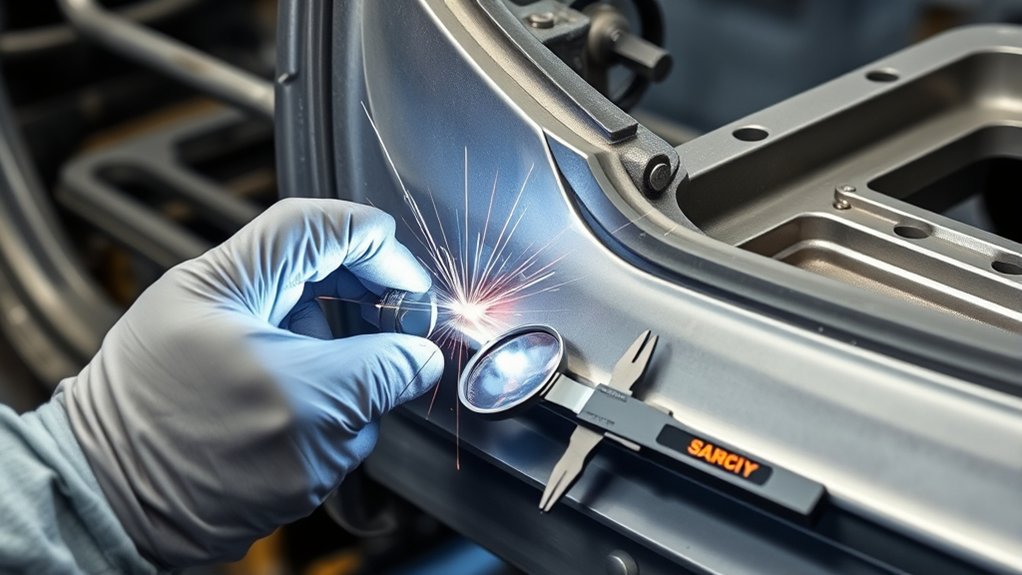
Inspection begins before the first vehicle weld. Check the welder, cables, gun liner, drive rolls, tips, electrodes, gas supply, ground path, and consumables. Make practice welds on matching coupons and destructively test them until the result meets the OEM or approved procedure.
During and after the vehicle repair, verify:
- Correct weld type, count, position, spacing, sequence, and size
- Required plug fill, nugget diameter, penetration, and tie-in to each layer
- No cracks, burn-through, holes, missed welds, unacceptable porosity, undercut, overlap, or lack of fusion
- No excessive spatter, contamination, heat spread, shrinkage, or distortion
- Correct rivet type, orientation, seating, and adhesive squeeze-out where mixed attachment methods are used
- Vehicle dimensions, panel gaps, glass openings, mounting points, and related component fit
- Restored seam sealer, primer, cavity wax, foam, undercoating, and back-side corrosion protection
- Completion of required scans, initialization, alignment, roadworthiness checks, and calibrations
Do not assume that a smooth surface bead proves penetration or internal fusion. Conversely, grinding a structural weld flush when the procedure does not call for it can remove required weld metal and hide defects.
Ultrasonic, radiographic, dye-penetrant, magnetic-particle, or other nondestructive testing may be appropriate for an engineered fabrication, heavy vehicle, commercial chassis, or code-controlled repair when the governing specification calls for it. These methods are not routine substitutes for OEM test coupons, dimensional checks, and approved collision-repair inspection criteria.
Visual inspection cannot prove that an overheated AHSS or UHSS part retained its intended metallurgical properties. If heat input, cut location, or welding method exceeded the repair procedure, replacing the affected part may be the only defensible correction.
Record the OEM document revision, repair measurements, welder identification, consumables, machine settings, coupon results, attachment count, inspection findings, corrosion materials, scans, calibrations, and final quality-control sign-off. This creates a clear compliance trail.
What Mistakes Weaken Auto Structural Welds?
A weld can fail before the arc starts if the wrong part, cut location, material, attachment method, or vehicle dimension has already been chosen.
- Skipping OEM research: The technician assumes a familiar procedure applies to a different model, year, material, or production change.
- Welding a replace-only part: A prohibited UHSS section, suspension component, casting, or reinforcement is heated or patched.
- Substituting processes: Plug welds replace required spot welds, TIG replaces MAG, or adhesive replaces welds without authorization.
- Poor material preparation: Rust, oil, paint, moisture, primer, aluminum coating, or adhesive contaminates the joint.
- Incorrect fit-up: The root gap, overlap, flange, backing strip, plug-hole size, or vehicle dimension is wrong.
- Wrong consumables: Wire strength, wire diameter, gas, adhesive, rivet, or primer does not match the repair procedure.
- No test welds: Settings are taken from a chart or machine display without matching coupons and destructive testing.
- Excessive heat: Slow travel, long beads, poor sequence, repeated rework, or an unsuitable process enlarges the heat-affected zone.
- Bad current path: The work clamp is too far from the weld and current passes through electronics, bearings, hinges, or other components.
- Incomplete inspection: The shop checks surface appearance but not penetration, nugget size, weld count, dimensions, corrosion protection, or required calibrations.
- Grinding away strength: Weld metal is dressed below the required profile or defects are hidden instead of corrected.
- Rushed corrosion protection: Back-side primer, seam sealer, cavity wax, adhesive, or undercoating is omitted after the joint cools.
Understanding correct stick-welding amperage is useful for general fabrication. Shielded metal arc welding should not be used on a modern unibody or frame repair unless an OEM, body-builder manual, engineer, or governing procedure specifically approves the process.
Frequently Asked Questions
What certifications do I need for automotive structural welding?
Requirements vary by employer, OEM network, contract, insurer, vehicle type, welding code, and jurisdiction. AWS, ASE, I-CAR, OEM, and equipment-manufacturer programs cover different knowledge or performance areas. A credential does not replace the current vehicle-specific repair procedure or qualification for the exact process being used.
What welding process is used for automotive repair?
Common attachment methods include squeeze-type resistance spot welding, GMAW or MAG plug welding, approved butt welding, MIG brazing, rivets, structural adhesive, and combinations of these methods. TIG is used only when the vehicle maker or governing procedure expressly approves it.
What counts as structural welding?
Structural welding joins or repairs an approved part that carries vehicle loads, controls body or chassis geometry, supports a safety-system mounting point, or manages crash energy. Examples can include frame rails, unibody rails, pillars, rockers, crossmembers, roof rails, floors, and mounting reinforcements.
What is the ISO standard for welding quality?
The ISO 3834 series covers quality requirements for fusion welding of metallic materials. It helps organizations manage welding quality, but it is not a vehicle-specific collision-repair procedure, a universal welding license, or permission to weld a particular automotive component.
Can you weld over paint or galvanized coating?
Do not weld through paint, rust, oil, moisture, or unknown contamination. Galvanized and factory-coated steel requires process-specific preparation. Some STRSW procedures require approved weld-through primer, while some MAG and MIG-brazing procedures prohibit it in the joint. Follow the exact OEM coating instructions and control hazardous fumes.
Can you weld a cracked frame rail?
Only when the current OEM, body-builder, or engineered procedure authorizes a repair at that exact location. A cracked, kinked, corroded, heat-damaged, hydroformed, reinforced, or high-strength rail may require partial or complete replacement instead of welding.
Is TIG welding approved for automotive frames?
Not as a universal rule. TIG may be suitable for a specific engineered steel, aluminum, or custom-fabrication joint, but many collision-repair procedures specify STRSW, MAG, MIG brazing, rivets, or adhesive instead. Use TIG only when the governing procedure expressly permits it.
What should be checked after structural welding?
Verify weld type, count, size, penetration, nugget or plug quality, dimensions, panel fit, mounting-point position, corrosion protection, scans, wheel alignment, system initialization, and any required ADAS calibrations. Document the procedure revision, settings, coupon tests, measurements, and final inspection.
Safety Disclaimer: This article is for informational purposes only. It does not replace current OEM repair procedures, professional collision-repair training, workplace exposure controls, high-voltage qualifications, a governing welding code, or inspection by a qualified repair professional.
Conclusion
Structural welding matters because one incorrect joint can change alignment, fatigue life, corrosion resistance, restraint mounting, and crash-energy management. A safe repair starts with the VIN and the current OEM procedure, not with a preferred welding process or a generic settings chart.
Confirm whether the part can be repaired or sectioned, identify every material and layer, protect the vehicle’s electrical and safety systems, prepare the joint by process, prove the settings on matching coupons, and inspect the finished repair against documented criteria. Restore every coating and complete the required measurements, scans, alignment checks, and calibrations before the vehicle returns to the road.
Sources
- I-CAR OEM Technical Information Matrix — locating vehicle-maker collision-repair procedures and attachment information.
- American Honda Body Repair Manual Welding & Sectioning Guideline Revisions — approved welding methods, material limits, wire selection, coating preparation, and sectioning guidance.
- I-CAR Battery Disconnect Considerations — electronic protection, work-clamp placement, 12-volt isolation, and high-voltage precautions.
- OSHA 29 CFR 1910.252 — welding, cutting, ventilation, fume, and hot-work safety requirements.
- American Welding Society Codes and Standards — scope and use of AWS structural welding codes.
- ISO 3834-1:2021 — criteria for selecting fusion-welding quality requirements.