To master TIG walking the cup, use the ceramic cup as a steady guide while your wrist rocks the torch between two contact points. The technique works best when the joint is clean, your hands are supported, the tungsten and cup are set correctly, and you can maintain the same arc length as the torch moves forward.
Quick Answer
To walk the cup in TIG welding, rest the ceramic cup lightly against a clean joint, rock it between two contact points with small wrist movements, and advance slightly with each rock. Keep the arc length, torch angle, puddle size, shielding gas, and filler timing steady. Practice the motion dry before welding live.
Key Takeaways
- Walking the cup uses two cup contact points, a light touch, and controlled wrist movement rather than arm strength.
- Set the cup, tungsten stickout, gas flow, amperage, and filler metal for the actual material and joint instead of copying one universal setup.
- Keep a short, steady arc and add filler near the leading edge of the puddle without touching the tungsten.
- Practice dry motion and flat beads before progressing to grooves, pipe, vertical, or overhead positions.
- Uniform ripples look good, but proper fusion, clean weld toes, penetration, and freedom from defects matter more.
At a Glance
| Time Required | Plan on 20 to 35 minutes for a focused practice session. Building reliable control may take many sessions. |
| Difficulty | Intermediate. New TIG welders can practice the motion, but they should first understand puddle control and tungsten contamination. |
| Tools Needed | TIG welder, compatible torch and ceramic cup, flowmeter, argon, tungsten, filler rod, clean scrap, dedicated cleaning tools, helmet, gloves, flame-resistant clothing, and ventilation. |
| Cost | Low additional cost if you already own a TIG setup. The main expenses are shielding gas, filler, tungsten, cups, and practice metal. |
Understanding the Walking the Cup Technique

Walking the cup means resting the ceramic TIG cup against a suitable surface and rocking it from one edge to the other while advancing along the joint. Lincoln Electric describes walking the cup as a common pipe and tube technique that helps advance the torch while maintaining a consistent arc length.
Picture the cup as a small barrel. One side of the cup contacts the joint, then your wrist rolls it onto the opposite side. Each change from one contact point to the other moves the torch a small distance forward. The cup should rock smoothly instead of scraping, bouncing, or being forced across the metal.
The cup is only a guide. Your tungsten still needs to remain centered over the joint, and the puddle must wash into both sides. If the cup moves but the arc length, torch angle, or puddle position changes, the bead will wander or become uneven.
The movement should come mainly from your wrist and fingers. Avoid steering the torch with large shoulder or elbow movements. Support your hands or forearms whenever possible so the cup can pivot with light, repeatable pressure.
Walking the cup is especially useful on stainless pipe, socket welds, tube joints, and grooves that give the cup two stable surfaces to ride against. It may also help in vertical or awkward positions. It is less useful on thin sheet, narrow outside corners, obstructed joints, rough surfaces, or any weld where the procedure requires freehand travel.
A uniform ripple pattern shows repeatable movement, but it does not prove fusion, penetration, or code compliance.
Essential Equipment and Setup for Walking the Cup
A stable setup makes the technique much easier. Your power source, torch, cup, tungsten, filler, shielding gas, joint preparation, and body position all affect whether the cup walks smoothly.
Products Worth Considering

SPECIFICATION: 49PCS TIG Torch Accessories kit (consumables).

Easy to assemble, You just push the transparent shield cup and make it installed firmly and seamlessly

Product Composition & Basic Info: This TIG torch accessories kit including shield cups, electrode clips, and rings. Fits WP-17, WP-18, WP-26 torches, providing parts for TIG welding tasks
Choose the Torch and Cup
Choose a torch that can safely carry the required amperage and still fit the joint. A 17- or 20-series designation identifies a torch style, not a cup size. Cup sizes use separate numbers such as #6, #8, or #10. For example, a #8 cup has an inside diameter of about 1/2 inch.
There is no single best cup for walking the cup. A cup needs enough outside surface to rock without catching, but it must also fit the groove or joint. A smaller cup can help with a narrow root area, while a larger cup may ride more smoothly over a wider fill or cap pass.
A gas lens can improve shielding-gas flow around the tungsten and puddle, especially when the joint requires extra tungsten stickout. Review the cup, gas-lens, flow, and electrode charts in the CK Worldwide TIG technical guide before selecting consumables.
Select and Prepare the Tungsten
A 2% lanthanated tungsten electrode is a versatile choice for many AC and DC TIG applications. Both Miller and CK Worldwide identify blue 2% lanthanated tungsten as a useful general-purpose electrode. The final choice must still match the machine, polarity, metal, amperage, and welding procedure.
Use a tungsten diameter that can carry the welding current without overheating. Grind the electrode lengthwise on a clean wheel or grinder reserved for tungsten. A contaminated grinding surface can transfer other metals to the electrode and make the arc unstable.
For common DC TIG practice, use an even taper with a small flat at the tip when needed for the amperage. If the tungsten touches the puddle or filler rod, stop and regrind it. Continuing with a contaminated point usually causes arc wander and poor puddle control.
Set Tungsten Stickout and Arc Length
A tungsten protrusion of about 1/8 to 1/4 inch is a common starting point with standard cups. That range is not universal. Cup diameter, electrode diameter, joint access, drafts, and gas-lens use may require more or less stickout.
Set the stickout so the cup can rest against the joint while the tungsten holds a short arc. A training arc gap of roughly 1/16 to 1/8 inch is common, but the machine manual, material, joint, and WPS take priority. Excessive stickout without enough shielding can expose the tungsten and puddle to air.
Set Shielding Gas and Amperage
Pure argon is commonly used for TIG welding steel, stainless steel, and aluminum. Set it with a flowmeter rather than relying only on regulator pressure. General TIG work often starts around 15 to 20 cubic feet per hour in a draft-free area, but the correct flow changes with cup size, gas lens, torch position, joint shape, and air movement.
Too little flow can allow contamination. Too much flow can create turbulence that draws surrounding air into the gas shield. Check the torch, hoses, O-rings, fittings, cup, and flowmeter if increasing flow does not correct a shielding problem.
Choose amperage from the machine chart, material thickness, joint design, position, tungsten size, and applicable WPS. A machine such as a Miller XMT 304 can support DC TIG work when correctly configured, but the machine model does not determine the correct welding current. Do not copy a 175-amp setting simply because it worked on another practice coupon.
Select the proper filler rod family for the base metal and service requirements. Keep the filler clean, dry, and within the shielding-gas envelope while welding.
Prepare the Joint and Work Area
Remove oil, grease, moisture, paint, rust, heavy mill scale, oxide, and grinding dust. Use material-specific cleaning tools, including dedicated stainless-steel brushes for stainless or aluminum where required. Good joint preparation also includes proper fit-up, tack placement, root opening, and alignment.
Arrange the torch cable so it does not pull against your wrist. Position the work at a comfortable height, confirm that your helmet gives a clear view of the puddle, and plan where your hands or forearms will be supported before starting the arc.
Warning: TIG welding can expose you to ultraviolet radiation, burns, electrical shock, fire, fumes, hot metal, and oxygen-displacing shielding gas. Use a suitable helmet, gloves, flame-resistant clothing, ventilation, and fire controls. Stainless-steel welding can generate hexavalent chromium. Never weld in a confined or enclosed space without required atmospheric testing, ventilation, supervision, and confined-space controls. Review OSHA welding hazard guidance and your employer’s safety procedures before welding.
How to Walk the Cup in TIG Welding Step by Step
- Clean and inspect the joint. Confirm that the metal, filler rod, cup, tungsten, and nearby work area are clean. Check the fit-up and tack welds before positioning the torch.
- Brace your body. Support your torch hand, forearm, elbow, or opposite hand on a stable surface. Make sure the torch cable cannot pull you away from the joint.
- Place the cup against two contact points. Rest one edge of the ceramic cup lightly against one side of the joint. Roll it onto the opposite edge and notice how the tungsten moves across the joint without changing its distance from the metal.
- Dry-walk the complete path. With the welder off, rock and advance the cup along the planned bead. Check for tacks, clamps, changes in groove width, or body positions that could interrupt the motion.
- Start the arc and form the puddle. Hold the cup stable, start the arc without touching the tungsten, and establish a puddle centered on the joint. Do not begin moving until both sides are wetting in as required.
- Rock and advance. Roll the cup from one contact point to the other. As the cup reaches the second edge, allow it to advance a small amount. Repeat the same motion with light pressure and a steady rhythm.
- Add filler at the leading edge. Keep the filler rod low, commonly around 10 to 20 degrees from the work as a starting range, and feed it into the front of the puddle. Keep the hot end inside the shielding-gas envelope and away from the tungsten.
- Watch the puddle, not just the ripples. Confirm that the puddle reaches both weld toes. Adjust amperage, travel speed, filler amount, or step width if one side is not tying in.
- Finish the bead correctly. Reduce travel speed slightly if needed, add enough filler to prevent an empty crater, taper the current with the pedal or downslope control, and hold the torch in place during post-flow.
Pro Tip: Practice the full rocking motion with the welder off before every new joint shape. If the cup catches, skips, runs into a tack, or forces your wrist into an uncomfortable angle, change your position before striking the arc.
Products Worth Considering

Complete 123-Piece Set:All necessary TIG torch accessories and consumables for WP-17, WP-18, and WP-26 torches.

79pieces TIG Torch Accessories (consumables).

Complete TIG Torch Kit - 71pcs Tig Welding Torch accessories (consumables) kit. This set includes all the essential TIG torch accessories and consumables, so you can get started on your welding projects right away.
Practice Drills for Building Cup Control
Walking the cup becomes easier when you practice one skill at a time instead of trying to master torch motion, filler timing, pipe position, and heat control in the same session.
Drill 1: Dry Motion
Use a clean cup with the machine off. Draw a straight soapstone line on flat plate and rock the cup along it. Keep the torch head centered over the line. Practice moving in both directions so you do not depend on only one wrist position.
Drill 2: Autogenous Beads
Run short beads without filler on clean plate that is suitable for autogenous practice. Focus on arc length, puddle width, straight travel, and equal wetting on both sides. Stop if the tungsten becomes contaminated.
Drill 3: Add Filler
Repeat the same path while adding a small, consistent amount of filler. Try feeding with each completed rock, then compare that result with a smoother continuous-feed method. Use whichever method gives the required bead and fusion for the joint.
Drill 4: Progress to Joints and Pipe
Move from flat beads to fillets or grooves, then to large-diameter pipe that gives the cup a stable path. Practice the easy sections first. Small-diameter pipe, changing clock positions, vertical travel, and overhead work should come later.
Focused sessions of about 20 to 35 minutes can help you build rhythm without letting fatigue turn into poor technique. Photograph or label each coupon so you can compare bead width, toe tie-in, heat tint, filler consistency, and defects between sessions.
How to Achieve Consistent Beads in TIG Welding
Consistent TIG beads come from repeatable setup and puddle control. Walking the cup cannot correct dirty metal, a damaged cup, poor fit-up, incorrect polarity, unstable gas flow, contaminated tungsten, or unsuitable filler.
Use a straight guideline when practicing on plate. Keep the cup’s forward step small enough that the puddle stays connected to the previous step. If the cup advances too far, the pattern may look stretched and the weld toes may not fill evenly. If the steps are too tight, the bead can become wide, high, or overheated.
A 50/50 ripple overlap can be used as an informal visual training cue, meaning the next ripple partly overlaps the previous one. It is not a welding standard and does not guarantee weld quality.
Keep the filler centered near the leading edge of the puddle. Too much filler can produce excessive reinforcement or cold overlap. Too little can leave an underfilled joint. Feeding to only one side can make one weld toe higher than the other.
Maintain a short arc and a steady torch angle. The cup should control the travel path without forcing the tungsten to swing far beyond the edges of the joint. A wide weave increases heat input and may reduce travel speed, so use only the side-to-side movement needed for fusion.
Inspect the Weld, Not Just the Pattern
After the coupon cools, look for:
- A straight bead centered on the joint
- Even tie-in at both weld toes
- No visible cracks, porosity, tungsten inclusions, overlap, or undercut
- Consistent reinforcement without a rope-like or sunken profile
- Appropriate penetration or root fusion for the joint
- No heavy oxidation or sugaring on stainless roots that require backing gas
- A crater that is filled rather than cracked or hollow
Appearance alone cannot confirm internal soundness. Critical work may require visual acceptance criteria, bend tests, penetrant testing, radiography, ultrasonic testing, or other inspection specified by the code or procedure.
Essential Tips for Enhancing Control and Precision in TIG Welding
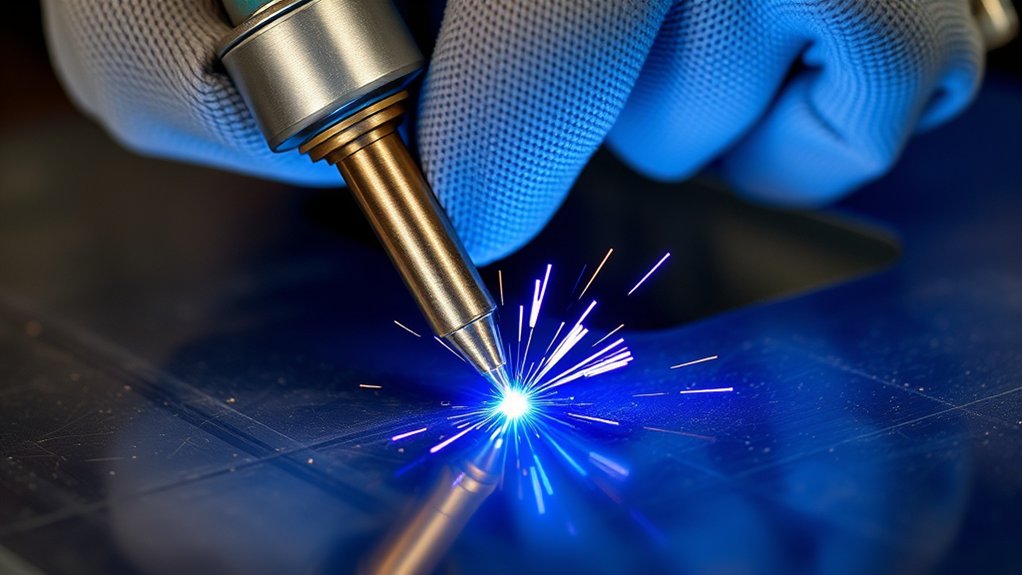
Walking the cup works best when your body is stable. Brace your torch hand, forearm, or elbow whenever possible. Move or rotate the workpiece when permitted instead of forcing your wrist through a weak position.
Relax your grip and use light cup pressure. Pressing hard increases friction and makes the cup catch. It can also cause sudden changes in torch angle when the cup crosses a tack or surface mark.
Keep the puddle in clear view. Feed filler from the side that gives you the best sight line, but do not allow your hand or rod to block the arc. Keep the filler within the gas shield so its hot end does not oxidize between additions.
Do not let the torch cable control the torch. Route it over your shoulder, support it with your arm, or arrange it on the bench so its weight stays off your wrist.
Use amperage and shielding gas settings that fit the material. A number such as 175 amps may work on a particular thick coupon but can destroy thin tube. Review the machine manual, test the setup on matching scrap, and adjust according to puddle behavior.
The main welding parameters work together. Current, arc length, travel speed, torch angle, and filler addition can all change bead width, heat input, penetration, and reinforcement.
Note: Walking the cup is not permitted or preferred on every job. A welding procedure specification may require freehand TIG, stringer beads, a maximum weave width, specific heat input, particular shielding arrangements, or a qualified progression. The WPS, code, engineer, employer, and machine manual take priority over general practice advice.
Material-Specific Walking the Cup Tips
Stainless Steel
Stainless pipe is one of the most common uses for walking the cup. Use clean stainless-only brushes and tools, correct filler, controlled heat input, and suitable argon coverage. Pipe roots often require an internal argon purge when the procedure calls for it. Poor root shielding can cause heavy oxidation or sugaring that damages corrosion resistance and weld quality.
Do not judge stainless quality from color alone. Heat tint can signal shielding or heat-input changes, but the acceptable condition depends on alloy, service, cleaning method, and procedure. Stainless welding also requires effective fume control because chromium-containing fume may include hexavalent chromium.
Carbon and Low-Alloy Steel
Remove oil, moisture, rust, paint, and heavy mill scale. Match the filler to the base metal and service requirements. Low-alloy or chromoly work may require controlled preheat, interpass temperature, filler selection, and cooling based on the alloy, thickness, restraint, and procedure.
Aluminum
You can walk the cup while AC TIG welding aluminum when the joint geometry and procedure allow it, but it is not always the easiest method. Aluminum needs thorough oxide removal, clean filler, suitable AC settings, and close heat control. A rough or dirty surface may make the ceramic cup catch, and thin aluminum can become too hot before a wide walking rhythm is established.
Use the correct tungsten, cup, gas coverage, and filler alloy. Practice on matching scrap before using the technique on a finished part.
Coated or Galvanized Metal
Do not weld over paint, plating, oil, or unknown coatings. Identify and remove coatings using an approved method, control the resulting dust and fumes, and follow the safety data and workplace procedure. Discussions about welding galvanized steel should treat zinc fume and coating preparation as safety issues rather than ordinary surface cleaning.
When Freehand TIG Is the Better Choice
Walking the cup is a useful tool, not the only correct TIG technique. Freehand travel may be better when:
- The cup cannot rest on two stable surfaces
- The joint is a narrow outside corner or thin sheet edge
- Fixtures, tacks, or nearby parts block the cup
- The surface is curved, rough, or interrupted
- Contact could transfer contamination to a sensitive material
- The required bead is narrower than the cup’s walking motion
- The WPS or code limits weaving or cup contact
- The pipe diameter is too small for a smooth cup path
A capable TIG welder should practice walking the cup, sliding the cup where permitted, and freehand torch control. That flexibility helps when the joint changes halfway through a job.
Troubleshooting Common Welding Issues in TIG
| Problem | Likely Causes | What to Check |
| Cup sticks or skips | Dirty surface, too much downward pressure, steep torch angle, poor hand support, or a cup that does not fit the joint | Clean the path, relax your grip, reduce pressure, dry-walk the joint, and try a different cup size. |
| Bead wanders | Unequal cup steps, cable drag, poor visibility, arc wander, or inconsistent joint width | Brace your hand, support the cable, sharpen the tungsten, shorten the arc, and follow a marked centerline. |
| Uneven or lumpy ripples | Irregular filler amounts, changing travel speed, wide steps, or varying puddle size | Use smaller steps, stabilize current, feed a repeatable amount, and watch the leading edge of the puddle. |
| Tungsten contamination | The tungsten touched the puddle, filler contacted the tungsten, or the grinding wheel was contaminated | Stop, remove the contaminated section if needed, and regrind lengthwise on a dedicated wheel. |
| Porosity or dull discoloration | Dirty metal, moisture, gas leak, drafts, damaged cup, excessive stickout, or turbulent flow | Clean and dry the joint, leak-check the system, inspect the cup, reduce stickout, shield drafts, and verify flow. |
| Undercut or cold lap | Incorrect heat, excessive weave, poor dwell, fast travel, or filler deposited without proper fusion | Narrow the motion, confirm both toes melt, adjust current and speed, and place filler into the molten leading edge. |
| Crater crack or hollow stop | Arc stopped abruptly without filling the crater or using downslope | Add filler before stopping, taper current, pause over the crater, and maintain post-flow. |
Change one variable at a time when troubleshooting. If you alter gas flow, amperage, filler timing, cup size, and tungsten stickout together, you will not know which change corrected or worsened the result.
TIG Welding Styles: Which One Fits You?
Welders use several informal names for walking patterns. These names are not universal standards, and different shops may use them differently. The correct movement is the one that produces the required fusion, profile, heat input, and inspection result.
Exploring Welding Techniques
- Butterfly Effect: An informal name for a broader side-to-side motion. It can create a wide visual pattern but adds movement and heat, so it should not be wider than the joint requires.
- Tight Weave: A narrower cup walk with short forward steps. It can help maintain a compact bead and controlled toe wetting.
- Super Tight Technique: An informal term for very small side-to-side movement and close ripple spacing. It demands steady arc length and careful filler control.
- Sliding the Cup: The cup remains in contact and slides rather than rocking through a full walk. Some joints allow this, while others become easier freehand.
- Freehand TIG: The cup does not rest on the joint. Hand bracing and direct torch control maintain the arc length.
Experiment on scrap and compare bead width, toe fusion, reinforcement, heat tint, travel speed, and consistency. Do not select a motion only because it creates dramatic ripples.
Finding Your Unique Style
Practicing different motions helps you find a comfortable and repeatable working style. Your preferred technique may become part of your personal welding identity, but it must remain flexible enough to fit the joint and procedure.
Pay attention to what feels stable rather than what looks most decorative. A slightly plainer bead with clean edges, proper penetration, and repeatable structure is better than an attractive pattern with overlap, undercut, or poor fusion.
Review the required TIG welding settings before changing styles, especially when moving between materials, thicknesses, and positions.
Join the Welding Community for Support and Growth
A skilled instructor or experienced welder can often spot a body-position or filler-timing problem that is difficult to diagnose from the finished bead alone. When asking for feedback, provide the material, thickness, joint, polarity, amperage, tungsten, cup, gas flow, filler, position, and photographs of both the front and root.
- Constructive Feedback: Ask reviewers to comment on toe fusion, bead profile, heat control, root condition, and setup instead of only rating the ripple pattern.
- Hands-On Learning: Attend a supervised class, apprenticeship lab, manufacturer demonstration, or local practice session where an instructor can correct the motion in real time.
- Community Challenges: Use repeatable coupons and documented settings so your improvement can be compared fairly.
- Lasting Connections: Share both successful and failed coupons. Defects often produce more useful discussion than a finished showpiece.
Frequently Asked Questions
How do you walk the cup in TIG welding?
Rest the ceramic cup lightly against two sides of a suitable joint. Rock the cup from one contact point to the other with your wrist, allow it to advance slightly, and repeat. Keep the tungsten centered, the arc length short, and the puddle tied into both sides.
What size TIG cup is best for walking the cup?
There is no universal best cup. A #8 cup is a common general starting point, while narrower roots may need a smaller cup and wider passes may work better with a larger one. The cup must fit the joint, provide shielding, and rock smoothly. Numbers such as 17 and 20 identify torch styles, not cup sizes.
Can you walk the cup with aluminum TIG?
Yes, when the joint and procedure allow it. Aluminum needs correct AC settings, oxide removal, clean filler, suitable tungsten, and close heat control. Freehand TIG may be easier on thin, curved, or rough aluminum surfaces where the cup cannot move smoothly.
What is the Rule of 33 in TIG welding?
The Rule of 33 is an informal pulsed-TIG starting point: about 33 pulses per second, 33% background current, and 33% pulse-on time or pulse width. It is not a 33-inches-per-minute travel rule, a welding standard, or a required setting for walking the cup.
Why does my cup stick or skip when I try to walk it?
The surface may be dirty or rough, the cup may not fit the joint, your torch angle may be too steep, or you may be pressing too hard. Clean the path, support your hand, reduce pressure, and dry-walk the joint before welding.
Is walking the cup better than freehand TIG?
Not always. Walking the cup can improve stability on pipe, grooves, and joints that support the cup. Freehand TIG is often better for thin sheet, tight access, small outside corners, interrupted surfaces, or procedures that restrict cup contact or weaving.
Do you add filler with every cup movement?
You can add filler with each completed rock, use a lay-wire method where permitted, or feed more continuously. The correct method depends on the joint and procedure. The important points are consistent filler volume, clean placement at the leading edge, and proper fusion before advancing.
Can a beginner learn to walk the cup?
Yes, but beginners should first learn basic TIG setup, arc length, puddle control, filler addition, and tungsten recovery. Start with dry motion and flat coupons before attempting pipe or positional welds.
Conclusion
Mastering walking the cup means controlling several things at once: cup pressure, wrist rhythm, arc length, heat, filler placement, travel speed, and puddle shape. Start with clean metal, suitable consumables, stable gas coverage, and a body position that lets the cup move without strain.
Practice the motion slowly before chasing speed or decorative ripples. Inspect each coupon for fusion, clean toes, reinforcement, penetration, oxidation, and defects. Walking the cup becomes a valuable TIG skill when it produces a sound weld and follows the required procedure—not merely when the surface pattern looks uniform.
Sources
- Lincoln Electric — Master Class — supports the definition and pipe-welding use of walking the cup.
- CK Worldwide — Technical Guide for TIG Welding — supports cup selection, tungsten preparation, stickout, gas flow, amperage ranges, and troubleshooting.
- CK Worldwide — Tungsten Specifications — supports current electrode types, color codes, and AC/DC applications.
- Miller — All About Tungsten in TIG Welding — supports tungsten selection, longitudinal grinding, sizing, and contamination control.
- Miller — Guide to TIG Welding Basics — supports torch placement, filler position, arc length, gas flow, and beginner troubleshooting.
- OSHA — Controlling Hazardous Fume and Gases During Welding — supports ventilation, stainless-steel fume, coating removal, confined-space, and shielding-gas safety guidance.