Weld penetration is how deeply the weld metal fuses into the base material, and you need enough of it to make a joint strong, durable, and safe. If penetration is too shallow, you can get lack of fusion, cracking, or weak load paths; too much can cause burn-through. Current, voltage, travel speed, joint prep, and electrode angle all affect it. Full control over penetration helps you meet inspection standards and optimize performance.
What Is Weld Penetration?
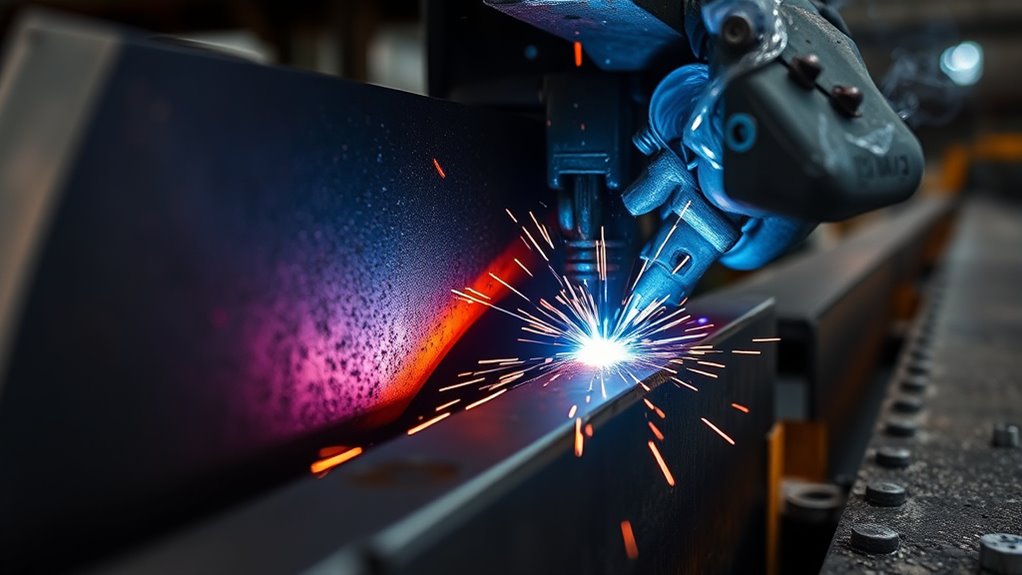
Weld penetration is the depth to which molten weld metal fuses into the base metals, and it’s a key factor in joint strength and integrity. You measure penetration depth by how far the weld fusion extends below the surface and into the parent material.
If you get shallow penetration, you only partially fuse the base metals; if you achieve deep penetration, you create full fusion through the joint. You control this outcome through welding current, travel speed, joint preparation, and torch or electrode angle.
When you set these variables precisely, you shape the weld to meet the task instead of accepting weak results. In technical terms, weld penetration describes the internal reach of fusion, not surface appearance.
You should treat it as a controllable parameter, because it determines how completely the joint forms and how faithfully the welded structure serves its intended function. Additionally, achieving the right weld size and length is crucial for optimal strength and performance.
Why Weld Penetration Matters
You need proper weld penetration to achieve maximum fusion, which directly improves joint strength and long-term durability. If penetration is insufficient, you increase the risk of lack of fusion, cracking, and other defects that can weaken the joint. In critical applications, you also need the right penetration profile to meet inspection requirements and maintain safety and reliability. Achieving the correct amperage settings is essential for optimizing penetration and preventing burn-through during the welding process.
Joint Strength And Durability
Proper weld penetration is a primary determinant of joint strength, because full penetration creates a continuous fusion zone that can carry higher static loads and resist fatigue more effectively. You preserve joint integrity when the weld root fully bonds, and you lower weld fatigue under cyclic stress.
| Penetration | Load Path | Outcome |
|---|---|---|
| Full | Continuous | Maximum strength |
| Deep | Stable | Better durability |
| Partial | Interrupted | Lower capacity |
| Adequate | Uniform | Reliable service |
In aerospace and oil & gas service, that margin matters. You need penetration that supports vibration, thermal cycling, and harsh exposure without loss of stiffness. When you specify the correct depth, you free the structure from avoidable weakness and keep performance aligned with safety requirements and inspection standards.
Defect Prevention Benefits
Because penetration controls how completely the weld metal fuses with the base metals, it directly affects defect formation and overall weld quality.
You use proper penetration to maximize fusion, which cuts the risk of lack of fusion, cracks, and other hidden flaws. When you hold penetration within the correct range, you improve defect identification during inspection because the weld profile is more consistent and easier to verify.
If penetration is too shallow, you create weak zones that can’t support demanding service. If it’s too deep, you risk burn-through and distortion.
Safety And Reliability
Penetration control does more than reduce defects; it directly shapes the safety and reliability of the finished weld. When you achieve the correct depth, you maximize fusion, limit cracks and lack of fusion, and protect joint strength under load.
In aerospace and oil & gas service, that precision isn’t optional; it’s how you meet weld standards, satisfy industry regulations, and support strict safety protocols. You also improve fatigue resistance, so your assemblies hold up longer in demanding conditions.
Inspection techniques often measure penetration depth, so accurate control helps you pass quality checks without compromise. By avoiding burn-through while preserving full fusion, you create welds that perform predictably, resist failure, and give you the freedom to build with confidence.
Full Penetration vs. Partial Penetration
Full penetration means the weld fuses through the entire joint thickness, creating a continuous bond suited to high-stress applications, while partial penetration reaches only the surface region and is generally acceptable in lower-demand service.
You should treat these penetration types as distinct engineering choices, not interchangeable options. Full penetration gives you maximum load transfer and structural continuity, which is why aerospace and shipbuilding rely on it when safety and performance can’t be compromised.
Partial penetration can meet service needs in lighter-duty assemblies, but it may leave you with reduced strength where forces concentrate. When you select welding techniques, you must match the joint to the required demand, because the wrong choice can undercut integrity.
Full penetration often demands more heat and tighter control to avoid burn-through, so you need precision and discipline. Additionally, understanding the maximum fillet weld size is crucial in ensuring the effectiveness of your welds.
If you want resilient structures, choose the penetration level that fits the load, not the one that merely looks adequate.
What Factors Affect Weld Penetration?

Once you’ve selected full or partial penetration for the joint, you still need the right process settings and technique to achieve it.
You control weld penetration by balancing current, voltage, and travel speed, because these variables shape heat distribution and determine how deeply the arc melts the base metal. Your welding method and weld techniques also matter: slower travel increases fusion, while erratic motion reduces consistency.
Joint alignment, root gap, and bevel angle govern access for molten metal, so poor fit-up limits penetration even when power is adequate.
Material composition and thickness change the energy demand; thicker sections and alloys with higher conductivity or greater mass need more input.
Electrode angle affects arc focus, and filler materials influence puddle behavior and fusion profile. Additionally, mastering welding parameters ensures better control over penetration and overall weld quality.
Operator skill keeps these factors stable, and environmental conditions can steal heat or disturb shielding, making control less certain.
How to Increase Weld Penetration
To increase weld penetration, you need to raise heat input and improve arc access to the joint. Increase amperage or voltage so the arc delivers more energy into the base metal, then slow your travel speed to keep heat in the puddle longer. That extra dwell time lets fusion reach deeper and gives you tighter control over the root.
Your electrode selection matters too: choose the correct type and size for the material and thickness; larger electrodes can support stronger penetration on heavier sections. Prepare the joint with proper beveling and clean surfaces so the arc can reach the root without contamination or blockage.
You should also match the welding process to the task. TIG and MIG each offer distinct penetration profiles, so pick the process that gives you the depth and control your application demands. When you adjust these variables deliberately, you gain deeper fusion and freer control. Additionally, using FineCut consumables can improve the overall precision of your welding by minimizing heat input and enhancing arc stability.
How to Measure Weld Penetration
You can measure weld penetration by cutting a cross-section through the joint, then polishing and etching it to expose the fusion depth for direct analysis. You can also use visual inspection methods, including high-resolution microscopes, to assess penetration without damaging the weld when the surface condition is properly prepared. For higher precision, you can combine calibrated measurement tools and software to quantify the penetration profile and improve repeatability. Additionally, understanding heat input management is crucial for achieving optimal weld penetration and minimizing distortion.
Cross-Section Analysis
You use cross sectional techniques to expose the fusion boundary, then polish and etch the specimen so you can read penetration depth with precision.
This destructive test gives you hard data on weld quality, revealing lack of fusion, undercutting, or excessive penetration that can weaken the joint.
When you need higher resolution, high-resolution digital microscopes and calibrated software sharpen measurement accuracy and reduce guesswork.
You also depend on consistent sample preparation, because variation skews results and hides defects.
Visual Inspection Methods
| Indicator | What you see | Meaning |
|---|---|---|
| Bead width | Uniform across the joint | Penetration is likely consistent |
| Bead height | Stable, neither too high nor too low | Fusion depth may be correct |
| Undercut/spatter | Gouges or scattered metal | Penetration problems may exist |
When you train your eye well, you catch flaws before they become failure points. Skilled inspection keeps your work accountable, precise, and resistant to hidden weakness.
Measurement Tools and Software
Measuring weld penetration starts with choosing the right tool for the job. You can section the weld, then cut, polish, and etch the sample to expose fusion depth with high detail.
If you need non-destructive assessment, use high-resolution digital microscopes and digital imaging to inspect the bead without weakening the joint. Prepare the specimen carefully; a clean, contaminant-free surface improves accuracy.
Then apply software calibration so analysis tools convert image pixels into real depth values. Calibrated software lets you measure penetration precisely and compare results across welds.
Keep your inspection procedure consistent each time, because repeatable methods produce reliable data and stronger quality control. With the right tools, you don’t just observe welds—you verify performance and protect the freedom to build with confidence.
Frequently Asked Questions
Why Is Weld Penetration Important?
Weld penetration matters because you need full fusion for strong joint strength and reliable weld quality. It prevents lack of fusion, cracks, and failure, helping you meet design specs, pass inspection, and avoid burn-through.
How Much Penetration Should a Weld Have?
You should target penetration depth based on joint thickness: about 100% for full penetration in critical, load-bearing welds; less for thin sections to avoid burn-through. Tune amperage and travel speed to protect weld quality.
Conclusion
So, you’d think weld penetration is just about melting metal, but it’s really about controlling strength, reliability, and failure risk. When you get penetration right, your joint performs as intended; when you don’t, even a neat-looking weld can hide a structural weakness. By checking fit-up, heat input, and measurement, you make the invisible visible. In welding, the deepest-looking flaw is often the one you can’t see until it matters.