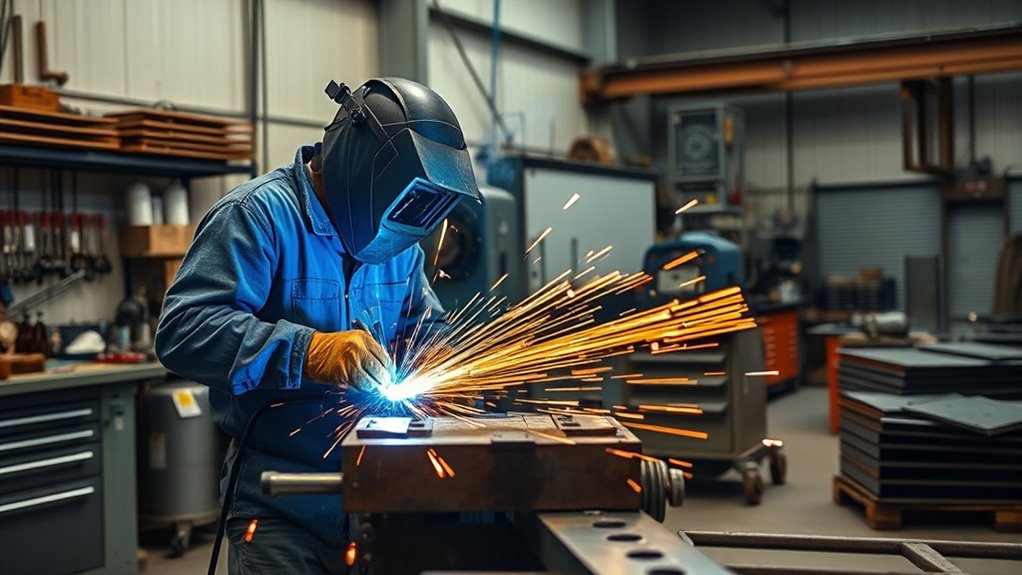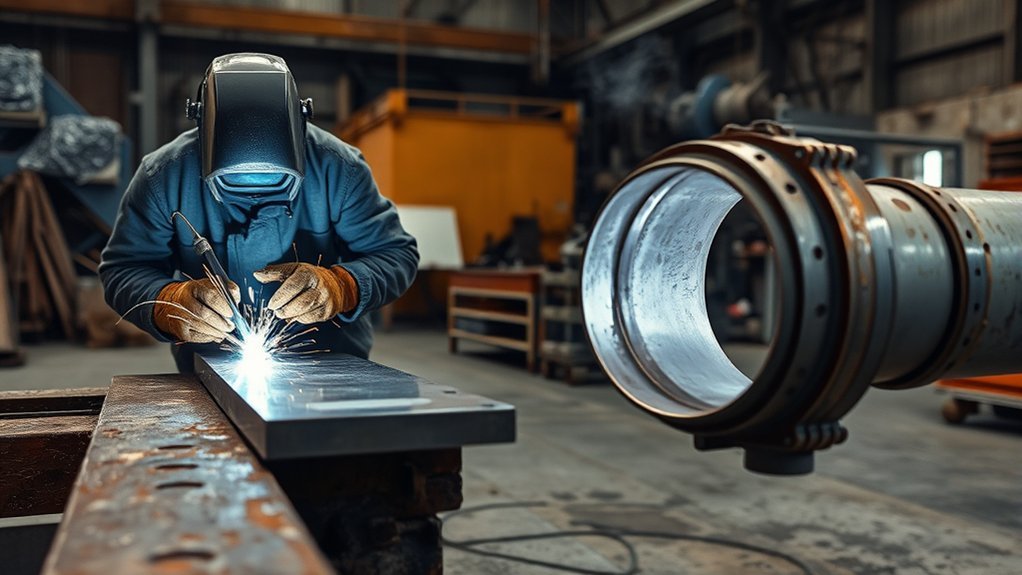
Plate and pipe welding use the same basic puddle-control skills, but the joint orientation changes how gravity, access, and body position affect the weld. Plate training normally covers 1G through 4G. Pipe adds rolled and fixed setups such as 1G, 2G, 5G, and 6G. These codes describe qualification-test setups; they are not a universal difficulty ranking or blanket permission to weld every joint. Understanding that distinction helps you practice in a useful order, read a welding procedure specification correctly, and avoid common defects.
Quick Answer
Plate groove tests generally use 1G flat, 2G horizontal, 3G vertical, and 4G overhead positions. Pipe groove tests commonly use 1G rolled pipe, 2G fixed pipe with a vertical axis, 5G fixed pipe with a horizontal axis, and 6G fixed pipe inclined about 45 degrees.
Key Takeaways
- The same number can describe different plate and pipe test setups, so read the full designation and coupon orientation.
- The letter G identifies a groove-weld test, while F identifies a fillet-weld test.
- Pipe work is usually harder because the work angle, travel angle, visibility, and body position change around the circumference.
- Vertical-up and vertical-down progression are not interchangeable; use only the direction allowed by the WPS and governing code.
- 6G is one of the most demanding common tests, but its qualification range still depends on the code, process, material, thickness, diameter, backing, and other variables.
- A position label never replaces an approved WPS, welder qualification record, hazard assessment, or hot-work permit.
What Are Welding Positions?
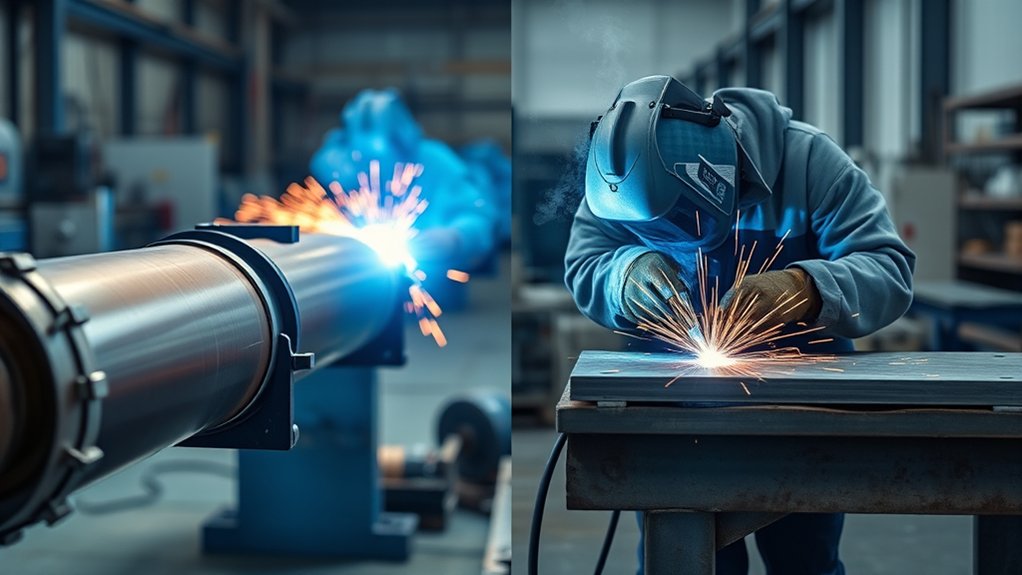
Welding positions describe the orientation of the joint and weld face while the weld is being made. Orientation affects how gravity pulls on the molten puddle, how clearly you can see the joint, and how you hold the torch, gun, or electrode.
The familiar labels 1G, 2G, 3G, 4G, 5G, and 6G are mainly qualification-test designations. The number identifies a defined coupon setup, while the letter identifies the weld type. Production welds are also described as flat, horizontal, vertical, or overhead. Those production terms and the test codes are related, but they are not always interchangeable.
Flat work is normally the easiest place to build control because gravity helps the puddle stay in the joint. Horizontal, vertical, overhead, and fixed-pipe work demand tighter control because molten metal can sag, run ahead of the arc, or drip before it freezes.
Note: Position labels do not replace the welding procedure specification. For code work, follow the approved WPS for the process, base metal, filler metal, joint design, preheat, electrical settings, progression, inspection, and qualification requirements.
The position code tells you how the test coupon is oriented. The WPS tells you how to weld it, and the qualification record tells you the permitted range of work.
If you are still learning the basics, it also helps to understand the main welding processes. MIG, TIG, stick, and flux-core welding can behave very differently in the same position.
How to Read G, F, and R Welding Position Codes
G means the test uses a groove weld, such as a butt joint with prepared edges. F means the test uses a fillet weld, such as a lap, tee, or corner joint. Plate fillet tests commonly use 1F, 2F, 3F, and 4F. Pipe and tube fillet designations vary with the governing standard and coupon setup.
An R can identify a special condition rather than a basic weld type. For example, 6GR is a restricted-access tubular test used in some structural applications. It adds a restriction near the joint to limit access. A 6GR test is not simply a harder name for ordinary 6G, and it should not be treated as the automatic next step for every pipe welder.
The number is not a difficulty score. A higher number often describes a more complex setup, but difficulty also depends on the process, material, diameter, joint design, access, and acceptance criteria.
Welding Position Reference Table
Use this table as a practical orientation guide. The training-stage descriptions are general, not code rules. Exact qualification ranges depend on the governing standard, test coupon, weld type, process, material, thickness, diameter, backing, progression, and acceptance method.
| Position | Plate Groove Setup | Pipe Groove Setup | Typical Training Stage |
|---|---|---|---|
| 1G | Flat groove weld | Pipe rotates while the weld stays near the top | Foundation |
| 2G | Horizontal groove on a vertical plate face | Fixed pipe with its axis vertical; weld travels horizontally around it | Early to intermediate |
| 3G | Vertical groove, with progression specified up or down | Not one of the usual basic pipe-groove coupon codes | Intermediate |
| 4G | Overhead groove weld | Not one of the usual basic pipe-groove coupon codes | Advanced |
| 5G | Not a plate groove test code | Fixed pipe with its axis horizontal; weld goes around the full circumference | Advanced |
| 6G | Not a plate groove test code | Fixed pipe inclined about 45 degrees | Most advanced common test |
Products Worth Considering

Crafted with precision, our steel plates are laser-cut, offering unparalleled edge smoothness and dimensional accuracy compared to stamped and sheared parts.

🎲Superior Processing: Our steel plates are all laser-cut, providing edge and overall flatness that is unmatched by other stamped and sheared components.

Includes 2 pre-cut steel sheets that detach into 24 parts—weld them to build 2 hollow cubes and 2 dice.
How Plate Welding Positions Work
Plate positions are usually learned first because the joint is open, straight, and easier to see. The four main groove-weld plate test positions are flat 1G, horizontal 2G, vertical 3G, and overhead 4G.
In the 1G flat position, gravity helps the molten metal settle into the joint. This is the best place to practice bead shape, travel speed, arc length, starts, stops, and tie-in at both weld toes. Flat welding is not automatic or foolproof, but it is the most forgiving starting point.
In the 2G horizontal position, the groove runs across a vertical plate face. Gravity pulls the puddle toward the lower side, so watch the lower toe for overlap or sagging and the upper toe for undercut. Smaller passes and steady travel are often easier to control than one oversized bead.
In the 3G vertical position, the weld progresses up or down the joint. Vertical-up is common when deeper sidewall fusion and controlled fill are required. Vertical-down is used in some approved procedures, especially for certain thin materials or pipe applications. The direction must match the WPS.
In the 4G overhead position, you weld from below the joint. Keep the puddle compact and the arc controlled. Excess heat, a long arc, or slow travel can make the weld sag, crown, or drip.
Plate setup also affects joint design. Weld size and plate thickness must match the drawing and procedure, so understanding maximum fillet weld size can help you avoid oversized welds and poor edge fusion.
How Vertical Progression Changes 3G and Pipe Welds
Vertical progression is a separate variable from the position name. A 3G coupon can be welded upward or downward, and fixed-pipe procedures may also specify different progression for the root, fill, or cap. Do not assume that skill or qualification in one direction automatically covers the other.
Vertical-up techniques usually use a controlled pause at the sidewalls so each shelf of metal supports the next. Vertical-down techniques use faster travel and a smaller puddle to stay ahead of excessive buildup. The correct motion, heat input, and electrode angle depend on the process, filler classification, joint design, and WPS.
Warning: Do not change from vertical-up to vertical-down, or reverse the root-pass direction, simply because the bead is easier to run. That change can fall outside the approved procedure or qualification range.
What Makes Pipe Welding Positions Different?
Pipe welding is usually harder than plate welding because the joint wraps around a curved surface. As you move, your work angle, travel angle, body position, arc length, and view of the puddle all change. A fixed-pipe weld can feel flat at one point, vertical at another, and overhead at another.
In 1G pipe, the pipe normally rotates around a horizontal axis while the welder keeps the arc near the top. Because the work moves into a favorable orientation, 1G is a useful bridge between flat plate and fixed-pipe practice.
In 2G pipe, the pipe is fixed with its axis vertical. The weld joint stays in a horizontal plane, and the welder travels around the pipe while keeping the bead level.
In 5G pipe, the pipe is fixed with its axis horizontal. You cannot rotate it, so you weld around the full circumference. Puddle behavior changes as you move through overhead, vertical, and flat-like portions of the joint.
In 6G pipe, the pipe is fixed at about a 45-degree incline. Access, gravity, visibility, and hand position change at the same time, which makes 6G one of the most demanding common pipe tests.
Pro Tip: When a fixed-pipe weld becomes inconsistent, check body position before changing machine settings. Brace yourself so you can maintain arc length, keep the lead edge of the puddle visible, and complete each segment without reaching beyond a stable range of motion.
Heat input also becomes more important in fixed pipe. Too little can cause incomplete fusion, while too much can cause burn-through, sagging, undercut, or an overly wide bead. If you are troubleshooting defects, start with the basics of heat input, travel speed, and puddle control.
Plate vs Pipe Welding Positions
The main difference is that plate positions keep the joint on a straight, open surface, while pipe positions make you follow a curved circumference. The curve forces continuous changes in access and technique.
| Factor | Plate Welding | Pipe Welding |
|---|---|---|
| Typical groove-test positions | 1G, 2G, 3G, and 4G | 1G, 2G, 5G, and 6G |
| Access | Usually open and easier to see | Often curved, tighter, and harder to reach |
| Puddle behavior | Changes by position but follows a straight joint | Changes continuously around fixed pipe |
| Body position | Can often remain steady for the full bead | Must change while arc length and angles stay controlled |
| Primary skill challenge | Learning bead shape, sidewall tie-in, heat, and angle | Keeping those skills consistent as orientation and access change |
| Qualification limits | May qualify only specified positions, thicknesses, and joint variables | Also depends on diameter, fixed or rolled setup, progression, and other code variables |
Products Worth Considering

COMPLETE PRACTICE SET: Includes 6 welding practice coupons, each 2" x 4" and 3 mm thick; compact mild steel plates form a convenient welding starter kit

Material: low carbon steel; Finish: Plain

Fun and Functional Dachshund Design: turn practice into art! This welding practice kit lets you craft a charming 3D dachshund (sausage dog) sculpture; Once completed, it serves as an ideal desk decor piece or handmade gift, ideal for Father's Day, birthdays, and holiday gifting for welding enthusiasts and dog lovers alike
How Do AWS and ASME Use Welding Position Designations?
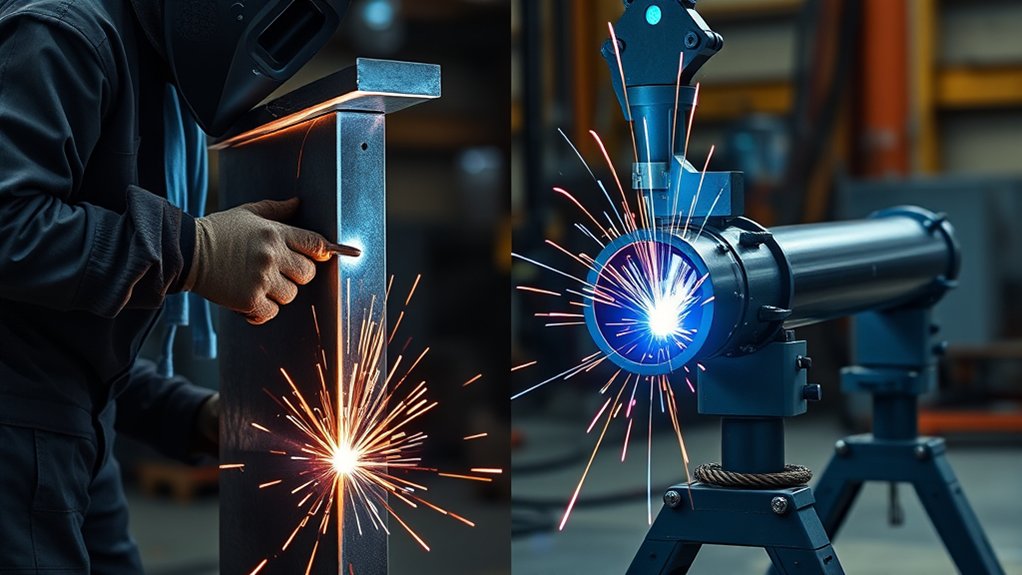
AWS codes and qualification specifications use standardized test positions so welders, inspectors, and employers can document the coupon orientation and the range qualified. For structural steel, the current AWS D1.1/D1.1M:2025-AMD1 Structural Welding Code—Steel addresses procedure qualification, welder qualification, fabrication, inspection, and acceptance. Other industries use different AWS codes, so D1.1 should not be treated as a universal welding rulebook.
For pressure-related work, ASME BPVC Section IX, 2025 edition, contains rules for qualifying welding procedures and personnel when another ASME construction code requires Section IX. The construction code, project specification, and adopted edition determine which rules actually control the job.
In shop language, people often use 1G through 6G as shorthand for production work. Technically, it is safer to separate the test position from the production welding position. A passing test establishes a code-defined qualification range; it does not erase limits on process, material, thickness, diameter, backing, progression, joint type, or employer documentation.
Note: The newest published code is not automatically the contract edition. Use the edition named by the project, jurisdiction, employer, or construction code, including any adopted addenda or amendments.
Code work also depends on the material and coating. Galvanized parts need suitable preparation and fume controls, so review safe practices for MIG welding galvanized steel before welding zinc-coated metal.
What Does a Welding Position Test Qualify You to Do?
A position test qualifies only the range allowed by the governing code and the recorded test variables. The qualification document should identify the welding process, coupon type and position, base-metal grouping, filler-metal classification or grouping, deposited thickness, pipe diameter when applicable, backing, progression, and test results.
A plate test does not automatically authorize every pipe weld. However, it is also too broad to say plate can never qualify pipe work. Some codes allow limited transfer based on pipe diameter, position, thickness, and other variables. Read the code table and the welder performance qualification record rather than relying on a shop saying.
A 6G pipe test is widely respected because it exposes the welder to changing orientations on fixed pipe. AWS describes it as covering all positions on fixed pipe, but the resulting qualification still remains tied to the applicable code and test variables. “All position” does not mean all processes, all materials, all diameters, or every joint detail.
Warning: A training certificate, employer qualification, and portable industry credential are not automatically the same thing. Confirm who issued the record, which code and edition it uses, what variables it covers, and whether continuity requirements are current.
Why Pipe Welding Usually Requires More Skill
Pipe welding usually requires more skill because the joint is curved, access is tighter, and the effective weld position changes as you move. On plate, you can often keep your body steady and focus on a straight joint. On fixed pipe, your body and torch angle must change while the bead still needs to remain consistent.
In 5G and 6G, you manage the bottom, sides, and top without rotating the workpiece. The puddle may flatten, sag, or drip depending on where you are around the pipe. Small changes in arc length or travel speed can create undercut, incomplete fusion, excessive reinforcement, or poor tie-in.
That is why pipe practice often focuses on repeatable starts and stops, a clean root pass, steady sidewall fusion, and controlled fill and cap passes. A smooth-looking cap is not enough; the weld must also meet the WPS and pass the required examination.
Shielding matters as well. Poor gas coverage, drafts, leaks, excessive flow, or the wrong setup can cause porosity and contamination. If welds suddenly look dirty or porous, review the basics of shielding gas selection and machine setup.
What Are the Most Common Welding Mistakes?
The most common mistakes in plate and pipe positions are poor travel angle, weak puddle control, wrong heat input, bad fit-up, contamination, and unstable body position. Harder positions expose small errors faster because gravity and limited access leave less room for correction.
Oil, paint, mill scale, rust, moisture, and coatings can affect weld quality. Zinc coatings need extra caution because heating them produces hazardous fumes and can contaminate the weld. Before welding coated steel, learn how to remove zinc coating from galvanized steel safely and follow the required ventilation controls.
Poor Travel Angle
A poor travel angle disrupts puddle control, bead shape, and fusion. In flat work, a modest push or drag angle may be suitable depending on the process and filler. In vertical and overhead work, the angle must support the puddle without letting molten metal roll ahead of the arc.
| Position | What to Watch |
|---|---|
| Flat | Keep bead width and toe tie-in consistent; avoid moving so slowly that the bead piles up. |
| Horizontal | Watch the lower edge for overlap or sagging and the upper edge for undercut. |
| Vertical | Use timing and travel speed to hold the puddle instead of chasing it. |
| Overhead | Keep the puddle small so the metal does not drip, overlap, or crown excessively. |
| Fixed pipe | Adjust smoothly around the circumference without letting work angle, arc length, or travel speed drift. |
Holding the electrode too steeply or too flat can create spatter, incomplete fusion, burn-through, or thin bead edges. The less favorable the position, the faster those mistakes appear.
Weak Puddle Control
Weak puddle control is a major cause of defects in vertical, overhead, 5G, and 6G work. If the puddle runs ahead of the arc, the bead can look full while the sidewalls remain unfused. If it becomes too hot, it can sag, undercut, or drip.
Keep a consistent arc length, use the approved travel speed, and pause only long enough to tie into the sidewalls. In vertical-up practice, welders may use a slight weave, triangle motion, or side-to-side pause, but the permitted technique and maximum weave width depend on the process and procedure.
Filler choice matters too. Some electrodes and wires are designed for all-position use, while others have position limits. TIG welders should match filler size and composition to the joint, which is why a TIG welding filler rod selection chart can help when building consistency.
Wrong Heat Input or Travel Speed
Too little energy can leave cold lap or incomplete fusion. Too much can cause undercut, excessive penetration, burn-through, or a puddle that becomes too large to hold in position. Change one variable at a time and keep it within the WPS range.
Do not judge heat only by amperage or wire-feed speed. Voltage, travel speed, electrode extension, polarity, shielding, joint geometry, and technique all affect the result.
Poor Fit-Up, Cleaning, and Restarts
Uneven root opening, mismatched lands, high-low at a pipe joint, tack welds in the wrong condition, or poor alignment can make a position test much harder than it needs to be. Prepare the coupon to the specified dimensions, remove contamination, and blend starts and stops as the procedure permits.
Restarts deserve special practice on fixed pipe. Feather or prepare the stop only as allowed, re-establish shielding and arc stability, and tie back into sound weld metal without leaving a crater, pinhole, or lack-of-fusion line.
Unstable Body Position
Many apparent “machine problems” are actually posture problems. If your shoulder, wrist, or lead hand reaches its limit halfway through a segment, arc length and angle will change. Dry-run each section with the machine off, route cables and hoses away from the travel path, and reposition before your control breaks down.
Which Welding Position Is Hardest to Weld?
The hardest common welding position is usually considered 6G pipe. The pipe is fixed at about a 45-degree angle, so it cannot be rolled into an easier orientation. The welder must control the joint while access, gravity, visibility, and hand position change around the circumference.
A small root-pass error can affect every later pass. That makes fit-up, tack quality, restarts, sidewall fusion, and cap profile important from the beginning.
Overhead plate and 3G vertical work are also difficult, and a restricted 6GR tubular test can be even more demanding in its specific application. Still, 6G is the usual answer for the hardest widely encountered plate-versus-pipe comparison because it combines several positions in one fixed setup.
Which Welding Position Should You Learn First?
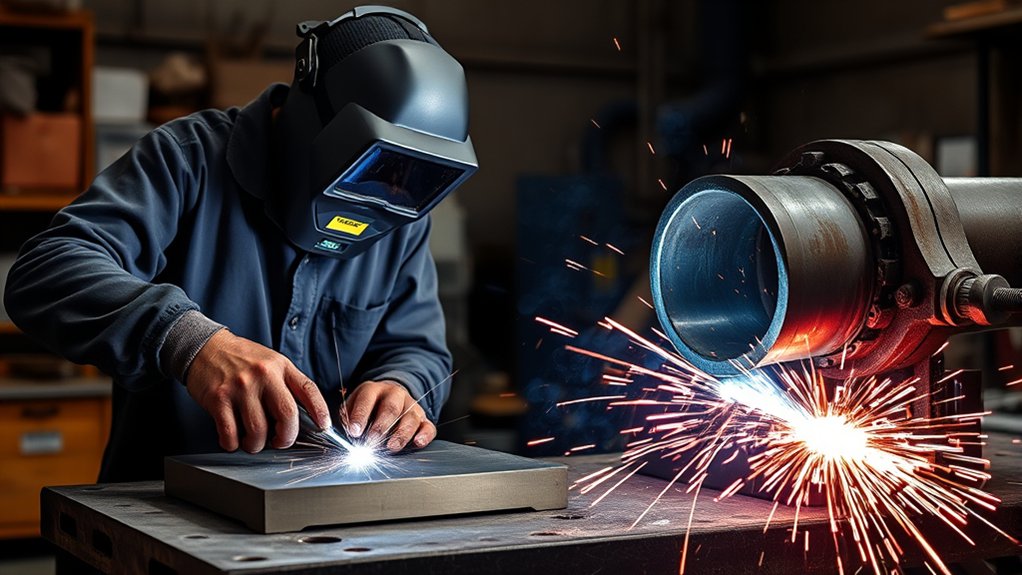
Start with 1G flat plate. It gives you the clearest view of the puddle and the most stable way to practice starts, stops, arc length, travel speed, sidewall tie-in, and heat control.
Then move to 2G horizontal plate, followed by 3G vertical and 4G overhead. This sequence introduces gravity and access problems one step at a time.
For pipe, one practical progression is rolled 1G, fixed 2G, fixed 5G, and then fixed 6G. Your employer or training program may use a different order based on the process and job. You can also add process-specific practice, such as flux-core welding techniques, when that is the process you use most.
Practice Checklist for Each Position
- Set the coupon accurately: Confirm angle, axis, fixed or rolled condition, groove dimensions, alignment, and tack placement.
- Dry-run your movement: Check visibility, footing, cable routing, and where you will stop and reposition.
- Use approved parameters: Match the process, polarity, filler, shielding, progression, preheat, and setting range to the WPS or training procedure.
- Control one segment at a time: Maintain arc length and watch the puddle edges rather than staring at the arc flare.
- Clean between passes: Remove slag and defects as permitted before adding more weld metal.
- Evaluate the result: Check bead profile, toe blend, undercut, overlap, porosity, cracks, starts, stops, and root condition. Visual appearance alone cannot prove internal soundness.
Note: Do not rush into 6G because the label sounds impressive. You will learn faster when your flat, horizontal, vertical, overhead, and restart techniques are already repeatable.
Safety Basics for All Welding Positions
Every welding position creates hazards, but overhead and fixed-pipe work can make them harder to manage because sparks, slag, fumes, cables, and awkward posture are more difficult to avoid. Inspect the area, secure the workpiece against movement, remove or shield combustibles, and confirm that the hot-work controls and PPE fit the position.
OSHA’s welding, cutting, and brazing requirements address fire prevention, eye and face protection, protective clothing, ventilation, and confined-space precautions. Overhead work needs particular attention to falling slag and sparks, so protect the head, neck, ears, arms, torso, and feet with suitable flame-resistant equipment selected through the workplace hazard assessment.
Warning: Never weld, cut, or heat a used drum, tank, pipe, vessel, or other container until it has been properly identified, isolated, cleaned, tested, vented, and made safe under an approved procedure. Residue or trapped vapor can cause fire, explosion, or toxic exposure.
Use adequate ventilation for welding fumes, especially indoors, near coated or alloyed metals, inside temporary enclosures, or in confined spaces. Oxygen must never be used for ventilation. If ventilation cannot control exposure and respiratory protection is required, follow the applicable respiratory-protection program and use properly selected, approved equipment.
For PPE, follow the workplace hazard assessment and use the correct helmet lens, safety glasses, gloves, protective clothing, hearing protection, footwear, and respiratory protection when needed. OSHA’s general PPE standard requires protective equipment where workplace hazards can cause injury or impairment.
Also keep welding leads, hoses, and tools clear of walkways and climbing routes. Support pipe on suitable stands or fixtures, prevent unintended rolling, and avoid positioning your body where a shifting workpiece or falling slag can trap or burn you.
Frequently Asked Questions
What are the welding positions for pipe and plate?
Plate groove tests commonly use 1G flat, 2G horizontal, 3G vertical, and 4G overhead. Pipe groove tests commonly use 1G rolled pipe, 2G fixed pipe with a vertical axis, 5G fixed pipe with a horizontal axis, and 6G fixed inclined pipe. Fillet-weld tests use F designations.
What do the number and letter mean in 1G or 2F?
The full code identifies a defined test setup. G means groove weld, and F means fillet weld. The number identifies the position or coupon orientation within that weld type. It is not a universal difficulty score.
What is the difference between 2G and 5G pipe?
In 2G pipe, the fixed pipe axis is vertical and the weld travels horizontally around the joint. In 5G pipe, the fixed pipe axis is horizontal, so the welder moves through overhead, vertical, and flat-like portions while completing the circumference.
What safety risks should welders take seriously?
Welders should control fumes, arc radiation, burns, electric shock, fire, explosion, noise, confined-space hazards, falling slag, unstable workpieces, and awkward posture. Use suitable PPE, ventilation, fire prevention, training, equipment inspection, and the hot-work rules required for the job.
What is the golden rule in welding?
A practical rule is to control the puddle, not just the arc. Keep the approved heat, travel speed, work angle, travel angle, arc length, joint preparation, and shielding for the position. Watch both puddle edges so the weld ties into sound metal.
Can a welder qualified on plate weld on pipe?
Not automatically. Some codes may allow a plate test to cover limited pipe work when diameter, position, thickness, process, and other variables fall within the qualified range. For code work, check the governing standard, WPS, and welder qualification record instead of assuming.
Is 6G harder than overhead welding?
Usually, yes. Overhead plate is difficult because gravity pulls molten metal downward. A 6G test adds changing pipe geometry, limited access, changing body position, and several effective welding orientations in one fixed-pipe joint.
Does passing a 6G test qualify a welder for everything?
No. A 6G test can qualify all welding positions within the applicable code range, but limits still apply to the process, material or grouping, deposited thickness, pipe diameter, backing, progression, joint details, continuity, and employer or project requirements.
Conclusion
Plate and pipe welding positions build toward the same goal: a sound weld made under control. Plate positions teach the foundation through flat, horizontal, vertical, and overhead work. Pipe positions test whether you can keep that control while the joint curves, access changes, and gravity affects the puddle differently around the circumference.
Start with 1G and build repeatable technique through 2G, 3G, and 4G before moving into rolled and fixed pipe. Then treat 5G and 6G as combinations of skills you already understand, not as isolated tricks. For any production or code weld, let the approved WPS, qualification record, governing code, and safety plan control the work.
Sources
- AWS D1.1/D1.1M:2025-AMD1 Structural Welding Code—Steel — supports current structural-welding qualification, fabrication, inspection, and acceptance context.
- ASME BPVC Section IX: Welding, Brazing, and Fusing Qualifications, 2025 — supports pressure-work procedure and personnel qualification context.
- OSHA 1910.252 Welding, Cutting, and Brazing — supports fire prevention, eye protection, ventilation, coated-metal, container, and confined-space guidance.
- OSHA Hot Work and Welding eTool — supports hot-work hazard assessment, fire and explosion controls, air monitoring, PPE, and ventilation guidance.
- OSHA 1910.132 Personal Protective Equipment — supports PPE selection through workplace hazard assessment.
- OSHA 1910.134 Respiratory Protection — supports respiratory-protection program requirements when respirators are needed.