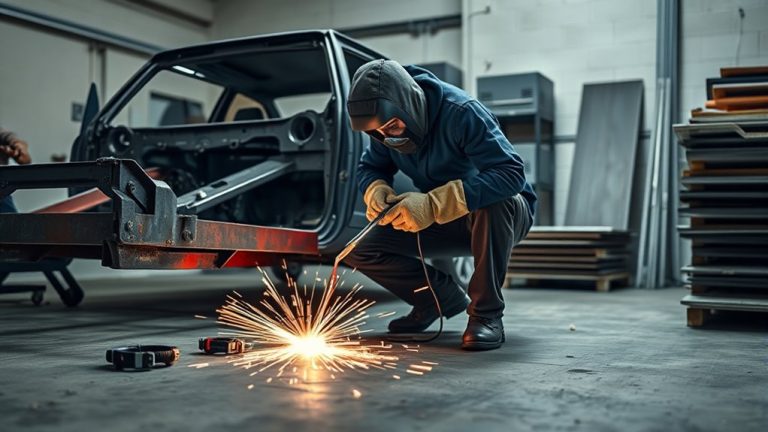
Automotive welding joins vehicle parts with controlled heat, pressure, and, when needed, filler metal to create strong, durable bonds. You clean and fit the metal, choose the right method, and set the welder for the material and thickness. MIG works well for fast panel repairs, TIG gives precise control, and spot welding joins overlapping sheet metal. Good technique reduces warping, brittleness, and defects. Keep going, and you’ll see which method fits each repair.
What Is Automotive Welding?
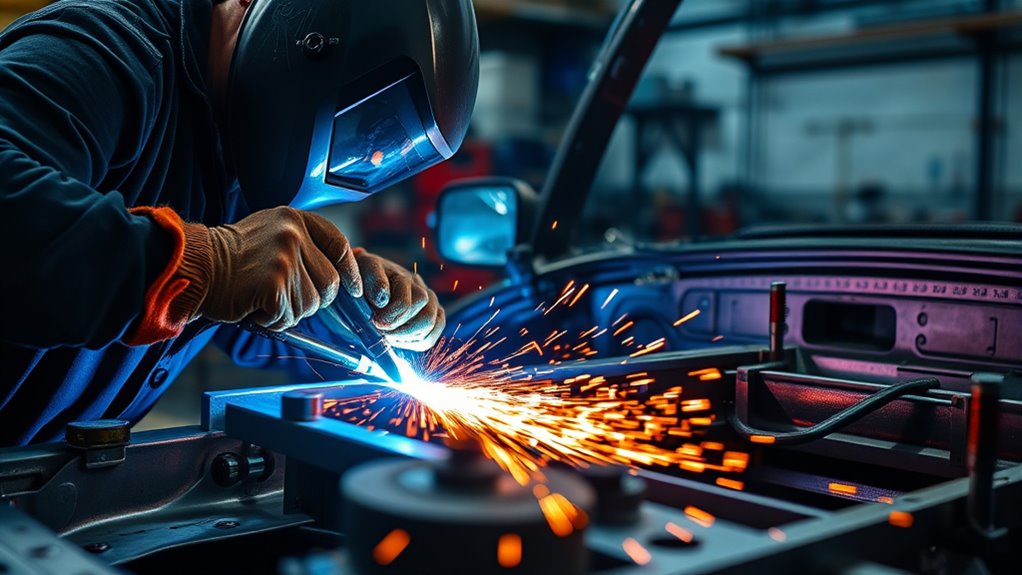
Automotive welding is the process of joining vehicle components with controlled heat, pressure, or both to create strong, durable bonds that preserve structural integrity and safety. You use it to restore or build parts that must carry loads, resist impact, and protect occupants.
In practice, you choose techniques such as MIG, TIG, or spot welding based on the metal and the job. Each method supports precise metal fusion, but you must match it to the material’s behavior under heat. Poor execution can cause warping, brittleness, or weak seams, so welding skill matters.
You also rely on proper tools, including welding machines, angle grinders, helmets, and gloves, to maintain welding safety. When you understand how weld quality affects crashworthiness and performance, you gain control over the repair process and help keep vehicles strong, reliable, and safe. Additionally, using specific filler wire during the welding process can significantly improve the strength and durability of the joints.
How Automotive Welding Works
You start by cleaning and preparing the metal surfaces so the joint can form a strong, reliable bond.
Then you select the appropriate method—MIG, TIG, or spot welding—and control the arc, heat, voltage, and wire feed speed to fuse the parts without compromising material thickness or crashworthiness.
After welding, you inspect the bead, remove any slag, and check for cracks or brittleness to confirm the joint’s quality. Proper surface preparation is crucial, as it enhances weld strength and reduces the risk of porosity in the welds.
Welding Preparation Steps
Before welding begins, put on a welding helmet, gloves, and protective clothing. Then set up the workspace in a clean, well-ventilated area away from flammable materials. You protect yourself and your work by following safety standards and choosing welding techniques suited to the job.
- Clean metal surfaces thoroughly to remove rust, paint, and contaminants.
- Inspect the joint area for fit-up, gaps, and alignment.
- Adjust the welder’s gas selection and wire feed speed to match the material.
- Bevel thicker sections so you improve penetration and joint strength.
These preparation steps help you control heat, reduce defects, and achieve reliable results.
When you prepare carefully, you keep the process precise, efficient, and under your command.
Joining Methods Explained
Welding methods in automotive work join metal parts with controlled heat and speed to restore strength and keep vehicles safe. You can choose welding techniques based on the joint, metal thickness, and repair goal.
MIG welding uses continuous wire feed, so you move fast on panels from 24-gauge to 1/4-inch thick. TIG welding gives you precise control with a tungsten electrode, which helps when you work on custom parts or critical components.
Spot welding lets you fuse overlapping sheet metal quickly on assembly lines without filler. You also need to read metal properties carefully; aluminum and stainless steel demand different heat settings and travel speeds.
When you match the method to the material, you reduce distortion and keep the structure sound.
Post-Weld Inspection Process
Once the weld cools, you inspect it to confirm that the joint meets strength and safety requirements. You protect weld integrity by checking bead size, shape, and surface finish for cracks, porosity, or incomplete fusion.
This defect detection step lets you catch problems before they limit your freedom to trust the repair.
- Verify cooling time to reduce brittleness and stress fractures.
- Examine the weld visually for irregularities and contamination.
- Use ultrasonic or magnetic particle testing to reveal hidden flaws.
- Record results to support quality control and regulatory compliance.
You compare findings against specifications, then decide whether rework, repair, or release is appropriate.
Precise inspection keeps vehicles safer, stronger, and ready for the road.
Essential Automotive Welding Tools and Safety Gear
To weld automotive metal accurately and safely, you need the right equipment and protective gear. You’ll rely on MIG and TIG welding machines for versatile, precise joining, and these tools reflect current welding technology trends and automotive repair innovations that expand what you can fix on your own terms.
Use an angle grinder to strip rust, bevel edges, and smooth finished joints so your welds bond cleanly. Secure panels with welding clamps and magnets; they hold parts true, reduce distortion, and let you work with control.
Protect yourself with an autodarkening welding helmet, heat-resistant gloves, and flame-resistant clothing to block sparks and UV radiation. Remember to invest in quality protective clothing to prevent injuries and ensure compliance with safety standards. Keep your workspace clean, organized, and well ventilated. That lowers fire risk, improves visibility, and supports safer fume control.
With disciplined setup and proper gear, you can weld more precisely, stay protected, and maintain the freedom to repair metal confidently.
MIG Welding for Car Repairs
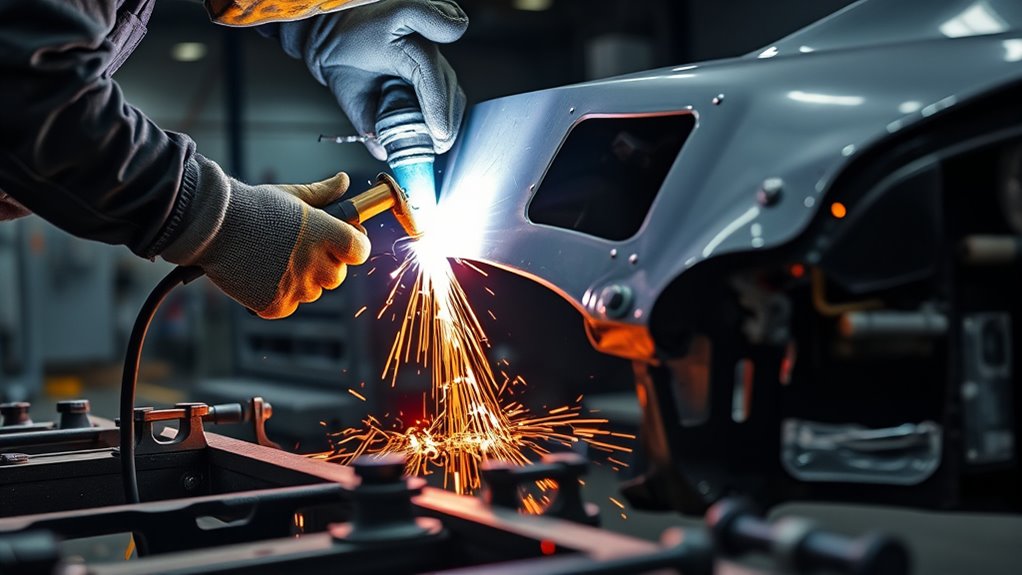
MIG welding is the go-to method for most car repairs because it’s versatile, fast, and easy to control. You feed a consumable wire electrode through the gun, and the arc melts the wire and base metal into a strong joint.
It works well on carbon steel, aluminum, and stainless steel, so you can repair panels and brackets without changing processes. For auto body work, it handles 24-gauge to 1/4-inch metal, giving you the freedom to restore thin sheets without excessive distortion.
- Set voltage and wire feed speed to match thickness.
- Use MIG techniques that keep travel steady and arc length short.
- Watch for burn-through on thin panels and adjust immediately.
- Use welding troubleshooting to correct porosity, weak penetration, or spatter.
Additionally, understanding amperage control is crucial for achieving the desired penetration and bead shape in your welds.
Wear an autodarkening helmet, gloves, and protective clothing to block UV radiation, sparks, and heat.
TIG and Spot Welding for Auto Body Work
When you need precise control on thin or sensitive metal, TIG welding gives you a stable arc, a clean weld pool, and strong results on parts like aluminum or stainless steel. Additionally, understanding Miller TIG Welder settings can enhance your results, ensuring optimal heat input and minimizing issues like warping or burn-through. When you’re joining overlapping steel sheets in auto body work, spot welding lets you make fast, localized bonds for panels, frames, and other production-style assemblies. You should choose the method based on material, joint access, and the level of control or speed the repair requires.
TIG Welding Precision
TIG welding gives you fine control in auto body work because a non-consumable tungsten electrode creates a stable arc, letting you weld intricate parts with precision.
You use argon shielding to keep the weld pool clean, so you get strong joints and a refined finish.
TIG welding advantages include low distortion on thin stainless steel and aluminum, which frees you to repair panels without warping them.
TIG welding applications cover braces, brackets, and trim areas that demand exact heat input.
- Set torch angle carefully.
- Match travel speed to joint thickness.
- Add filler rod only when needed.
- Maintain arc length for consistency.
Because TIG requires skill, you control torch, speed, and filler together, achieving deliberate, liberated craftsmanship in automotive welding.
Spot Welding Uses
Spot welding is a resistance welding method you use to join overlapping metal sheets in auto body work, especially when securing panels and frames. You apply copper electrodes to one spot, then deliver heat and pressure to create localized melting and fusion without disturbing the full sheet.
That control gives you key spot welding advantages: fast joining, minimal distortion, and clean seams on thin steel, often from 24-gauge to 1/8-inch. In spot welding applications, you can attach body panels, braces, and structural tabs with precision and efficiency.
Like TIG welding, it demands accurate voltage, pressure, and timing, but spot welding frees you from excess heat and warping when you need reliable, repeatable joints across automotive assemblies.
Choosing The Right Method
Choosing the right welding method depends on the joint, the metal, and the level of finish you need. You should match your welding techniques to the repair, not force the repair to fit the tool.
TIG gives you precise heat control, so you can protect thin panels and create clean seams on aluminum or stainless steel. Spot welding works faster on overlapping mild steel sheets, making it practical for body panels and frames. Use material selection to guide your choice and keep distortion low.
- TIG for intricate, high-quality repairs
- Spot weld for fast panel attachment
- TIG when heat control matters most
- Spot weld for accessible, repeatable joins
When you choose well, you keep control, cut waste, and build with confidence.
How to Prepare Metal for Welding
Proper metal preparation is essential for producing strong, reliable welds. You begin with metal surface preparation by removing rust, paint, and grease, because contaminants can weaken the joint and undermine welding defect prevention.
Use an angle grinder or wire brush to clean the surface and create a smooth, uniform contact area. For thicker stock, bevel the edges to form a groove; this improves penetration and helps the weld fuse deeper.
Next, align the parts accurately and clamp them tightly so they can’t shift during welding. Check fit-up carefully: gaps should be minimal, since wide openings demand more filler metal and often reduce strength.
When you prepare the metal this way, you give yourself better control, cleaner fusion, and a stronger finished joint. Precise preparation also reduces rework, saves time, and supports dependable results in automotive fabrication. Additionally, ensuring a clean surface is crucial for preventing issues like porosity during the welding process.
Common Automotive Welding Positions
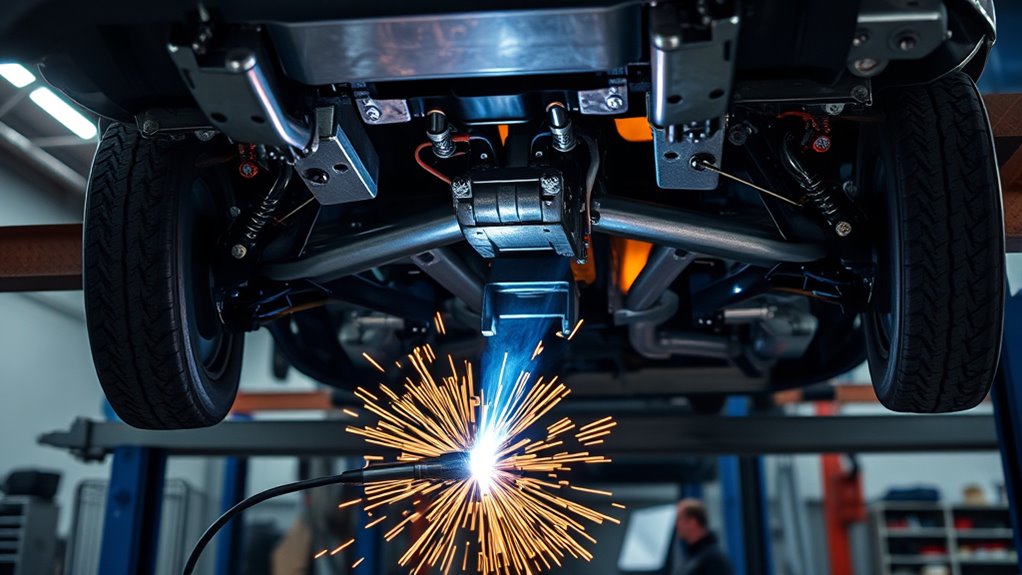
In automotive welding, the joint position directly affects heat control, bead shape, and weld quality. You’ll choose positions that suit the repair, and each one offers distinct position advantages.
- Flat: You’ll use this most often for body panels and frame repairs. Keep a 90-degree angle for butt welds and 45 degrees for T-joints to stabilize the puddle.
- Horizontal: When you join frame rails, hold the work angle between 0 and 15 degrees. This limits sagging and keeps the bead consistent.
- Vertical: For frame sections, reduce voltage and amperage by 10 to 15 percent. That gives you better visibility and tighter control.
- Overhead: For underside welding, lower parameters by 10 to 15 percent and move faster to prevent drop-through.
You can also adapt welding techniques: push suits thin material, while pull helps thicker sections achieve stronger penetration. Additionally, understanding flux core welding can enhance your skills in various automotive applications.
Manual vs. Robotic Welding
You can use manual welding when you need flexibility and precise control for unique or intricate repairs, but it depends heavily on technician skill and takes more time.
Robotic welding gives you faster cycle times, consistent weld quality, and strong repeatability in high-volume production, especially when you use vision-guided systems for real-time adjustment. Additionally, incorporating a versatile 5-in-1 machine can enhance the efficiency of your welding processes.
If you’re moving from manual to robotic welding, you’ll need to assess current workflows, choose the right robot, and train your team for the new process.
Manual Welding Benefits
Manual welding gives you greater flexibility and precision than robotic systems, especially when repairs involve complex geometries, mixed materials, or components that don’t fit a standard automation program. You can rely on skilled technicians to apply custom techniques that match each part’s needs.
- You cut setup costs for small runs and custom repairs.
- You weld MIG or TIG on varied thicknesses and alloys.
- You adjust heat, angle, and travel speed in real time.
- You monitor safety and compliance directly during the weld.
This hands-on control lets you preserve structural integrity without waiting for reprogramming.
It also supports liberated decision-making on the shop floor, where your judgment can solve fit-up issues fast and keep production moving.
Robotic Welding Advantages
Robotic welding offers a clear productivity advantage when repeatability, speed, and throughput matter. You get consistent, high-quality welds because the system controls torch path, heat input, and timing with robotic precision. That reduces human error and variation that manual welding can introduce, so your parts meet tighter specifications with less rework.
Robotic systems can run continuously, which boosts output and improves welding efficiency while lowering labor demand. Vision-guided models also adapt to workpiece variation, helping you maintain weld quality when fit-up isn’t perfect.
Although you’ll invest in equipment and training upfront, you often recover that cost through reduced waste, faster cycle times, and more predictable production. For you, that means more control, less dependence, and stronger long-term savings.
Automation Transition Steps
When moving from manual to robotic welding, start by evaluating your current process to identify which tasks are best suited for automation and where consistency gaps exist. You can then address automation challenges with a clear change plan.
- Map each weld operation, cycle time, and defect pattern.
- Select robotic equipment that matches part geometry, throughput, and joint access.
- Design the cell layout for workflow optimization, safe part flow, and easy maintenance.
- Train your team to program, operate, and service the system, then run pilot programs to validate settings before full deployment.
This approach helps you gain precision, reduce labor dependence, and improve weld quality without surrendering control.
When you build the system around your production reality, robotics becomes a tool for liberation, not disruption.
Vision-Guided Robotic Welding
Vision systems also read changes in material thickness and surface condition, then adjust welding parameters on the fly for a more stable arc and consistent penetration. In welding technology trends, robotic vision advancements are reshaping automotive production as vehicles use more complex designs and mixed materials.
This technology parallels advancements in plasma cutter thickness capabilities, enhancing efficiency and precision in welding operations. You can deploy this capability to reduce manual intervention, strengthen process consistency, and keep production moving with less waste. The result is a smarter, more autonomous workflow that helps you build with accuracy, speed, and the freedom to scale.
Post-Weld Cleanup and Inspection
After welding, you remove slag and spatter from the bead to leave a smooth surface and reduce corrosion risk. This slag removal lets you inspect the weld bead directly and judge whether the joint supports the load you need.
You should let the metal cool naturally, because forced cooling can trap stress and make the joint brittle. Then you examine the bead for uniform width, fusion, and continuity, since cracks or undercut can weaken the connection. If the first pass falls short, you add reinforcement with another pass, not guesswork.
- Clean the area with a brush or grinder.
- Measure dimensions with calipers.
- Check hidden flaws with ultrasonic testers.
- Document defects and correct them before service.
Careful inspection keeps you in control of quality, safety, and structural integrity, so you can build with precision and move freely. Additionally, maintaining a clean workspace helps mitigate risks associated with flammable materials.
Frequently Asked Questions
How Much Would It Cost for Weld Work on a Car?
You’ll usually pay $50–$150 an hour; about 70% of shops use MIG, keeping repair costs lower. Your welding techniques, materials, and damage level can push a simple fix to $100–$500 or more.
Can You Make $100,000 as a Welder?
Yes, you can make $100,000 as a welder if you target high-demand niches, earn certifications, and pursue career growth. Specialized roles, overtime, and location drive welding salaries upward through technical expertise.
Is MMA Stronger Than MIG?
MMA can be stronger than MIG in thicker, dirtier, or structural work: deeper penetration, better fusion, tougher bonds. MIG applications favor speed, thin metal, and ease. You choose strength, control, and freedom.
Conclusion
In automotive welding, you join metal with controlled heat, filler, and shielding so you can restore strength without upsetting the surrounding structure. You’ve seen how MIG, TIG, spot, and robotic systems each suit different repair needs, and how proper gear, positioning, and inspection keep the work predictable. When you finish with careful cleanup and a close look at every seam, you’re not just closing gaps—you’re giving the vehicle a quieter, more dependable second life.