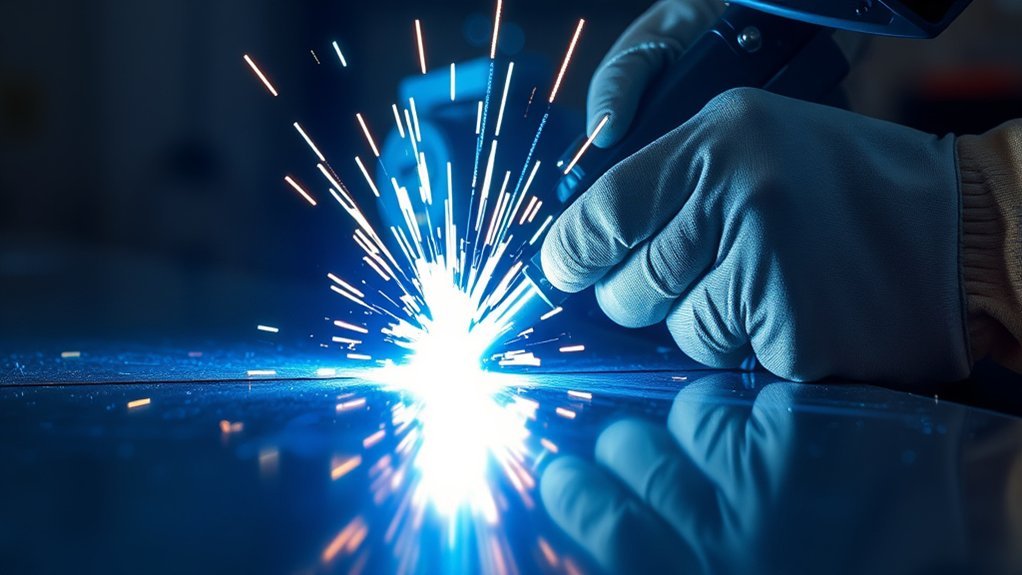
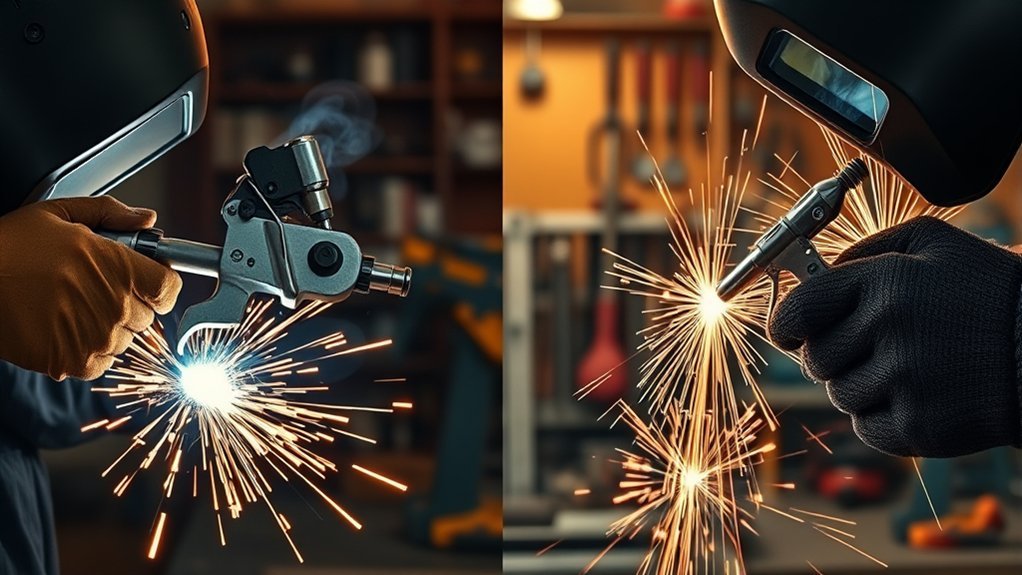
GMAW is the American Welding Society term for Gas Metal Arc Welding, the process everyone else calls MIG. The wire-feed welder in almost every body shop, fabrication shop and well-equipped home garage is a GMAW machine. It replaced stick welding for most production work because the wire feeds itself, there is no slag to chip, and a beginner can lay a decent bead on the first day. If you have seen a welder pulling a trigger on a gun while a hum of wire feeds out, that is GMAW.
Quick Answer
GMAW stands for Gas Metal Arc Welding, the AWS name for MIG welding. A spool of solid wire is fed continuously through a gun, the wire is the electrode and the filler, and a shielding gas (usually 75% argon / 25% CO2 for steel) protects the puddle. It is the fastest and easiest arc welding process to learn, which is why it dominates auto body, fabrication shops and home garages.
Key Takeaways
- GMAW = MIG welding (Metal Inert Gas). MAG (Metal Active Gas) is the European term for the same process with CO2-containing gas.
- Pull the trigger and wire feeds automatically, so one hand does everything.
- Needs a gas cylinder. Without gas you are running flux-core (FCAW), not MIG.
- Solid wire runs on DCEP. ER70S-6 is the standard steel wire.
- Great on clean steel from 24 gauge to 1/2″, poor outdoors in wind and on rusty metal.
What Does GMAW Stand For?
- Gas: an external shielding gas from a cylinder flows through the gun nozzle to protect the weld from air.
- Metal: the electrode is a solid metal wire that melts and becomes the filler.
- Arc: an electric arc between the wire tip and the workpiece supplies the heat.
- Welding: wire and base metal fuse together.
“MIG” (Metal Inert Gas) dates from the 1950s when the process used pure argon or helium. Modern steel welding uses argon-CO2 blends or straight CO2, which are active gases, so technically most MIG today is MAG. The AWS term GMAW covers both. The acronyms are compared side by side in our welding process acronyms guide.
How GMAW Welding Works
A GMAW machine is a constant-voltage power source paired with a wire feeder. You set voltage on the machine and wire feed speed on the feeder; the machine automatically supplies whatever amperage keeps the arc length stable. When you pull the trigger, three things start together: wire feeds through the liner and contact tip, shielding gas flows out of the nozzle, and current energizes the wire. The arc strikes as the wire touches the plate, and metal transfers across the arc continuously until you release the trigger.
Because the arc self-regulates, you only control gun angle, travel speed and stick-out (the length of wire past the contact tip, normally 3/8″ to 1/2″). That is what makes GMAW easy: there is no arc length to manage by hand.
Metal transfer modes
| Mode | Voltage / current | Best for |
|---|---|---|
| Short circuit | Low (14 to 22 V) | Thin sheet, all positions, home 120 V and 240 V machines |
| Globular | Medium, often with CO2 | Rarely chosen on purpose; lots of spatter |
| Spray | High (24 V+), argon-rich gas | Thick plate, flat and horizontal, production fab |
| Pulsed spray | Inverter-controlled | Aluminum, stainless, out-of-position spray with less heat |
Most home welding is short-circuit transfer. Set it up with our MIG wire speed and voltage chart.
GMAW Equipment and Consumables
- Power source and feeder: combined in one box on 120 V and 240 V home units, separate on industrial machines.
- Gun with liner, contact tips sized to the wire, and gas nozzle.
- Shielding gas: C25 (75% Ar / 25% CO2) is the all-purpose steel gas; 100% CO2 is cheaper with deeper penetration and more spatter; 98/2 argon-oxygen for spray on steel; 100% argon for aluminum; tri-mix (He/Ar/CO2) for stainless. Learn why in what is shielding gas.
- Wire: ER70S-6 solid steel wire in 0.023″, 0.030″ or 0.035″ for most garages; ER308L for stainless; ER4043 or ER5356 aluminum (which needs a spool gun or push-pull gun).
- Regulator / flowmeter, set around 20 to 25 CFH.
Advantages of GMAW
- Easy to learn. One-handed, no arc length control, immediate results.
- Fast. Continuous wire means high arc-on time and deposition rates far above stick.
- Clean. No flux, no slag; little post-weld cleanup beyond light spatter.
- Excellent on thin material. Short-circuit transfer with 0.023″ wire welds 24-gauge auto body panels.
- All positions in short-circuit or pulsed modes.
Limitations of GMAW
- Needs gas. A cylinder, regulator and refills add cost and cut portability.
- Wind kills the shield. Outdoors you need a windbreak or switch to self-shielded flux-core.
- Wants clean metal. Rust, mill scale and paint cause porosity; grind to bright metal first.
- Lack-of-fusion risk. Short-circuit MIG can look great while barely bonding on thick plate. Use enough voltage or move to spray or flux-core above 1/4″.
- More parts to maintain. Liners, tips, drive rolls and nozzles wear out.
What GMAW Is Used For
Auto body and collision repair, exhaust work, trailer and gate fabrication, furniture, farm equipment on clean steel, light structural work, robotic production welding, and most home garage projects. It is the first machine most hobbyists buy. For aluminum, GMAW with a spool gun is faster than TIG on thicker sections but less precise.
GMAW vs FCAW (MIG vs Flux-Core)
The same wire-feed machine can usually run both. Solid wire with gas is GMAW; tubular flux-filled wire without gas is self-shielded FCAW. Flux-core is better outdoors, on rusty steel and on thicker plate, but it is messier and poorer on thin sheet. If you have a 120 V machine with no cylinder, you are flux-core welding. See what is FCAW and does flux-core require gas.
Common GMAW Problems and Fixes
- Porosity: no gas or low flow, drafts, dirty metal, or a clogged nozzle. Check the cylinder is open and the flowmeter reads 20 to 25 CFH.
- Bird-nesting at the drive rolls: tip blocked, liner dirty, or wrong drive roll tension.
- Burn-back (wire fuses to the tip): wire speed too low for the voltage, or stick-out too short.
- Excess spatter: voltage too high or too low for the wire speed, or 100% CO2. See why your weld spatter is so bad.
- Nothing happens when you pull the trigger: check the trigger leads, the gun connection, the duty-cycle thermal cutout, and the input breaker.
Frequently Asked Questions
Is GMAW the same as MIG?
Yes. GMAW is the AWS designation. MIG and MAG are common names that differ only in whether the gas is inert or active.
Does GMAW need gas?
Yes. Without shielding gas, solid MIG wire produces a porous, oxidized weld. Gasless wire-feed welding is a different process, FCAW-S.
What polarity is GMAW?
DCEP (electrode positive) for solid wire. Most self-shielded flux-core wires use DCEN, so check the polarity when you swap wire types. Our polarity guide explains why.
What thickness can GMAW weld?
A 120 V machine handles 24 gauge to about 3/16″ in a single pass. A 240 V machine reaches 1/2″ with multiple passes or spray transfer.
Can GMAW weld aluminum?
Yes, with 100% argon, aluminum wire and a spool gun or push-pull gun. Standard guns cannot push soft aluminum wire through a long liner without tangling.
Conclusion
GMAW, or MIG, is the workhorse of modern welding because it is fast, clean and easy. Give it clean steel, the right gas and a draft-free space and it will handle the vast majority of garage and shop jobs. Its weaknesses, wind, rust and very thick plate, are exactly where SMAW and FCAW shine, and its ceiling on precision is where GTAW takes over.
Sources
- AWS A5.18/A5.18M, Specification for Carbon Steel Electrodes and Rods for Gas Shielded Arc Welding
- AWS A3.0M/A3.0, Standard Welding Terms and Definitions
- Lincoln Electric, GMAW Welding Guide
- Miller Electric, MIG Handbook