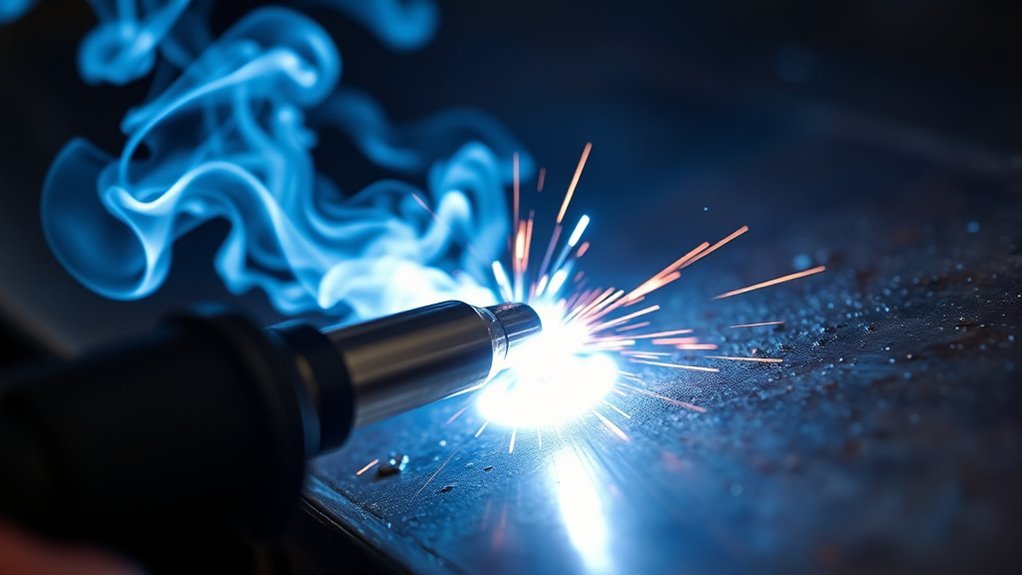
GTAW is the American Welding Society abbreviation for Gas Tungsten Arc Welding. Nearly everyone in a shop calls it TIG, short for Tungsten Inert Gas, and a few old-timers still say heliarc after the helium-shielded version Linde introduced in the 1940s. All three names mean the same process: an arc from a tungsten electrode that does not melt, an inert gas shield, and filler metal added by hand. It is the process behind polished stainless exhausts, aluminum boat hulls, aerospace tubing and the neat “stack of dimes” beads people post online.
Quick Answer
GTAW stands for Gas Tungsten Arc Welding, the AWS name for TIG welding. A non-consumable tungsten electrode creates the arc, argon gas from the torch shields the puddle, and filler rod is added by hand only when needed. It produces the cleanest, most precise welds of any manual arc process and is the standard choice for aluminum, stainless steel, thin sheet and anything that must look good.
Key Takeaways
- GTAW = TIG welding (Tungsten Inert Gas). Older texts call it heliarc.
- The tungsten does not melt; filler comes from a separate rod you feed with your other hand.
- Pure argon is the normal shielding gas. No flux, no slag, almost no spatter.
- Steel is welded on DCEN; aluminum needs AC to break up the oxide layer.
- Highest quality and control, but the slowest and hardest process to learn.
What Does GTAW Stand For?
- Gas: an inert shielding gas, almost always argon, flows from the torch cup to keep air off the molten metal.
- Tungsten: the electrode is a tungsten alloy rod with a melting point near 6,200 °F (3,400 °C), so it carries the arc without being consumed.
- Arc: the electric arc between the tungsten tip and the work provides the heat.
- Welding: base metal and optional filler fuse into one piece.
Because the tungsten is non-consumable, GTAW is fundamentally different from SMAW, GMAW and FCAW, where the electrode itself melts into the joint. See our consumable vs non-consumable electrodes explainer for the full distinction.
How GTAW Welding Works
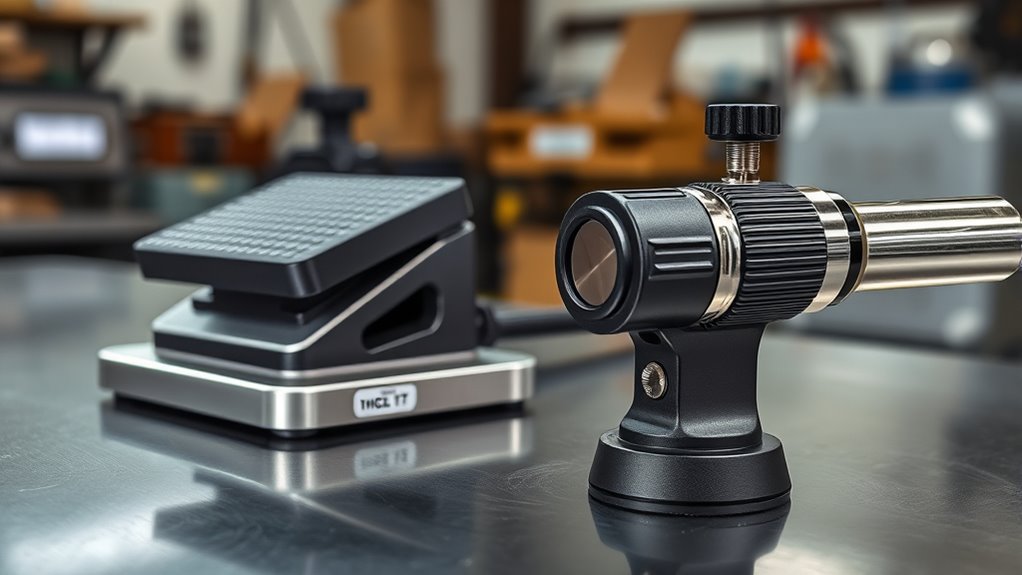
A TIG torch holds a sharpened tungsten inside a ceramic cup. When you press the foot pedal or torch switch, the machine starts the arc, usually with a high-frequency pulse so the tungsten never has to touch the metal. Argon flows around the tungsten and bathes the puddle. You hold the torch at about 15 degrees from vertical with one hand, keep the arc short, and dab filler rod into the leading edge of the puddle with the other hand. The foot pedal lets you raise and lower amperage mid-weld, which is how TIG welders control heat on thin material and taper off at the end of a bead to avoid crater cracks.
When the arc stops, most machines keep gas flowing for several seconds (post-flow) so the hot tungsten and weld do not oxidize.
Polarity and current type
| Material | Current | Why |
|---|---|---|
| Carbon and stainless steel, titanium, copper | DCEN (electrode negative) | Most heat goes into the work, tungsten stays cool and sharp |
| Aluminum, magnesium | AC | The positive half-cycle blasts off the oxide skin, the negative half-cycle penetrates |
| Rarely used | DCEP | Overheats the tungsten; only for very thin aluminum on old machines |
Our TIG DC straight vs reverse polarity article goes deeper.
GTAW Equipment
- Power source: constant-current, DC for steel or AC/DC for aluminum. Inverters with pulse, AC balance and AC frequency controls are now affordable.
- Torch: air-cooled up to about 200 A, water-cooled above that or for long runs. WP-17, WP-9 and WP-26 are the common air-cooled sizes.
- Tungsten electrodes: 2% lanthanated (blue) or 2% ceriated (grey) work on both AC and DC. Pure tungsten (green) is only for AC on transformer machines. Thoriated (red) works well on DC but is mildly radioactive to grind.
- Shielding gas: 100% argon for nearly everything. Argon-helium mixes add heat for thick aluminum or copper.
- Filler rods: 36-inch cut lengths, matched to the base metal. ER70S-6 for steel, ER308L for 304 stainless, ER4043 or ER5356 for aluminum. Our TIG filler rod selection chart lists the common pairings.
- Foot pedal or torch amperage control, gas lens collet body, and a dedicated tungsten grinder.
Advantages of GTAW
- Weld quality. No flux, no slag, no spatter, and full control of heat input make GTAW the reference process for code work, pressure vessels and aerospace.
- Precision on thin metal. You can weld 0.030″ stainless or aluminum without filler, and foot-pedal control prevents burn-through.
- Material range. Steel, stainless, aluminum, magnesium, copper, brass, titanium, nickel alloys, even dissimilar metals with the right rod.
- Appearance. The clean, uniform bead often needs no grinding.
- Autogenous welds. Edges can be fused with no filler at all.
Limitations of GTAW
- Slow. Deposition rates are a fraction of MIG or flux-core.
- Hardest to learn. Both hands and one foot are busy; arc length must stay around 1/8″.
- Needs clean metal. Oil, rust, mill scale and oxide cause porosity and contaminated tungsten. Aluminum must be brushed with a dedicated stainless brush and wiped with acetone.
- Not for wind or outdoors unless you build a shelter; a breeze strips the argon away.
- Expensive. AC/DC machines, gas, tungsten and consumables all cost more than a stick setup.
What GTAW Is Used For
Aluminum fabrication (boats, trailers, intake manifolds), stainless food and dairy equipment, exhaust and turbo piping, motorcycle and bicycle frames, roll cages, pipe root passes before stick or MIG fill, aerospace and nuclear work, and any repair where the weld will be visible. For aluminum in particular, read our TIG welding aluminum tips.
GTAW vs GMAW (TIG vs MIG)
The question almost every hobbyist asks. GMAW feeds wire automatically and is three to five times faster, easier to learn, and better on thick steel. GTAW gives cleaner welds, works on thinner metal and more alloys, and is what you want for stainless or aluminum that has to look right. Many home shops end up owning both. Read the full comparison in GMAW vs GTAW: core differences and how MIG differs from TIG.
Common GTAW Problems and Fixes
- Grey, sooty weld or black tungsten tip: gas coverage lost. Check flow (15 to 20 CFH for argon), cup size, leaks, drafts, and post-flow time.
- Tungsten balled up on DC: wrong polarity (DCEP) or current far too high for the tungsten diameter.
- Tungsten dipped in the puddle: arc too short or filler rod touched the tip. Stop, regrind, and restart.
- Porosity on aluminum: oxide not removed, dirty filler, or moisture. Clean again and use fresh rod.
- Crater cracks at the end of the bead: ramp the pedal down slowly and keep adding filler as you fade out.
Frequently Asked Questions
Is GTAW the same as TIG?
Yes. GTAW is the AWS designation, TIG is the common name, and heliarc is the historical trade name.
Does GTAW use filler metal?
Usually, but not always. Thin edge joints and corner joints can be fused autogenously with no rod. Most butt and fillet welds need filler added by hand.
What gas is used for GTAW?
Pure argon for almost everything. Argon-helium blends for thick aluminum or copper where extra heat helps. Never CO2 or argon-CO2 MIG mixes, which will destroy the tungsten.
Can you GTAW weld without gas?
No. There is no flux in the process, so without argon the tungsten burns up and the weld oxidizes immediately.
What tungsten should a beginner use?
2% lanthanated, 3/32″ diameter, sharpened to a point for DC steel. It also works on AC for aluminum, so one type covers most home shop work.
Conclusion
GTAW, better known as TIG welding, trades speed for control and quality. It is the process to learn if you want to weld aluminum, stainless, thin sheet or anything that will be seen. Expect a steeper learning curve than MIG, invest in clean metal and good gas coverage, and the results will justify it. For how TIG fits next to stick, MIG and flux-core, see our welding process acronyms comparison.
Sources
- AWS A5.12/A5.12M, Specification for Tungsten and Oxide Dispersed Tungsten Electrodes
- AWS A5.18, Carbon Steel Electrodes and Rods for Gas Shielded Arc Welding
- AWS A3.0M/A3.0, Standard Welding Terms and Definitions
- Miller Electric, TIG Handbook