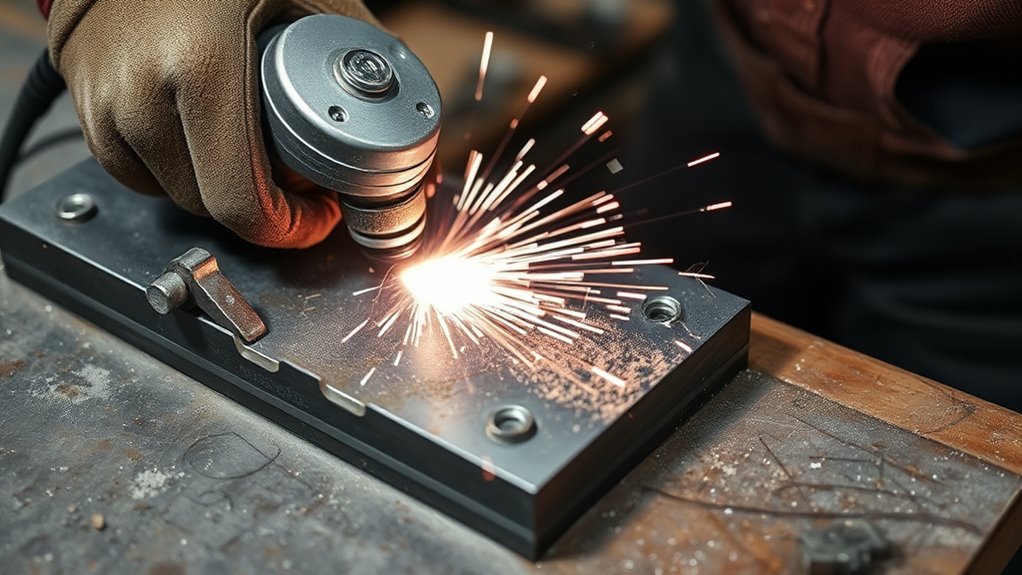
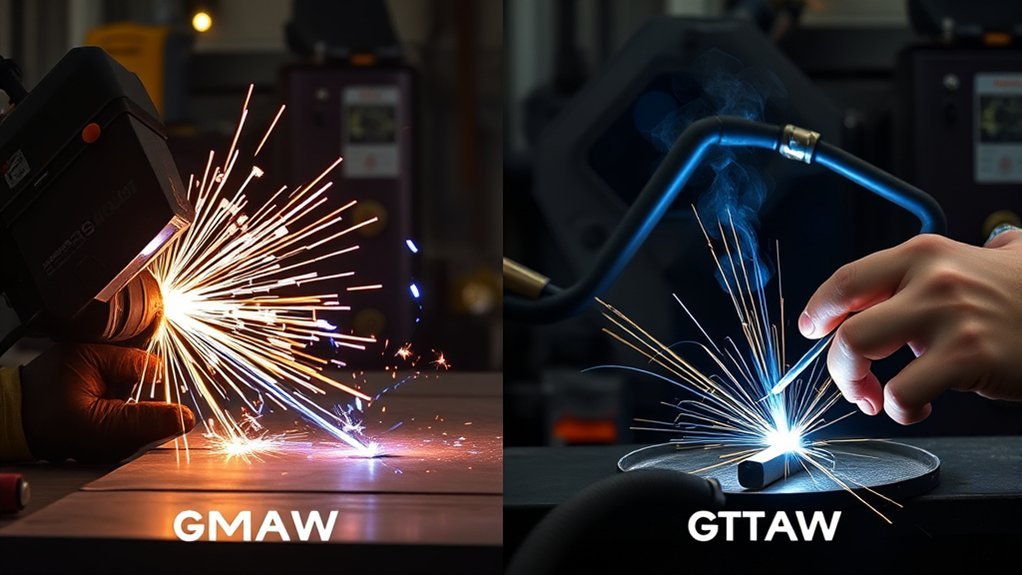
Welding textbooks, certification papers and procedure sheets use four-letter codes: SMAW, GMAW, FCAW and GTAW. Walk into a shop and you will hear stick, MIG, flux-core and TIG instead. They are the same four processes, and the fastest way to understand the whole subject is to see what the letters mean and how each one trades off speed, cost, portability and quality. This guide puts all four side by side and ends with a simple recommendation for which one to use.
Quick Answer
SMAW is stick welding, GMAW is MIG, FCAW is flux-core, and GTAW is TIG. All four are arc welding processes; they differ in what the electrode is made of and how the weld is shielded. Stick and flux-core shield with flux and work outdoors on dirty steel. MIG and TIG shield with gas and need clean metal and still air. MIG is the easiest and fastest, TIG the most precise, stick the most portable, and flux-core the best for thick plate without gas.
Key Takeaways
- The four-letter AWS codes are the official names; stick, MIG, flux-core and TIG are the shop names.
- Consumable electrode: SMAW, GMAW, FCAW. Non-consumable electrode: GTAW.
- Flux shielding: SMAW, FCAW-S. Gas shielding: GMAW, GTAW, FCAW-G.
- Beginner home shop: start with GMAW/FCAW on a wire-feed machine. Field repair: SMAW. Aluminum and stainless that must look good: GTAW.
- Many machines are multi-process and can run three of the four.
What the Welding Acronyms Mean
The American Welding Society assigns every process a letter code in AWS A3.0 so that a drawing or procedure can specify exactly which one is required. The pattern is consistent: the last two letters are always AW for Arc Welding, and the first letters describe the electrode and the shielding.
| Code | Stands for | Shop name | Other names |
|---|---|---|---|
| SMAW | Shielded Metal Arc Welding | Stick | Arc welding, MMA, manual metal arc |
| GMAW | Gas Metal Arc Welding | MIG | MAG, wire welding, hard wire |
| FCAW | Flux-Cored Arc Welding | Flux-core | Gasless MIG (FCAW-S), dual shield (FCAW-G), Innershield |
| GTAW | Gas Tungsten Arc Welding | TIG | Heliarc, argon welding |
Each has its own full article: What is SMAW, What is GMAW, What is FCAW and What is GTAW. Other codes you may meet are SAW (submerged arc, automated), PAW (plasma arc), OFW (oxy-fuel), RSW (resistance spot) and LBW (laser beam). The full list is in our welding terms glossary.
The Two Things That Separate the Processes
1. What the electrode is
In SMAW, GMAW and FCAW the electrode is consumable: it melts and becomes the weld. That makes them fast at depositing metal but ties filler and heat together. In GTAW the tungsten electrode is non-consumable; it only carries the arc, and filler is added separately by hand. That separation is why TIG gives such fine control and why it is slow. More in consumable vs non-consumable electrodes.
2. How the puddle is shielded
Molten steel absorbs oxygen and nitrogen from the air and turns porous and brittle. Every arc process has to keep air away. Flux shielding (SMAW, FCAW-S) burns a coating or core to make its own gas and slag; it works anywhere but leaves slag to chip. Gas shielding (GMAW, GTAW, FCAW-G) blows argon or CO2 from a cylinder; it is cleaner but a 5 mph breeze ruins it. Read what is shielding gas for the chemistry.
SMAW vs GMAW vs FCAW vs GTAW: Full Comparison Table
| SMAW (Stick) | GMAW (MIG) | FCAW (Flux-Core) | GTAW (TIG) | |
|---|---|---|---|---|
| Full name | Shielded Metal Arc Welding | Gas Metal Arc Welding | Flux-Cored Arc Welding | Gas Tungsten Arc Welding |
| Electrode | Flux-coated consumable rod | Solid consumable wire | Tubular flux-filled consumable wire | Non-consumable tungsten |
| Filler | The rod itself | The wire itself | The wire itself | Separate hand-fed rod (optional) |
| Shielding | Flux coating | External gas (Ar/CO2) | Flux in wire; optional gas | External gas (argon) |
| Typical polarity | DCEP or AC | DCEP | DCEN (self-shielded), DCEP (gas-shielded) | DCEN steel, AC aluminum |
| Power source | Constant current | Constant voltage | Constant voltage | Constant current |
| Slag to chip | Yes | No | Yes | No |
| Spatter | Moderate | Low to moderate | High | None |
| Outdoor / wind | Excellent | Poor | Excellent (self-shielded) | Poor |
| Dirty or rusty steel | Excellent | Poor | Good | Very poor |
| Thin sheet (under 1/8″) | Poor | Excellent | Fair | Excellent |
| Thick plate (over 1/4″) | Good | Good with spray | Excellent | Slow |
| Aluminum | Rare | Yes, spool gun | No | Best |
| Stainless | Yes | Yes | Yes | Best |
| Cast iron | Best (nickel rod) | Possible | Possible | Possible |
| Deposition rate | Low | High | Highest | Lowest |
| Skill required | Moderate | Low | Low | High |
| Weld appearance | Fair | Good | Fair | Excellent |
| Equipment cost | Lowest | Moderate | Moderate | Highest |
| Portability | Best | Needs cylinder | Good (no cylinder) | Needs cylinder |
Process by Process
SMAW (stick): the field repair process
A coated rod, a constant-current machine and a clamp. No gas, no feeder. Stick goes anywhere, welds through rust and paint, and handles cast iron with nickel rods. It is slow because of rod changes and slag, and it struggles below 1/8″ thickness. Rod numbers such as E6011 and E7018 tell you strength, position and coating; see the stick welding amperage chart for settings.
GMAW (MIG): the production and beginner process
Solid wire feeds continuously, gas comes from a cylinder, and the arc self-regulates so you only manage gun angle and speed. It is the quickest to learn, the standard for auto body and fabrication, and excellent from 24 gauge to 1/2″. It needs clean metal, still air and a gas bottle. Settings start with the MIG wire speed and voltage chart.
FCAW (flux-core): stick toughness with wire speed
Same machine as MIG, but the wire carries flux inside. Self-shielded flux-core needs no gas and welds outdoors on dirty plate, which is why gasless 120 V welders use it. Gas-shielded flux-core is the structural industry workhorse for thick steel. Expect slag, smoke and spatter, and remember most self-shielded wire runs DCEN. See does flux-core require gas.
GTAW (TIG): the precision process
A tungsten that never melts, pure argon, a foot pedal and a filler rod in your other hand. Slowest, hardest to learn, cleanest result. TIG is the choice for aluminum, stainless, thin sheet, and any weld that will be seen or X-rayed. Start with TIG welding aluminum tips and the TIG filler rod chart.
Which Welding Process Should You Use?
| Situation | Best process | Why |
|---|---|---|
| First welder for a home garage | GMAW/FCAW multi-wire machine | Easiest to learn, runs MIG indoors and flux-core outdoors |
| Auto body panels, exhaust | GMAW with 0.023″ wire | Low heat, no slag, thin-sheet control |
| Trailer, gate, fence outdoors | SMAW or FCAW-S | Flux shielding ignores wind and rust |
| Thick structural steel | FCAW-G or SMAW E7018 | Deep penetration, high deposition, code-approved |
| Aluminum boat, intake, bike frame | GTAW on AC | Only process with full control of aluminum |
| Stainless food or dairy equipment | GTAW | Clean, no contamination, sanitary finish |
| Cast iron repair | SMAW nickel rod | Slow heat input, machinable deposit |
| No 240 V outlet, no gas cylinder | FCAW-S on 120 V | Complete setup with one spool |
| Pipeline or high-pressure pipe | GTAW root, SMAW or FCAW fill | Standard industry procedure |
How the Acronyms Appear on Certifications
AWS welder qualification papers and WPS documents name the process by code, the position by number (1G through 6G for grooves, 1F through 4F for fillets) and the electrode by classification. A typical line reads “SMAW, E7018, 3G and 4G, unlimited thickness.” If you are preparing for a test, our guides to welding positions and AWS certification levels cover the rest of that sentence.
Frequently Asked Questions
What is the difference between SMAW, GMAW, FCAW and GTAW?
SMAW uses a coated stick rod and flux shielding. GMAW uses solid wire and shielding gas. FCAW uses flux-filled wire, with or without gas. GTAW uses a non-consumable tungsten with argon and separate filler.
Which welding process is strongest?
Any of them can make a full-strength weld in steel when done correctly; E7018, ER70S-6 and E71T wires all deposit 70,000 psi metal. Strength comes from fusion and procedure, not the process name. GTAW produces the fewest defects, FCAW and SMAW penetrate deepest on thick plate.
Which is easiest for beginners?
GMAW, followed closely by self-shielded FCAW. Both feed wire automatically. SMAW takes more practice, and GTAW the most.
Is MIG the same as GMAW?
Yes. MIG is the common name; GMAW is the AWS designation. The same is true of TIG and GTAW, and stick and SMAW.
Can one machine do all four?
Multi-process inverters commonly run SMAW, GMAW, FCAW and DC GTAW. AC TIG for aluminum usually needs a dedicated AC/DC TIG machine.
Conclusion
Once you decode the acronyms, choosing a process becomes a matter of three questions: Is the metal thin or thick? Is it clean and indoors, or dirty and outside? Does it need to look good? MIG for clean, thin and indoors; stick or flux-core for thick, dirty and outside; TIG when appearance, aluminum or stainless matter. Most home shops start with a wire-feed machine and add stick or TIG later, and the knowledge of what SMAW, GMAW, FCAW and GTAW really mean makes every spec sheet, manual and certification easier to read.
Sources
- AWS A3.0M/A3.0, Standard Welding Terms and Definitions
- AWS Welding Handbook, Volume 2: Welding Processes
- Lincoln Electric, Welding Process Selection Guide
- Miller Electric, Guidelines for Welding Processes