Welding has more acronyms than almost any other trade. Rod packages say E7018 and DCEP, machines say CC and CV, certification papers say SMAW 3G, and forum posts throw around stick-out, undercut and arc blow as if everyone knows them. This glossary defines the terms you will actually meet in a garage, a welding class or a job posting, in the order you are likely to need them.
How to Use This Glossary
Terms are grouped by topic: process acronyms, electrical and polarity terms, consumables, joints and positions, weld defects, and safety. Each entry is one or two sentences in plain language, with a link to a deeper guide where we have one. Use Ctrl+F (Cmd+F) to jump to a word.
Welding Process Acronyms
- SMAW
- Shielded Metal Arc Welding. Stick welding: a flux-coated consumable rod and a constant-current machine. What is SMAW.
- GMAW
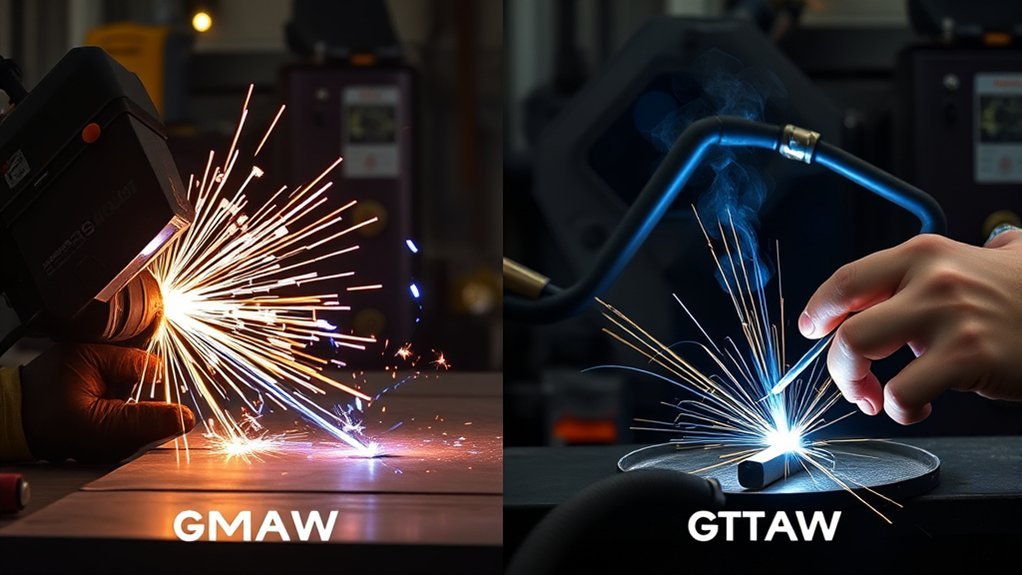
- Gas Metal Arc Welding. MIG welding: continuously fed solid wire shielded by gas from a cylinder. What is GMAW.
- MIG / MAG
- Metal Inert Gas and Metal Active Gas, the common names for GMAW. MIG uses argon or helium; MAG uses CO2 or argon-CO2 blends. In the US “MIG” covers both.
- FCAW
- Flux-Cored Arc Welding. Wire-feed welding with a tubular, flux-filled wire. FCAW-S is self-shielded (gasless); FCAW-G is gas-shielded (dual shield). What is FCAW.
- GTAW
- Gas Tungsten Arc Welding. TIG welding: a non-consumable tungsten electrode, argon shielding and hand-fed filler rod. What is GTAW.
- TIG / Heliarc
- Tungsten Inert Gas, the common name for GTAW. Heliarc is the original 1940s trade name from the helium shielding first used.
- SAW
- Submerged Arc Welding. An automated process where the arc runs beneath a blanket of granular flux. Used for long seams on thick plate and pipe.
- PAW / PAC
- Plasma Arc Welding and Plasma Arc Cutting. A constricted arc through a small orifice produces a very hot, narrow plasma jet. PAC is what a plasma cutter does.
- OFW / OAW
- Oxy-Fuel Welding and Oxy-Acetylene Welding. Heat from a gas flame, no electricity. The same torch with a cutting attachment is OFC (oxy-fuel cutting).
- RSW
- Resistance Spot Welding. Two copper electrodes clamp overlapping sheets and a current pulse fuses a spot between them. Standard for automotive body assembly.
- ESW / EGW
- Electroslag and Electrogas Welding. Vertical single-pass processes for very thick plate in shipbuilding and heavy fabrication.
- LBW / EBW
- Laser Beam and Electron Beam Welding. High-energy-density processes for precision and deep narrow welds in manufacturing.
- Brazing / Soldering
- Joining with a filler that melts below the base metal, which does not melt. Brazing is above 840 °F (450 °C), soldering below. Neither is welding.
- Multi-process welder
- A machine that can run several processes, typically SMAW, GMAW, FCAW and DC GTAW, from one power source.
Electrical and Arc Terms
- Arc
- The sustained electrical discharge between electrode and workpiece that produces welding heat, roughly 6,000 to 10,000 °F depending on process.
- Amperage (A)
- Welding current. Controls heat input and penetration on constant-current processes (stick, TIG). Stick amperage chart.
- Voltage (V)
- Arc voltage. On MIG and flux-core it sets arc length and bead width; on stick and TIG it follows from arc length.
- CC (Constant Current)
- A power source that holds amperage steady while voltage varies with arc length. Used for SMAW and GTAW.
- CV (Constant Voltage)
- A power source that holds voltage steady while amperage follows wire feed speed. Used for GMAW and FCAW.
- DCEP / DC+ / Reverse polarity
- Direct current, electrode positive. The electrode holder is on the positive terminal. Standard for MIG, E7018 stick and most gas-shielded flux-core. Polarity guide.
- DCEN / DC− / Straight polarity
- Direct current, electrode negative. Standard for DC TIG on steel and most self-shielded flux-core wire.
- AC
- Alternating current. Required for TIG on aluminum; also used with E6011, E6013 and E7018 AC rods on transformer stick welders.
- AC balance / AC frequency
- TIG settings for aluminum. Balance sets the ratio of cleaning (EP) to penetration (EN); frequency tightens or widens the arc cone.
- Duty cycle
- The percentage of a 10-minute period a machine can weld at a given amperage before it must cool. 20% at 90 A means 2 minutes on, 8 off.
- OCV (Open Circuit Voltage)
- Voltage at the electrode before the arc is struck. Higher OCV makes arc starting easier, especially with E6010.
- High frequency (HF) start
- A high-voltage, high-frequency pulse that jumps the gap to start a TIG arc without touching the tungsten to the work.
- Lift start / Scratch start
- TIG arc-starting methods that touch the tungsten to the work. Lift start uses a low current so the tungsten is not contaminated; scratch start is like striking a match.
- Arc blow
- Magnetic deflection of a DC arc near the end of a joint or the work clamp, causing a wandering arc and porosity. Switching to AC or moving the clamp fixes it.
- Arc length
- The distance from electrode tip to the puddle. Roughly equal to the rod diameter for stick; about 1/8″ for TIG.
- Stick-out / CTWD
- The length of wire beyond the contact tip (contact-tip-to-work distance). About 3/8″ to 1/2″ for MIG, 3/4″ to 1″ for self-shielded flux-core.
- Wire feed speed (WFS)
- How fast wire leaves the gun, in inches per minute. On CV machines it effectively sets amperage. MIG settings chart.
- Transfer mode
- How metal crosses the arc in MIG: short circuit (thin metal), globular, spray (thick plate) or pulsed spray.
- Pulse
- Rapid alternation between a high peak and a low background current. Reduces heat input and distortion on TIG and MIG.
- Heat input
- Energy delivered per length of weld, calculated from volts, amps and travel speed. Higher heat input means more penetration and more distortion.
Consumables and Shielding
- Electrode
- The conductor that carries current to the arc. Consumable (stick rod, MIG wire, flux-core wire) or non-consumable (TIG tungsten). Electrode types.
- Filler metal
- Metal added to the joint: the rod or wire in SMAW, GMAW and FCAW, or a separate rod in GTAW.
- E7018 (and the E-number system)
- AWS stick rod classification. E = electrode, 70 = 70,000 psi tensile, 1 = all position, 8 = low-hydrogen iron-powder coating. Decoding rod numbers.
- Low-hydrogen rod
- A stick rod such as E7018 whose coating is formulated to keep hydrogen out of the weld. Must be stored in a rod oven at 250 °F or higher after the can is opened.
- Cellulose rod
- E6010 and E6011. A paper-based coating that produces a forceful, deeply penetrating arc ideal for rusty steel and pipe roots.
- ER70S-6
- The standard solid MIG wire for carbon steel. ER = electrode/rod, 70 = tensile strength, S = solid, 6 = high silicon and manganese for welding over mill scale.
- E71T-11 / E71T-GS
- Common self-shielded flux-core wires. T = tubular; 11 is multi-pass general purpose, GS is single-pass only. Flux-core wire types.
- Flux
- A mineral and chemical mixture that burns to produce shielding gas, forms slag, deoxidizes the puddle and stabilizes the arc.
- Slag
- The glassy crust left on top of a stick or flux-core bead by the melted flux. Must be chipped and brushed off before the next pass.
- Shielding gas
- Gas that keeps air away from the molten metal. Argon, CO2, helium and blends such as C25 (75% Ar / 25% CO2). Shielding gas explained.
- C25 / 75-25
- The most common MIG gas for steel: 75% argon, 25% carbon dioxide.
- CFH
- Cubic feet per hour, the unit on a gas flowmeter. Typical: 15 to 20 CFH for TIG, 20 to 25 CFH for MIG.
- Tungsten
- The non-consumable TIG electrode. Colour-coded by alloy: blue 2% lanthanated, grey 2% ceriated, red 2% thoriated, green pure.
- Gas lens
- A TIG collet body with a screen that smooths the argon flow so you can use a longer stick-out and a larger cup.
- Contact tip
- The copper tube at the end of a MIG gun that transfers current to the wire. Sized to wire diameter and replaced when worn.
- Liner
- The coiled steel or plastic tube inside a MIG gun cable that guides the wire.
- Drive rolls
- The wheels in a wire feeder that push the wire. V-groove for solid wire, knurled for flux-core, U-groove for aluminum.
- Spool gun
- A MIG gun with a small wire spool mounted on it, used so soft aluminum wire does not have to travel through a long liner.
- Anti-spatter
- A spray or gel applied to the nozzle or workpiece so spatter does not stick.
Joints, Positions and Weld Types
- Butt joint
- Two pieces joined edge to edge in the same plane. Butt joints explained.
- Lap joint
- Two pieces overlapping, welded along the edge of the top piece.
- T-joint / Corner joint / Edge joint
- Pieces meeting at 90 degrees in a T, meeting at the corners, or lying face to face with edges aligned.
- Fillet weld
- A triangular weld joining two surfaces at roughly right angles, as in a T or lap joint. Fillet weld sizing.
- Groove weld
- A weld made in a prepared groove between the pieces, used for full-penetration butt joints on thick plate.
- Bevel / V-groove / J-groove
- Edge preparations that open up a joint so the weld can reach the root of thick material.
- Root / Root pass / Root gap
- The deepest point of a joint, the first pass that fuses it, and the deliberate space left between pieces to allow penetration.
- Hot pass, fill pass, cap pass
- The sequence after the root in multi-pass pipe and plate welding: clean up the root, fill the groove, then finish the surface. Single vs multi-pass.
- Tack weld
- A short weld that holds parts in alignment before the full weld. Tack welding.
- Plug weld / Slot weld
- A weld made through a hole or slot in the top piece to join it to the piece beneath. The MIG substitute for factory spot welds in auto body work. Plug welds.
- Stitch weld / Skip weld
- Short intermittent welds with gaps between them, used to limit heat and distortion on sheet metal.
- Stringer bead / Weave bead
- A bead run in a straight line with no side-to-side motion, versus one oscillated to make a wider bead.
- 1G, 2G, 3G, 4G, 5G, 6G
- Groove weld test positions: flat, horizontal, vertical, overhead, pipe horizontal fixed, pipe at 45 degrees. Welding positions.
- 1F, 2F, 3F, 4F
- Fillet weld test positions: flat, horizontal, vertical, overhead. 1F to 4F explained.
- Vertical up / Vertical down
- Welding a vertical joint upward (stronger, deeper penetration) or downward (faster, thin material only).
- Push vs drag (pull)
- Gun angle relative to travel. Push for MIG solid wire; drag for stick and flux-core so slag stays behind the puddle.
- Travel speed
- How fast the arc moves along the joint. Too slow piles up metal and overheats; too fast leaves a narrow, undercut bead.
- Work angle / Travel angle
- The torch angle relative to the joint faces, and relative to the direction of travel.
- Weld symbol
- The standardized notation on drawings that specifies weld type, size, length and location. Welding symbols.
- Penetration
- How deep the weld fuses into the base metal. Full penetration means through the entire thickness.
- HAZ (Heat-Affected Zone)
- The band of base metal next to the weld that did not melt but was changed by the heat. Often the weakest area.
- Preheat / Interpass temperature / PWHT
- Warming the metal before welding, the maximum temperature allowed between passes, and post-weld heat treatment to relieve stress.
- Autogenous weld
- A weld made by fusing the base metal with no filler added, common in TIG edge and corner joints.
Weld Defects and Problems
- Porosity
- Gas pockets trapped in the weld, from lost shielding, dirty metal, damp rods or wind. Appears as pinholes or hidden voids.
- Worm tracks
- Elongated surface porosity on flux-core welds, usually from too much voltage or too short a stick-out.
- Undercut
- A groove melted into the base metal at the toe of the weld and left unfilled. Caused by excess current, long arc or wrong angle.
- Overlap / Cold lap
- Weld metal that rolls over onto the base metal without fusing to it.
- Lack of fusion / Incomplete penetration
- Weld metal that did not bond to the base metal or the previous pass, or did not reach the root. The classic hidden flaw in short-circuit MIG on thick plate.
- Slag inclusion
- Slag trapped inside the weld because it was not removed between passes or was pushed ahead of the arc.
- Spatter
- Droplets of metal thrown from the arc that stick to the surrounding surface. Fixing spatter.
- Crater / Crater crack
- The depression at the end of a bead, and the star-shaped crack that forms in it if the arc is stopped too abruptly.
- Hot crack / Cold crack
- Cracking during solidification (hot), or hours later from hydrogen and residual stress (cold). Low-hydrogen rods and preheat prevent cold cracking.
- Burn-through
- Melting a hole through thin material from too much heat.
- Distortion / Warping
- Movement of the workpiece as the weld cools and shrinks. Controlled with tacks, clamping, sequencing and stitch welding.
- Tungsten inclusion
- A piece of tungsten in a TIG weld from dipping the electrode into the puddle.
- Burn-back
- MIG wire fusing to the contact tip, usually from low wire speed or too short a stick-out.
- Bird nest
- A tangle of wire at the drive rolls when the wire cannot get through the liner or tip.
- Sugaring
- Heavy oxidation on the back side of a stainless TIG weld when the root is not back-purged with argon.
Safety and Equipment Terms
- Arc flash / Arc eye
- Painful UV burn of the cornea from looking at an arc without a filter. Symptoms appear hours later.
- Shade number
- The darkness of a welding lens. Shade 9 to 13 for arc welding depending on amperage; shade 5 for cutting and brazing.
- Auto-darkening helmet (ADF)
- A helmet whose lens switches from clear to dark in milliseconds when the arc strikes.
- PPE
- Personal protective equipment: helmet, safety glasses, leather gloves, flame-resistant jacket, boots, and respiratory protection as needed. Welding safety checklist.
- Fume extraction
- Local ventilation that pulls welding smoke away from the breathing zone. Especially important for flux-core, galvanized and stainless.
- Hexavalent chromium
- A carcinogen released when welding stainless steel. Requires good ventilation or respiratory protection.
- Metal fume fever
- Flu-like illness from breathing zinc oxide fumes when welding galvanized steel.
- Regulator / Flowmeter
- The device on a gas cylinder that reduces pressure and sets flow rate in CFH.
- Rod oven
- A heated cabinet that keeps low-hydrogen electrodes dry, typically at 250 to 300 °F.
- Chipping hammer
- A pointed hammer for breaking slag off stick and flux-core welds.
- Ground clamp / Work clamp
- The clamp that completes the welding circuit through the workpiece. Technically the work lead, not an earth ground.
- Stinger
- Shop slang for the stick welding electrode holder.
- Buzz box
- Slang for a basic AC transformer stick welder, after the hum it makes.
- WPS / PQR
- Welding Procedure Specification and Procedure Qualification Record: the written recipe for a code weld and the test record that proves it works.
- AWS / ASME / API
- The American Welding Society, American Society of Mechanical Engineers and American Petroleum Institute, the bodies that publish structural, pressure vessel and pipeline welding codes. AWS certifications.
- CWI
- Certified Welding Inspector, an AWS credential for people who inspect and qualify welds and welders.
- NDT / NDE
- Non-destructive testing or examination: X-ray, ultrasonic, dye penetrant and magnetic particle inspection of finished welds.
Related Guides
- SMAW vs GMAW vs FCAW vs GTAW: full comparison
- Essential automotive welding terms
- How MIG differs from TIG
- Welding polarity explained
Sources
- AWS A3.0M/A3.0, Standard Welding Terms and Definitions
- AWS A5.1, A5.18 and A5.20 filler metal specifications
- OSHA 29 CFR 1910.252 and ANSI Z49.1, Safety in Welding, Cutting and Allied Processes