In automotive manufacturing, magnetic pulse welding is a fast solid-state joining process used to bond conductive metals without melting the full joint like arc or laser welding. A capacitor bank releases a short, high-current pulse through a coil. That pulse creates a strong magnetic field, induces current in the workpiece, and drives one part into another at very high speed. The result can be a strong, repeatable, leak-tight joint with very low bulk heat distortion.
Quick Answer
Magnetic pulse welding joins conductive automotive parts by using a short electromagnetic pulse to accelerate one metal into another. It is most useful for dissimilar metals, tube assemblies, electrical connections, and leak-tight joints where low heat input, repeatability, and fast cycle time matter.
Key Takeaways
- MPW is not arc welding. It uses impact pressure from electromagnetic force, not a molten weld pool.
- It works best on conductive metals such as aluminum and copper, though steel can be joined in some designs with the right tooling and energy setup.
- It is strongest in production settings where the same joint is repeated thousands of times with tight part control.
- It needs serious safety controls because the equipment uses stored capacitor energy, high current, strong magnetic fields, and impulse noise.
At a Glance
| Process Type | Solid-state electromagnetic impact welding |
| Best Automotive Uses | Fuel and fluid tubes, battery cable terminals, busbars, sleeves, exhaust interfaces, and selected mixed-metal body parts |
| Best Materials | Conductive metals, especially aluminum, copper, and some aluminum-steel or copper-aluminum combinations |
| Main Limits | Custom tooling, conductive-material dependence, tight fit-up, high equipment cost, and industrial safety requirements |
What Is Magnetic Pulse Welding?
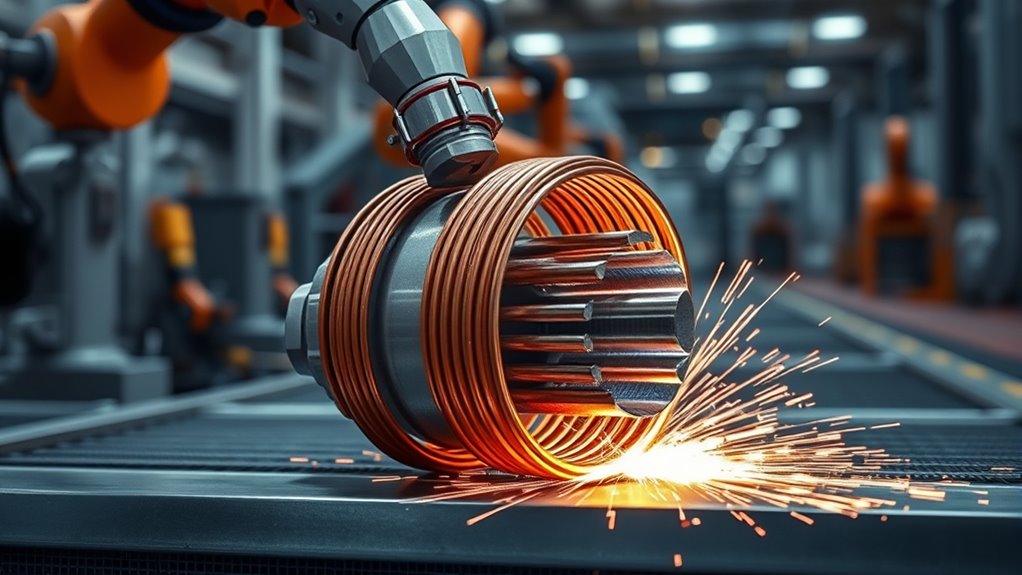
Magnetic Pulse Welding, often shortened to MPW, is a solid-state welding process. That means the parts bond through high-speed impact and pressure rather than through a large molten weld pool.
The basic idea is simple: one part acts as the flyer, and the other acts as the target. The machine uses electromagnetic force to launch the flyer into the target. When the impact happens at the right speed and angle, the surfaces deform, oxides break away, and a metallurgical bond forms along the interface.
You use MPW when you need controlled, repeatable joining with low heat input. In automotive work, it is valuable for dissimilar metals, conductive joints, lightweight assemblies, and leak-tight tube connections. Because the process does not rely on filler wire, flux, or shielding gas, it can simplify production once the tooling is dialed in.
MPW is strongest when the joint is designed for the process from the start: correct overlap, correct gap, correct coil, and repeatable part position.
It is not a general repair-shop replacement for MIG, TIG, or spot welding. It is a specialized production process for parts that can be loaded into precise fixtures and fired with repeatable pulse energy.
How Magnetic Pulse Welding Works
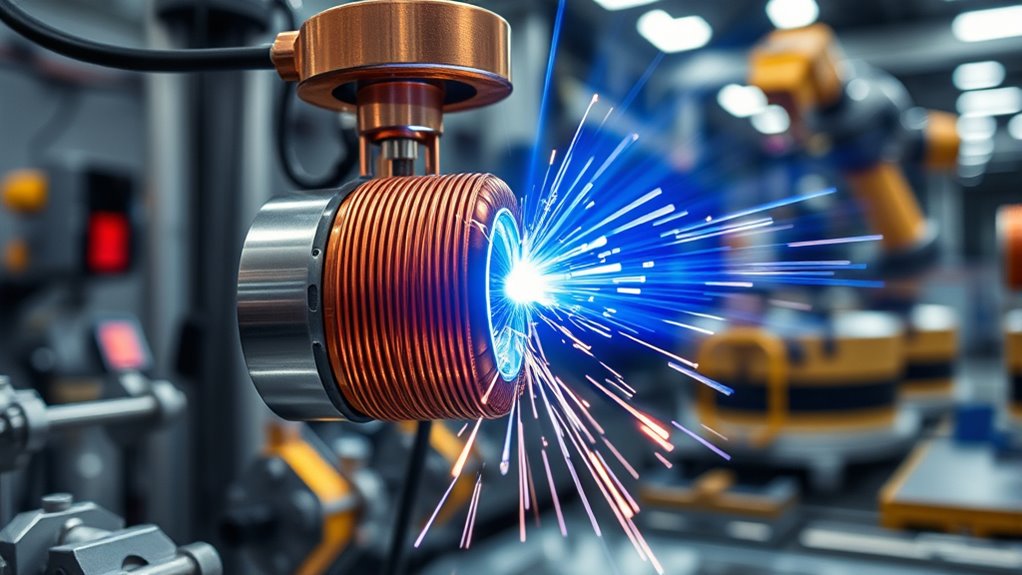
To run magnetic pulse welding, the machine first charges a capacitor bank. When the weld cycle begins, the stored energy discharges through a coil in a very short pulse. This creates a rapidly changing magnetic field around the work area.
That magnetic field induces eddy currents in the nearby conductive workpiece. The opposing magnetic fields create a Lorentz force, which pushes the flyer part toward the target part at high speed. The impact usually happens in microseconds, and the whole cycle can be completed very quickly in automated production.
At the collision line, a small jet of surface material can form. This jet helps break up and eject oxides or light surface films. The bond forms through plastic deformation, pressure, and intimate metal contact. This is why MPW can join some metal combinations that are difficult to weld by fusion methods.
Note: MPW is often described as having no heat-affected zone, but the safer wording is very low bulk heat input. Local interface heating and microstructural changes can still occur, especially in sensitive dissimilar-metal joints.
Basic MPW Cycle
- Load and locate the parts. The flyer and target are placed in a fixture with the correct overlap and stand-off gap.
- Charge the capacitor bank. The power supply stores the required energy for the pulse.
- Fire the pulse. The current passes through the coil and creates the magnetic field.
- Accelerate the flyer. The electromagnetic force drives the flyer into the target.
- Form the weld. The impact creates a solid-state bond along the designed collision path.
- Inspect the joint. The part is checked for alignment, leak-tightness, strength, or conductivity, depending on its purpose.
Equipment Used in Magnetic Pulse Welding
A production MPW cell is more than a power supply. The equipment must store energy, shape the pulse, guide the magnetic field, hold the parts, and protect the operator.
| Capacitor Bank | Stores the electrical energy released during the pulse. |
| Pulse Coil | Creates the magnetic field that accelerates the flyer part. |
| Field Shaper | Focuses the magnetic force into the area where the weld should form. |
| Fixture | Controls overlap, stand-off gap, alignment, and part support. |
| Controls and Interlocks | Manage charging, discharge, guarding, cooling, diagnostics, and safe access. |
The coil and fixture are often custom-made for a specific part. That is one reason MPW can be excellent for high-volume manufacturing but less attractive for one-off fabrication.
Products Worth Considering
POWERFUL HOLDING FORCE: Featuring robust magnets embedded in the welding holder, these durable magnets boasts a strong magnetic holding force of up to 50 lbs, ensuring reliable performance.

POWERFUL HOLDING FORCE: Featuring robust magnets embedded in the welding holder, these durable magnets boasts a strong magnetic holding force of up to 25/50/75 lbs, ensuring reliable performance.

POWERFUL HOLDING FORCE: Featuring robust magnets embedded in the welding holder, these durable magnets boasts a magnetic holding force of up to 25 lbs, suitable for light welding tasks.
Why Automakers Choose Magnetic Pulse Welding
Automakers choose magnetic pulse welding when they need strong joints between metals that do not respond well to normal fusion welding. Aluminum-to-copper electrical connections are a common example because they are useful in electrified vehicles but can be difficult to join cleanly with high heat.
MPW also helps when a part must stay dimensionally stable. Since the process uses a very short pulse and does not melt the full joint, it reduces distortion compared with many heat-heavy processes. That matters for thin tubes, sleeves, electrical terminals, and parts that need tight fit after welding.
Strong Dissimilar-Metal Joints
When you need a joint between metals that do not weld well by conventional means, magnetic pulse welding gives you a controlled option. You can join selected dissimilar metals, such as aluminum to copper, without adding filler metal.
The main benefits are:
- Lower heat input than fusion welding.
- Less distortion on thin or tubular parts.
- Fewer consumables because no shielding gas or filler wire is required.
- High repeatability when the same joint is produced with the same tooling.
These benefits are not automatic. Joint strength depends on part design, material pairing, surface condition, pulse energy, gap, overlap, and inspection standards.
Fast, Clean Production
MPW can complete the joining event in milliseconds. That makes it attractive for automated lines where cycle time matters. It can also reduce shop-floor waste because there is no filler wire, flux, or shielding gas.
The process can reduce some cleaning demands because the impact jet helps disrupt light oxides at the interface. Still, production parts should be clean, dry, and dimensionally consistent before welding. Oils, heavy oxides, incorrect coatings, or poor fit-up can still cause weak or inconsistent joints.
Pro Tip: Treat MPW as a joint-design process, not just a machine setting. The flyer thickness, target support, gap, overlap, and coil shape often matter as much as the discharge energy.
Common Magnetic Pulse Welding Applications in Cars
You will see magnetic pulse welding most often where automakers need a compact, reliable joint on conductive parts. It is especially useful for tubes, sleeves, cables, terminals, and lightweight structures that benefit from low distortion.
Fuel and Fluid Lines
In fuel, brake, coolant, and other fluid-handling assemblies, MPW can create strong, leak-tight joints without a long heat cycle. This helps preserve tube geometry and reduces the risk of distortion near the joint.
Useful applications include:
- Fuel pipe sleeves and couplings
- Brake or hydraulic tube interfaces where the design is validated for pressure
- Coolant tube connections in vehicle thermal systems
- Lightweight aluminum tube assemblies
For pressure-carrying parts, the weld must be validated with the correct leak, burst, fatigue, and corrosion tests. A good-looking MPW joint is not enough by itself.
Battery Cable and Busbar Connections
Electric and hybrid vehicles need reliable low-resistance electrical joints. MPW can be useful for copper-to-aluminum or aluminum-to-copper combinations in cables, terminals, and busbar-related parts when the design is suitable.
| Production Step | Why It Matters |
| Position cable and terminal | Controls alignment and contact area |
| Set pulse energy | Controls impact speed and joint formation |
| Form solid-state bond | Creates the conductive metal-to-metal path |
| Inspect resistance and strength | Confirms the joint can carry current and survive service loads |
For high-voltage vehicle parts, the weld is only one part of the design. Insulation, creepage, clearance, corrosion control, and thermal cycling must also be validated.
Exhaust and Body Parts
MPW can also fit selected exhaust and body applications, especially where a tube, sleeve, or mixed-metal interface must stay dimensionally stable. It can join certain aluminum, steel, and stainless combinations when the part geometry allows the flyer to accelerate correctly.
Common examples include:
- Exhaust tube-to-sleeve joints
- Filter or canister interfaces
- Mixed-metal lightweight structures
- Local reinforcements or transition pieces
Body-panel use depends heavily on geometry. MPW is easier to apply to tubes and sleeves than to wide flat panels because the magnetic field and collision path must be controlled.
MPW Joint Types and Material Limits
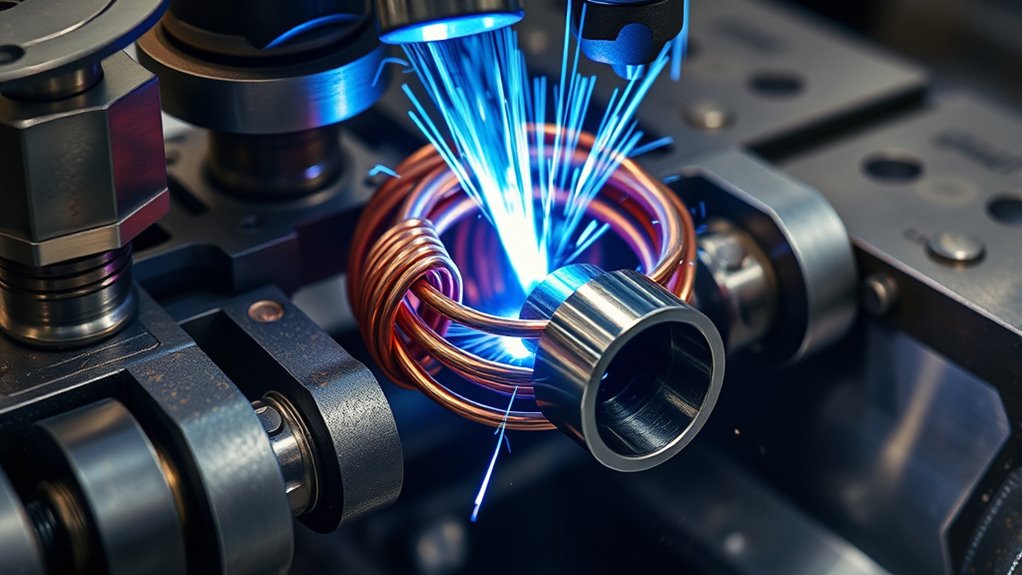
Magnetic pulse welding is especially well suited to tubular automotive parts. Tube-to-tube, tube-to-sleeve, and tube-to-end-cap joints are common because the geometry lets the flyer collapse toward the target in a controlled way.
The most important joint variables are:
- Overlap: The shared length where the parts can bond.
- Stand-off gap: The space that allows the flyer to accelerate before impact.
- Collision angle: The angle at which the flyer meets the target.
- Flyer thickness: The moving part must be thin and conductive enough to accelerate properly.
- Target support: The target must resist movement so the collision creates pressure instead of simple bending.
- Coil and field shaper: These control where the magnetic force is focused.
High-conductivity metals such as aluminum and copper are usually the easiest to drive because they couple well with the magnetic pulse. Steel can be joined in some applications, but it often needs more careful design because it is less conductive than copper or aluminum. Nonconductive materials cannot be directly accelerated by the magnetic field unless a conductive driver transfers the force.
Magnetic Pulse Welding vs. Other Automotive Joining Methods
MPW is not “better” than every other process. It is better for specific joint problems. The table below shows where it fits.
| Process | Best Fit | Main Tradeoff |
| Magnetic Pulse Welding | Dissimilar conductive metals, tubes, terminals, leak-tight sleeves | High tooling cost and strict geometry needs |
| MIG/MAG Welding | General fabrication, repairs, steel structures, many body and frame jobs | More heat, filler metal, distortion, and metallurgical limits |
| Resistance Spot Welding | High-volume sheet-metal joining | Needs electrode access and is less suited to many tube or sleeve joints |
| Laser Welding | Precise seams, high-speed automated welding, thin parts | Still uses heat and needs strong fit-up and optical access |
| Crimping or Mechanical Fastening | Lower-cost assembly and serviceable joints | May add weight, loosen, leak, or need extra sealing |
Products Worth Considering

Tip: Argon gas can be connected through the pressure gauge for better welding results. It can work normally without argon gas. (Argon gas needs to be purchased by yourself)

5-in-1 MIG Welder: This 250A 5-in-1 pro mig welder supports various functions - MIG Pluse, gasless MIG, gas MIG, MMA, and Lift TIG. The innovative pulse welding function provides fast, high-quality, low-spatter welds and better thermal control than traditional MIG welders, allowing perfect welds at lower temperatures.

【3-IN-1 Foldable Exercise Bike for Home Workout】Achieve high-intensity training in an upright position for maximum calorie burn, or switch to a comfortable recumbent posture for a low-impact, enjoyable ride. The added feature of resistance bands ensures a full-body workout, targeting your upper muscles for a comprehensive exercise session.
Quality Control and Inspection
MPW quality depends on more than the final appearance. A production line should verify both the process and the finished joint.
Common inspection methods include:
- Visual and dimensional inspection to confirm collapse, alignment, and surface condition.
- Leak testing for fuel, brake, coolant, HVAC, or exhaust-related joints.
- Pull, peel, shear, or burst testing during validation and production sampling.
- Electrical resistance testing for battery cables, terminals, and busbars.
- Metallographic sectioning during development to confirm the bond interface.
- Process monitoring of charge voltage, discharge current, coil condition, part position, and cycle history.
Because the weld event happens so quickly, the best quality systems focus on repeatability. If the charge energy, fixture position, coil condition, and part dimensions stay controlled, the weld is much more likely to stay consistent.
MPW Safety and Production Requirements
Warning: Magnetic pulse welding equipment stores and releases high electrical energy. Only trained personnel should operate, service, or troubleshoot MPW systems, and maintenance should follow documented energy-control, discharge-verification, guarding, and lockout/tagout procedures.
You should treat every MPW cycle as a controlled release of stored energy. A safe production cell needs guarding, interlocks, emergency stops, discharge indicators, insulated enclosures, and a maintenance procedure that verifies stored energy has been released before access.
Key safety and production requirements include:
- Stored-energy control: Capacitors must be safely discharged and verified before service.
- Lockout/tagout: Maintenance work should follow documented energy-control procedures consistent with OSHA 1910.147.
- Machine guarding: Operators should be protected from moving parts, ejected fragments, and access during charging or firing.
- Noise control: MPW can create impulse noise, so hearing protection and monitoring may be needed under OSHA 1910.95.
- EMF controls: Access rules should protect workers with medical implants, pacemakers, or other sensitive devices according to site safety policy.
- Cooling and coil life: Coils, bus bars, switches, and charging circuits need routine checks because heat and mechanical stress can degrade them.
- Part-position control: Small setup errors can change the collision angle and weaken the joint.
Production planning should also include coil replacement intervals, fixture wear checks, calibration schedules, and a reaction plan for failed leak, resistance, or strength tests.
When Magnetic Pulse Welding Is Not the Best Choice
MPW is powerful, but it is not a universal welding method. It may not be the right choice when the part geometry does not allow a flyer to accelerate, when production volume is low, or when the joint can be made more cheaply with a proven conventional process.
MPW may be a poor fit if:
- The parts are not electrically conductive and cannot use a conductive driver.
- The joint has no room for a proper stand-off gap or overlap.
- The part is too massive or too stiff to accelerate correctly.
- The production run is too small to justify custom tooling.
- The assembly needs field repair with common shop equipment.
- The company cannot support high-voltage equipment maintenance and safety controls.
For repair work, prototype fabrication, or low-volume jobs, MIG, TIG, resistance welding, brazing, adhesives, mechanical fastening, or laser welding may be more practical.
Frequently Asked Questions
What are the disadvantages of magnetic pulse welding?
The main disadvantages are high equipment cost, custom coil and fixture needs, tight setup tolerances, and limits on material and joint geometry. MPW works best with conductive metals and repeatable production parts, so it is usually not the best choice for one-off repairs or complex shapes that cannot be fixtured correctly.
Which is better, MIG, MAG, or magnetic pulse welding?
None is always better. MIG and MAG are flexible arc-welding processes for fabrication and repair. Magnetic pulse welding is a specialized automated process for selected conductive parts, especially dissimilar-metal joints, tubes, sleeves, and electrical connections where low heat input and repeatability matter.
Where is magnetic pulse welding used in cars?
In cars, MPW can be used for fuel and fluid tubes, brake or hydraulic line assemblies, exhaust sleeves, battery cable terminals, busbar-related parts, aluminum-copper electrical joints, and selected lightweight mixed-metal structures. The exact use depends on part geometry, material pairing, and validation testing.
Is a magnetic pulse welder worth it?
A magnetic pulse welder can be worth it for high-volume production where the same joint is repeated and the benefits outweigh the tooling cost. It is usually not worth it for low-volume fabrication, hobby use, or repair work because the equipment, safety systems, coils, and fixtures are specialized.
Can magnetic pulse welding join aluminum to copper?
Yes, aluminum-to-copper is one of the important material combinations studied for MPW, especially for electrical applications. The joint still needs careful design because intermetallic layers, local heating, gap, impact angle, and surface condition can affect strength and conductivity.
Does magnetic pulse welding melt the metal?
MPW is considered a solid-state process because it does not rely on melting the full joint area like arc welding. However, local interface heating and small metallurgical changes can occur. That is why development testing and sectioning are important for critical parts.
Conclusion
You can see why magnetic pulse welding matters in automotive manufacturing. It can join selected dissimilar metals with high-speed force, low bulk heat input, and strong repeatability. That makes it useful for tubes, sleeves, fuel and fluid systems, exhaust interfaces, battery cables, and aluminum-copper electrical connections.
The tradeoff is that MPW is not a simple plug-in replacement for MIG, TIG, MAG, spot welding, or laser welding. You need conductive materials, correct joint design, custom tooling, controlled part fit-up, process monitoring, and serious stored-energy safety controls. When those pieces are in place, MPW gives automakers a fast and precise joining option for modern lightweight and electrified vehicle designs.
Sources
- Kapil and Sharma, Journal of Cleaner Production — magnetic pulse welding as an efficient multi-material joining technique.
- Li et al., Al/Cu magnetic pulse welding interface study — impact conditions, interface development, and aluminum-copper joint behavior.
- Sapanathan et al., Magnetic Pulse Welding chapter — MPW for similar and dissimilar metal pairs.
- OSHA 1910.147 — control of hazardous energy and lockout/tagout requirements.
- OSHA 1910.95 — occupational noise exposure and hearing conservation requirements.