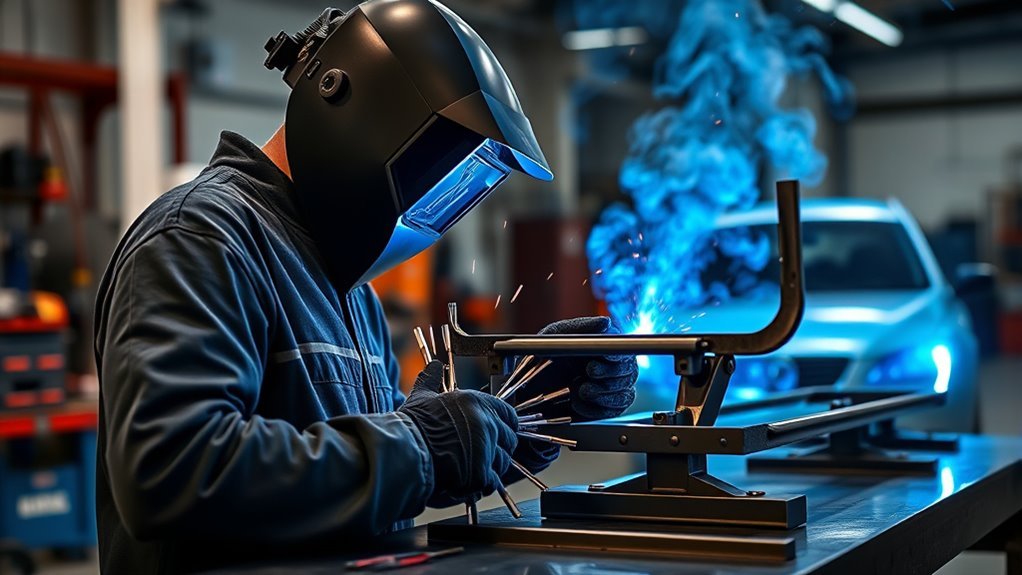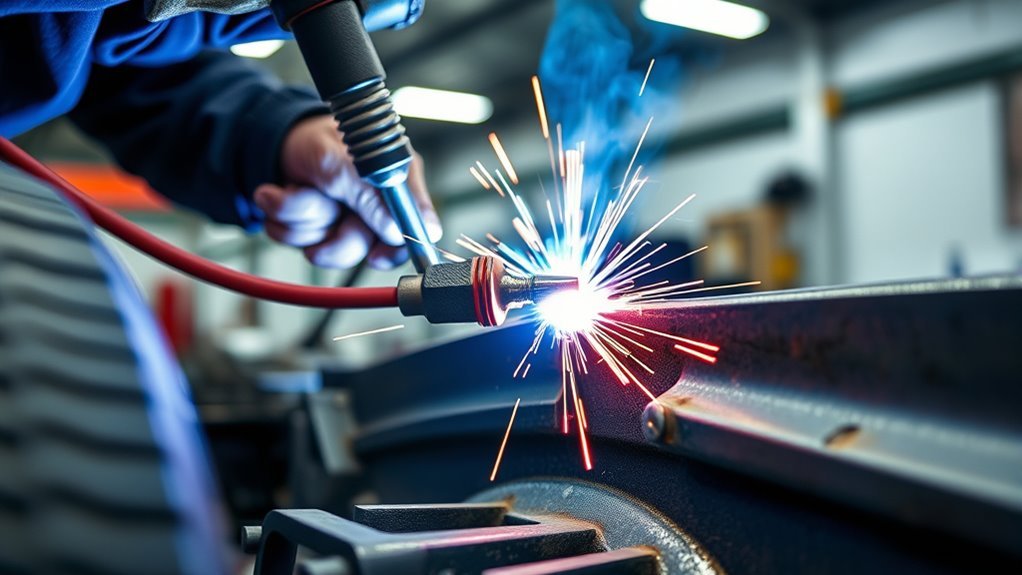
Place the welding ground clamp—more accurately called the work clamp or current return clamp—on clean, bare metal on the part being welded. Keep it as close to the weld as practical so the current returns directly to the welder instead of passing through hinges, bearings, wiring, or other vehicle components.
Quick Answer
Clamp the welder’s work clamp to clean, bare metal on the same panel, pipe, bracket, or structural part you are welding. Keep the connection close, firm, and outside the heat and spatter zone. Never use the battery terminal, brake line, fuel line, bearing, suspension joint, or a random body ground.
Key Takeaways
- Clamp directly to the workpiece whenever possible, not to a convenient but unrelated vehicle part.
- Remove paint, rust, grease, undercoating, seam sealer, and loose scale from the clamp point.
- Keep the current path short and away from hinges, bearings, suspension joints, wiring, modules, fuel lines, and brake lines.
- Check the VIN-specific OEM repair procedure before disconnecting power or welding a body or structural component.
- The work clamp is not always negative. Set polarity from the welder manual and the wire or electrode instructions.
At a Glance
| Time Required | About 2 to 10 minutes to verify, clean, attach, and inspect the clamp point |
| Difficulty | Clamp placement is simple; welding on modern, structural, hybrid, or electric vehicles may require trained technicians |
| Tools Needed | Welder work clamp, wire brush, scraper or sanding tool, clean rag, welding PPE, suitable ventilation, and fire extinguisher |
| Cost | Usually $0 when the welder, clamp, preparation tools, PPE, and fire protection are already available |
Warning: Welding on a vehicle can start a fire, damage electronics, release hazardous fumes, weaken heat-sensitive structural metal, or expose you to electric shock. Follow the exact OEM repair procedure for the VIN and model year. Do not work on hybrid or EV high-voltage systems unless you have the required training, PPE, test equipment, and verified isolation procedure.
Where to Place the Ground Clamp
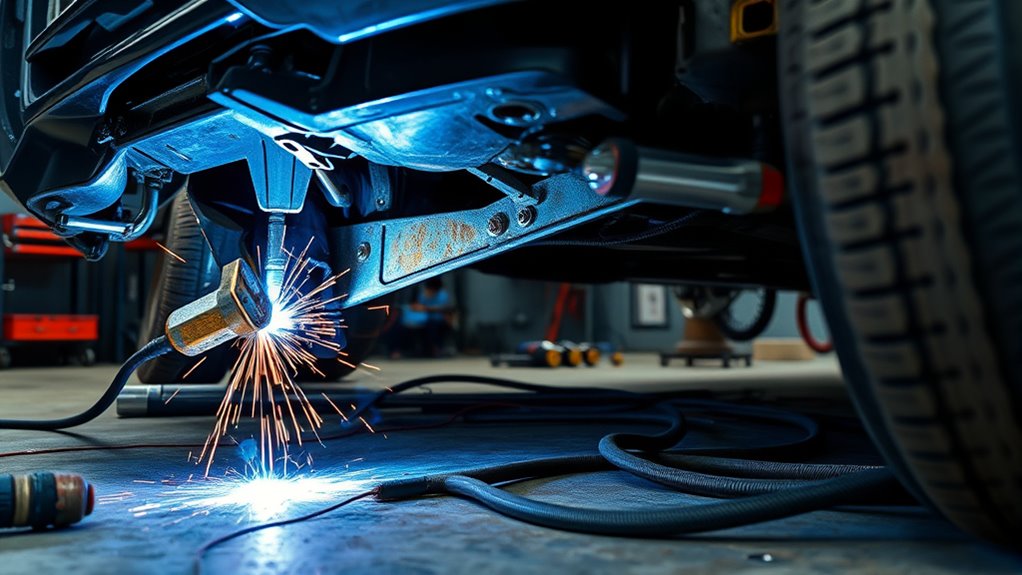
Attach the work clamp directly to the part you are welding whenever possible. If you are repairing a body panel, clamp to that panel. For an exhaust repair, clamp to the pipe or exhaust section being welded. For an approved bracket or structural repair, clamp to the same bracket, rail, or crossmember.
The goal is to give welding current a short, direct route through solid metal and back to the machine. OSHA requires the work lead to be firmly attached to the work. Lincoln Electric also instructs welders to connect the work cable to clean base metal as close as possible to the welding area and to avoid current paths through hinges, bearings, or electronic components. See the OSHA arc-welding requirements and the welder manufacturer’s instructions.
Use this order of preference:
- Best: Clamp directly to the exact part being welded.
- Good: Clamp to clean bare metal on the same panel, pipe, bracket, rail, or crossmember.
- Acceptable when required by the repair setup: Use a nearby rigid metal point that has a direct, solid-metal connection to the workpiece.
- Avoid: Any path that crosses hinges, bearings, bolted painted joints, rubber mounts, suspension pivots, wiring, brake lines, fuel lines, or unrelated assemblies.
The clamp belongs on the workpiece. A convenient factory body ground, battery terminal, jack stand, or nearby metal component is not a substitute.
Ground Clamp vs. Work Clamp: What the Term Really Means
Most welders casually say ground clamp, but work clamp or current return clamp is more accurate. The clamp completes the welding circuit between the metal being welded and the power source.
It is not the same thing as the protective grounding conductor for the welder’s case or power supply. It also is not a vehicle battery ground that can be attached anywhere on the chassis. A welder may still strike an arc with a poor or remote connection, but the current can then use an unwanted route through other metal parts.
Note: This guide uses “ground clamp” because it is the common search term. During setup, think of it as the work clamp: it should be attached to the metal workpiece, not to a random vehicle grounding point.
Check the VIN-Specific Repair Procedure First
Before choosing a clamp point, confirm that the planned weld is allowed. Correct clamp placement cannot make an unapproved structural repair safe.
- Record the VIN and model year. Similar-looking vehicles can use different batteries, electronics, metals, adhesives, and repair methods.
- Open the correct OEM body or service manual. Check the exact component and repair location.
- Confirm the joining method. The procedure may require GMA welding, squeeze-type resistance spot welding, brazing, rivets, adhesive, replacement at factory seams, or another method.
- Identify the material. Mild steel, high-strength steel, ultra-high-strength steel, aluminum sheet, cast aluminum, and extruded aluminum do not share one repair rule.
- Check shutdown instructions. Follow the specified battery, SRS, module, ADAS, hybrid, and high-voltage procedures in the stated order.
- Confirm post-repair requirements. These may include corrosion protection, weld testing, inspections, diagnostic scans, calibrations, or system initialization.
For example, Tesla’s body-structure material guidance limits welding by component, material, thickness, wire, and repair procedure. Other vehicle makers publish different limits, so never transfer one brand’s procedure to another vehicle.
Warning: Do not assume that disconnecting one battery cable makes a modern vehicle safe to weld. Some procedures require both low-voltage cables to be isolated, a waiting period for SRS circuits, module removal, high-voltage disablement, voltage verification, or other model-specific steps.
Before You Clamp: Vehicle Safety Checklist
Make the work area safe before striking an arc. Clamp placement is important, but it is only one part of welding safely on a vehicle.
- Follow the OEM procedure: Use the correct VIN, model year, component, and repair location.
- Shut down systems as directed: Complete all battery, module, SRS, ADAS, and high-voltage steps required by the manufacturer.
- Remove fire hazards: Move carpet, trim, insulation, paper, oil-soaked material, and other combustibles away from both sides of the weld.
- Inspect hidden spaces: Check inside pillars, rocker panels, rails, boxed sections, floor cavities, and the back of body panels.
- Shield nearby components: Protect glass, upholstery, wiring, hoses, fuel lines, brake lines, tanks, plastics, and painted surfaces from sparks and heat.
- Control coatings and fumes: Remove coatings only as required for the approved repair and use suitable ventilation or local exhaust. Paint, zinc coatings, adhesives, seam sealer, undercoating, and contamination can create hazardous fumes.
- Wear proper PPE: Use a welding helmet, dry gloves, flame-resistant clothing, safety glasses for grinding, hearing protection, and respiratory protection when required.
- Keep fire protection ready: Place a suitable fire extinguisher within reach and assign a trained fire watch when the conditions require one.
OSHA’s general hot-work requirements address combustible materials, hidden fire exposure, extinguishing equipment, explosive atmospheres, and fire watches.
Warning: Do not weld on a fuel tank or any container that has held flammable material merely because it appears empty. Residual vapor can form an explosive atmosphere. Such work requires a qualified cleaning, purging, testing, and authorization procedure.
Hybrid and EV High-Voltage Safety
Orange cables, traction batteries, inverters, electric compressors, heaters, capacitors, and drive units can remain hazardous even when the vehicle appears switched off. Do not cut, heat, drill, clamp to, or weld near high-voltage parts without the exact manufacturer procedure.
High-voltage disablement is not complete just because a service disconnect has been removed. Current procedures may require trained personnel, insulated gloves, lockout controls, a specified waiting period, approved test equipment, and measurement to prove that voltage is absent. Tesla’s high-voltage disablement procedure is one example of this level of control.
Inspect the Work Clamp and Cable
A clean vehicle contact point cannot compensate for damaged welding equipment. Inspect the complete return circuit before use.
- Turn off and isolate the welder before changing lead connections or polarity.
- Check both clamp jaws for dirt, oxide, oil, heavy spatter, burning, or missing contact surfaces.
- Confirm that the spring or screw mechanism holds the jaws tightly.
- Inspect the cable, lug, connector, and insulation for looseness, cuts, crushing, exposed conductor, or overheating.
- Make sure the cable and clamp are rated for the welding current and duty cycle.
- Spread out tightly coiled welding cable so it does not trap heat.
- Replace unsafe equipment according to the welder manufacturer’s instructions.
Why Clean Bare Metal Matters
The work clamp needs direct contact with conductive metal. Paint, rust, powder coating, undercoating, seam sealer, adhesive, heavy scale, grease, and road contamination can increase resistance or prevent the jaws from making a dependable connection.
A poor connection can cause difficult starts, an arc that cuts in and out, extra spatter, erratic welding output, or heat at the clamp. Surface preparation also helps both jaws share the current instead of touching through one small high-resistance point.
Bare Metal Contact
A small, clean metal pad is better than a large painted area. The jaws should grip exposed steel, stainless steel, or aluminum that is directly connected to the approved weld area.
Do not rely on sharp clamp teeth to pierce paint or undercoating. They may make brief contact without creating a stable connection across both jaws.
Remove Paint, Rust, and Contamination
Use the preparation method allowed by the repair procedure. A wire brush, scraper, sanding disc, abrasive pad, or small grinder may be suitable, but avoid thinning a body panel or damaging nearby coatings.
- Expose a clean patch large enough for both clamp jaws.
- Remove loose rust, paint, oil, underseal, sealer, and scale from the contact area.
- Wipe away abrasive dust and residue.
- Attach the clamp so it cannot rock or slide.
- Keep the prepared pad outside the weld pool and direct spatter zone.
Improve Clamp Conductivity
If the clamp gets hot, loses tension, or shows burned contact surfaces, stop welding. Clean the jaws, tighten approved connections, or replace the damaged clamp or lead before continuing.
Do not defeat safety devices or improvise a return cable from undersized wire, jumper cables, chains, brake lines, or shop equipment.
Pro Tip: Prepare a dedicated clamp pad before positioning the gun or torch. After the repair and inspection, restore the bare area with the corrosion protection specified by the vehicle maker.
Step-by-Step: How to Place the Ground Clamp
- Identify the exact weld location. Know which panel, pipe, bracket, rail, tab, patch, or joint will be welded.
- Confirm that welding is approved. Check the vehicle’s VIN-specific repair procedure, material, process, and joining method.
- Complete the shutdown procedure. Follow all battery, SRS, module, ADAS, and high-voltage instructions before connecting the welder.
- Choose the closest suitable metal point. Use the same component first. If that is impossible, use the nearest rigid point with an uninterrupted solid-metal path to the work.
- Prepare the contact area. Remove coatings and contamination until both jaws can grip clean metal.
- Attach the clamp firmly. Make sure it cannot wiggle, rotate, or be pulled loose by cable weight.
- Route the cable safely. Keep it away from sharp edges, hot exhaust, rotating parts, fuel and brake lines, wiring, and walking areas.
- Verify polarity and settings. Follow the welder manual and consumable label.
- Use suitable scrap for setup practice. Test settings on scrap of similar material and thickness when possible. Do not strike an unnecessary test arc on a hidden vehicle surface.
- Monitor the connection. Stop if the clamp heats up, the arc sputters, the machine cuts out, or arc marks appear away from the joint.
How to Verify the Clamp Point
Use a visual and physical check before welding:
- Both jaws touch bright, solid metal.
- The clamp cannot be moved by light cable tension.
- The current path does not cross a hinge, bearing, rubber mount, loose fastener, adhesive layer, or painted joint.
- The cable is not resting on sharp or hot parts.
- The clamp is outside the path of the gun, torch, filler rod, and spatter.
A multimeter continuity beep can help identify an open circuit, but it does not prove that a joint can safely carry welding current. A meter uses very little current and may beep through a small fastener, thin contact point, or unintended vehicle circuit that would be unsuitable for welding.
Best Ground Points on a Car
The best clamp point is normally the approved metal component being welded. This keeps the return route short and limits the number of unrelated parts between the arc and the clamp.
- Body-panel repair: Clamp to clean bare metal on the same panel, patch, flange, or approved adjacent reinforcement.
- Exhaust repair: Clamp directly to the pipe, muffler shell, bracket, or exhaust section being welded.
- Approved structural repair: Clamp to the same rail, crossmember, bracket, or replacement part as directed by the repair setup.
- Bracket or tab: Clamp to the bracket or tab itself when the jaws can hold it without distorting the part.
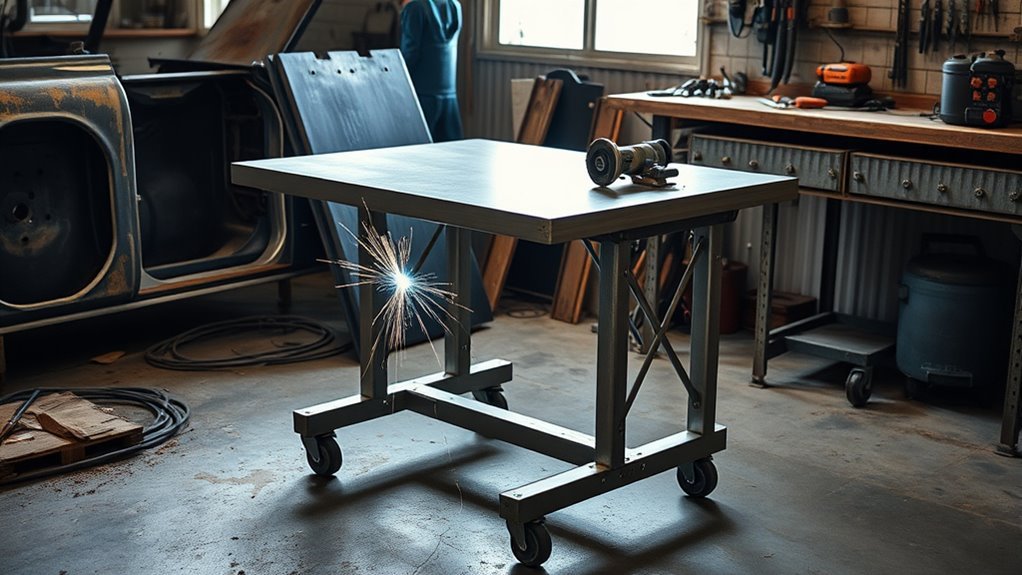
- Loose parts on a bench: Clamp directly to the workpiece, not only to the welding table, unless clean metal-to-metal contact with the table is certain and suitable for the current.
A factory ground stud, body-ground strap, engine ground, or battery terminal is designed for vehicle electrical systems. It is not automatically an approved welding-current return point.
Products Worth Considering

Premium Material: This welded grounding clamp is made of iron. Iron has high strength and hardness and is able to withstand high mechanical stress. Iron grounding clamps ensure stable current transmission and maintain their structural integrity and stability. Iron has good durability, which allows the welding earth clamp to maintain its good performance and appearance during use.

Practical Function: This T-shaped welding grounding clamp has a 300A high-current capacity, meeting the high-power demands of automotive welding and circuit testing. During welding, the current remains stable and uninterrupted, ensuring welding quality. The duckbill design and powerful spring ensure a secure grip that does not easily come loose. Even during vehicle body vibrations or mobile operations in automotive repairs, it maintains stable grounding.
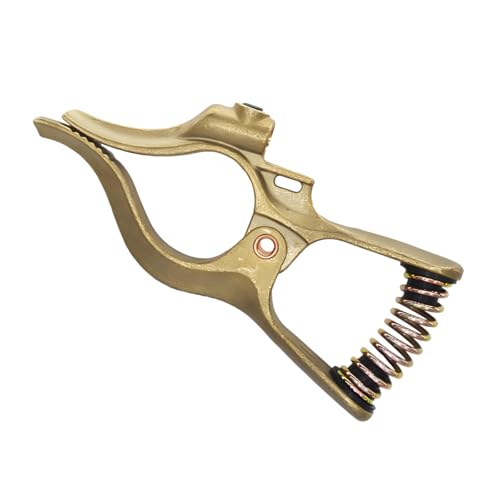
High Quality Material: This product is crafted from copper. Copper offers good electrical conductivity and is resistant to deformation and fracture, ensuring the product maintains its structural integrity. Even after prolonged use, copper retains its inherent properties, providing a reliable material foundation for the product and making it suitable for a wide range of automotive grounding applications.
Ground Clamp Placement on Body Panels
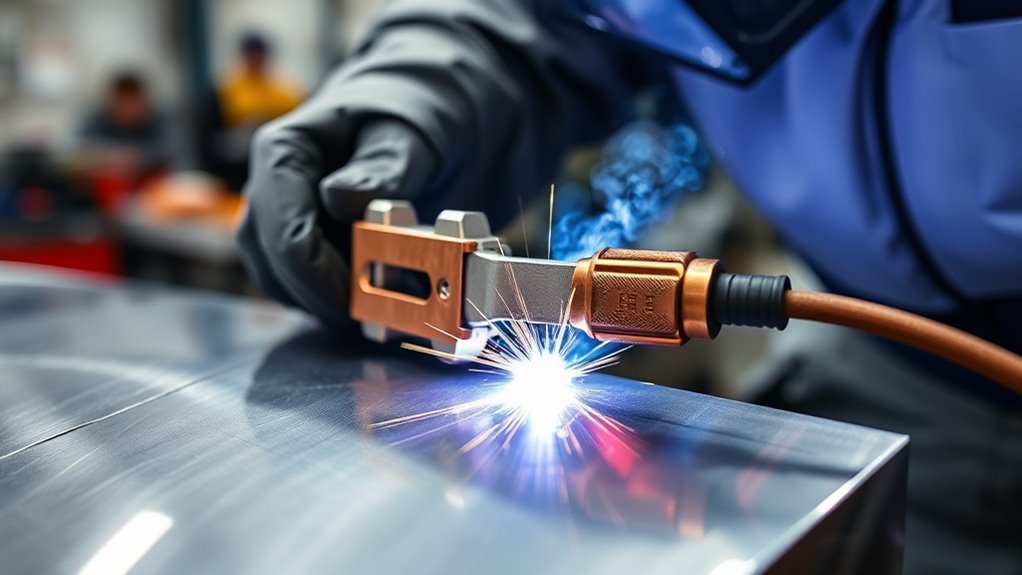
On a body panel, place the clamp on clean, bare metal on the same panel or approved connected flange. Keep it near the weld without blocking your view or putting the cable in the spatter path.
Thin sheet metal can be dented or distorted by a heavy clamp. When the panel cannot safely support the jaws, use an approved welded flange, temporary tab, brace, or nearby solid edge that remains part of the same direct current path.
Do not clamp to body filler, seam sealer, adhesive, trim screws, rusty edges, thin unsupported lips, or a panel separated from the weld by painted or bonded joints.
Products Worth Considering

Value Pack: The package includes 24 packs of butt welding clamps, enough quantity to meet your daily needs and replacements. Each butt welding clamps is individually wrapped in a small bag, convenient to carry and use.

16-Pack Welding Clamps Set: Includes 16 butt welding clamps designed for precise edge-to-edge welding, ideal for body repair, floor patching, door skins, and sheet metal alignment.

【Product Purpose】Butt welding clamps set includes 16 welding corner square welder clamps, which can be used to make precision butt welds and edge-to-edge welds for patch repairs in floors, wings, door skins, fabricating, and re-skinning projects. They are good accessories to help you to find the location quickly in repair work.
Multiple Panels, Bolted Parts, and Bonded Joints
Two pieces that appear connected may not provide a dependable welding path. Paint, adhesive, E-coat, corrosion, sealant, rubber bushings, and loose fasteners can electrically separate them.
- Welded flanges: Confirm that bare metal or existing sound welds provide direct continuity between the repair and clamp point.
- Bolted assemblies: Do not assume current can pass safely through painted bolt faces, threads, bushings, or bearing surfaces.
- Adhesive-bonded panels: Follow the exact OEM weld-bonding and shunting procedure. Do not improvise with ordinary pliers.
- Multiple loose parts: Clamp to the primary workpiece and make sure the parts have the approved fit-up and metal contact before welding.
Grounding Aluminum Vehicle Parts
Clamp directly to clean aluminum on the approved part. Remove oxide and contamination using the method specified for the repair. Use tools reserved for aluminum when required so steel particles are not embedded in the surface.
Do not assume an aluminum casting or extrusion can be welded because a clamp fits on it. Many cast or extruded structural parts have strict repair limits or are replacement-only components. Check the OEM material map and component procedure first.
Grounding Safely Under a Vehicle
Under a vehicle, attach the work clamp to rigid, prepared metal close to the approved weld. Keep the clamp visible and reachable so you can inspect it without placing your body near hot metal.
- Raise and support the vehicle with equipment rated and positioned according to the service procedure.
- Inspect both the clamp point and the area behind or above the weld.
- Clean the contact area to bare metal.
- Lock the clamp onto rigid metal where it cannot be hit by your body, gun, torch, or cable.
- Keep the lead away from driveshafts, wheels, fans, suspension movement, sharp edges, and hot exhaust parts.
- Recheck the clamp for looseness, heat, or arcing during the job.
Do not clamp to brake lines, fuel lines, parking-brake cables, steering parts, springs, shocks, wheel hubs, bearings, sway bars, wiring brackets, or jack stands.
Grounding for Exhaust Welding
For exhaust welding, clamp directly to the exhaust part being repaired. Place the jaws on clean metal near the joint without crowding the gun, torch, filler rod, or your hands.
Road grime, rust, aluminized coatings, and heat scale can interfere with the connection. Clean a sound section of pipe or shell until both jaws make firm contact. If the pipe is too thin or corroded to hold the clamp, move to a stronger section on the same exhaust assembly or replace the failed metal as required.
Inspect the surrounding area for fuel lines, plastic shields, brake hoses, wiring, rubber hangers, underbody coating, and trapped debris before welding.
How Close Should the Ground Clamp Be?
Place it as close as practical while leaving enough room to weld safely. There is no universal number of inches that fits every repair.
On a small patch, the clamp may be on the same panel near the joint. On a larger approved chassis repair, it may be on the same rail, bracket, or crossmember. The important points are a direct solid-metal path, a firm connection, and no sensitive or moving component between the clamp and the arc.
What Not to Clamp To
Avoid these locations unless a vehicle-specific repair procedure expressly calls for a controlled setup:
- Painted, rusty, greasy, sealed, or undercoated surfaces
- Battery terminals, factory ground studs, or ground straps
- Loose sheet metal, cracked brackets, or thin unsupported edges
- Rubber-isolated mounts, bushings, and engine mounts
- Suspension arms, springs, shocks, struts, hubs, and bearings
- Brake, fuel, hydraulic, refrigerant, or coolant lines
- Wiring looms, module brackets, sensor brackets, and connectors
- Door hinges, latches, trim screws, and small painted fasteners
- Chains, hoists, jack stands, lifts, cranes, or unrelated shop equipment
- High-voltage cables, battery cases, inverters, electric drive units, or orange-marked components
OSHA prohibits using chains, wire ropes, cranes, hoists, and elevators to carry welding current. Apply the same principle to a car: keep the circuit on the intended workpiece instead of using whatever metal is nearby.
Common Ground Clamp Mistakes
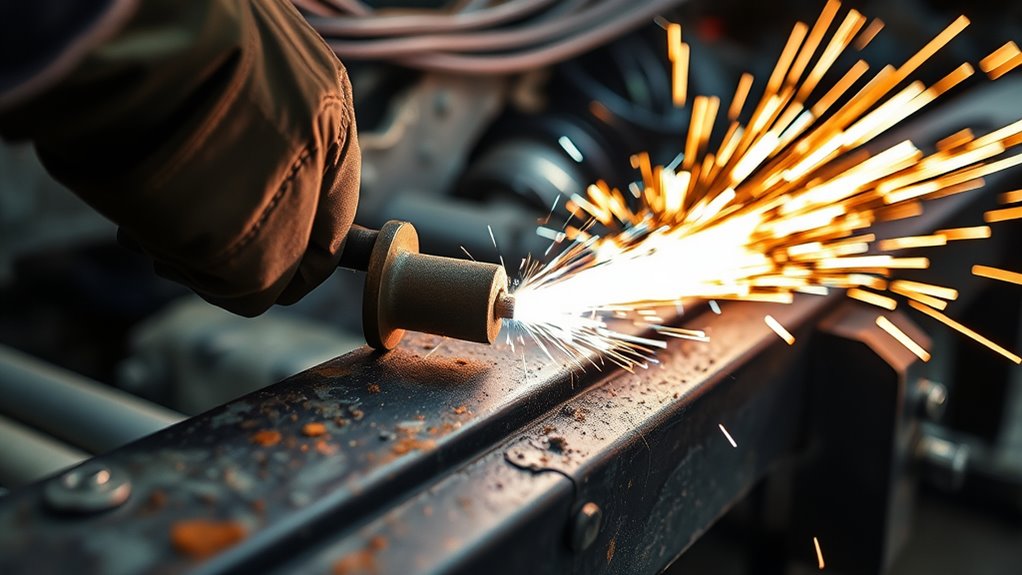
- Clamping too far away: Move to the same component and closer to the approved weld area.
- Clamping over paint or rust: Prepare a clean pad for both jaws.
- Using only one tooth or jaw: Reposition the clamp so the full contact surfaces grip solid metal.
- Crossing a hinge, bearing, or rubber mount: Move the clamp to the other side of that component.
- Using a battery terminal or factory ground: Attach directly to the workpiece instead.
- Ignoring cable pull: Support and route the cable so its weight cannot loosen the clamp.
- Leaving the cable tightly coiled: Spread it out to limit heat buildup.
- Testing on a hidden vehicle surface: Use suitable scrap or an approved tack at the actual joint.
- Forgetting corrosion protection: Restore the prepared area after inspection.
Troubleshooting a Bad Ground
Stop welding and inspect the return circuit when the arc does not behave normally.
| Hard or inconsistent arc starts | Clean the clamp pad, inspect both jaws, and tighten the connection. |
| Arc sputters or cuts out | Move the clamp to the workpiece and check for paint, rust, loose jaws, cable damage, and poor lead connections. |
| Clamp or cable gets hot | Stop immediately. Check contact area, jaw condition, loose connectors, cable size, cable damage, and duty-cycle limits. |
| Excess spatter or weak fusion | Verify the return connection, then check polarity, voltage, wire speed or amperage, gas flow, consumable condition, joint preparation, and technique. |
| Arc marks away from the weld | Stop and inspect for an unintended current path, loose metal contact, or a clamp point separated by a joint or moving component. |
What Poor Clamp Placement Can Damage
Poor placement does not guarantee damage, but it increases the chance of unintended arcing, heating, or voltage differences across parts that should not carry welding current. Keep the clamp on the approved workpiece and complete all OEM electrical precautions.
Brake Line Damage
Never use a brake line or fitting as a welding-current path. Protect nearby lines from sparks, grinding debris, and radiant heat.
- Place the work clamp on the metal being welded.
- Shield or move the line as allowed by the service procedure.
- Keep the welding cable from resting on the line.
- Inspect the line and coating for heat marks, pitting, rubbing, leaks, or other damage before returning the vehicle to service.
Wiring, Sensors, and Module Damage
Modern vehicles contain low-voltage networks, pyrotechnic safety devices, sensors, cameras, radars, modules, and high-voltage electronics. Remote or indirect clamp placement can add unintended current routes or voltage differences, but close clamp placement alone is not complete electrical protection.
Follow the OEM procedure for battery isolation, waiting periods, module disconnection or removal, harness routing, high-voltage shutdown, post-repair scanning, and calibration. Keep welding leads away from wiring, modules, antennas, and sensors whenever practical.
Bearing, Hub, and Suspension Harm
Do not create a return path through wheel bearings, hubs, hinges, universal joints, shocks, struts, steering parts, or suspension pivots. These parts may contain small contact areas, rolling elements, seals, lubricants, and rubber isolation that are unsuitable for welding current.
- Bearings and hubs: Place the clamp on the same side of the bearing as the weld.
- Hinges and pivots: Do not rely on pins or moving joints to carry current.
- Shocks and struts: Keep the circuit away from shafts, seals, mounts, and internal components.
- Rubber-mounted links: Treat them as electrically unreliable even when the outer parts are metal.
Should the Welding Ground Be Positive or Negative?
The work clamp is not always connected to the negative terminal. Polarity depends on the welding process, machine, and consumable.
- Solid-wire MIG/GMAW with shielding gas: Commonly uses DCEP, with the gun or electrode positive and the work clamp negative.
- Gas-shielded flux-core/FCAW-G: Commonly uses DCEP, but check the wire data and machine manual.
- Self-shielded flux-core/FCAW-S: Many wires use DCEN, with the gun or electrode negative and the work clamp positive. Some products differ.
- Stick/SMAW: The required polarity depends on the electrode classification and procedure.
- TIG/GTAW: Polarity and current type depend on the material, power source, tungsten, and approved process.
Miller’s process and polarity table shows why the wire or electrode instructions must control the setup. Turn off and isolate the welder before moving lead connections.
Polarity does not change the placement rule: the work clamp still belongs on clean metal on the approved workpiece.
After-Welding Checks
Continue fire and damage checks after the arc stops. Heat can travel through sheet metal and ignite material on the hidden side.
- Turn off the welder and allow hot metal to cool safely.
- Inspect the weld, clamp pad, lead, and jaws for abnormal heat or arc damage.
- Check behind and inside the repaired area for glowing, smoking, or smoldering insulation, adhesive, seam sealer, undercoating, trim, or debris.
- Inspect nearby wiring, hoses, brake lines, fuel lines, glass, rubber, and plastic for heat or spatter damage.
- Maintain the required fire watch. Where OSHA’s fire-watch provisions apply, the watch continues for at least 30 minutes after welding or cutting.
- Restore primer, seam sealer, cavity wax, paint, or other corrosion protection specified by the repair procedure.
- Reconnect low- or high-voltage systems in the exact OEM order.
- Complete required scans, initializations, warning-light checks, calibrations, leak checks, and roadworthiness inspections.
Frequently Asked Questions
Where should you ground when welding on a car?
Attach the welder’s work clamp to clean, bare metal on the approved part being welded. When direct attachment is impossible, use the nearest rigid metal on the same panel, pipe, bracket, rail, or crossmember with no hinge, bearing, rubber mount, adhesive joint, or sensitive component in the current path.
Where do you attach a ground clamp when welding?
Attach it directly to the metal workpiece whenever possible. Prepare a clean, paint-free contact area large enough for both jaws and place the clamp near the weld without exposing it to the weld pool or heavy spatter.
What is the best place to put the welding ground clamp?
The best location is clean bare metal on the exact part being welded, as close to the joint as practical. The clamp should have a firm bite and a direct solid-metal path to the arc.
Should the welding ground be positive or negative?
It depends on the process and consumable. Solid-wire MIG commonly uses a negative work clamp, while many self-shielded flux-core wires use a positive work clamp. Stick and TIG requirements vary. Follow the welder manual and the wire or electrode label.
Can I clamp the welder ground to the car battery terminal?
No. A battery terminal is not a welding work-clamp point. Attach the clamp to the approved metal workpiece and follow the vehicle maker’s battery, module, SRS, and high-voltage precautions.
Can I weld if the ground clamp is on painted metal?
You should not. Paint, rust, oil, undercoating, seam sealer, and scale can prevent stable contact and cause difficult starts, heat, or intermittent welding output. Prepare a bare-metal pad first.
Should I disconnect the car battery before welding?
Follow the exact OEM procedure for the VIN and model year. Many procedures require battery isolation, but the number of batteries, cable order, waiting periods, SRS precautions, module steps, and high-voltage requirements vary. Disconnecting one terminal is not a universal protection method.
Can I clamp to the frame while welding a body panel?
Clamp to the body panel or its approved connected flange when possible. A remote frame point may force current through seams, fasteners, adhesives, hinges, or other parts. Use the frame only when the repair procedure and direct current path make it suitable.
How far can the ground clamp be from the weld?
There is no universal distance. Place it as close as practical on the same component while keeping it clear of the weld pool, spatter, and tool movement. Avoid any path through a joint, bearing, hinge, rubber mount, or sensitive component.
Can a multimeter verify a good welding clamp point?
A meter can reveal an open circuit, but a continuity beep does not prove that the path can safely carry welding current. Approve the point by checking for clean jaw contact, rigid metal, a short direct route, and no painted joint, hinge, bearing, wire, or rubber mount in the path.
Conclusion
The best place to put a welding ground clamp on a car is on clean, bare metal on the approved part being welded, as close to the joint as practical. Prepare enough area for both jaws, keep the cable secure, and avoid paths through hinges, bearings, suspension parts, wiring, fuel lines, brake lines, or vehicle ground terminals.
Clamp placement does not replace the OEM repair procedure. Verify the VIN and model year, confirm that welding is allowed on the component, complete all battery and high-voltage safety steps, protect hidden combustibles, and restore corrosion protection after the repair. A few minutes spent on the return connection can improve arc stability and reduce avoidable fire, equipment, and vehicle-damage risks.
Sources
- OSHA 1910.254 — Arc Welding and Cutting — work-lead attachment, equipment inspection, cable handling, and prohibited welding-current paths.
- OSHA 1910.252 — General Welding, Cutting, and Brazing Requirements — combustible control, explosive atmospheres, extinguishing equipment, and fire-watch requirements.
- Lincoln Electric — Arc-Welding Safety and Circuit Guidance — clean-metal contact, close work-clamp placement, and avoidance of hinges, bearings, and electronic components.
- Miller Electric — Process and Polarity Table — common GMAW, FCAW-G, and FCAW-S polarity arrangements.
- I-CAR Repairability Technical Support — Vehicle Protection Before Welding — short current paths, battery isolation, high-voltage precautions, and cable routing around vehicle electronics.
- Tesla Collision Repair Manual — Body Structure Materials and Allowed Operations — material-specific welding and structural-repair limits.