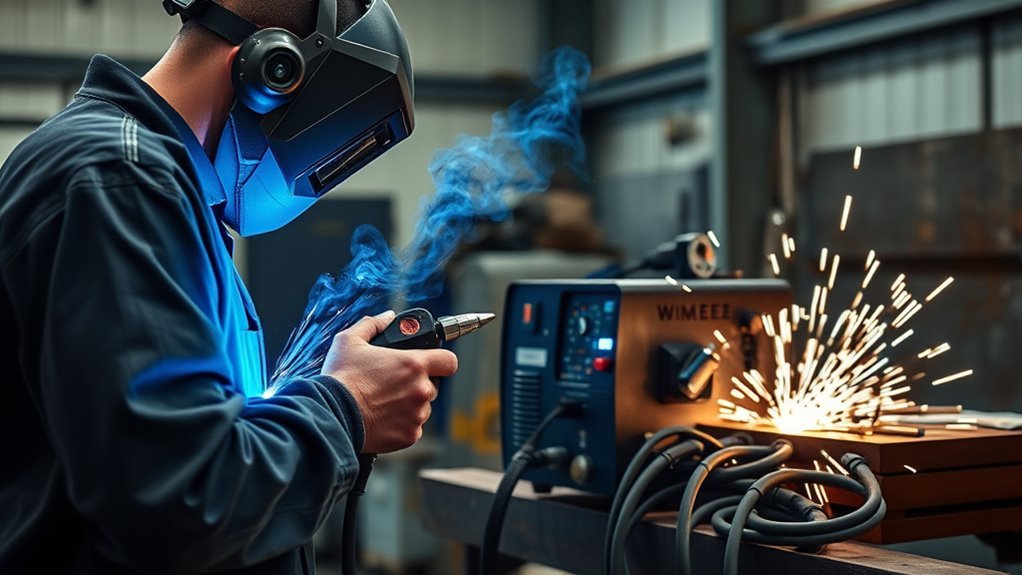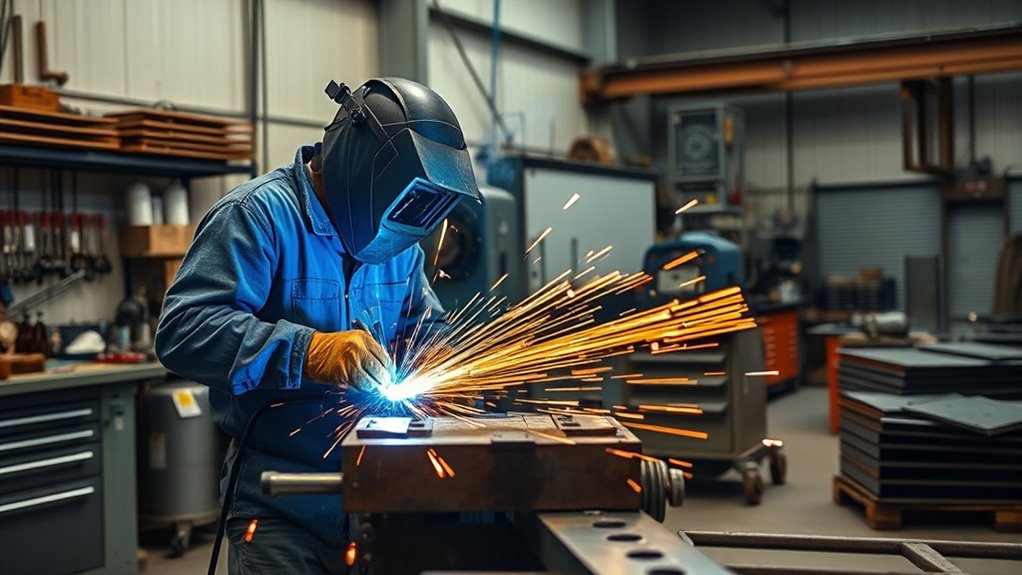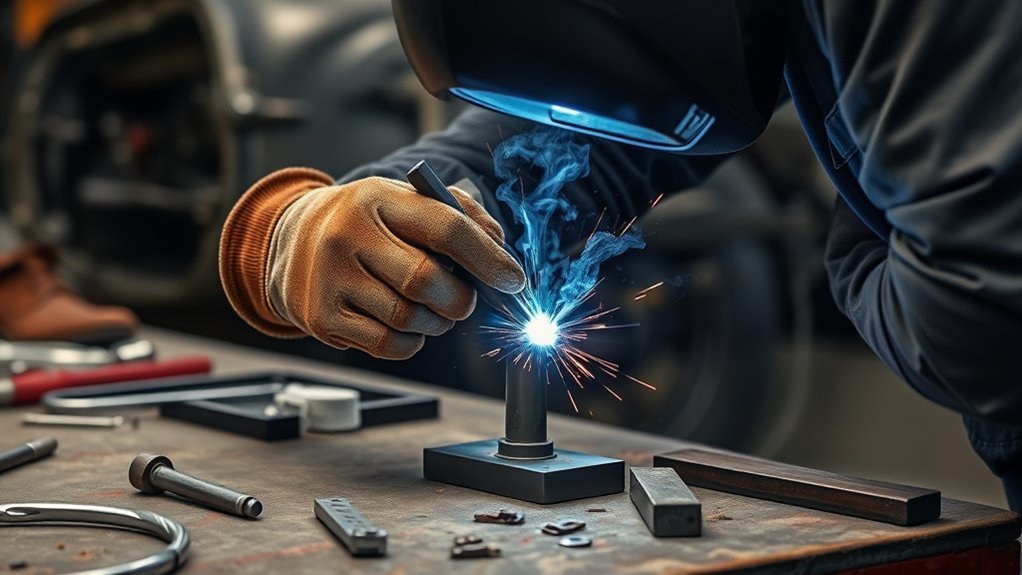
As a DIYer, you can weld some truck body panels, exhaust sections, tabs, and non-critical brackets with a MIG welder, but you should not treat every truck weld as a beginner job. Structural frame, suspension, steering, tow-point, airbag-area, and crash-zone repairs need OEM repair procedures and a qualified welder. For safe beginner work, choose the right welder, clean the metal to bare steel, test your settings on matching scrap, and control heat with short tack and stitch welds.
Quick Answer
To weld on a truck, use MIG for mild-steel panels, exhaust, and light brackets. Clean both pieces to bare metal, clamp the joint tightly, set wire speed and voltage from your welder chart, test on matching scrap, then use short tack or stitch welds to avoid burnthrough and warping.
Key Takeaways
- MIG welding is the easiest process for most DIY truck sheet metal, exhaust, and light bracket repairs.
- Use solid ER70S-6 wire and 75/25 argon-CO2 gas for clean mild-steel MIG work in calm indoor conditions.
- Never guess on structural repairs. Frame, suspension, steering, and crash-zone welds need OEM procedures and qualified work.
- Thin truck panels need short tack welds, cooling pauses, and low heat to prevent burnthrough and warping.
- Fire control, fume control, battery isolation, and nearby fuel-line checks matter as much as bead appearance.
At a Glance
| Time Required | 30 minutes to several hours, depending on prep, rust removal, fit-up, and finishing |
| Difficulty | Beginner for practice coupons and simple brackets; intermediate for thin body panels and exhaust |
| Tools Needed | MIG welder, wire, shielding gas, clamps, grinder, wire brush, PPE, fire extinguisher, primer, seam sealer |
| Cost | Usually $30-$150 in consumables if you already own a welder; more if you need gas, PPE, or panel patches |
What You Can Safely Weld on a Truck
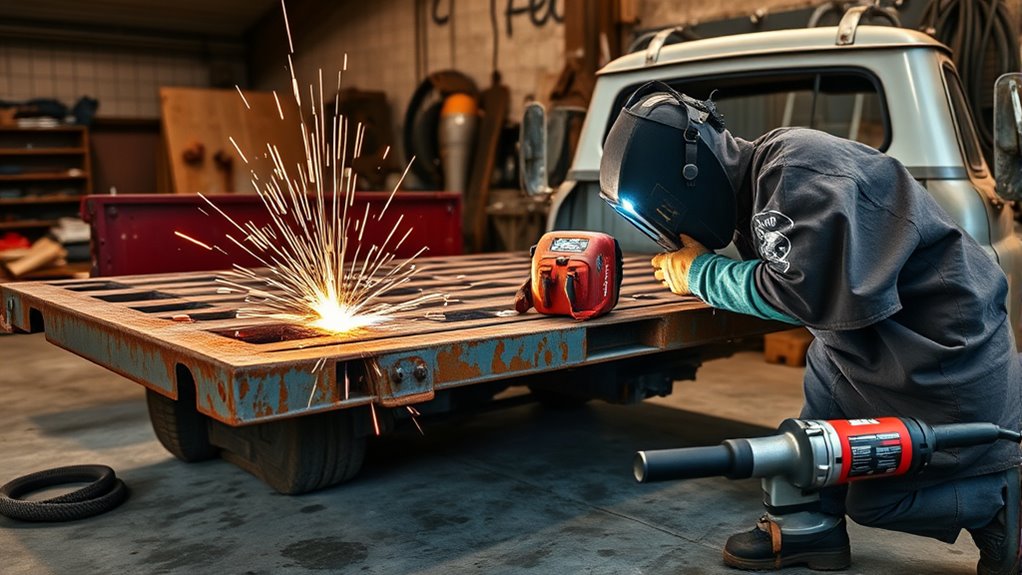
On a truck, you can weld several common parts, but each repair needs the right process, material, and safety limit. As a beginner, the safest DIY welding jobs are usually auto-body panels, patch panels, exhaust sections, floor patches, tabs, and light non-critical brackets.
Beginner truck welding should start with non-critical repairs. If the part carries crash loads, steering loads, suspension loads, or towing loads, treat it as professional work.
You can use MIG welding on mild-steel truck panels when you are fixing rust holes, dents, seams, or thin 24-gauge to 18-gauge sheet. You can also weld exhaust tubing, especially when you are sealing a leak or replacing a short damaged section. For stainless exhaust work, the wire and shielding gas may change; MIG welding 304 stainless steel uses a different setup than ordinary mild steel.
Be careful with chassis and frame language. A truck frame is not just thick steel. It may include high-strength steel, heat-treated areas, crush zones, brackets, and factory weld locations that must be repaired exactly as the vehicle maker specifies. Welding in the wrong place can weaken the part instead of restoring it.
Warning: Do not weld frames, control arms, strut mounts, steering parts, tow hooks, hitch mounts, airbag sensor areas, fuel tanks, or crash structures unless you have the OEM repair procedure, the right equipment, and the skill to perform and inspect that repair.
Choose the Right Welder for Auto Repair
For most truck and automotive applications, MIG welding is the practical choice because it is fast, easy to learn, and controllable on mild steel. TIG gives cleaner precision on thin metal and aluminum, but it takes more skill and time. Flux-core can work outside in wind, but it makes more smoke and spatter, so it is harder to use cleanly on thin body panels.
| Welder Choice | Best Use | Beginner Note |
|---|---|---|
| 110V MIG | Thin panels, floor patches, small tabs, light brackets | Good for garages with normal outlets, but limited on thick steel |
| 220V MIG | Heavier brackets, thicker plate, longer welds | Better duty cycle and power, but needs the right circuit |
| TIG | Aluminum, stainless, precise thin-metal work | Cleanest control, but slower and harder to learn |
| Flux-core | Outdoor work, thicker mild steel, rough repairs | More smoke and cleanup; less ideal for thin visible panels |
Check power requirements against your shop supply. A 110V machine suits lighter repair work, while a 220V machine handles heavier fabrication with more headroom. If your welder has Auto-Set features, use them as a starting point, then confirm the weld on scrap.
Choose wire and gas selection carefully. For mild-steel MIG, solid ER70S-6 wire with a 75% argon and 25% CO2 mix is a common clean setup. Learn the machine settings for voltage and wire feed speed, then begin with the manufacturer’s chart. Understanding MIG transfer modes can also help you understand why thin sheet needs lower heat than thicker brackets.
Products Worth Considering

【3 IN 1 WELDER MACHINE】: AZZUNO 135A MIG welder offers 3 powerful functions: Flux Core Gasless MIG, Lift TIG, and MMA, with a 135A output for optimal performance. Capable of welding up to 5/32" thickness, it's perfect for home DIY, maintenance, and professional projects.

Great Repair Tool: WEP 960-V plastic welder is great for repairing cracks in ABS plastics such as car bumper, plastic gas tank, car dashboard and more. The hot staples gets heated rapidly when you press the activation button, and you can embed the staples into plastic cracks to join the two broken pieces. Once done joining, pull to separate, and cut away the excess staple. Plastic welding is easy as that!
Tools, Wire, Gas, and Safety Gear You Need
Before you weld on a truck, set up the job like hot work. Welding creates sparks, heat, ultraviolet light, and fumes. OSHA’s welding, cutting, and brazing guidance treats these operations as hazard-controlled work, not casual garage work.
- MIG welder: Use a machine sized for your metal thickness and duty cycle.
- Wire: Use 0.023-inch solid wire for thin sheet when your machine supports it; use 0.030-inch or 0.035-inch wire for thicker mild steel.
- Gas: Use 75/25 argon-CO2 for clean mild-steel MIG indoors. Use 100% argon for aluminum MIG with a spool gun or push-pull system.
- Clamps: Use locking clamps, panel clamps, magnets, or copper backing where appropriate.
- Prep tools: Keep a grinder, flap disc, wire brush, scraper, and wax-and-grease remover nearby.
- PPE: Wear an auto-darkening welding helmet, safety glasses, welding gloves, hearing protection, leather or cotton welding clothing, and closed leather footwear.
- Fire safety: Keep a suitable fire extinguisher ready and remove flammable trim, insulation, paper, oily rags, and loose fuel vapors from the area.
Note: Welding fumes can contain metals, and confined or poorly ventilated welding can raise exposure. Use local exhaust, a welding fume extractor, or a suitable respirator when ventilation is poor. NIOSH explains welding-fume and manganese exposure risks in its welding fumes guidance.
Products Worth Considering

Multi Use- They can darken to between level #3 and #11. This means that the T TOVIA Auto Darkening Welding Helmet are ideal for all sorts of welding applications including gas welding, plasma, MIG, TIG, and more. They provide a high degree of protection.

FLAME RESISTANT COTTON: Made entirely from durable 9 oz. flame-resistant cotton, this welding jacket offers protection against sparks and light spatter - perfect for light-duty MIG and TIG welding where moderate protection is needed.

MIG Welding Basics for Auto Body Work
For auto body work, MIG welding gives you the speed and control you need on thin steel, from 24-gauge sheet metal up to light plate. You can repair panels and brackets with less distortion when you respect the joint, the metal, and the heat.
| Check | Target | Why it matters |
|---|---|---|
| Wire selection | Solid wire for gas MIG | Supports cleaner welds on mild steel |
| Stickout | About 1/4-3/8 in. | Helps arc stability and gas coverage |
| Prep | Bare, dry, tight-fitting metal | Improves fusion and reduces porosity |
Use proper wire selection for automotive metals: solid wire with 75% argon and 25% CO2 for mild-steel MIG. Keep your wire stickout around 1/4 to 3/8 inch from the contact tip. On thin materials, push the puddle so you can see the joint and spread heat more gently. On thicker sections, pulling can help you focus heat and penetration, but it also adds more heat to the work.
Clean the base material and bevel joints only when the material is thick enough to need it. Do not bevel thin sheet metal. On thin panels, tight fit-up and controlled tacks matter more than heavy grinding. Also confirm correct polarity, because solid-wire MIG with shielding gas normally uses a different polarity than many self-shielded flux-core wires.
Set Wire, Gas, and Power Settings
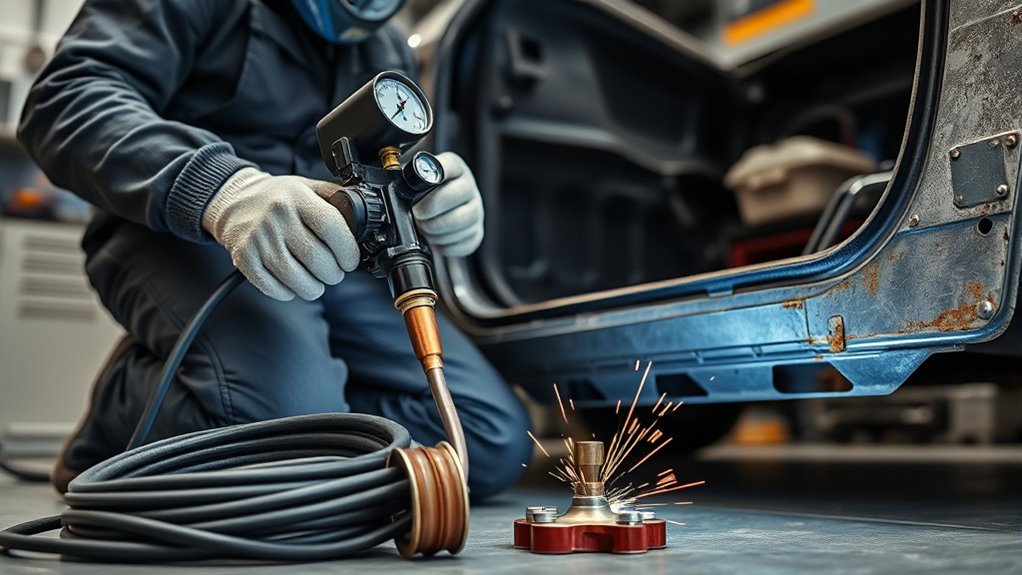
Dial in your MIG setup before you touch the truck. Start with the chart inside your welder door or the manufacturer’s manual. Match the chart to wire diameter, shielding gas, material thickness, and joint style. Then make test welds on scrap that matches the truck metal.
For mild-steel body panels, 0.023-inch wire is often easier to control because it melts with less heat. For heavier brackets, 0.030-inch or 0.035-inch wire may be a better match. Set gas flow high enough for coverage but not so high that turbulence pulls air into the weld. A common starting point is around 20-25 cubic feet per hour indoors, then adjust for nozzle size, drafts, and weld quality.
- Confirm shielding gas flow before striking an arc.
- Use clean solid wire for gas MIG on mild steel.
- Make test welds on scrap that matches the panel.
- Adjust one setting at a time: voltage, wire feed speed, then travel speed.
- Cut, bend, or hammer-test practice welds before trusting the setup on the truck.
Avoid universal “one-size-fits-all” settings. A chart setting that works on a flat test coupon may still need adjustment on a rusty flange, lap joint, vertical seam, or heat-sensitive panel. If you are using self-shielded wire, understand that E71T-GS welding wire behaves differently from solid wire with gas and usually creates more smoke and cleanup.
Prep Metal Before You Weld
Clean metal is nonnegotiable before you strike an arc. Rust, paint, oil, undercoating, seam sealer, and dirt can contaminate the weld and weaken the joint. Use a grinder, wire brush, scraper, or chemical cleaner to expose bright metal at the weld area and at the ground-clamp location.
Check the fit-up next. Your parts should meet tightly, with no excessive gaps. Gaps on thin truck sheet metal invite burnthrough. If you are welding a patch panel, trim slowly and sneak up on the fit. A small, even gap is easier to control than a ragged opening.
For metal thicker than about 1/8 inch, beveling may help penetration. For thinner sheet, leave the edge square and precise. After cleaning, let the metal dry completely. Moisture can flash to steam and cause porosity. If the steel has mill scale, remove it before welding; heavy scale can interfere with fusion, as explained in this guide on how to clean mild steel for welding.
Pro Tip: Clamp a copper backing bar behind small holes or thin panel seams when you can reach the back side. Copper absorbs heat and does not fuse to the steel as easily, which gives you more control on thin patches.
Practice Automotive Welding on Scrap
Practice on scrap metal that matches the gauge and composition of your project parts. This lets you repeat real welds without risking good panels. If the truck panel is rust-thinned 20-gauge steel, a thick piece of clean plate will not teach you the same heat control.
Start with clean thin-sheet butt joints, lap joints, and T-joints. Adjust your MIG settings, wire size, and gas mix until the bead profile and penetration are consistent. If you are working with aluminum, clean oxide thoroughly; aluminum oxide causes problems fast, and oxide cleaning is a key part of any aluminum welding plan.
Keep a fire extinguisher nearby and inspect each test weld between passes so you can correct defects early.
Scrap Metal Practice
When you’re learning automotive welding, scrap metal gives you a low-risk way to build skill before you touch a vehicle panel. Choose scrap metal near the gauge you’ll use in your project, then make practice welds on clean, rust-free surfaces.
Include thin sheet metal and thicker offcuts so you can test welding techniques, voltage, and wire speed without guessing. Change welding position from flat to vertical to see how torch angle affects penetration and bead shape.
- Clean each piece before you strike an arc.
- Record settings, metal thickness, wire size, gas, and results in a log.
- Change only one variable at a time.
- Cut or bend practice welds to check fusion before welding the truck.
Replicate Real Welds
To replicate real automotive welds, start with scrap metal that matches the thickness and type of the panels you’ll actually repair. Then run MIG practice passes on clean, rust-free pieces.
Set your wire stickout to about 1/4 to 3/8 inch, then tune voltage and wire speed for the scrap thickness. Practice flat, horizontal, and vertical weld positions so you can adapt your hands and torch angle without hesitation.
Keep your workspace clean, and wipe every joint before you strike an arc. That discipline sharpens welding techniques, reveals gaps in your setup, and lets you build skill before you risk a visible body panel.
Use the Right Torch Angle and Stickout
Good MIG technique is simple, but it has to be consistent. Hold the gun so the wire points into the joint, keep a short stickout, and move steadily. A small mistake in angle or distance can turn a clean bead into spatter, porosity, or burnthrough. For galvanized material, also review safe prep and ventilation because MIG welding galvanized steel creates extra fume concerns.
Torch Angle Basics
For a flat butt or lap weld, hold a travel angle of about 10 to 15 degrees. For a fillet weld, split the angle between both pieces so the arc does not favor one side. Keep the gun close enough to protect the puddle with shielding gas.
- Use a push technique on thin materials for visibility and lower heat concentration.
- Use a steady travel speed and listen for a smooth, even arc.
- Avoid waving the gun around on thin sheet; small controlled motion is better.
Watch the puddle, not just the bright arc. If the puddle grows too wide, you are adding too much heat. If the wire stubs into the work, your wire speed may be too high, your voltage too low, or your travel too fast.
Stickout Distance Control
Keep the wire stickout between about 1/4 and 3/8 inch from the contact tip for most short-circuit MIG work. This stickout distance supports arc stability, protects gas coverage, and helps you drive clean weld penetration.
If you extend it too far, the arc can wander, the puddle can get unstable, and weld quality drops. If you shorten it too much, the wire can burn back into the tip and interrupt feeding. Match voltage and wire feed speed to the stickout you’re using so the arc stays consistent.
Push vs Pull
When you’re choosing between push and pull, think about heat and visibility. The push technique points the gun in the direction of travel. It usually gives you a flatter, wider bead and better visibility of the seam, which is useful on thin truck panels.
The pull technique, also called dragging, points the gun back toward the finished weld. It can concentrate more heat into the joint and may help on thicker mild steel, but it can also overheat thin sheet metal faster.
- Use push for thin panels and body patches.
- Use pull only when the joint and material thickness call for more heat focus.
- Keep stickout steady at about 1/4 to 3/8 inch.
- Test both techniques on scrap before welding the truck.
Weld Thin Sheet Metal Without Burnthrough
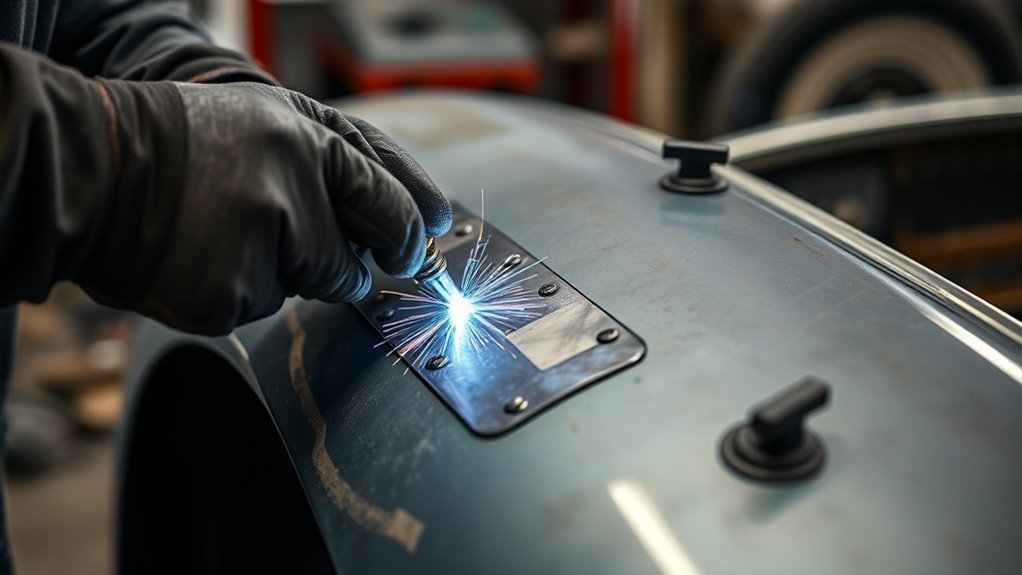
To weld thin sheet metal without burnthrough, you need to keep heat input low and control the puddle closely. Use the smallest suitable wire, set the machine from the chart, test on scrap, and avoid running one long bead across a panel.
In MIG welding, a shallow push angle helps spread heat and keep the arc visible. Choose 0.023-inch wire when your machine supports it; it melts with less energy and gives you tighter control on thin welding materials.
Before you run the seam, add small tack welds along the edge to lock alignment and share heat. Then connect the tacks with short, deliberate stitch welds. Move around the panel instead of welding one area continuously. Let the metal cool between stitches so the panel does not warp.
- Fit the patch tightly and clamp it in place.
- Tack opposite ends first to hold alignment.
- Add tacks every few inches, then fill the spaces slowly.
- Skip around the seam so no one area gets too hot.
- Let the panel cool naturally; do not quench hot steel with water unless a procedure calls for it.
- Inspect for pinholes before grinding or sealing.
Watch the puddle, not the finished bead. If the edge starts to sag or open, stop and let it cool. Thorough cleaning also prevents poor weld quality, porosity, and weak fusion.
Handle Vertical and Overhead Welds
Vertical and overhead welding are harder than flat welding because gravity pulls the molten pool out of the joint. Practice both positions on scrap before working on the vehicle. Lower heat, shorter welds, and tighter puddle control matter more in these positions.
Vertical Weld Control
Vertical welds demand tighter control than flat welds. For thin material, vertical-down can help you move quickly and limit heat. For thicker material, vertical-up can improve fusion, but it is harder to control. Reduce heat slightly from your flat-position setting, then test on scrap.
- Keep your arc tight for better control.
- Use small movements instead of wide weaves on thin metal.
- Adjust travel speed to match pool size and position.
- Stop if the puddle grows heavy or starts to sag.
Watch the puddle, not the arc alone. If it grows too large, move faster or pause. If it stiffens and piles up, slow down slightly or adjust your settings.
Overhead Weld Safety
When you’re welding overhead, reduce heat, shorten the weld length, and protect yourself from falling sparks. Set your body so you can grip the torch steadily and work without strain. Stable posture improves accuracy in overhead welding.
Wear full safety gear, including a welding helmet with auto-darkening lens, gloves, safety glasses, hearing protection, and fire-resistant clothing. Sparks and hot slag can fall into sleeves, pockets, shoes, and hair. Button your collar, cover cuffs, and keep synthetic fabric away from the weld area.
Protect Electronics, Fuel Lines, and Interior Trim
Truck welding is not just metal work. Modern trucks have batteries, modules, sensors, harnesses, fuel lines, vapor lines, sound deadener, undercoating, carpet, and airbag components near the work area. Heat and sparks can damage parts you cannot see from the outside.
Warning: Before welding, disconnect the battery according to the vehicle maker’s procedure, keep the ground clamp close to the weld, move or shield wiring and fuel lines, and inspect both sides of the panel for flammable material. OSHA’s general welding requirements stress removing or guarding fire hazards before hot work.
- Disconnect the battery only after checking whether the vehicle requires a memory-saver or scan-tool procedure.
- Keep the work clamp on clean bare metal close to the weld to reduce stray current paths.
- Remove carpet, plastic trim, insulation, and sound deadener near the weld zone.
- Shield glass, paint, rubber, and wiring from sparks.
- Check behind the panel before and after welding.
- Stay in the shop for a fire watch after welding because insulation and undercoating can smolder.
Inspect, Grind, Prime, and Seal the Repair
A truck weld is not finished when the arc stops. Let the repair cool, then inspect the bead and surrounding metal. Look for pinholes, undercut, missed edges, cracks, porosity, or places where the weld sits on top without fusion.
On body panels, grind only as much as needed to level the surface. Heavy grinding can thin the panel and weaken the repair. Use short passes with a flap disc and let the metal cool between passes. On brackets or structural-looking parts, do not grind away weld reinforcement unless the procedure requires it.
After grinding and inspection, protect the repair from corrosion:
- Clean dust and residue from both sides of the weld.
- Apply weld-through primer only where it is appropriate before welding; after welding, use epoxy primer or a suitable bare-metal primer.
- Seal seams with automotive seam sealer after primer when the product instructions call for it.
- Undercoat exposed underside repairs after primer and sealer cure.
- Paint or topcoat visible panels to keep moisture out.
Troubleshoot Common Beginner MIG Weld Problems
| Problem | Likely Cause | Fix |
|---|---|---|
| Burnthrough | Too much heat, large gap, slow travel, rusty thin metal | Lower heat, tighten fit-up, use short tacks, add copper backing |
| Porosity | Poor gas coverage, dirty metal, wind, paint, moisture | Clean metal, check gas flow, block drafts, shorten stickout |
| Excess spatter | Wrong settings, dirty metal, wrong polarity, poor wire | Confirm polarity, tune voltage and wire speed, clean the joint |
| Wire stubbing | Wire feed too fast, voltage too low, travel too fast | Adjust wire speed and voltage one step at a time |
| Lack of fusion | Too cold, dirty metal, wrong angle, moving too fast | Clean better, slow down, improve angle, test a hotter setting on scrap |
| Warped panel | Too much continuous heat | Skip around, use tacks and stitches, let the panel cool naturally |
Make Your First Truck Welds Safely
Before you strike your first arc, suit up with a welding helmet that has auto-darkening, gloves, safety glasses, hearing protection, and fire-resistant clothing. Then clean the truck metal back to bare steel by removing rust, paint, undercoating, and any contamination. You need this prep to make sound welds and protect your safety.
Set your machine for the metal thickness, then check voltage and wire feed speed before you start MIG welding. Use welding gloves that fit well and keep your hands protected while you maintain control.
- Practice on scrap steel with the same gauge as your truck.
- Hold a steady travel angle and keep a consistent stickout.
- Watch the puddle and stop before you overheat or warp the panel.
- Check both sides of the weld area for heat damage or smoldering material.
- Inspect the weld before grinding, sealing, or painting.
You’ll build skill faster when you practice deliberately. Keep your bead short, inspect it, then adjust and repeat. Proper welder settings can improve weld quality, but your prep, fit-up, and heat control matter just as much.
Frequently Asked Questions
Do I need a welding certification for home auto repairs?
You usually do not need a welding certification for your own non-commercial home repairs, but you do need skill, safe equipment, and sound judgment. For structural, suspension, steering, crash-zone, or inspected road-use repairs, use a qualified professional and follow OEM procedures.
Which metals are hardest to weld on older vehicles?
Rust-thinned sheet metal, galvanized steel, cast iron, aluminum, stainless, and unknown high-strength steel are harder to weld than clean mild steel. The challenge comes from contamination, coatings, cracking risk, oxide layers, heat sensitivity, and the need to match filler metal to the base metal.
How do I know if a panel is too rusted to repair?
A panel is too rusted to patch when the surrounding metal is thin, flaky, soft, or full of pinholes after cleaning. If you cannot reach solid metal around the damaged area, replace a larger section or the full panel instead of trying to weld to weak steel.
Can I weld near the truck’s electrical system safely?
You can reduce risk by following the vehicle maker’s battery-disconnect procedure, keeping the ground clamp close to the weld, moving or shielding wiring, and avoiding airbag or control-module areas. If you are unsure where modules or harnesses run, stop and check service information first.
What safety gear is essential for beginner automotive welding?
Use an auto-darkening welding helmet, safety glasses, leather welding gloves, hearing protection, fire-resistant clothing, closed leather shoes, and ventilation or respiratory protection when fumes are present. Keep a fire extinguisher ready and remove flammable materials before welding.
Can I weld a truck frame at home?
Do not weld a truck frame at home unless you have the OEM procedure, know the frame material, have the correct equipment, and are qualified to perform and inspect the repair. Frame repairs can affect crash performance, alignment, towing safety, and insurance or inspection compliance.
What is the best beginner MIG wire for truck body panels?
For mild-steel body panels, 0.023-inch ER70S-6 solid wire with 75/25 argon-CO2 shielding gas is a good starting point when your welder supports it. It gives better low-heat control than larger wire on thin sheet metal.
Conclusion
Getting started with automotive welding means matching your welder, wire, gas, settings, and technique to the metal you’re joining. You’ll get better results when you clean the surface, clamp the joint tightly, control stickout, and keep heat low on thin sheet. Practice on scrap first, then move to simple truck repairs such as panels, exhaust, tabs, and light brackets. Leave frame, suspension, steering, tow-point, and crash-zone welding to qualified repair work backed by OEM procedures.
Sources
- OSHA: Welding, Cutting, and Brazing — supports welding hazard awareness and safety framing.
- OSHA 29 CFR 1910.252 General Requirements — supports fire prevention, guarding, and extinguisher guidance for hot work.
- CDC/NIOSH: Welding Fumes and Manganese — supports welding-fume, manganese, and confined-space exposure cautions.