One hard hammer strike can turn a repairable dent into stretched sheet metal that is harder to control. A hammer and dolly let you shape an auto body panel from both sides, but the dolly position matters as much as the hammer blow. This guide shows you how to assess the damage, choose the right tools, rough out lows, planish the surface, diagnose oil canning, and finish the repair with as little filler as possible.
Quick Answer
Place a dolly behind or beside the damaged area, depending on the correction. Use off-dolly blows to rough out lows and reduce nearby highs with less stretching. Use very light on-dolly blows only for final planishing because direct hammer-to-dolly contact can stretch metal. Check the contour after every short pass.
Key Takeaways
- Confirm that the damaged panel is repairable and check the vehicle maker’s procedure before straightening modern steel or aluminum parts.
- Match the hammer face and dolly crown to the panel contour, and keep both faces clean and smooth.
- Use hammer off dolly for most rough shaping; use hammer on dolly sparingly for final planishing and tiny remaining lows.
- Release locked creases and high areas before chasing the center of a low spot.
- Stop if the panel oil-cans, cracks, tears, loses its body line, or stops responding predictably.
- Apply filler only after the metal is stable, close to contour, clean, and prepared to the filler maker’s instructions.
At a Glance
| Time Required | Varies by access and damage; a small open dent may be brief, while creases, edges, trim removal, and panel alignment can take several hours. |
| Difficulty | Moderate for a shallow steel dent with backside access; advanced for sharp creases, body lines, aluminum, structural damage, or stretched metal. |
| Tools Needed | Body hammer, matched dolly, panel light, marker or guide coat, straightedge or contour gauge, cleaning supplies, eye protection, gloves, and hearing protection. |
| Cost | Low if you already own the tools; otherwise the main expense is a quality hammer-and-dolly set plus any filler, abrasive, primer, and trim-removal supplies. |
What’s in This Article
- What a Hammer and Dolly Does
- Pick the Right Hammer and Dolly
- What You’ll Need Before You Start
- Assess the Damage and Check OEM Procedures
- Find Highs, Lows, and Locked Damage
- Rough Out the Damage in the Right Sequence
- Use Hammer Off Dolly for Rough Shaping
- Use Hammer On Dolly for Final Planishing
- Shape Quarter Panels Without Stretching
- Square the Deck Lid Opening
- Diagnose Oil Canning and Stretched Metal
- Finish the Metal With Light Filler
- Troubleshoot Common Panel Problems
- Avoid Common Hammer and Dolly Mistakes
- Frequently Asked Questions
- Conclusion
- Sources
What a Hammer and Dolly Does
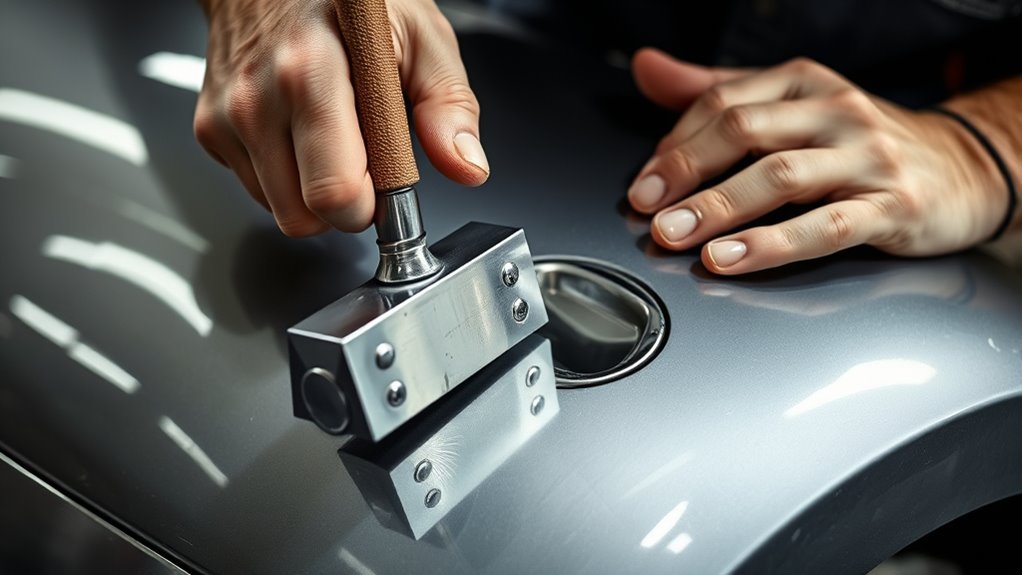
A hammer and dolly reshape damaged auto body sheet metal by combining a controlled strike on one side with support on the other. I-CAR describes hammer-and-dolly work as a form of cold straightening, meaning the metal is moved without heat.
The dolly can sit directly under the hammer blow or slightly beside it. Those two positions create different results:
- Hammer off dolly: The hammer strikes beside the dolly. This is the main rough-shaping method because it can lower a nearby high area while the dolly supports and lifts the low area with less direct pinching.
- Hammer on dolly: The hammer strikes directly over the dolly. This pinches and stretches the sheet slightly, so it is best reserved for light final planishing or cautiously raising a tiny remaining low.
The goal is not to make the panel perfect with force. Your goal is to restore a stable contour, preserve body lines and panel gaps, and leave only shallow imperfections for finishing. If welded work is part of the repair, correct fillet weld sizing and heat control also help limit distortion.
Warning: Limit DIY hammer-and-dolly work to repairable exterior sheet metal. Do not straighten structural parts, ultra-high-strength steel, sensor mounts, torn seams, or collision-damaged reinforcements unless the vehicle maker specifically allows the procedure.
Pick the Right Hammer and Dolly
Choose a hammer face and dolly surface that follow the panel contour as closely as practical. A mismatched tool concentrates force in the wrong place and can create a new high spot, a ring around the dent, or a stretched patch.
Products Worth Considering

7 Piece Auto Repair Kit: Each pack comes with a standard bumping hammer, pick & finish hammer, reverse curve hammer, curved dolly, utility dolly, double end hand dolly, and shrink dolly to provide the perfect fit both large and small body car dent repairs.

Auto Body Repair Kits contain all the tools necessary for automobile fender, bumper, and large or small body car dent repairs.

This Body Hammer Set uses high quality fiberglass shaft, covering all body repair and panel beating requirements. High quality fiberglass shaft panel percussion hammer. Long lasting quality.
Hammer Types Matter
- Flat or low-crown finishing hammer: Good for flatter doors, bedside panels, and broad low-crown areas.
- Higher-crown hammer: Better for curved fenders, quarter panels, and tighter contours.
- Pick hammer: Concentrates force in a very small area. Use it cautiously because one misplaced blow can create a sharp high spot or puncture thin metal.
- Slapping spoon or body spoon: Spreads force over a wider area and is often easier to control on broad waves or body lines.
Use the lightest hammer that moves the damage. A body hammer is not used like a framing hammer; short, relaxed taps give you more control than a hard swing.
Dolly Shape Fit
Use a flat face on a flat panel, a rounded face on a curved panel, and a heel, toe, wedge, or spoon shape where access is tight. Hold the dolly firmly enough to control it, but do not force a crown that does not match the panel.
- Clean the hammer and dolly faces before every repair pass.
- Check for chips, deep scratches, mushroomed edges, or rust that can transfer marks to the panel.
- Place the dolly behind the area and tap lightly to confirm its position by feel and sound.
- Change tools when the panel contour changes instead of trying to make one dolly fit every area.
If shaping is followed by welding on galvanized sheet, remove coatings only where the repair procedure requires it and control exposure to zinc residues.
What You’ll Need Before You Start
- Body hammer with a face that matches the panel crown
- General-purpose dolly plus any heel, toe, wedge, or spoon dolly needed for access
- Panel light, inspection light, or bright side lighting
- Marker, masking tape, guide coat, straightedge, or flexible contour gauge
- Trim-removal tools for safe backside access
- Clean rags and a surface cleaner compatible with the refinishing system
- Eye protection with side protection, work gloves, and hearing protection
- Sanding blocks, abrasives, filler, and primer if refinishing is required
Repair time depends on the panel material, dent depth, crease sharpness, backside access, nearby body lines, and whether trim or adjacent panels must be removed. Do not use a time estimate as a reason to rush the metal.
Warning: Wear impact-rated eye protection with side protection. Keep your free hand out of the hammer path, inspect hand tools before use, and identify wiring, glass, braces, sound deadener, airbags, and electronic modules behind the panel before striking.
Products Worth Considering

【Package】Hiceeden auto body repair kit is a must-have for any car enthusiast! Our auto body repair kit including 11.6 inches standard bumping hammer, pick & finish hammer, reverse curve hammer, and curved dolly, utility dolly, double end hand dolly, shrink dolly. Come with a portable plastic case.

Hickory handles are flame treated for reliable strength

COMPREHENSIVE KIT - Includes bumping, pick, and reverse curve hammers plus four specialized dollies, providing professional-grade tools for both major collision repair and precision dent removal on vehicles
Assess the Damage and Check OEM Procedures
Before you strike the panel, decide whether the damage is suitable for conventional metal straightening. The same-looking dent may require a different repair on mild steel, high-strength steel, aluminum, or a panel that contains bonded reinforcements.
I-CAR recommends following current vehicle-maker procedures for the exact part and vehicle. Its cold-straightening guidance also notes that some aluminum and ultra-high-strength steel parts can crack when straightened, and heat should be used only when the vehicle maker permits it.
Stop and seek a qualified collision-repair technician when you find:
- Torn metal, cracked seams, broken spot welds, or separated adhesive joints
- Sharp kinks in a reinforcement, rail, pillar, rocker, wheelhouse, or inner quarter structure
- Misaligned hinges, latch mounts, suspension points, glass openings, or sensor brackets
- Extensive corrosion, a previous thick filler repair, or hidden damage behind the outer skin
- An aluminum panel with a sharp body-line crease, heavy work hardening, or no clean backside access
Find Highs, Lows, and Locked Damage
Clean the panel, then inspect it under low-angle light. Sight along the surface from several directions. Use the flat of your hand rather than your fingertips, because fingertips tend to follow small texture changes and can miss a broad wave.
- Mark the center of the low area.
- Mark any raised ring, ridge, crease, body-line displacement, or bent edge around it.
- Compare the panel with the undamaged side, a straightedge, or a flexible contour gauge.
- Press very lightly to see whether the panel is stable or pops in and out.
A dent is rarely just one low spot. The impact may push the center inward while the surrounding metal rises, locks at a crease, or shifts at an edge. If you hammer the center before releasing those locked areas, the dent may resist movement or the panel may stretch.
Note: Paint, primer, undercoating, foam, and old filler can hide the real shape. A previous repair may also change how the panel responds, so stop if the metal behaves differently from the surrounding area.
Rough Out the Damage in the Right Sequence
Do not automatically start at the middle of the deepest low or assume one rear panel must always be repaired first. Read the direction of impact and release the damage in a controlled sequence. In many dents, that means restoring a bent edge or body line and reducing the outer high areas before moving inward.
- Support the broad low area with the dolly or a spoon.
- Tap the raised edge, ridge, or crease that is holding the dent.
- Work around the perimeter in short passes rather than staying in one spot.
- Move toward the center only as the panel relaxes.
- Stop often, clean the surface, and check the contour from several angles.
You guide the sheet back toward its intended form; you do not force it flat in one pass. Good surface preparation is also essential if the repair later includes welding.
The metal usually moves more cleanly when you release the crease or high area that is locking the low spot, rather than hammering the deepest point first.
Use Hammer Off Dolly for Rough Shaping
Hammer off dolly is the safer starting method for most rough dent correction. Place the dolly behind the low area, then strike the nearby high area, ridge, or outer edge of the dent rather than striking directly over the dolly.
The hammer lowers the high area while the supported dolly helps the low area rise. Because the metal is not pinched directly between the hammer and dolly, this method usually creates less stretch than repeated on-dolly blows.
- Hold a matching dolly under the low area.
- Apply light upward support without forcing the panel past its contour.
- Tap the surrounding high area with short, controlled blows.
- Move around the dent instead of concentrating on one point.
- Recheck the panel after every short pass.
Work from the outside of the locked damage toward the center as the shape releases. If heat, sparks, grinding, or welding will follow, wear suitable flame-resistant clothing for those operations.
Pro Tip: Keep a marker in your hand and redraw the high and low areas after each pass. The damage pattern changes as the panel relaxes, so yesterday’s target may not be the next place to strike.
Use Hammer On Dolly for Final Planishing
Hammer on dolly means the dolly sits directly behind the hammer contact point. You may hear a sharper ring when the two tools line up through the sheet. This direct contact pinches the metal and can stretch it, so use the method sparingly.
Use light on-dolly taps when the panel is already close to shape and you need to:
- Planish small ripples left after rough shaping
- Smooth a repaired flange or edge that is properly supported
- Raise a tiny remaining low while blending it into the surrounding contour
- Finish a weld seam only when the material and repair procedure allow planishing
Do not repeatedly hammer a high spot directly against the dolly. That can flatten the crown while increasing the surface area, leaving a larger, looser panel. Use the same stop-and-check discipline you would use when monitoring operational parameters during grinding.
- Match the dolly crown to the panel.
- Use relaxed wrist action and very light taps.
- Overlap the taps rather than striking one point repeatedly.
- Stop as soon as the ripple blends into the surrounding shape.
Shape Quarter Panels Without Stretching
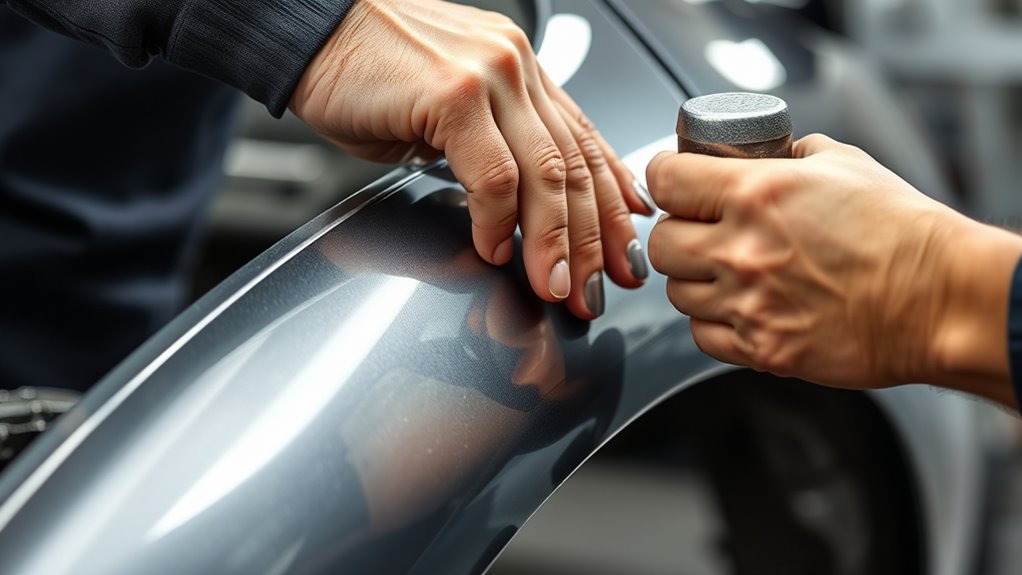
Quarter panels are harder to read than flat panels because they combine broad crowns, body lines, wheel-opening edges, flanges, and hidden inner structure. A correction in one area can change the contour several inches away.
Start with the least aggressive method that will move the damage. Support broad lows, release bent edges and body lines, and rough-shape off dolly. Save on-dolly planishing for the final surface correction.
| Method | Best Use | Main Risk |
|---|---|---|
| Hammer off dolly | Roughing out lows, releasing creases, and lowering nearby highs | Moving the wrong high area if the damage is mapped poorly |
| Hammer on dolly | Final planishing, tiny remaining lows, and supported edge finishing | Stretching and flattening the panel crown |
| Spoon or slapper | Broad waves and body lines that need distributed force | Moving a larger area than intended |
| Light spring hammering without a dolly | A small isolated high after the panel is nearly shaped | Creating a new low if the blow is too hard |
Use a contour gauge, flexible ruler, or template from the undamaged side to protect the panel’s crown. If abrasive work follows, understanding wheel markings helps you choose a suitable accessory and avoid an overly aggressive disc.
Pro Tip: Sight down the quarter panel from a low angle every few minutes. A small wave that is hard to feel becomes obvious when reflected light breaks across the surface.
Square the Deck Lid Opening
A shifted deck-lid opening after rear-end damage is not automatically a hammer-and-dolly job. Misalignment can come from the outer quarter skin, gutter, rear body panel, hinges, latch support, floor, rails, or inner quarter structure.
Before shaping the opening:
- Check that the deck lid, hinges, latch, weatherstrip flange, lamps, and adjacent panels are installed or positioned correctly.
- Compare gaps on both sides and note where the lid binds, sits high, or drops below the surrounding panels.
- Inspect the inner structure and seams for kinks, cracks, broken welds, or adhesive separation.
- Consult the OEM repair information before moving hinge, latch, reinforcement, or structural mounting points.
If the damage is limited to a repairable outer flange or skin, use off-dolly support to correct the high and low areas in small steps. Test-fit the deck lid after each pass. Knowledge of strong and permanent joints is useful when a repair also includes welded sections, but welded structure must follow the vehicle maker’s procedure.
Warning: Stop if the opening remains out of square, the latch does not engage correctly, the glass or lamp gaps change, or inner structure is damaged. These signs can indicate collision misalignment that requires measuring and professional straightening equipment.
Diagnose Oil Canning and Stretched Metal
Oil canning is the popping or flexing of a broad panel when light pressure makes it move between two positions. It can be caused by stretched sheet metal, a flattened crown, a loose brace, failed anti-flutter adhesive, heat distortion, or a combination of problems.
Do not assume more hammering will fix it. Repeated on-dolly blows can increase the panel’s surface area and make the condition worse.
- Check whether the panel crown matches the undamaged side.
- Inspect hidden braces, adhesive pads, seams, and edge flanges.
- Look for a large flat area surrounded by a tight high ring.
- Stop if light pressure causes a broad snap rather than a controlled flex.
Ordinary hammer-and-dolly work does not automatically shrink stretched metal. Specialized cold-shrinking tools or controlled heat may be needed, and I-CAR states that heat should be applied only when allowed by the vehicle maker. When the panel is severely stretched, cracked, work-hardened, or unsupported, replacement may be safer and more durable than continued straightening.
Finish the Metal With Light Filler
Once the metal is stable and close to its final contour, use a thin coat of automotive filler only for shallow imperfections. Filler should not bridge holes, hold a loose panel in shape, replace missing metal, or hide a structural problem.
Follow the exact technical data sheet for the filler and primer system you use. For example, the 3M Bondo Body Filler technical bulletin directs users to clean the surface, sand the damaged area with 80-grit abrasive to bare metal, keep an application below 1/4 inch, sand cured filler with 80 grit, and feather the edge with 180 grit or finer. Other products may allow application over approved epoxy primer or require a different abrasive range.
- Remove wax, grease, rust, loose coating, and sanding dust.
- Prepare the substrate exactly as the filler maker specifies.
- Mix only the amount you can spread within the stated working time.
- Press a thin coat into the prepared surface, then build only enough to restore contour.
- Block-sand across the panel shape and use guide coat to reveal remaining highs and lows.
- Apply compatible primer and corrosion protection after the filler has cured and been sanded.
If the repair includes welding before filler, use suitable thin-sheet technique to avoid burn-through and excess heat distortion.
Note: Filler preparation, maximum thickness, cure time, and approved substrates vary by product. The label and current technical data sheet take priority over generic bodywork advice.
Troubleshoot Common Panel Problems
| Problem | Likely Cause | What to Do |
|---|---|---|
| The low spot will not rise | A crease, edge, or surrounding high is locking the damage | Map the whole dent, support the low, and release the high or crease with off-dolly taps. |
| The panel becomes flatter and looser | Too much on-dolly hammering has stretched or flattened the crown | Stop hammering, compare the crown, inspect supports, and determine whether approved shrinking or replacement is required. |
| New small dents appear | Dirty, damaged, or mismatched tool faces; blows are too hard | Dress or replace damaged tools, clean the faces, match the crown, and reduce force. |
| The panel oil-cans | Stretched metal, lost crown, or a loose brace or adhesive pad | Inspect the whole panel and hidden supports. Do not keep planishing blindly. |
| Filler edges show after sanding | Poor feathering, contamination, wrong abrasive, or too much filler | Recheck the product instructions, clean the surface, feather with a block, and correct the metal before adding more filler. |
| Panel gaps keep changing | The opening, hinge, latch, or inner structure is misaligned | Stop cosmetic shaping and measure the structure using the OEM procedure. |
Avoid Common Hammer and Dolly Mistakes
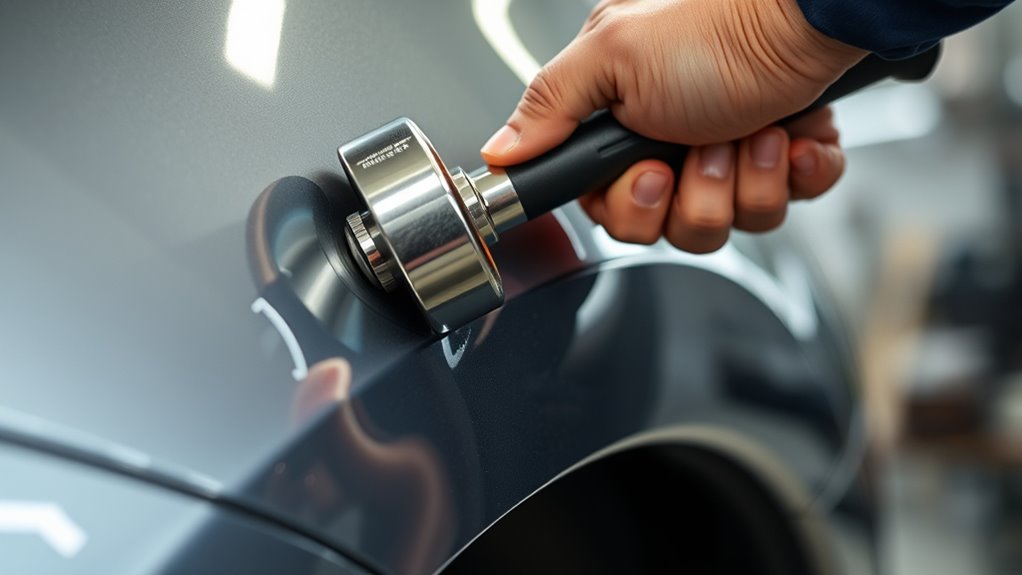
- Striking too hard: Heavy blows create new damage faster than they remove the old damage.
- Using on-dolly blows for every high spot: Direct contact can stretch the sheet and flatten the panel crown.
- Hammering the deepest low first: The low may be locked by a crease, edge, or surrounding high area.
- Using the wrong dolly crown: A mismatched dolly can imprint its shape into the panel.
- Holding the dolly where you think it is: Confirm its location by feel, sound, and light taps before a repair pass.
- Ignoring the material: Steel, aluminum, and high-strength parts have different repair limits.
- Chasing perfection with the hammer: Stop when the metal is stable and close enough for a thin finishing coat.
- Skipping repeated fit checks: Quarter panels, deck-lid openings, and body lines can shift as the metal moves.
When grinding or cutting near a body repair, use grinder-rated accessories. An unsuitable accessory can damage the repair and create a serious safety hazard.
Frequently Asked Questions
How do you use an auto body hammer and dolly?
Map the full dent, match the tools to the panel contour, and start with off-dolly blows to release creases and rough out the low area. When the panel is close to shape, use very light on-dolly taps for final planishing. Recheck the contour after every short pass.
What is the difference between hammer on dolly and hammer off dolly?
On dolly means the hammer strikes directly over the dolly, which pinches and can stretch the metal. Off dolly means the hammer strikes beside the dolly, allowing you to lower a nearby high while the dolly supports the low with less direct stretching.
Can you shrink metal with a normal hammer and dolly?
Normal on-dolly planishing generally stretches rather than shrinks sheet metal. Specialized cold-shrinking tools or controlled heat may reduce excess surface area, but the correct method depends on the alloy and vehicle-maker procedure. Do not heat a modern panel unless the OEM specifically permits it.
What is the hammer-and-dolly method of vehicle body repair?
It is a cold-straightening method that combines a body hammer on one side of a panel with a shaped metal dolly on the other. Changing the dolly position lets you rough out damage, support a low area, lower nearby highs, and planish the final contour.
What four rules should you follow when using body hammers?
Use an undamaged hammer that matches the panel, wear suitable eye and hand protection, keep your free hand clear, and strike with light controlled blows while checking the metal often. Also confirm what is behind the panel before you begin.
Can you use a hammer and dolly on aluminum panels?
Sometimes, but aluminum work-hardens and does not respond like mild steel. Use clean aluminum-dedicated tools to avoid steel contamination, keep the force light, and follow the vehicle maker’s repair limits. Sharp creases, crowns, and heavily work-hardened areas may require replacement.
When should you stop repairing and replace the panel?
Consider replacement when the OEM prohibits straightening, the metal is torn or cracked, a structural part is kinked, the panel is severely stretched or work-hardened, corrosion is extensive, hidden supports have failed, or a durable contour cannot be restored without excessive filler.
Conclusion
The most important rule is to move the metal a little at a time and understand what each tool position does. Use off-dolly blows for most rough shaping, then use light on-dolly taps only when the panel is close to contour and needs final planishing.
Match the tools to the panel, release locked damage before chasing the low, compare the crown and gaps often, and stop when the metal becomes unstable or unpredictable. A sound repair has a stable shape, correct body lines, and only a thin finishing layer rather than a panel forced flat under heavy filler.
Sources
- I-CAR: Back-To-Basics—Cold Straightening — cold straightening, material limits, and OEM permission before applying heat.
- I-CAR: Cosmetic Repairs to Aluminum Exterior Panels — aluminum work hardening, repairability, and backside-access considerations.
- I-CAR: Always Follow Vehicle Maker Procedures — the need to use current OEM repair instructions.
- OSHA: Eye and Face Protection — protection from flying particles and the need for side protection.
- 3M Bondo Body Filler Technical Bulletin — surface preparation, mixing, thickness, curing, and sanding guidance for that product.
- Eastwood: How to Control Warpage on Sheet Metal — the stretching effect of hammering directly on dolly.