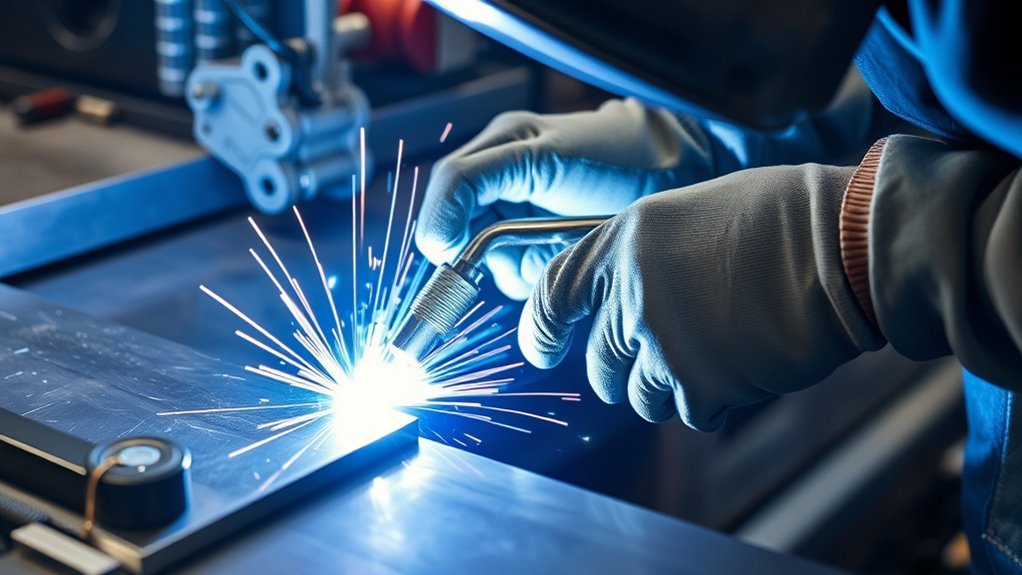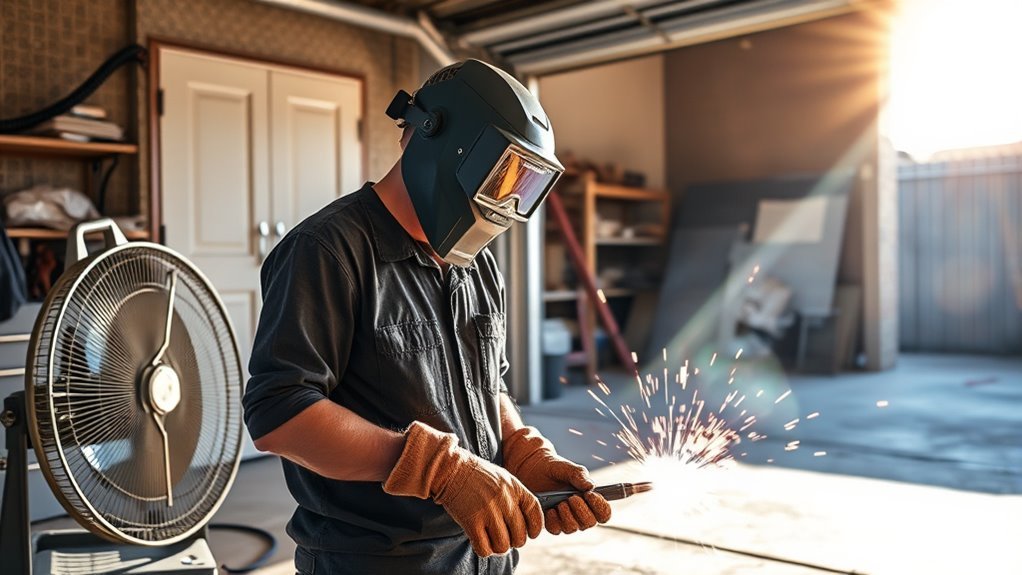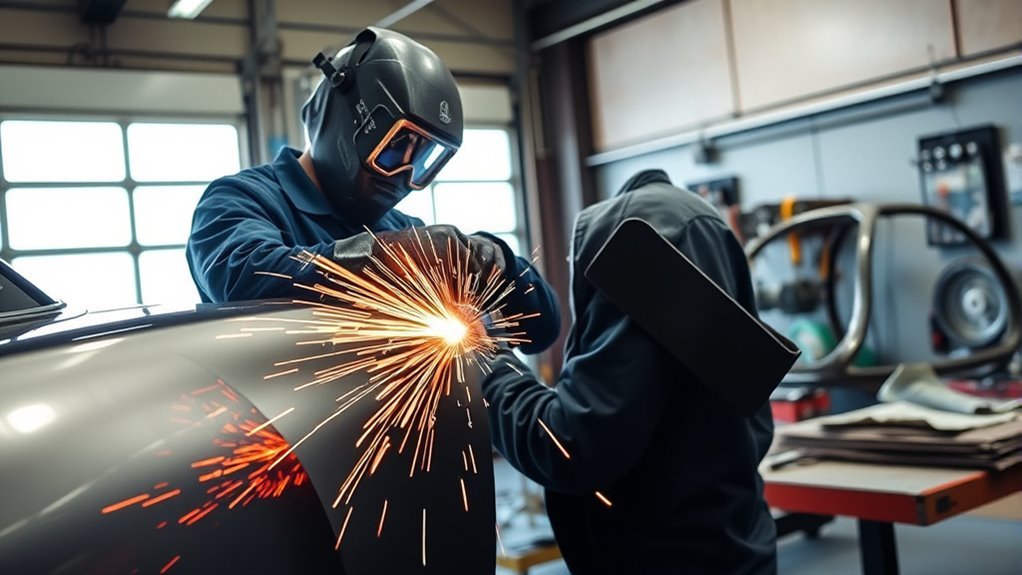
Quarter-panel welding is more than a cosmetic patch. The outer skin may connect to the wheelhouse, door opening, rocker, rear body panel, roof rail, or sensor mounting areas, so the correct repair depends on the vehicle. A lasting job starts with the OEM body repair procedure, clean solid metal, accurate fit-up, controlled heat, verified weld quality, and complete corrosion protection on both sides of the repair.
Quick Answer
To weld a quarter panel correctly, first use the vehicle-specific body repair manual to confirm where cutting is allowed and which joining method is required. Remove all damaged metal, test-fit the replacement, make test welds, control heat with spaced tacks or specified plug welds, then restore primer, seam sealer, undercoating, paint, and cavity wax.
Key Takeaways
- Check the OEM body repair manual before choosing a patch, sectioning location, flange, adhesive, or welding process.
- Inspect the inner quarter, wheelhouse, rocker, rear body panel, wiring, fuel system, restraints, and nearby sensors before cutting.
- Use clean, tight-fitting metal and prove your welder settings on matching scrap before touching the vehicle.
- Control distortion with spaced tacks, skip welding, short arc time, and cooling pauses instead of one continuous bead.
- Do not grind the repair flat by thinning the quarter panel. Remove only the proud part of each weld.
- Restore the full corrosion system, including primer, seam sealer, exterior coatings, and cavity wax inside the panel.
At a Glance
| Time Required | Several hours for a small patch, plus coating cure time. A full quarter-panel replacement and refinish can become a multi-day repair. |
| Difficulty | Advanced. Full replacements and repairs near structural joints, restraints, ADAS sensors, or high-voltage components belong in a qualified collision-repair shop. |
| Tools Needed | OEM repair information, MIG/GMAW or specified joining equipment, spot-weld cutter, drill, grinder, body saw, clamps, measuring tools, PPE, ventilation, fire extinguisher, and corrosion-protection materials. |
| Cost | Varies widely by vehicle, hidden rust, panel size, required joining method, trim removal, paint materials, scanning, and calibration needs. |
What’s in This Article
- Understand Quarter-Panel Construction and OEM Repair Rules
- How to Identify and Assess Rust Damage
- Tools, Materials, and Welder Setup
- Safety and Vehicle Protection Checks
- Remove the Old Panel
- Prepare and Test-Fit the New Panel
- Weld the Quarter Panel
- Grind and Metal-Finish the Welds
- Restore Corrosion Protection
- Troubleshoot Common Problems
- Maintain the Repair
- Frequently Asked Questions
- Conclusion
Understand Quarter-Panel Construction and OEM Repair Rules
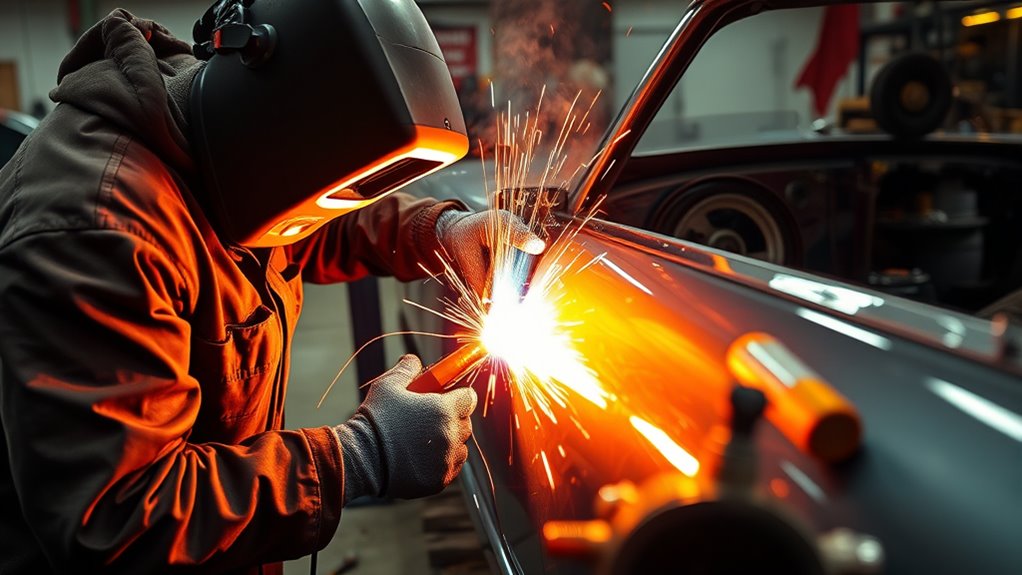
Welding quarter panels takes planning because you are cutting finished bodywork, working around hidden components, and joining thin sheet metal that can distort quickly. A rushed cut, poor fit, or long weld bead can cause burn-through, oil-canning, poor body lines, or a weak repair.
The first step is not cutting. It is finding the vehicle-specific body repair procedure. Quarter panels differ in steel grade, construction, flange design, weld type, adhesive use, sectioning location, and corrosion-protection requirements. I-CAR’s sectioning guidance explains that sectioning is allowed only when the vehicle maker supports it and that the repair manual controls the required joint and welding method.
Note: The visible outer quarter skin may look cosmetic, but it is joined to other body structures. Do not assume that a cut location, overlap, flange, or weld pattern that worked on another vehicle is safe on this one.
Choose Between Repair, a Patch, Sectioning, and Full Replacement
Use the least invasive repair that removes all damage and follows the OEM procedure:
- Metal repair without cutting: Suitable when the panel is dented but still sound, accessible, and repairable without excessive stretching or thinning.
- Small rust patch: Suitable only when the rust is localized, the surrounding steel is solid, the inner panel is healthy, and the patch location does not conflict with OEM restrictions.
- Partial replacement or sectioning: Use only at a location and with a joint design allowed by the vehicle maker.
- Full quarter-panel replacement: Often the better choice when rust or collision damage reaches multiple flanges, the wheel opening, door opening, sail panel, rear body panel, or hidden inner structure.
If the inner wheelhouse, rocker, reinforcement, or mounting structure is weak, repair that damage before closing it behind a new outer panel. A strong-looking skin cannot compensate for corroded or distorted metal underneath.
Choose the Correct Joint and Joining Method
A butt joint can create a clean exterior finish, while a flanged overlap can support a patch and simplify alignment. However, neither method is universally correct. The OEM procedure must decide whether you use a butt joint, lap joint, plug welds, squeeze-type resistance spot welds, MIG brazing, structural adhesive, rivets, or a combination.
Do not substitute adhesive for welding, add a flange, or create an arbitrary sectioning joint because it feels easier. Also do not use a fixed overlap dimension, such as “half an inch,” unless the repair procedure or approved patch design specifies it.
Warning: Check both sides of the quarter panel before every cut or weld. Fuel filler hoses, vapor lines, wiring, restraint components, sound insulation, trim, foam, and blind-spot radar hardware may sit close to the work area.
Clean the weld area before you strike an arc. Remove rust, paint, seam sealer, adhesive, undercoating, and contamination only where the selected joining process requires bare metal. Proper mild-steel cleaning improves arc stability and helps the weld fuse to sound steel.
How to Identify and Assess Rust Damage in Quarter Panels
Before you weld, inspect the quarter panel and the surrounding structure from the outside and inside. The repair will only last if you remove all weak metal and join the replacement to solid steel.
Inspecting Visible Rust Areas
Start with the lower quarter panel, wheel opening, fuel-door area, seams, bumper edge, rocker connection, and the area behind splash shields. These spots often trap dirt, road salt, and moisture.
Look for bubbling or flaking paint, pinholes, cracks, dark staining, swollen seams, and rough edges. Use a magnet to find heavy body filler or previous repairs, but remember that some modern panels and fillers can make magnet results unreliable. Treat the magnet as one clue, not a final diagnosis.
Probe badly rusted metal with a pick or screwdriver only after protecting the surrounding finish. If the tool breaks through or the metal crumbles, enlarge the planned repair until every edge reaches solid steel. The article on repairing rust holes can help you recognize when a small cosmetic spot has become a cut-out repair.
Checking Structural Integrity
Tap the panel lightly and compare the sound and stiffness across the area. A dull or flexible spot can indicate filler, stretched metal, delamination, or hidden rust. Remove trim and liners when needed so you can inspect the inner quarter, wheelhouse, reinforcement, brackets, and seam flanges.
Check door, trunk, liftgate, tailgate, bumper, and lamp gaps before cutting. Uneven gaps may point to collision movement that must be measured and corrected before a new outer panel is fitted.
Evaluating Underlying Damage
Use a light, mirror, or inspection camera to look behind the panel. Check for packed debris, failed seam sealer, wet insulation, clogged drains, damaged foam, and rust trails from an upper seam. Mark the complete damaged area, not just the hole you can see.
Inspect mounting points and nearby body structure. If the repair approaches a pillar, rocker, roof rail, restraint anchorage, high-strength reinforcement, or sensor bracket, stop and follow the exact OEM procedure. Random sectioning of reinforcements can change how the body handles crash loads.
Decide Whether the Panel Is Safe to Patch
A patch is a reasonable choice when all of the following are true:
- The rust is localized and all remaining edges are solid.
- The inner panel and adjoining flanges are undamaged.
- The patch location is allowed by the vehicle maker.
- You can reach both sides for inspection and corrosion protection.
- The body line, wheel opening, and nearby gaps can be restored accurately.
Choose a larger section or full replacement when rust continues under seams, the inner wheelhouse is damaged, the panel has been repaired several times, or the proposed patch would cross a restricted joint or reinforcement.
Tools, Materials, and Welder Setup
Gather the equipment before you start. Stopping halfway through an open body cavity can lead to rushed cuts, contamination, moisture exposure, or poor corrosion protection.
Products Worth Considering

COMPATIBILITY: Designed for Lincoln Magnum 100L (K530 series) and Tweco Mini/#1 welding torches. This kit is also a direct fit for YESWELDER FLUX-135PRO Old Version/MIG-140DS PRO/YWM-160/MIG-165DS PRO/MIG-185DS PRO/MIG-205DS PRO/MIG-250PRO/MCT-520.

220W Rapid Heating:The plastic welding machine has a power of 220 watts and a 110V-US plug, which has higher output current and faster heating speed. Using heat to embed nails or plastic rods into plastic will not cause damage to the car or plastic surface, and is very sturdy. Not only are there two repair methods to choose from: welding rods and hot nails, but there is also an overheat protection device to ensure your safety
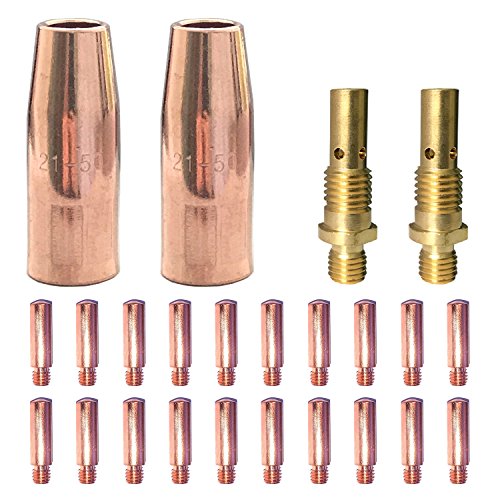
Mig Welding gun accessory 0.035" kit with contact tip,gas nozzle,gas diffuser for Lincoln Magnum 100L & Tweco Mini/#1.
Essential Tools Overview
- OEM body repair information: Confirms material, cut location, joint design, weld type, adhesive, fasteners, and corrosion steps.
- MIG/GMAW welder or specified joining equipment: Joins the replacement panel using the process approved for the vehicle.
- Spot-weld cutter and drill: Removes factory spot welds while protecting the lower layer.
- Body saw, cutoff wheel, or air saw: Makes controlled rough and final cuts.
- Air chisel: Separates released flanges after the welds are cut. Do not use it to tear through attached spot welds.
- Hole punch or drill: Creates plug-weld holes of the size required by the procedure.
- Grinder and abrasives: Clean metal and dress welds without thinning the panel.
- Clamps, magnets, panel holders, and self-tapping alignment screws: Hold the panel during repeated test fits.
- Measuring tools: Check reference points, gaps, body lines, and wheel-opening shape.
- Corrosion materials: Approved weld-through coating where required, primer, seam sealer, undercoating or chip guard, paint materials, and cavity wax.
Test each tool before cutting. Replace worn spot-weld cutters and damaged abrasives, confirm the welder feed system works smoothly, and make sure the work lead and clamp are clean and secure.
Choose Wire, Gas, and Settings for Thin Sheet Metal
Gas-shielded short-circuit MIG welding is common for conventional mild-steel patch work because it offers good control on thin sheet. For light-gauge sheet, Miller recommends small solid wire, commonly 0.023 or 0.024 inch, then adjusting voltage and wire speed to the actual metal and machine. Use the wire classification, shielding gas, polarity, and process required by the OEM and filler-metal manufacturer.
Flux-core wire can add heat, spatter, and cleanup on thin exposed panels. It is usually a poor first choice for a cosmetic quarter-panel seam. If you are evaluating it for a noncritical patch, review the limitations in this guide to welding thin metal with flux core, then confirm the process is allowed and practice on matching scrap first.
Do not copy a setting from another machine and assume it will work. Panel thickness, zinc coating, joint fit, extension-cord voltage drop, wire, gas flow, torch angle, and travel speed all affect the result. Use your machine chart as a starting point and make test welds on coupons that match the vehicle metal as closely as possible.
Safety Equipment Necessities
Wear a welding helmet with a suitable shade, safety glasses under the helmet, leather gloves, hearing protection, fire-resistant clothing, and sturdy closed footwear. Use respiratory protection selected for the coating and fume hazards after reviewing product safety data and local requirements.
Welding and grinding can release hazardous fumes. Galvanized automotive steel can produce zinc-oxide fume when heated, so use local exhaust or effective mechanical ventilation and keep your head out of the plume. OSHA’s welding standard requires adequate ventilation and controls for welding fumes.
Keep an appropriate fire extinguisher close enough to reach immediately. Assign a fire watch when sparks can enter hidden cavities, insulation, trim, or underbody coatings.
Before You Begin: Quarter-Panel Welding Safety Checks
Complete this checklist before cutting or welding:
- Read the OEM procedure: Confirm the panel material, approved sectioning location, joint, weld type, adhesive, fasteners, and corrosion-protection steps.
- Document gaps and reference points: Photograph and measure the door, trunk or liftgate, lamp, bumper, and wheel-opening alignment before removal.
- Identify nearby electronics and sensors: Blind-spot radar units are often mounted behind the rear bumper or on the quarter-panel area. Check whether removal, body repair, or bracket work triggers a scan or calibration. I-CAR notes that these sensor locations and requirements vary by vehicle.
- Protect the electrical system: Follow the vehicle maker’s battery, restraint, module, and welding precautions. General Motors, for example, calls for disconnecting battery negative cables, disabling the air-bag system, shielding electronics, and placing the work clamp close to the weld area in its Electrical Best Practices manual.
- Handle hybrid and EV systems correctly: Disconnecting the 12-volt battery alone does not disable the high-voltage system. Follow the vehicle maker’s high-voltage power-down and welding procedure. I-CAR’s hybrid and EV welding guidance calls for vehicle-specific high-voltage disabling precautions.
- Remove or shield flammable and heat-sensitive parts: Move carpet, trim, insulation, foam, wiring, vapor lines, fuel filler parts, and nearby modules out of the hot-work zone as the repair manual requires.
- Inspect both sides: Never cut from the outside without confirming what the tool will reach inside the cavity.
- Clean the work area: Remove paint, rust, seam sealer, undercoating, adhesive, and contamination from the immediate cut and weld zones.
- Set the panel and welder on scrap first: Prove the joint fit, settings, plug-weld technique, and backside penetration before welding the vehicle.
- Place the work clamp correctly: Attach it to clean metal as close as practical to the weld so current does not travel through bearings, modules, wiring, or unrelated joints.
Warning: Do not weld near a fuel leak, fuel vapor, a damaged high-voltage battery, undeployed restraint component, or an unknown foam-filled cavity. Stop and correct the hazard before continuing.
Removing the Old Panel: Step by Step
Take your time during removal because the surrounding flanges and lower layers must remain straight and usable.
- Remove nearby components: Take off the tail lamp, bumper cover, liftgate or tailgate trim, fender flare, wheelhouse liner, interior trim, weatherstrip, and any other parts listed in the repair procedure.
- Brace and measure when required: If damage or corrosion affects an opening, support the body and record reference measurements before cutting.
- Mark the approved cut area: Follow the OEM sectioning location or factory seams. Leave extra material for controlled final trimming rather than cutting directly to the finish line.
- Check behind the panel: Verify the location of the fuel filler hose, vapor lines, wiring, sensors, brackets, insulation, and foam.
- Expose factory attachment points: Remove coating only as needed to locate spot welds, braze joints, adhesive, rivets, or seams.
- Rough-cut the damaged skin: Remove the center of the panel when that improves access, but stay away from flanges and hidden lower layers.
- Cut or drill factory spot welds: Use a spot-weld cutter or controlled drill depth. Stop as soon as the upper layer releases.
- Separate the flanges carefully: Use a seam splitter or air chisel only after the attachment points are released. Excessive prying can stretch the host flange.
- Remove adhesive and residue: Follow the adhesive manufacturer’s and OEM’s method without gouging or overheating the underlying panel.
- Assess the inner panel: Repair or replace weak inner metal before installing the new outer panel.
- Prepare coated steel safely: Remove zinc or other coatings only at the immediate weld area and only as required. Use ventilation because heated galvanized coatings can create hazardous fume. See the guide to removing zinc coating before welding for preparation precautions.
After removal, straighten the remaining flanges, remove burrs, and check for thin spots, tears, and missed rust. Any corrosion left behind can continue under the replacement panel.
Preparing the New Panel for Installation
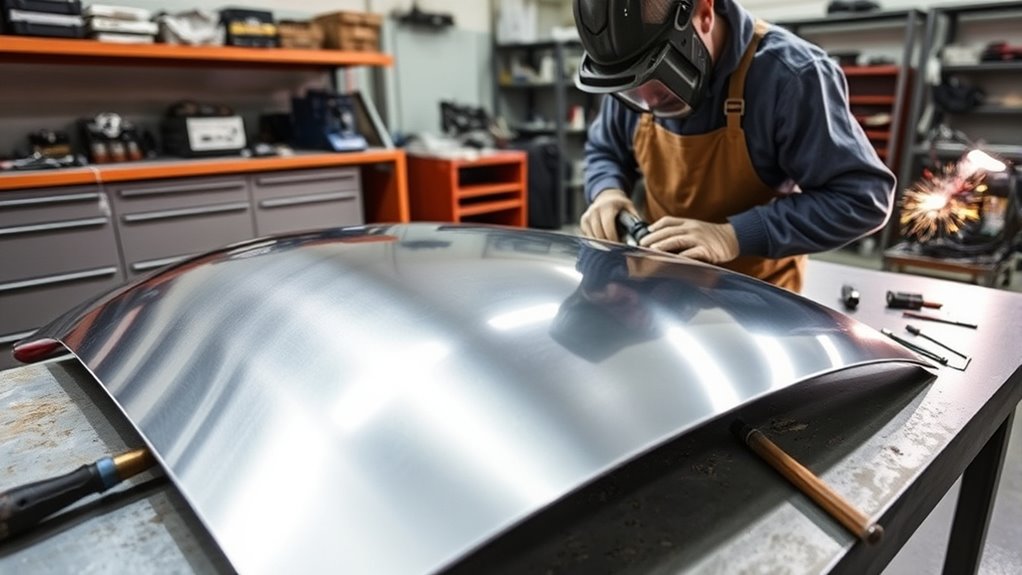
Compare the replacement panel with the removed part and the vehicle before trimming. Check stampings, flanges, drain paths, bracket locations, fuel-door opening, wheel arch, lamp pocket, and body lines.
Trim and Test-Fit the Panel
- Start oversized: Trim a little at a time so you do not create a wide gap or cut beyond the approved sectioning line.
- Fit the panel repeatedly: Check the door gap, wheel opening, roof or sail-panel line, trunk or liftgate opening, tail lamp, bumper edge, and fuel door.
- Correct the host metal: Straighten bent flanges and repair inner damage instead of forcing the new panel to fit a distorted opening.
- Clamp every attachment area: Tight flange contact is essential for plug welds, spot welds, adhesive bond lines, and accurate exterior alignment.
- Confirm access: Make sure you can reach the backside for fire checks, weld inspection, primer, and cavity wax.
The final fit should come from accurate trimming and straight host metal, not from pulling the panel into shape with welds.
Prepare Flanges, Plug-Weld Holes, and Coatings
Prepare each area for the joining method specified by the repair manual:
- Make plug-weld holes with the required diameter and spacing. Do not guess or use a universal hole pattern.
- Preserve factory E-coat wherever the process does not require its removal.
- Apply an approved zinc-based weld-through coating to mating steel flanges only where the OEM or product system calls for it.
- Do not put weld-through primer in an adhesive bond area unless the adhesive manufacturer and OEM specifically allow it.
- Apply structural adhesive, seam sealer, rivets, or weld-bonding materials only in the locations and sequence specified.
- Replace foam and NVH materials at the correct stage, usually after hot work is complete unless the procedure says otherwise.
3M’s panel-bonding procedure separates weld-through-primer areas from adhesive areas and calls for dry fitting before final installation.
Pro Tip: Install the tail lamp, bumper cover, weatherstrip, or adjacent trim temporarily during the final test fit when those parts control the visible gap. A quarter panel can look aligned by itself and still fit poorly once the surrounding parts return.
How to Weld a Quarter Panel Without Warping It
Thin automotive sheet metal can warp quickly, so your goal is enough fusion with the least practical heat. Use the process, weld count, sequence, and joint design from the vehicle maker.
Products Worth Considering

Value Pack: The package includes 24 packs of butt welding clamps, enough quantity to meet your daily needs and replacements. Each butt welding clamps is individually wrapped in a small bag, convenient to carry and use.

16-Pack Welding Clamps Set: Includes 16 butt welding clamps designed for precise edge-to-edge welding, ideal for body repair, floor patching, door skins, and sheet metal alignment.
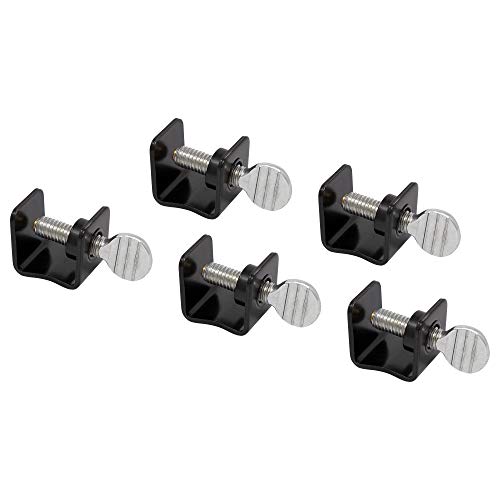
Use clamps to hold panels in place for welding
1. Make Test Welds First
Use scrap or coupons that match the vehicle metal, coating, joint, and number of layers. Test the same plug-weld hole, flange preparation, wire, gas, polarity, voltage, and wire speed you plan to use on the car.
Inspect the front and backside. A sound test weld should fuse into the lower layer without a large burned edge, excessive porosity, or a loose nugget. Adjust the setup before welding the vehicle. An internal wire and setting chart can provide a starting point, but the coupon result must control the final adjustment.
2. Lock In Panel Alignment
Clamp the panel so every body line and gap remains correct. Add temporary alignment screws or panel clamps where allowed. Recheck the door, wheel opening, lamp, bumper, and deck opening after clamping because tightening one flange can move another area.
3. Tack and Skip-Weld a Cosmetic Seam
- Place widely spaced tacks around the seam to lock the panel without concentrating heat.
- Confirm alignment after the first tacks. Cut and reposition a tack now rather than fighting a shifted panel later.
- Add short tacks between the earlier welds, moving to a distant area after each one.
- Let the panel cool before welding near the same location again.
- Continue filling the spaces gradually until the required seam is complete.
Do not run a continuous bead along an exterior quarter-panel seam unless the approved procedure specifically requires it. Skip welding spreads heat and reduces shrinkage. The automotive sheet-metal welding guide covers additional heat-control techniques.
A copper backing bar can help absorb heat and support a small gap when you can place it safely behind the seam, but it does not correct poor fit-up. Avoid quenching a hot panel with water or compressed air unless the OEM or welding procedure allows it, because rapid uneven cooling can add distortion.
4. Make Plug Welds at Factory Flanges
For a MIG plug weld, clamp the layers tightly. Aim the arc at the lower panel through the hole, establish fusion, then wash the puddle into the edge of the upper hole until it fills. Use the approved hole size, weld count, and spacing. A plug weld that only fills the top hole without fusing to the lower layer is not a sound attachment.
When the procedure calls for squeeze-type resistance spot welding, MIG brazing, rivet bonding, or adhesive with welds, use the specified equipment and process. Do not replace one attachment method with another because it is more convenient.
5. Control the Current Path and Fire Risk
Keep the work clamp on clean metal close to the active weld area. Move it as the work moves when needed. After each weld series, inspect the backside and nearby cavities for glowing material, melted wiring, smoldering foam, or damaged coating. Continue the fire watch after hot work ends because hidden trim and sealer can smolder without visible flame.
6. Inspect Weld Quality Before Grinding
Check for:
- Consistent fusion and full attachment at every required point.
- Backside penetration appropriate to the joint and process.
- No cracks, porosity clusters, missed holes, loose plug welds, or unfilled pinholes.
- Correct panel alignment and body lines.
- No heat damage to wiring, sensors, hoses, foam, or nearby coatings.
Repair defects before grinding. Once you flatten the weld face, it becomes harder to judge whether the original weld fused correctly.
Grinding and Metal-Finishing Quarter-Panel Welds
Grinding creates heat and can thin the panel just as quickly as welding. Use a controlled abrasive and work only on the raised part of the weld.
- Start with the proud weld: Keep the abrasive off the surrounding sheet as much as possible.
- Use short passes: Move around the repair instead of heating one spot continuously.
- Check thickness and shape often: Stop when the weld is nearly level. Do not chase a perfectly invisible seam by cutting into the base metal.
- Repair pinholes: Clean and reweld them with short tacks rather than burying them under filler or seam sealer.
- Metal-finish gently: Planish only where access, steel type, and repair procedure permit it.
- Final-sand for the coating system: Follow the primer, filler, and paint manufacturer’s surface-preparation instructions.
If the panel becomes flexible or develops a low crown, stop grinding. More abrasive work will not restore stretched or thinned steel.
Sealing, Priming, Undercoating, and Cavity Wax
After welding and metal finishing, restore every layer of corrosion protection that cutting, grinding, or heat removed. Seam sealer and undercoating alone are not a complete system.
3M describes four core corrosion-protection elements: cavity wax, seam sealers, protective coatings, and the paint system. The correct product order depends on the OEM, seam sealer, and paint system.
| Step | Action |
|---|---|
| Clean and inspect | Remove grinding dust, spatter, residue, and contamination. Confirm every pinhole and weld defect is repaired. |
| Prime exposed metal | Apply the approved epoxy, urethane, or direct-to-metal primer in the sequence required by the paint system and sealer. |
| Apply seam sealer | Seal the same joints and drainage paths shown in the OEM procedure. Use a product approved for the substrate. |
| Restore exterior coatings | Recreate required undercoating, chip guard, rocker coating, and wheelhouse protection without blocking drains. |
| Refinish the visible panel | Complete filler, primer-surfacer, sealer, color, and clearcoat according to the paint system. |
| Apply cavity wax | Use a wand to coat the inner quarter, backside of welds, flanges, and repaired cavities after the coating stage specified by the product and OEM. |
| Final inspection | Check coverage, drains, plugs, wiring, trim, fasteners, sensor brackets, gaps, and water sealing before delivery. |
Allow every product to flash, dry, or cure for the time listed in its technical data sheet before covering it or exposing the vehicle to water and road grime. Do not apply seam sealer over dirt, loose rust, or an incompatible acidic primer.
Common Quarter-Panel Welding Problems and Fixes
Use the table below to diagnose problems before they spread across the repair.
| Problem | Likely Cause | Fix |
|---|---|---|
| Warping or oil-canning | Long arc time, clustered welds, wide gap, overgrinding, or forced fit. | Stop, let the panel cool, correct fit-up, use spaced tacks and skip welding, and avoid thinning the base metal. |
| Burn-through | Too much heat, slow travel, large wire, rust-thinned metal, or an open joint. | Cut back to sound metal, tighten the gap, lower heat input, shorten arc time, and use matching scrap to reset the machine. |
| Porosity or heavy spatter | Paint, rust, sealer, moisture, poor gas coverage, wind, dirty nozzle, or wrong polarity. | Grind out the defect, clean the joint, check gas flow and connections, block drafts, clean consumables, and confirm polarity. |
| Lack of fusion | Settings too cold, poor work-lead contact, contamination, or aiming only at the top layer. | Remove the bad weld, clean the metal, improve the ground, adjust settings on a coupon, and direct plug-weld heat into the lower layer. |
| Weak plug weld | Loose flange, wrong hole size, insufficient heat, coating at the weld point, or poor technique. | Restore tight contact, prepare the weld site correctly, follow the required hole specification, and prove the weld on a test coupon. |
| Panel shifted during welding | Too few clamps, welding one end first, or failing to recheck gaps. | Cut the affected tacks, realign the panel, add clamps, and lock the panel with distributed tacks. |
| Pinholes after grinding | Incomplete tacks, porosity, or aggressive grinding. | Clean each pinhole, add a short controlled tack, cool the area, and dress only the raised weld. |
| Rust returns at the seam | Rust left inside, bare backside metal, failed seam sealer, blocked drainage, or missing cavity wax. | Open the affected area as needed, remove the corrosion, repair the coating system, restore drainage, and apply cavity protection. |
Also protect vehicle electronics throughout the repair. If a module, sensor, light, or wiring harness was removed or exposed to heat, inspect it before reconnecting the battery. Complete any required scan, aiming, initialization, or calibration after assembly.
Tips for Maintaining a Welded Quarter Panel
Keep the wheel opening, lower quarter, drain paths, and bumper edge clean so mud and salt do not remain against the seams. Inspect the repair after winter driving, flooding, gravel-road use, or a new impact.
- Repair paint chips before bare steel stays exposed.
- Watch for bubbling paint, cracked seam sealer, loose undercoating, water inside the trunk, or staining around a joint.
- Keep factory drains and access plugs open and correctly installed.
- Check the inner quarter and wheelhouse when trim is removed for other service.
- Do not cover active rust with undercoating or filler. Remove the corrosion and rebuild the coating system.
Rust converters may have a place on some non-welded, properly prepared areas when their manufacturer and paint system allow them, but they should not remain in a weld zone or replace removal of weak metal.
Frequently Asked Questions
Can you weld a quarter panel with a MIG welder?
Yes, gas-shielded MIG welding is commonly used for conventional steel quarter-panel patches and plug welds when the OEM procedure allows it. Use the specified wire, gas, polarity, and weld pattern, then prove the settings on matching scrap before welding the vehicle.
Should you butt weld or overlap a quarter-panel patch?
Use the joint approved for the vehicle and repair location. A butt joint can give a cleaner exterior finish, while a flanged overlap can support a patch, but an unapproved overlap can trap moisture and an arbitrary butt joint can weaken a restricted area.
How do you stop a quarter panel from warping while welding?
Start with tight fit-up, place spaced tacks, move around the seam, and let the panel cool before welding nearby. Keep each arc short and grind in brief passes. Do not use a continuous bead on an exterior seam unless the approved procedure requires one.
Do you need to remove rust before welding a quarter panel?
Yes. Cut back to solid steel and remove rust, paint, coating, moisture, and contamination from the weld zone. Welding over weak or rust-thinned metal leads to burn-through, porosity, poor fusion, and early corrosion failure.
Is a quarter panel welded to the vehicle?
Most modern quarter panels are permanently attached with spot welds, plug welds, brazed joints, adhesive, rivets, or a combination. The exact attachment points and replacement method vary by make, model, year, and panel material.
Can you weld a quarter panel without removing the fuel tank?
Do not make that decision by distance alone. Follow the OEM hot-work procedure and inspect the fuel tank, filler neck, vapor lines, hoses, and shielding. Remove or protect components exactly as required, and never weld where fuel or vapor is present.
Is flux-core wire good for quarter-panel welding?
It is generally not the best choice for a thin exposed quarter-panel seam because it can add heat, spatter, and cleanup. Gas-shielded solid wire gives better control for most mild-steel cosmetic patches, but the OEM procedure and panel material must decide the process.
Is quarter-panel replacement a good beginner welding project?
A small nonstructural practice patch on an older simple steel panel may be manageable after training and scrap practice. A full replacement, restricted sectioning joint, hybrid or EV repair, or work near restraints and ADAS sensors should be handled by a trained collision-repair technician.
Conclusion
A strong quarter-panel repair starts with the vehicle-specific procedure, not a universal cut line or weld pattern. Inspect the inner structure, protect fuel and electrical systems, test-fit the panel repeatedly, and prove your welding setup on matching scrap. Use short, distributed welds to control heat, inspect fusion before grinding, then restore primer, seam sealer, undercoating, paint, and cavity wax. Taking time at each stage gives you a straighter panel, safer attachment, and much better resistance to future rust.
Sources
- I-CAR: Structural Sectioning Procedures — supports using vehicle-specific OEM sectioning and joining procedures.
- I-CAR: Welding on a Hybrid or Electric Vehicle — supports 12-volt and high-voltage disabling precautions.
- OSHA 29 CFR 1910.252 — supports welding ventilation, fume control, and hot-work safety.
- General Motors Electrical Best Practices — supports battery, restraint, electronics, and work-clamp precautions.
- Miller: Successfully Welding Sheet Metal — supports small solid wire, tight fit-up, skip welding, and heat control.
- 3M: Core Four Corrosion Protection — supports primer and paint systems, seam sealer, coatings, and cavity wax.