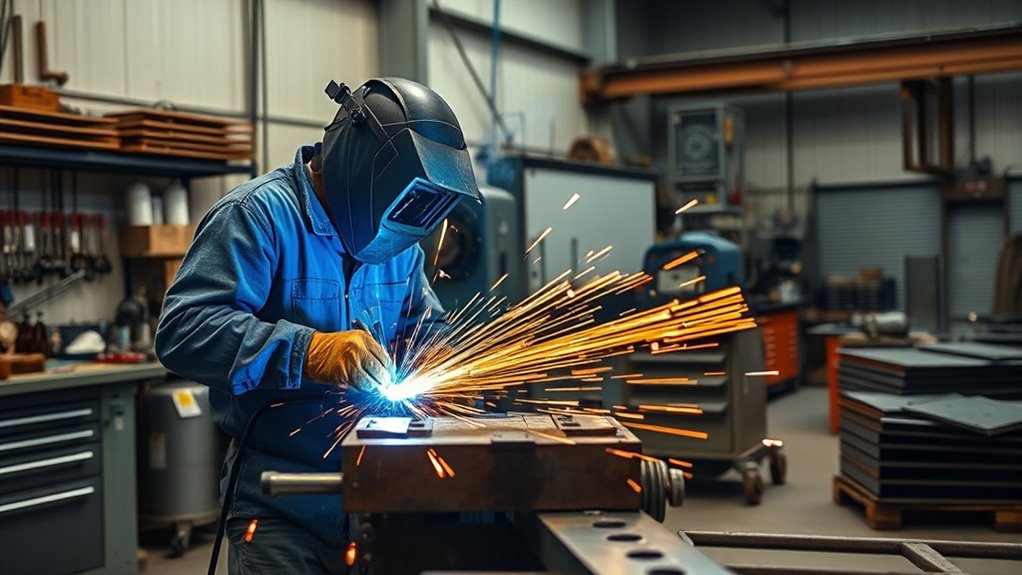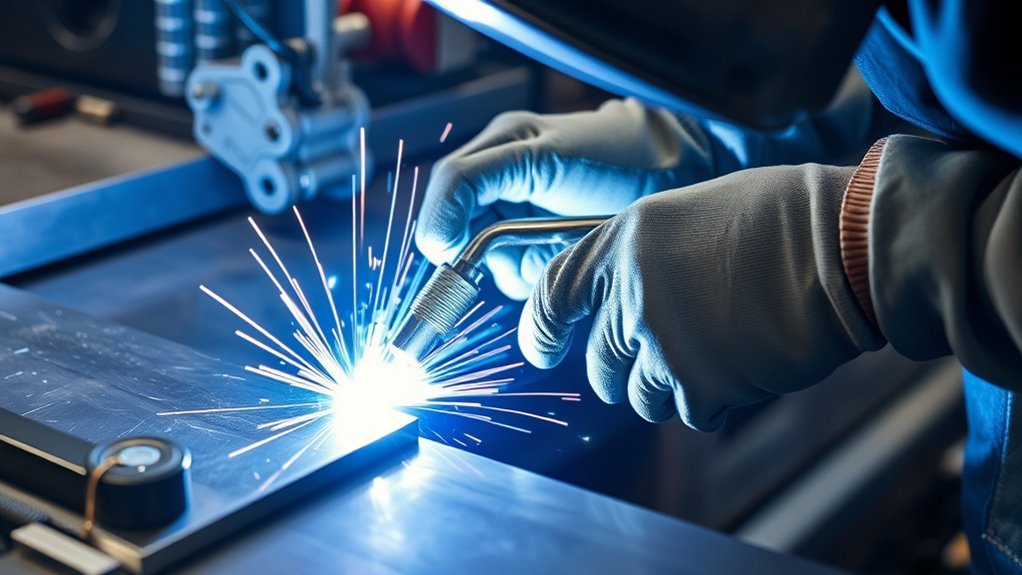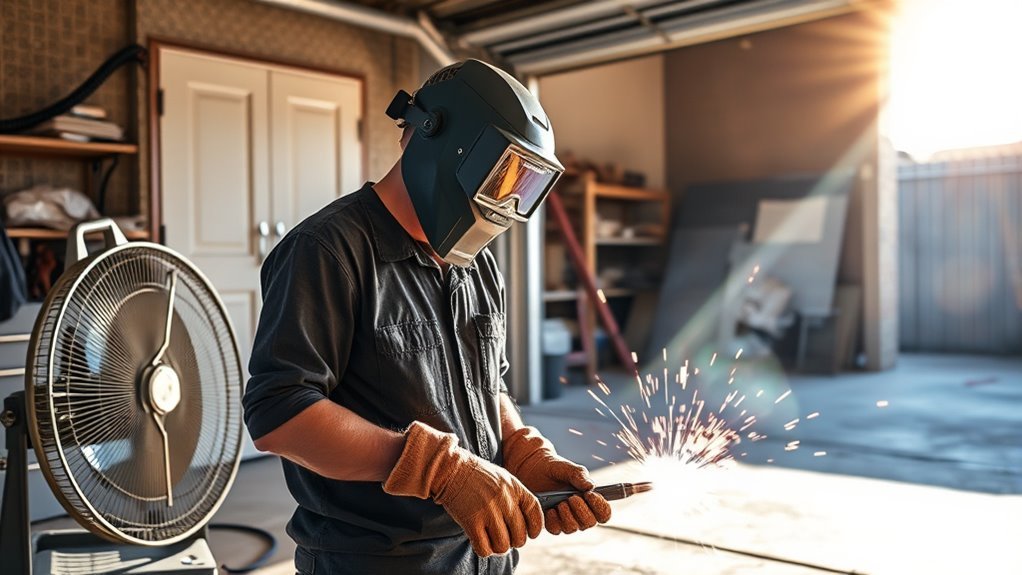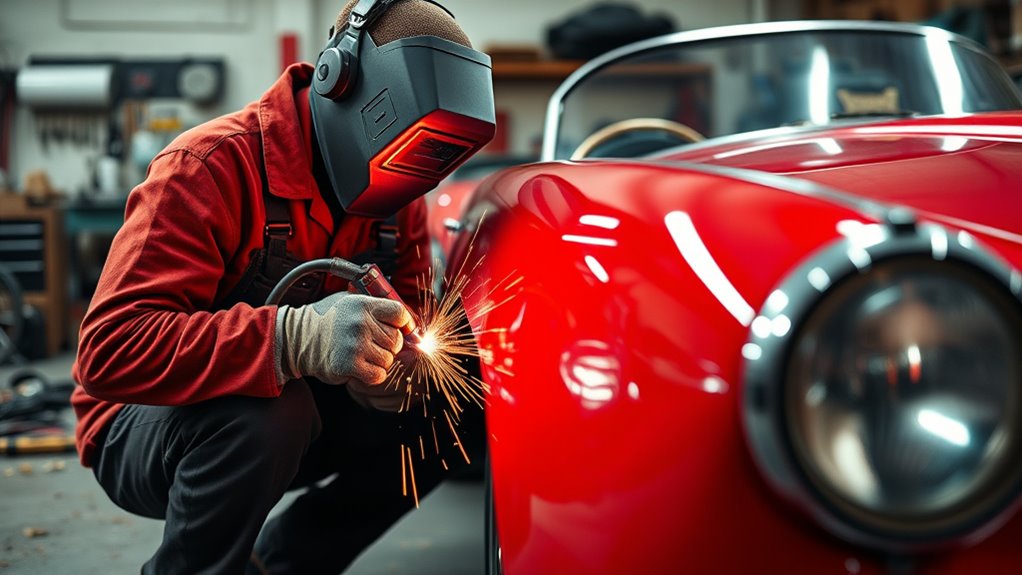
Rust holes and previous body repairs can spread farther than the damage you see from the outside. A lasting patch starts with confirming that the area is safe to repair, cutting back to sound metal, matching the original panel material, and controlling heat while you close the seam. This guide covers nonstructural steel body-panel patches such as small sections of a fender, door skin, wheel opening, or outer quarter panel.
Last updated: July 20, 2026
Quick Answer
To weld a patch panel onto a car body, confirm the area is nonstructural, follow the vehicle maker’s repair procedure, and remove all weak metal. Fit a matching patch, protect approved mating surfaces, then use separated MIG tacks while moving around the seam. Inspect, grind carefully, prime, seal, refinish, and restore cavity protection.
Key Takeaways
- Use this general method only for repairable nonstructural steel outer panels. Follow the OEM body repair manual for every vehicle.
- Match the original metal and thickness instead of assuming every body panel is 18-gauge mild steel.
- Inspect both sides of the panel and remove or protect wiring, fuel components, trim, foam, sealer, wax, and undercoating.
- Test the welder on matching scrap before touching the vehicle.
- Build the seam with separated tacks and cooling pauses rather than running a long bead.
- Restore the complete corrosion-protection system, including primer, seam sealer, coatings, and cavity wax where specified.
At a Glance
| Time Required | About 3 to 8 hours for a small accessible patch before full paint curing; extensive corrosion and complex finishing take longer. |
| Difficulty | Intermediate to advanced. Thin body metal is easy to burn through or warp. |
| Tools Needed | Automotive-capable MIG welder, cutting and trimming tools, panel clamps, grinder, hammer and dolly, PPE, ventilation, and fire-control equipment. |
| Cost | Varies by vehicle and tools. Budget for the patch, welding wire and gas, abrasives, primer, seam sealer, cavity protection, and refinishing materials. |
Planning note: The time estimate assumes that the surrounding metal is sound and the repair is accessible. Hidden rust, multiple panel layers, complex curves, and full paint blending can turn a small patch into a much larger job.
Warning: Do not use a generic patch-panel method on frame rails, pillars, roof rails, rocker reinforcements, suspension mounts, seat-belt mounts, airbag mounting areas, battery enclosures, or other crash-structure parts. Obtain the vehicle-specific OEM repair procedure. Hybrid and electric vehicles also require trained high-voltage shutdown procedures before welding.
What’s in This Article
- Confirm the Patch Area Is Safe to Repair
- Why Patch Panels Matter in Auto Repair
- Tools, Materials, and Safety Gear
- Prepare the Vehicle and Work Area
- Cut Out the Damage and Fit the Patch
- Set Up and Test the Welder
- Attach the Patch Panel Securely
- Tack Weld and Complete the Seam
- Inspect the Weld Before Grinding
- Grind and Smooth the Welds
- Fix Common Patch-Panel Welding Problems
- Prevent Rust After Welding
- Know When to Get Professional Help
- Frequently Asked Questions
- Conclusion
- Sources
Confirm the Patch Area Is Safe to Repair
Before you cut the car, identify what the damaged panel does. A small hole in a removable fender is different from corrosion in a rocker reinforcement, pillar, rail, floor crossmember, suspension mount, or seat-belt anchor.
Modern vehicles use different grades of steel, aluminum, adhesives, rivets, spot welds, and layered reinforcements. A part that looks like ordinary sheet metal may help manage crash energy. The vehicle-specific body repair manual tells you whether the area can be sectioned, where a cut is allowed, and which attachment method you must use.
I-CAR’s structural sectioning guidance explains why sectioning locations and welding methods must come from the vehicle maker. If the manual does not provide a repair or sectioning procedure, do not invent one.
- Usually suitable for this general guide: Small nonstructural patches in conventional-steel outer skins where the OEM permits repair.
- Requires OEM procedures and advanced skill: Outer quarter panels, welded fenders, door skins, floors, and rockers with multiple layers.
- Professional structural repair: Rails, pillars, reinforcements, roof rails, suspension mounts, seat-belt mounts, SRS areas, and high-voltage battery structures.
A patch is only as safe as the metal, attachment method, and corrosion protection around it. Cutting in the wrong place can weaken a part that was designed to manage crash loads.
Why Patch Panels Matter in Auto Repair
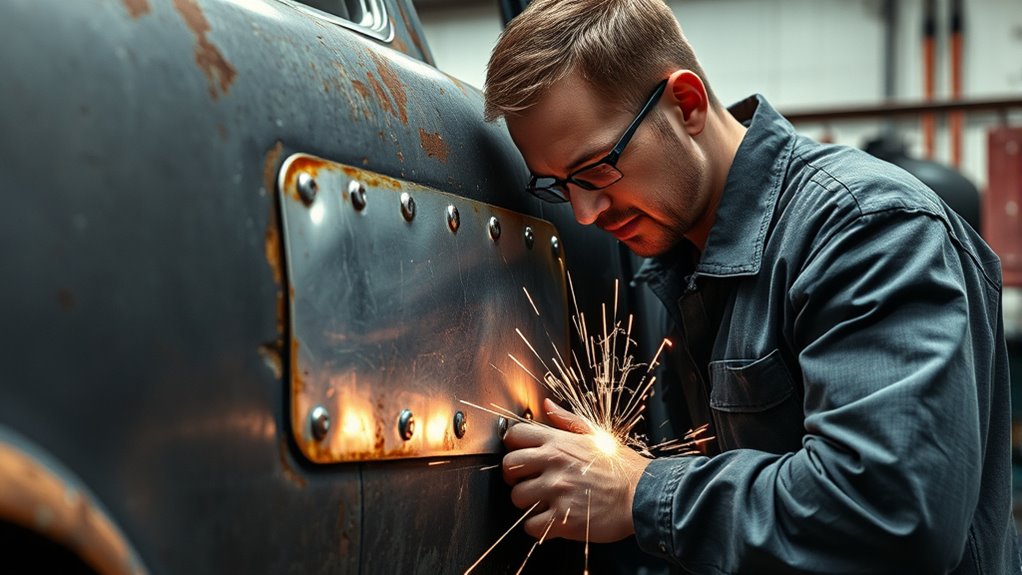
Patch panels let you replace localized rusted or damaged sheet metal without replacing an entire body panel. They are especially useful during vintage-vehicle restoration and repairs to fenders, wheel openings, lower doors, and other nonstructural outer sections.
A pre-made panel can save shaping time when it matches the vehicle’s contours, body lines, and wheel-opening profile. A handmade patch may work well for a simple flat or gently curved area, but it must match the original metal type and thickness closely.
The patch does not make weak surrounding metal strong. You must cut far enough to reach sound metal that can support the weld. Leaving thin, pitted edges usually causes burn-through, poor fusion, and rust that returns beside the repair.
Long-term durability also depends on the hidden side. Welding burns away factory coatings near the joint. You must restore the damaged primer, seam sealer, underbody coating, and cavity protection after the metalwork is complete.
Tools, Materials, and Safety Gear
Gather everything before you open the panel. Once you expose the inside, you may find wiring, insulation, foam, adhesive, or another layer that changes the repair plan.
Products Worth Considering

Value Pack: The package includes 24 packs of butt welding clamps, enough quantity to meet your daily needs and replacements. Each butt welding clamps is individually wrapped in a small bag, convenient to carry and use.

16-Pack Welding Clamps Set: Includes 16 butt welding clamps designed for precise edge-to-edge welding, ideal for body repair, floor patching, door skins, and sheet metal alignment.

Adaptability: Our butt welding clamps are suitable for both straight panels or curved panels. Maintains 0.40" gap between panels for edge-to-edge welding.They will work well in these 2 kinds of p
Welding and Metalworking Tools
- MIG welder: Use a machine that can maintain a stable low output on the original sheet-metal thickness.
- Correct wire and shielding gas: Follow the welder maker’s chart and the vehicle repair procedure. Gas-shielded MIG is generally easier to control and clean on thin exterior steel than self-shielded flux-core wire.
- TIG welder: TIG can produce a clean, controllable weld, but it requires excellent fitment, clean metal, and more operator skill.
- Thin cut-off wheel: Use it to remove rust and make controlled cuts.
- Offset aviation snips: Useful for trimming a loose patch away from the vehicle.
- Body saw, nibbler, or die grinder: Optional tools for controlled cutting in accessible areas.
- Panel clamps, butt-weld clamps, locking pliers, and magnets: Hold the patch flush while you verify the body line.
- Scriber and template material: Use thin cardboard or stiff paper to transfer the opening accurately.
- Hammer and dolly set: Correct small high and low spots before filler.
- Angle grinder and abrasives: Use controlled grinding and sanding to level the weld without thinning the panel.
- Copper backing plate: Supports the puddle and can help close a small hole when you can safely reach the backside.
- Inspection light and straightedge: Reveal pinholes, panel movement, and low spots.
Patch and Corrosion-Protection Materials
- Vehicle-specific replacement patch or matching sheet metal
- Weld-through coating only where the OEM and product maker specify it
- Automotive metal cleaner and approved surface-preparation products
- Epoxy primer or another primer approved by the OEM and paint system
- Automotive seam sealer compatible with the prepared substrate
- Topcoat, underbody coating, chip protection, or stone guard as required
- Cavity wax or internal corrosion-protection material
- Body filler and glazing putty for minor final surface correction only
Do not assume the patch should be 18-gauge mild steel. Measure the original panel where it remains sound and check the OEM information. Modern vehicles can combine conventional steel, high-strength steel, ultra-high-strength steel, aluminum, and other materials in nearby areas.
Safety Gear Requirements
- Welding helmet: Use a suitable lens shade and confirm the auto-darkening function before welding.
- Safety glasses: Wear them under the helmet and while cutting, drilling, and grinding.
- Flame-resistant welding gloves: Protect against sharp edges, hot metal, and spatter.
- Flame-resistant jacket or apron: Cover exposed skin and avoid synthetic clothing that can melt.
- Hearing protection: Cutting and grinding can exceed comfortable sound levels.
- Sturdy leather footwear: Keep sparks and sharp offcuts away from your feet.
- Effective ventilation: Capture or move fumes away from your breathing zone without blowing away the MIG shielding gas.
- Appropriate respirator: Select filters for the actual metal, coating, dust, and paint hazards. A dust mask does not control every welding or coating fume.
- Fire extinguisher: Keep a suitable extinguisher within immediate reach.
The OSHA welding-hazards overview lists burns, eye injury, electric shock, fumes, ultraviolet radiation, and fire among the main hazards. NIOSH also notes that welding fumes contain metal particles and other by-products that require effective exposure control.
Prepare the Vehicle and Work Area
Protect Electronics, SRS, and High-Voltage Systems
Look up the OEM welding and battery-disconnect procedure before you disconnect anything. Modern vehicles may require a pre-repair scan, retained codes, anti-theft information, window initialization, steering-angle calibration, idle relearn, or other steps after reconnection.
I-CAR’s battery-disconnect guidance explains why the correct sequence varies by vehicle. Follow that procedure instead of relying on a universal “remove the negative cable” rule.
- Switch the ignition off and allow modules to shut down as directed by the OEM.
- Complete any required pre-repair scan before battery isolation.
- Disconnect and isolate the 12-volt system only in the approved sequence.
- Keep welding leads away from modules, sensors, network wiring, and airbag components.
- Place the work clamp on clean metal as close to the weld as practical, preferably on the same panel.
- Do not allow welding current to travel through bearings, hinges, wiring, or electronic modules.
Warning: On a hybrid or electric vehicle, do not touch orange high-voltage cables, the traction battery, service disconnects, or battery enclosures unless you are trained, equipped, and following the exact OEM disable procedure. High voltage can remain present after the ignition is switched off.
Inspect and Clear the Backside
Remove enough trim to see the rear of the intended cut and weld zone. Check for:
- Fuel lines, filler pipes, tanks, vapor hoses, and brake lines
- Wiring harnesses, antenna cables, sensors, and control modules
- Carpet, headliner, insulation, sound deadener, and plastic trim
- Factory foam, adhesive, seam sealer, cavity wax, and undercoating
- Glass, weatherstrips, drain tubes, and nearby painted panels
- A second or third metal layer behind the visible skin
Hidden foam, seam sealer, wax, and undercoating can smolder or ignite after the visible welding stops. Remove combustible material from the heat zone where the repair procedure permits it, use fire-resistant shielding, and check the backside after every welding sequence. Continue checking for heat or smoke after the final weld.
Remove Coatings and Contamination
Strip paint, filler, rust, seam sealer, undercoat, grease, and contamination far enough from the joint to keep them out of the weld. Clean both sides where you can reach them.
Do not weld through unknown paint, old filler, oil, or heavy rust. Heated coatings can create toxic fumes, porosity, and fire. Use local exhaust or strong cross-ventilation while keeping the shielding-gas area protected from drafts.
Cut Out the Damage and Fit the Patch
Products Worth Considering

Premium 20 Gauge Mild Steel Sheet Metal – Crafted from high-quality cold rolled steel, these sheets offer exceptional durability and a smooth, uniform surface. Ideal for precision-driven projects requiring reliable material performance without compromising on structural integrit

Automotive Bodywork and Rust Repair

Generous Packaging: each package of ours includes 4 pieces of metal sheets, providing a sufficient quantity to meet your varying needs; Whether for a large project or for multiple smaller tasks, our generous pack ensures you have just what you need, when you need it; Products shipped by sea may have slight rust on the surface due to moisture, which is a normal oxidation phenomenon
Find the Full Extent of the Damage
Rust often travels behind paint, body filler, folded seams, trim, and undercoating. Probe suspect metal gently and remove paint around the visible damage until you can identify sound steel.
- Look for bubbles, pinholes, cracks, deep pitting, and swollen seams.
- Inspect the backside with a light and mirror when access is limited.
- Mark a cut line that reaches solid metal but does not enter a restricted structural area.
- Check the OEM procedure before cutting through any welded-on panel.
Cut the damaged section in small stages. It is easier to enlarge a controlled opening than to replace metal you removed unnecessarily.
Choose the Correct Joint
The vehicle maker’s procedure takes priority. Where a general nonstructural outer-panel patch allows a choice, the two common options are:
- Butt joint: The patch sits edge-to-edge with the original panel. It leaves no hidden overlap, but it requires accurate trimming and careful heat control.
- Lap or flanged joint: One panel overlaps the other. It may be easier to position, but the overlap must be protected and sealed because it can trap moisture.
Do not create a lap joint in a structural or reinforced area unless the OEM procedure specifies that joint. Adhesive, rivet, plug-weld, squeeze-type resistance spot weld, and MIG-braze requirements also vary by vehicle.
Make a Template and Trim the Patch
- Cut away loose rust until the opening has stable edges.
- Place template material over or behind the opening and trace its shape.
- Transfer the template to the replacement metal with a scriber.
- Cut the patch slightly oversize.
- Trim a small amount at a time until the patch follows the body contour.
- Confirm the body line, wheel opening, door gap, and nearby panel edges.
- Deburr the patch and opening so both sit flat.
For a butt joint, aim for a small, even gap that suits the wire, metal, and welding method. Avoid a forced zero-gap fit that causes the edges to climb over each other, but do not leave a wide gap that requires excessive weld metal. Test the intended fit on scrap first.
Pro Tip: Stop trimming when the patch sits flush without being forced. A patch held under tension can spring, sink, or distort as soon as the first tacks heat the metal.
Prepare Hidden Mating Surfaces
Clean the weld zone to bright metal. If the joint has overlapping mating surfaces, apply only the weld-through coating specified by the OEM and coating maker. Allow it to dry as directed.
Weld-through primer is not a universal final coating. Some GMA welding procedures require cleaning the direct weld location while leaving approved coating on the surrounding flange. After welding, you still need to restore primer, seam sealer, paint, underbody coating, and cavity protection.
Set Up and Test the Welder
No single voltage or wire-speed setting works for every patch. Machine design, input power, wire, shielding gas, metal thickness, joint gap, and coating condition all affect the weld.
- Make a practice joint from the same material and thickness as the vehicle panel.
- Prepare the scrap with the same gap, coating condition, and joint style.
- Start with the welder maker’s chart for that wire and thickness.
- Make a brief tack and inspect the front and back.
- Adjust one control at a time until the tack wets into both edges without blowing a hole.
- Test several tacks at realistic intervals to see how heat accumulates.
A useful tack should fuse both edges, sit reasonably flat, and show evidence of penetration without leaving a large molten crater. A tall cold blob may lack fusion. A widening hole means the heat, arc time, fit, or edge condition needs correction.
Confirm gas flow and protect the weld from strong air movement. Your ventilation should carry fumes away from your face without stripping shielding gas from the arc.
Attach the Patch Panel Securely
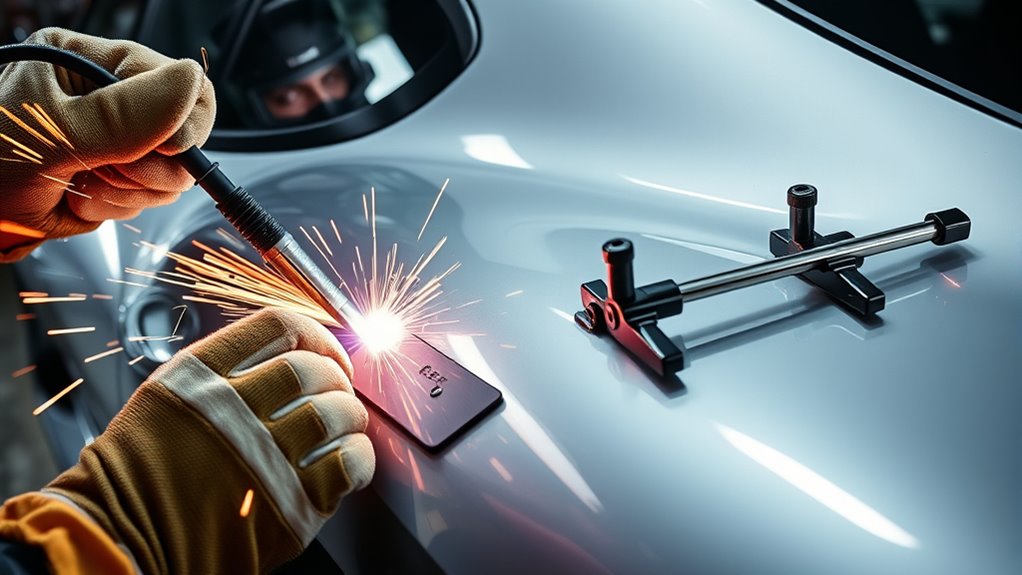
- Verify the repair procedure. Confirm that the location, joint, and welding process are approved for the vehicle.
- Cut to sound metal. Remove every weak, thin, or deeply pitted edge.
- Match the patch. Use the correct metal, thickness, shape, and coating preparation.
- Clear the backside. Remove or shield heat-sensitive and combustible components.
- Prepare the vehicle electronics. Complete scans and battery or high-voltage shutdown steps required by the OEM.
- Clean the work-clamp point. Attach the clamp close to the repair on the same panel where practical.
- Clamp the patch flush. Check the body line and panel curve from several viewing angles.
- Place anchor tacks. Start at separated points such as corners, midpoints, and areas that control the body line.
- Recheck alignment. Stop and correct movement before adding more weld.
- Add separated tacks. Move around the perimeter instead of concentrating heat in one location.
- Close the seam gradually. Continue adding tacks between cooled welds until the required seam is complete.
- Inspect before grinding. Find pinholes, cracks, missed edges, or poor fusion while the weld is still visible.
- Metal-finish carefully. Level the weld without thinning the surrounding panel.
- Restore corrosion protection. Prime, seal, refinish, and protect the backside as specified.
Initial tacks may end up roughly an inch or more apart on some small patches, but treat spacing as an adjustable starting pattern rather than a rule. Curved areas, corners, and body lines may need a different sequence to hold their shape.
Tack Weld and Complete the Seam
On thin body panels, “stitch welding” should not mean running a series of long beads. A safer method is to place short, separated tacks, allow cooling, and then fill the spaces in stages.
Place the First Tacks
- Make one short tack at a location that controls alignment.
- Move to a distant part of the patch for the next tack.
- Check that the patch remains flush.
- Add opposite or widely separated tacks until the panel is stable.
- Remove or reposition clamps only after enough tacks hold the shape.
Do not continue if the edges rise, sink, or pull sideways. Correct the fit while only a few tacks are present.
Fill the Seam Without Building Excess Heat
Once the patch is stable, add new tacks between previous ones. Keep skipping to a cool area. Allow the panel to lose heat naturally before returning.
- Keep each arc time brief.
- Avoid stacking several hot tacks in one location.
- Watch the panel surface for movement and oil-canning.
- Use a straightedge or reflected light to monitor the contour.
- Do not rely on a wet rag to compensate for excessive heat input.
- Do not run a continuous bead across a thin exterior skin unless the vehicle-specific procedure expressly requires it.
A copper backing plate can support a small gap or pinhole and reduce the chance of the molten puddle falling through. It cannot correct thin rusted edges, an oversized opening, or unsuitable welder settings.
Control the Current Path
Keep the work clamp close to the repair and on clean metal. Routing the welding current through hinges, bearings, modules, wiring, or unrelated panels can cause electrical or component damage. Keep the power source and leads away from vehicle computers and sensors where practical.
Note: The welder’s duty cycle describes how long the machine can operate within a set period. It helps prevent machine overheating, but it does not replace the short arc times and cooling pauses needed to protect a thin body panel.
Inspect the Weld Before Grinding
Do not grind immediately just because the front of the seam looks closed. Grinding can hide weak fusion and make pinholes harder to locate.
- Let the panel cool to a safe handling temperature.
- Inspect the seam under bright light from several angles.
- Shine a light from behind the repair to reveal pinholes where access allows.
- Look for cracks, undercut, cold raised tacks, and edges that were missed.
- Check the backside for adequate fusion without excessive burn-through.
- Add corrective tacks only after the area has cooled.
- Recheck the body line and panel contour before removing excess weld height.
Do not use body filler to bridge holes, conceal unfused welds, or cover active rust. Correct the metal first.
Grind and Smooth the Welds
Grinding should lower the weld to the surrounding surface without cutting deeply into the original panel. Thin body metal disappears quickly under an aggressive disc.
| Stage | Typical Tool | Goal |
|---|---|---|
| Lower high welds | Small grinder, file, or controlled abrasive disc | Remove only weld metal that stands above the panel |
| Correct the contour | Hammer and dolly | Raise minor low spots and level small highs |
| Refine scratches | Progressively finer abrasive, such as 50- to 80-grit followed by about 120-grit where appropriate | Prepare the metal for the approved refinishing system |
- Work in short passes and keep the grinder moving.
- Stop often to feel for heat and inspect the metal thickness.
- Use the least aggressive tool that will level the weld efficiently.
- Do not chase every discoloration with the grinder.
- Check the contour with a straightedge, sanding block, or reflected light.
- Wear eye, face, hearing, hand, and respiratory protection while using a cut-off wheel or grinder.
Use body filler only for minor final surface correction after the weld is sound and the substrate has been prepared according to the filler and paint-system instructions. Filler should not be the main source of strength or corrosion protection.
Fix Common Patch-Panel Welding Problems
| Problem | Likely Cause | Correction |
|---|---|---|
| Burn-through | Thin rusted edge, excessive arc time, too much heat, or an oversized gap | Cut back to sound metal, shorten the tack, correct the fit, retest the settings, and use copper backing where safe |
| Tall cold weld | Poor fusion, unsuitable voltage or wire speed, contamination, or weak work-clamp contact | Clean the joint and clamp point, test on scrap, and adjust the setup until both edges fuse |
| Panel warping | Too many welds in one area, long arc time, forced patch fit, or excessive grinding heat | Stop, allow cooling, correct the panel with controlled metal finishing, and resume with a wider skip pattern |
| Pinholes | Incomplete seam closure, contamination, porosity, or missed edges | Inspect with backlighting, clean locally, and close each defect with a controlled tack |
| Porosity | Paint, oil, rust, moisture, poor shielding gas, or strong airflow | Remove contamination, confirm gas delivery, shield the arc from drafts, and replace porous weld metal |
| Patch sits high or low | Poor trimming, clamp pressure, body-line mismatch, or heat movement | Correct fit before adding more welds; use controlled hammer-and-dolly work after cooling |
| Rust returns | Rust remained under the repair, overlap trapped moisture, or backside coatings were not restored | Remove all corrosion and restore the full primer, seam-sealer, coating, and cavity-wax system |
Do not keep increasing heat to force a weld onto rusty or paper-thin metal. Enlarging the opening until you reach sound steel is usually faster and more durable than repeatedly repairing new holes.
Prevent Rust After Welding Patch Panels
Welding destroys or damages factory corrosion protection near the joint. A finished-looking front surface can still rust from the backside if you do not rebuild that protection.
Clean and Prime the Repair
- Remove grinding dust, residue, and loose coating.
- Prepare the bare metal with products approved by the refinishing system.
- Apply epoxy primer or the specified corrosion-resistant primer where the OEM and paint maker require it.
- Allow the primer to cure before applying products that require a cured substrate.
Do not automatically apply seam sealer over dirty bare steel. 3M’s collision-repair seam-sealer guidance recommends cleaning the repair and following the paint maker’s approved primer and sealer sequence.
Seal the Joints and Water-Entry Points
Apply compatible seam sealer to the locations and substrate specified by the OEM and product maker. Reproduce the factory function, especially around lap joints, wheel openings, floor edges, and areas exposed to road spray.
A butt-welded cosmetic skin may not need a visible bead of seam sealer on the exterior face, but the backside and nearby factory seams still need the specified protection. Do not block drain paths while sealing the repair.
Refinish and Protect the Backside
- Apply the required topcoat, underbody coating, chip guard, or stone protection.
- Restore the finish on both sides where access permits.
- Apply cavity wax after refinishing when the OEM or corrosion-protection procedure calls for it.
- Use an applicator wand to reach enclosed areas without drilling unapproved holes.
- Reinstall trim only after coatings have cured as directed.
I-CAR’s corrosion-protection guidance explains that seam sealers, coatings, foams, adhesives, and cavity waxes must be restored at the correct stage of the repair. Weld-through primer alone is not a complete corrosion system.
Note: Low-hydrogen electrode storage applies to certain stick-welding work. Thin automotive body patches are normally completed with a process and consumables specified for collision repair, so low-hydrogen rod storage is not part of this MIG patch-panel workflow.
When to Get Professional Help
Stop and use a qualified collision-repair professional when:
- The rust reaches a frame rail, pillar, roof rail, rocker reinforcement, floor reinforcement, or suspension mount.
- The repair includes a seat-belt anchor, airbag component, sensor mount, or other occupant-protection part.
- The OEM does not provide a sectioning or repair procedure for the damaged part.
- The panel uses aluminum, ultra-high-strength steel, tailored blanks, composites, or mixed-material construction you cannot identify.
- The vehicle is a hybrid or EV and you are not trained to disable and verify the high-voltage system.
- The damage changes door gaps, glass openings, wheel alignment, suspension location, or body dimensions.
- Rust continues into hidden multi-layer seams that you cannot inspect or protect after welding.
- You cannot remove or shield a nearby fuel, brake, electrical, or safety component.
A poor repair in these areas can affect crash performance, corrosion resistance, alignment, and the operation of safety systems. Welding skill alone does not replace vehicle-specific repair information, measuring equipment, scans, calibrations, and corrosion-restoration procedures.
Frequently Asked Questions
How long does a small patch-panel repair take?
A small, accessible nonstructural patch may take about 3 to 8 hours through basic metal finishing. Hidden rust, difficult access, complex curves, coating removal, corrosion protection, filler, primer, paint blending, and curing can add substantial time.
Can I use a different metal for the patch panel?
Match the original metal type, grade, coating, and thickness whenever possible. Joining unlike metals can change weldability, corrosion behavior, strength, and refinishing requirements. Do not substitute material in a structural or OEM-controlled repair.
What safety gear do I need?
Use a welding helmet, safety glasses, flame-resistant gloves and clothing, sturdy footwear, and hearing protection. Provide effective ventilation and use respiratory protection selected for the metal, coating, dust, and paint hazards. Keep a suitable fire extinguisher close and inspect the hidden side for smoldering material.
How do I prevent burn-through and warping?
Cut back to sound metal, fit the patch without forcing it, and test the welder on matching scrap. Use brief separated tacks, move around the seam, and allow cooling pauses. Stop immediately if the edges thin, the opening grows, or the panel begins to move.
What primer and paint should I use over the repair?
Use the corrosion-protection and refinishing system approved for the vehicle and compatible with your seam sealer and body filler. Many repairs use a two-component epoxy primer on prepared bare metal, followed by approved seam sealer, refinishing materials, and cavity wax where required.
Should I butt weld or lap weld a patch panel?
Follow the OEM procedure first. A butt joint avoids a hidden overlap but requires accurate fitment and careful heat control. A lap joint can be easier to position, but the overlap must be protected and sealed against moisture. Never choose a joint freely in a structural or reinforced area.
Can I weld a car patch panel with flux-core wire?
It is possible on some conventional-steel repairs, but self-shielded flux-core wire often creates more spatter, smoke, cleanup, and heat-control difficulty on thin exterior panels. Gas-shielded MIG is generally easier to control. Follow the vehicle procedure and practice on matching scrap first.
Should I disconnect the car battery before welding?
Follow the vehicle maker’s welding and battery-disconnect procedure. Many vehicles require battery isolation, but the correct sequence may include a pre-repair scan, saved codes, shutdown delays, high-voltage disabling, and post-repair relearns or calibrations. Place the work clamp close to the weld on the same panel.
Can I weld a patch directly over rust?
No. Remove every weak, flaky, deeply pitted, or perforated section until the patch can attach to sound metal. Welding over rust causes contamination, porosity, poor fusion, burn-through, and early corrosion failure.
Conclusion
A clean patch-panel repair begins before the welder turns on. Confirm that the area is repairable, find the OEM procedure, identify the metal, inspect the backside, protect the vehicle’s electronics, and remove all weak material. Careful fitting and a tested welding setup reduce the amount of heat and grinding the panel needs.
Anchor the patch with separated tacks, recheck the contour often, and close the seam gradually. Inspect for fusion and pinholes before grinding. Finish by restoring the primer, seam sealer, paint, underbody protection, and cavity wax required for that vehicle. When the damage reaches crash structure, high-voltage components, or multi-layer reinforcements, professional collision repair is the safer choice.
Sources
- OSHA 1910.252, General Welding Requirements — fire prevention, combustible-material control, ventilation, and hot-work safety.
- NIOSH, Welding Fumes and Manganese — welding-fume composition and exposure concerns.
- I-CAR, Vehicle Welding and Battery Disconnect — battery isolation, work-clamp placement, high-voltage precautions, and cable routing.
- I-CAR, Structural Sectioning Procedures — OEM repair procedures, structural-part identification, and sectioning limits.
- 3M Collision Repair Seam Sealer and Coating Resources — surface preparation, primer compatibility, and seam-sealer application.
- I-CAR, Corrosion Protection During Repair — sequencing of seam sealer, coatings, foam, refinishing materials, and cavity wax.