Noise in a welding shop does not come from the welding arc alone. Grinders, plasma cutters, gouging, compressed air, extraction systems, fans, material handling, hammering, and nearby equipment can combine into a hazardous daily exposure. You protect your hearing best when you measure that exposure, reduce noise at the source, select hearing protection for the measured level, and check that each device fits correctly.
Quick Answer
OSHA requires a hearing conservation program for general-industry employees exposed to an 8-hour average of 85 dBA or more, while its permissible exposure limit is 90 dBA. NIOSH recommends a more protective 85 dBA limit. Measure the actual noise, control it at the source, and use properly fitted hearing protection.
Key Takeaways
- Grinding, plasma cutting, gouging, compressed air, ventilation, and metal handling may create more noise than the welding arc itself.
- OSHA uses a 90 dBA 8-hour permissible exposure limit and an 85 dBA hearing-conservation action level for general industry.
- NIOSH recommends 85 dBA over eight hours and halves the recommended exposure time for every 3 dB increase.
- A sound level meter helps locate noisy tasks, while a personal dosimeter measures a worker’s accumulated exposure through the shift.
- The labeled Noise Reduction Rating does not guarantee the protection a worker receives. Correct fitting and individual fit testing provide better evidence.
- Engineering controls, quieter purchasing, maintenance, isolation, and scheduling should come before relying only on earplugs or earmuffs.
At a Glance
| Main Risk | Permanent hearing loss, tinnitus, missed warnings, communication problems, fatigue, and a greater chance of shop accidents |
| Important Thresholds | OSHA action level: 85 dBA over 8 hours; OSHA PEL: 90 dBA over 8 hours; NIOSH REL: 85 dBA over 8 hours |
| Measurement Tools | Calibrated sound level meter for task and area checks; personal noise dosimeter for full-shift exposure |
| Best First Step | Measure representative work before choosing controls or hearing protectors |
Understanding Noise Levels in Welding
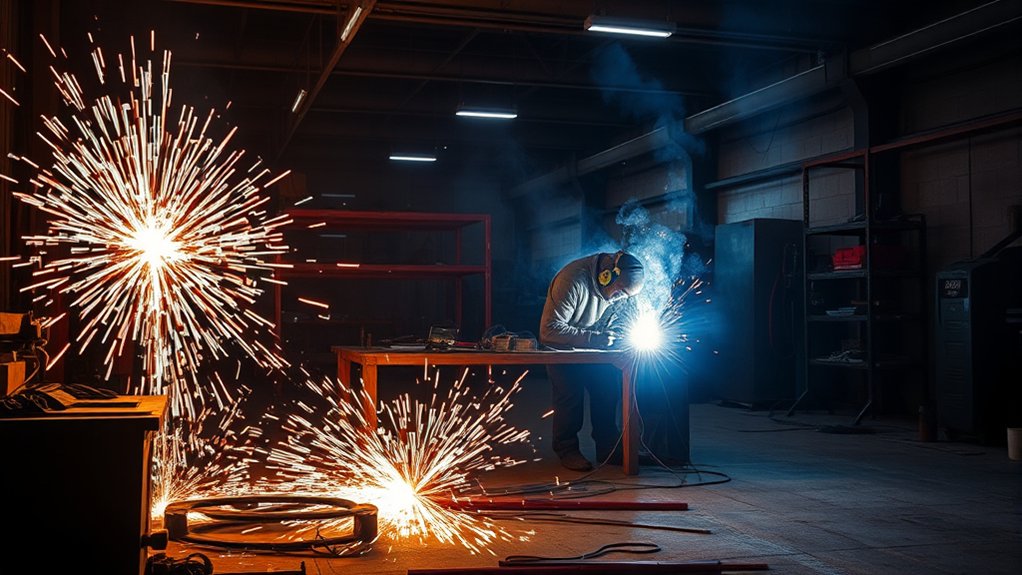
The welding process may not be the loudest part of your shift. A fabrication area can include angle grinders, air-arc or plasma gouging, cutting tables, compressors, extraction fans, impact tools, forklifts, dropped metal, and several workers operating equipment at once. Hard walls, floors, ceilings, and metal workpieces can reflect sound and increase exposure across the shop.
Noise is normally reported in A-weighted decibels, written as dBA. A weighting approximates the frequencies the human ear responds to most strongly. The decibel scale is logarithmic, so a small numerical increase represents a large increase in sound energy. You cannot judge the daily dose reliably by deciding that one area sounds only slightly louder than another.
A useful screening sign is whether you must raise your voice to speak with someone about an arm’s length away. OSHA notes that this may indicate noise above 85 dBA. It is only a warning sign, not a substitute for measurement. Review OSHA’s occupational noise guidance when planning a formal assessment.
Warning: Ringing, buzzing, muffled hearing, ear pain, or difficulty understanding speech after work may indicate excessive exposure. Report the symptoms promptly. Seek urgent medical care after a sudden hearing change, a blast exposure, severe dizziness, drainage, or significant ear pain.
What Welders Need to Know About Noise Regulations
OSHA rules establish enforceable employer duties in the United States. NIOSH recommendations provide more protective health guidance but are not themselves OSHA regulations. A shop should understand both because meeting the OSHA limit does not mean every worker has zero risk.
The discussion below focuses mainly on OSHA’s general-industry occupational noise standard, 29 CFR 1910.95. Construction work may fall under different provisions, including 29 CFR 1926.52 and 1926.101. State-plan rules, contracts, and company standards may also be more protective.
Note: A qualified industrial hygienist, safety professional, or hearing-conservation specialist can determine which standard applies and design representative monitoring for your work.
Noise Exposure Limits
OSHA’s permissible exposure limit is 90 dBA as an 8-hour time-weighted average. OSHA also uses an 85 dBA 8-hour action level. At or above that action level, covered general-industry employees must enter a continuing hearing conservation program.
NIOSH recommends an exposure limit of 85 dBA over eight hours. It uses a 3 dB exchange rate, which means the recommended exposure time halves whenever the sound level rises by 3 dB. OSHA’s PEL calculation uses a 5 dB exchange rate.
| Guideline | 8 hours | 4 hours | 2 hours | 1 hour | 30 minutes | 15 minutes |
|---|---|---|---|---|---|---|
| OSHA PEL, 5 dB exchange rate | 90 dBA | 95 dBA | 100 dBA | 105 dBA | 110 dBA | 115 dBA |
| NIOSH REL, 3 dB exchange rate | 85 dBA | 88 dBA | 91 dBA | 94 dBA | 97 dBA | 100 dBA |
These times apply to simplified continuous exposure examples. A real welding shift usually includes several noise levels and tasks. You must combine those exposures into a daily dose instead of evaluating each task in isolation. Short grinding, gouging, cutting, or hammering periods can make a meaningful contribution to the total.
Hearing Conservation Program Requirements
Under OSHA’s general-industry standard, an employer must administer a continuing hearing conservation program when employee exposure equals or exceeds an 8-hour TWA of 85 dBA. A complete program includes more than handing out earplugs.
- Exposure monitoring: Measure representative employees, tasks, work areas, and changing conditions.
- Employee notification: Tell affected workers when monitoring shows exposure at or above the action level.
- Audiometric testing: Establish a hearing baseline and compare it with later tests.
- Hearing protectors: Offer suitable choices at no cost and evaluate whether they provide enough attenuation.
- Training: Explain noise effects, protector selection and fitting, and the purpose of hearing tests.
- Recordkeeping: Keep required exposure-measurement and audiometric records.
- Program review: Repeat monitoring and improve controls when tools, layouts, production levels, or exposures change.
Audiograms, Follow-Up, and Records
For covered general-industry workers, OSHA normally requires a valid baseline audiogram within six months of first exposure at or above the action level. A mobile test van may extend that period to one year, but workers must use hearing protection after the first six months until the baseline is obtained.
Baseline testing must follow at least 14 hours without workplace noise, although hearing protectors may substitute for that quiet period under the standard. Employers must then provide an annual audiogram for every employee exposed at or above the action level. A qualified person compares the annual result with the baseline to identify a standard threshold shift and determine the required follow-up.
Hearing tests do not replace noise controls. They help identify changes early and show whether the overall prevention program is working.
The Risks of Noise-Induced Hearing Loss
Noise-induced hearing loss often develops slowly. Early damage may affect high-frequency sounds, including speech consonants, alarms, tool sounds, and warning signals. You may hear voices but struggle to understand the words, especially in a crowded shop, restaurant, vehicle, or family gathering.
A temporary muffled feeling after work does not prove that your ears recovered without harm. Repeated temporary threshold shifts can precede permanent loss. Tinnitus, which may sound like ringing, buzzing, hissing, or humming, can also follow hazardous exposure.
High noise creates risks beyond hearing damage. It can mask forklift horns, backup alarms, gas-leak warnings, dropped materials, equipment changes, and shouted instructions. It may also increase fatigue and reduce concentration. Tool-specific protection still matters, including guards, correct accessories, and procedures that prevent angle-grinder kickback.
Noise and Ototoxic Chemicals
Some workplace chemicals can damage hearing or make the ear more vulnerable to noise. NIOSH calls these substances ototoxic chemicals. Relevant groups include certain solvents, metals, asphyxiants, nitriles, and other industrial chemicals.
A welding or fabrication shop may encounter cleaners, thinners, coatings, lead-containing materials, engine exhaust, or carbon monoxide. Exposure depends on the material and process, so review safety data sheets and include chemical hazards in the exposure assessment. According to NIOSH’s 2026 guidance on chemicals and hearing loss, combined chemical and noise exposure may cause greater hearing damage than either hazard alone.
Hearing protection supports communication and warning-signal awareness, but the strongest prevention plan reduces the noise before it reaches the worker.
Choosing the Right PPE for Noise Protection
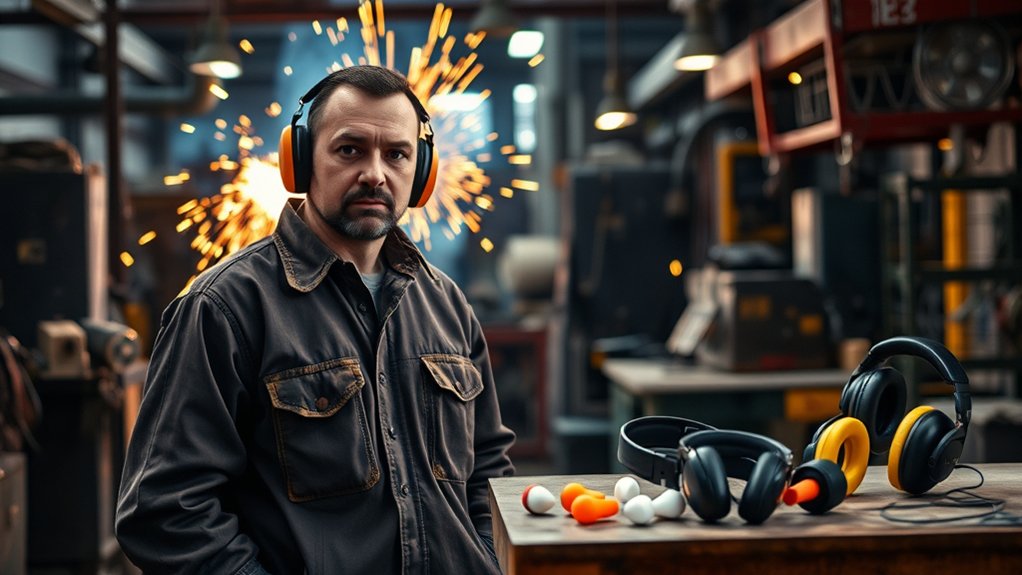
Choose hearing protection only after you understand the measured exposure, task duration, communication needs, and other PPE worn at the same time. OSHA requires employers to evaluate whether a protector provides enough attenuation for the specific noise environment.
Products Worth Considering

Earmuffs & Bands,essseehear a grabbag,new arrivals,New Arrivals Product Collection,Chemical and Plastics Product Collection,Welding Safety Product Collection

RAZOR TACTI-GRIP - The Tacti-Grip silicone composite headband provides a secure slip-free fit in dynamic shooting scenarios; With the durable rubber headband featuring a metal wireframe & sound-dampening composite housing, these muffs ensure peace of mind

Gloves, Eyewear, Ear Protection, Masks & Clothing
Understand NRR and Real-World Protection
The Noise Reduction Rating printed on a package is a laboratory rating. It does not guarantee that each worker receives that amount of protection. Ear shape, insertion depth, worn cushions, safety-glass arms, helmet hardware, facial hair, and movement can all change the result.
Do not subtract the printed NRR directly from every measured dBA value without using an accepted evaluation method. Also, do not add the ratings of earplugs and earmuffs together. OSHA provides specific attenuation-estimation methods in Appendix B to 29 CFR 1910.95.
NIOSH now recommends individual quantitative fit testing where systems are available. A fit test measures the protection achieved by the individual worker and reports a personal attenuation rating. This gives stronger evidence than relying on the package label alone.
Earplugs, Earmuffs, and Level-Dependent Protection
- Foam earplugs: Compact and usually compatible with welding helmets, face shields, and respirators. They require correct rolling, insertion, and expansion.
- Premolded or reusable plugs: Faster to insert, but the size and shape must seal the ear canal correctly.
- Earmuffs: Easy to inspect and put on, but other PPE can break the cushion seal.
- Level-dependent protectors: Designed to reduce hazardous noise while helping the wearer hear lower-level speech or signals. Choose products evaluated as occupational hearing protection.
- Dual protection: Earplugs plus earmuffs may be appropriate in very high noise or when one device alone cannot provide enough attenuation.
Consumer music headphones or ordinary active noise-canceling headphones are not automatically hearing protectors. Do not use them instead of evaluated occupational PPE unless the manufacturer identifies the product for that purpose and the employer confirms adequate attenuation.
Ear protection must also work with your welding hood, safety glasses, respirator, protective clothing, and face shield. Review the requirements for flame-resistant welding clothing and other PPE as one complete system rather than selecting each item separately.
Pro Tip: Test the complete PPE combination before the shift. Put on your safety glasses, respirator, welding hood, and earmuffs together, then check for cushion gaps, pressure points, loose helmet hardware, and blocked communication.
Top Noise Reduction Techniques for Welders
Follow the hierarchy of controls instead of treating hearing protection as the entire solution. The best control removes the noise or prevents it from reaching workers. PPE sits near the bottom of the hierarchy because its performance depends on selection, fitting, condition, and consistent use.
1. Eliminate or Substitute Noisy Work
Review whether the job needs the loud process at all. Better cutting accuracy may reduce secondary grinding. A different joint design, cutting method, consumable, or fabrication sequence may reduce chipping, hammering, and rework. When purchasing equipment, ask for sound-emission data and compare machines under similar operating conditions.
2. Use Engineering Controls
- Move compressors, dust collectors, and other fixed noise sources into suitable isolated areas.
- Install acoustic barriers or enclosures that block the direct sound path.
- Add vibration isolation beneath machines, ducts, panels, tables, and guards.
- Repair rattling covers, loose fasteners, worn bearings, unbalanced fans, and damaged wheels.
- Use quieter compressed-air nozzles and the lowest effective air pressure.
- Increase distance between loud tasks and occupied benches, inspection areas, offices, and training zones.
- Use process-specific cutting tables, mufflers, or water-based systems when the equipment manufacturer approves them.
Do not create a new hazard while controlling noise. An enclosure must preserve required ventilation, cooling, fire protection, visibility, access, and emergency shutdown. Water-table and underwater plasma systems require process-specific manufacturer guidance, especially when cutting reactive materials or when gas could accumulate.
3. Use Administrative Controls
Administrative controls reduce how long or how often workers remain near the source. Schedule the loudest work when fewer people are present, limit access to high-noise zones, rotate tasks carefully, and place warning signs at controlled-area boundaries.
Rotation does not reduce the total noise created, and it may expose more people if managed poorly. Use it only after considering stronger engineering controls.
4. Provide Hearing Protection and Verify the Result
Give workers suitable choices, train them to fit and inspect each device, and check attenuation against the measured exposure. Where practical, use individual fit testing instead of assuming that every person receives the same protection.
5. Review the Controls
Measure again after installing a barrier, enclosure, quieter nozzle, new machine, or revised schedule. A control is successful only when follow-up data show that it reduced worker exposure without creating another safety problem.
Noise controls should support, not replace, the other requirements described in your plasma-cutting PPE and setup procedures.
Modern Equipment and Shop Upgrades That Can Reduce Noise
Do not assume that newer or inverter-based equipment will always create less operator exposure. Compare measured sound data, fan behavior, process requirements, duty cycle, extraction needs, and the secondary work the machine creates.
- Buy-quiet purchasing: Request sound-emission information before purchasing grinders, compressors, extraction units, cutting systems, and production machinery.
- Automated or remote operation: Move the operator away from the cutting or gouging source when safe automation and guarding allow it.
- Acoustic enclosures: Enclose suitable fixed sources while maintaining airflow, cooling, access, and fire safety.
- Water-table or underwater cutting options: Suitable plasma systems may reduce noise, glare, and some airborne contamination. Follow the manufacturer’s limitations and material-specific precautions.
- Low-noise compressed-air equipment: Replace open pipes and inefficient nozzles with engineered nozzles that perform the task at lower sound levels.
- Vibration damping: Stiffen or damp resonant sheet-metal panels, ducts, machine covers, and tables.
- Preventive maintenance: Lubricate approved components, align drives, replace worn bearings, tighten panels, inspect fan blades, and replace damaged abrasive wheels.
A portable machine is not automatically a quieter machine. When comparing portable plasma cutters, review the complete cutting setup, including the air supply, extraction, arc process, material, amperage, work height, and time spent near the cut.
Products Worth Considering

Made in the USA Adjustable from 1.0" dia to 12.50" dia in 1/2" incerments. Kit contains circle cutting plate and one brass thumb screw.
Importance of Continuous Training for Noise Awareness
Workers need practical training when they enter the hearing conservation program and at least annually while covered by OSHA’s general-industry requirements. Training should match the equipment and conditions in the shop rather than relying on a generic video alone.
A useful session should cover:
- How noise damages hearing and why the damage may develop gradually
- The shop’s measured high-noise tasks and controlled areas
- How to roll and insert foam earplugs
- How to inspect reusable plugs and earmuff cushions
- How glasses, helmets, respirators, and facial hair can affect the seal
- When dual protection is required by the site assessment
- Why consumer headphones are not a substitute for evaluated hearing PPE
- What baseline and annual hearing tests show
- How to report tinnitus, muffled hearing, damaged PPE, or changed work conditions
- How noise controls interact with guards, ventilation, and face-shield requirements for grinding
Note: Training should include a hands-on fitting check. Watching someone insert an earplug does not prove that each worker can achieve an effective seal.
How to Check Noise Levels in a Welding Shop
You cannot manage shop noise by guessing. Room acoustics, distance, production volume, multiple operating tools, maintenance condition, and task duration all affect exposure. Use a planned survey that represents normal and reasonably foreseeable work.
- Map the work: List welding, grinding, cutting, gouging, hammering, compressed-air, extraction, material-handling, and maintenance tasks.
- Identify exposed workers: Include operators, helpers, inspectors, maintenance staff, nearby workers, and people who move through several areas.
- Conduct area and task checks: Use a calibrated sound level meter to identify loud operations and sound paths.
- Measure personal exposure: Use a noise dosimeter when workers change locations, perform several tasks, or experience varying noise through the shift.
- Record operating details: Note the tool, process, amperage or speed where relevant, material, distance, duration, production rate, ventilation status, and nearby equipment.
- Include intermittent and impulsive noise: Do not ignore hammer strikes, dropped metal, impact tools, or brief high-level work.
- Compare results with the correct criterion: Confirm whether the instrument is configured for the OSHA or NIOSH criterion level, threshold, and exchange rate.
- Test controls: Measure before and after maintenance, isolation, barriers, quieter tooling, or schedule changes.
- Repeat monitoring: Reassess after new equipment, process changes, production increases, layout changes, or worker complaints.
OSHA explains the roles of both instruments in its monitoring-noise-levels appendix. A sound level meter provides an instantaneous or short-term reading at a location. A dosimeter stores measurements and integrates them into a worker’s exposure over time.
A phone app may help screen for possible noise, but it should not be the sole basis for a compliance decision, hearing-protector selection, or proof that exposure is safe. Microphone quality, calibration, case design, wind, handling, and app settings can affect the reading.
Pro Tip: Photograph or record the machine settings and work position during each sample. That makes the result easier to reproduce when you test a control or repeat the survey later.
Common Mistakes That Reduce Hearing Protection
- Wearing foam plugs halfway inserted: The plug must sit correctly in the ear canal and expand to form a seal.
- Using one plug size for everyone: Ear canals differ, so workers need suitable sizes and styles.
- Keeping damaged earmuff cushions: Cracked, hardened, dirty, or compressed cushions may leak sound.
- Letting glasses or helmet parts break the seal: Even a small gap can reduce attenuation.
- Removing protection to communicate: Use evaluated level-dependent protection or another communication method in areas where speech matters.
- Ignoring short loud tasks: Grinding, gouging, cutting, hammering, and impact work all contribute to daily dose.
- Adding two NRR values together: Dual protection does not provide the simple sum of the plug and muff ratings.
- Using consumer headphones as PPE: Ordinary headphones are not automatically designed or evaluated for occupational noise.
- Choosing the highest rating without considering communication: Excessive attenuation may make alarms and speech harder to hear.
- Failing to measure after a process change: New ventilation, tools, shifts, or layouts can change exposure.
- Using unsafe cutting accessories to avoid noise or save time: Always use the correct abrasive, guard, speed rating, and tool configuration. Never improvise with an unsuitable saw blade on an angle grinder.
Frequently Asked Questions
What is the noise exposure in welding?
Exposure varies by process and shop. The welding arc may be only one source. Grinding, gouging, plasma cutting, compressed air, extraction systems, hammering, and material handling can raise the daily dose. Use representative measurements rather than assuming one level applies to every welder.
What is the golden rule in welding safety?
There is no single official golden rule. A useful principle is to identify each hazard and control it at the source before relying on PPE. For noise, that means measuring exposure, reducing the sound through engineering and work controls, and then using correctly fitted hearing protection.
Why do some people believe welders do not live long?
Welding can involve fumes, radiation, burns, electric shock, noise, awkward posture, and physical work, but those hazards do not mean welders cannot have long careers and healthy lives. Effective ventilation, process controls, PPE, training, exposure monitoring, and medical surveillance can greatly reduce risk.
What is the OSHA noise level limit?
For general industry, OSHA’s permissible exposure limit is 90 dBA as an 8-hour time-weighted average. OSHA’s hearing-conservation action level is 85 dBA as an 8-hour average. NIOSH separately recommends an 85 dBA 8-hour exposure limit with a more protective 3 dB exchange rate.
Are earplugs or earmuffs better for welders?
Either may work when it provides enough attenuation and fits with the rest of the PPE. Earplugs often fit more easily under welding helmets. Earmuffs are easier to inspect and put on, but glasses and helmet parts may break the seal. Very high exposure may require both.
Can welding shop noise cause permanent hearing loss?
Yes. Repeated exposure to hazardous noise can permanently damage hearing and may cause tinnitus. The change often develops gradually, so a worker may not notice it until speech, alarms, or high-frequency sounds become harder to understand.
Can I use a phone app to check welding noise?
A reputable app can help screen for possible high noise, but it should not replace a calibrated sound level meter, personal dosimeter, or professional exposure assessment. Phone microphones and settings vary, and the app may not use the correct OSHA or NIOSH measurement criteria.
When should welders use double hearing protection?
Use earplugs plus earmuffs when the site assessment shows that one protector cannot reduce exposure enough or when the employer requires dual protection for a high-noise area. Do not add the two printed NRR values together. Evaluate dual protection with an accepted method or individual fit testing.
Sources
- OSHA 29 CFR 1910.95 Occupational Noise Exposure – supports the general-industry PEL, action level, hearing conservation, audiometric testing, training, and recordkeeping requirements.
- OSHA Appendix G: Monitoring Noise Levels – explains sound level meters, area monitoring, personal dosimeters, and exposure assessment.
- NIOSH: Understand Noise Exposure – supports the 85 dBA recommended exposure limit, hazard recognition, and hearing-monitoring guidance.
- NIOSH Publication 2025-104: Individual Fit-Testing Recommendation – supports quantitative fit testing for hearing protection devices.
- NIOSH: Chemicals and Hearing Loss, 2026 – supports the discussion of ototoxic chemicals and combined chemical-noise exposure.
- OSHA Technical Manual, Section III, Chapter 5 – supports noise measurement, attenuation evaluation, exposure assessment, and control methods.
Conclusion
Protecting hearing in a welding shop starts with a repeatable sequence: identify noisy tasks, measure representative exposure, control noise at the source, select hearing protection for the remaining risk, verify the fit, provide hearing tests and training when required, and measure again after conditions change. Do not wait for ringing or muffled hearing before acting. Those symptoms may mean the exposure has already been too high.