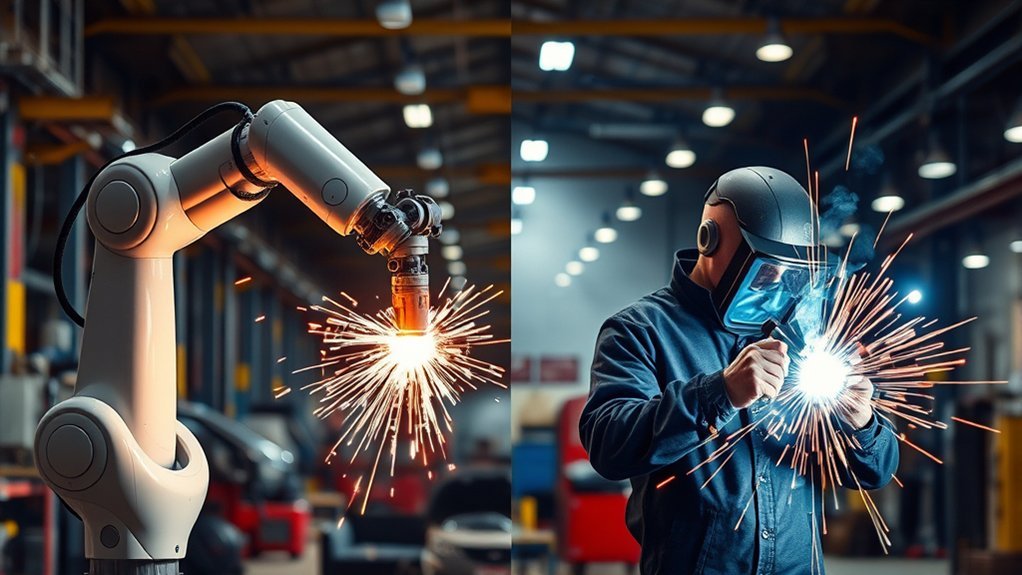
Robotic and manual welding both have a place in auto body production, but they solve different problems. Robotic welding works best when the same joints repeat all day with tight fixtures, stable part fit-up, and clear weld procedures. Manual welding works best when the job changes often, the joint is hard to reach, or a skilled welder must make judgment calls during repair, rework, or prototype work.
Quick Answer
Choose robotic welding for repeatable, high-volume auto body seams where fixtures hold parts in the same position every cycle. Choose manual welding for repairs, low-volume builds, prototypes, complex access points, and jobs where the welder must adjust to fit-up problems in real time.
Key Takeaways
- Robotic welding is best for repeatable body-in-white, bracket, subassembly, and production-line welds.
- Manual welding is better for collision repair, custom panels, rework, short runs, and awkward joints.
- Robots improve consistency only when the fixture, part fit-up, torch position, and weld program are controlled.
- Manual welding can match strong quality targets, but results depend heavily on welder skill, fatigue, access, and inspection.
- The strongest shops often use both: robots for repeatable production and skilled welders for repair, setup, validation, and exceptions.
Robotic vs. Manual Welding: An Overview
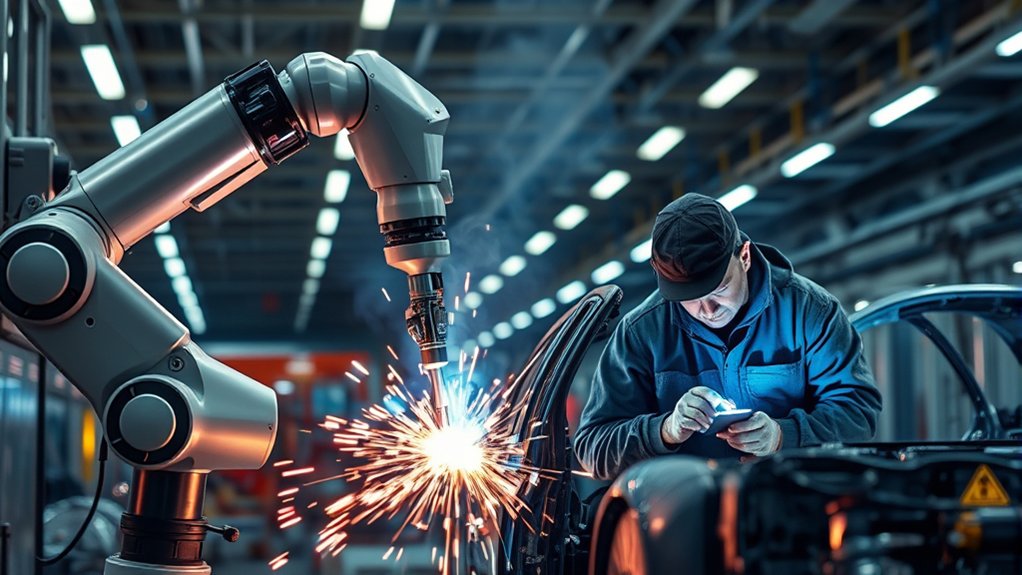
In auto body production, robotic welding uses a programmed robot arm, welding power source, torch, fixtures, sensors, and safety controls to repeat the same weld path. It is common in body-in-white assembly, resistance spot welding, arc welding of brackets, and repeatable subassemblies.
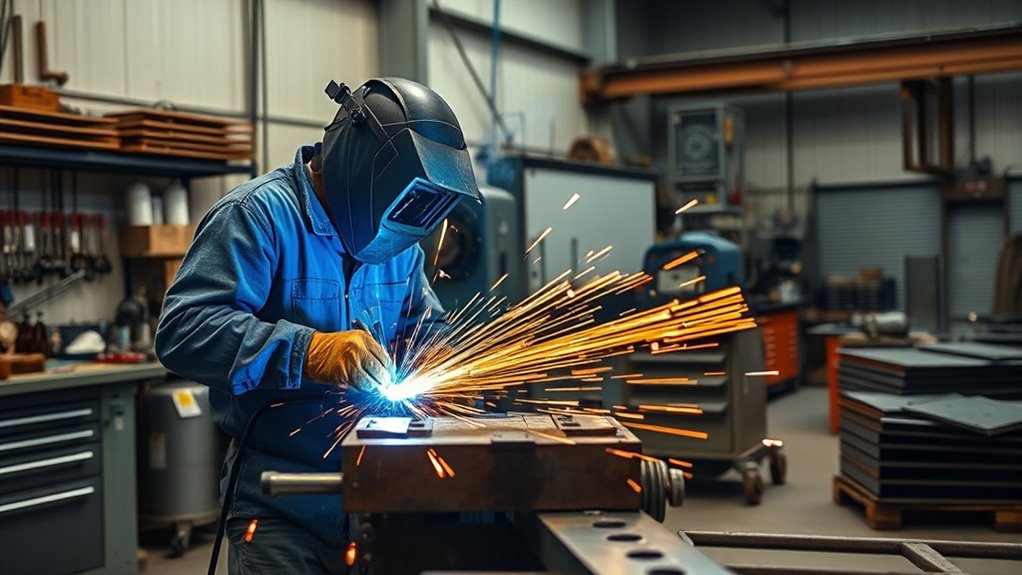
Manual welding relies on a trained welder controlling the torch, travel speed, angle, filler, and heat input by hand. It is common in collision repair, prototype builds, restoration work, small batches, and production areas where parts vary too much for a fixed robot program.
Current robotics data shows why automation matters in manufacturing. The International Federation of Robotics reported 542,076 industrial robot installations in 2024. Automotive remained one of the largest customer industries, but electronics slightly led global robot installations in that year.
| Factor | Robotic Welding | Manual Welding |
|---|---|---|
| Best fit | High-volume, repeatable welds | Repairs, prototypes, short runs, and custom work |
| Quality driver | Programming, fixturing, part consistency, and process control | Welder skill, access, preparation, and fatigue control |
| Changeover | Fast after programming, slower when fixtures or parts change | Fast for one-off changes and unexpected fit-up problems |
| Cost profile | High upfront cost, lower repeat-cycle labor per part | Lower equipment cost, higher ongoing labor dependence |
| Main risk | Poor fixture control, bad programming, downtime, and robot safety hazards | Inconsistent technique, heat distortion, fatigue, and direct fume or UV exposure |
Understanding the Principles of Robotic Welding
Robotic welding is not just a robot arm holding a torch. A complete system includes the robot, controller, teach pendant, torch or spot gun, welding power source, wire feed or electrodes, fixtures, sensors, safety guarding, and part-handling equipment. OSHA describes industrial robot systems as integrated systems that can include end-effectors, controls, sensors, power sources, and surrounding equipment.
For auto body work, robotic welding depends on repeatability. The robot follows a taught or offline-programmed path, but it can only make a sound weld if the part arrives in the right position and the joint is clean, clamped, and accessible. A robot will repeat a good weld all day if the setup is right. It will also repeat a bad weld all day if the setup is wrong.
Note: Robotic precision is not the same as finished weld quality. The final result still depends on joint design, clamp repeatability, surface condition, weld procedure, shielding gas, torch angle, and inspection.
Modern robotic welding can also use seam tracking, vision, point-cloud data, and adaptive programming. Research on robotic arc welding has shown that 3D sensing and path planning can help robots detect weld grooves and generate weld trajectories, which improves flexibility for complex parts. Even so, these systems still need skilled setup and validation.
Manual Welding in Auto Body Production: How It Works
In manual welding, the welder controls the arc directly. For auto body work, that may include MIG/GMAW plug welds, stitch welds, tack welds, TIG welds on specialty materials, or manual correction of robot welds. The welder adjusts travel speed, gun angle, stickout, heat, and technique based on what the joint is doing in front of them.
Manual welding is valuable because vehicle bodies are not always perfect. Panels may be slightly bent, replacement parts may need trimming, old metal may have coatings or corrosion, and access can be tight. A skilled welder can change angle, add a tack, pause to control heat, or correct a gap before the defect becomes bigger.
Skilled Welder Adaptability
Manual welders bring judgment to work that changes from one vehicle or panel to the next. That matters in repair bays, low-volume production, restoration, and prototype builds. A welder can make real-time choices when a flange is not flush, a panel gap opens, or heat starts to pull thin sheet metal out of shape.
This adaptability is why manual welding still matters even in highly automated plants. Robots can handle the planned repeatable work, while skilled welders support setup, first-article checks, rework, maintenance, and unusual joints.
Complex Joint Execution
Manual welding is often the better choice when the joint is irregular, hidden, or difficult to fixture. Examples include patch panels, rocker repairs, custom brackets, cage work, exhaust modifications, and body repairs after collision damage. In these cases, the human welder can see small fit-up problems and adjust technique before the weld fails inspection.
The tradeoff is consistency. Manual welding quality changes with skill, posture, fatigue, lighting, joint access, and surface preparation. A strong shop controls that risk with clean metal, written procedures, proper PPE, test welds, and inspection.
Cost Analysis: Comparing Robotic and Manual Welding
The cost difference between robotic and manual welding is not just “robot price versus welder wage.” The real comparison is total cost per acceptable part over time.
A robotic cell may include the robot arm, controller, welding package, spot gun or torch, wire feed, fixtures, positioners, part-present sensors, safety fencing or scanners, fume extraction, programming, installation, training, preventive maintenance, spare parts, and downtime planning. Costs can range from tens of thousands of dollars for a small collaborative setup to several hundred thousand dollars or more for a fully integrated production cell.
Manual welding usually has lower startup cost. You need welding machines, PPE, ventilation, clamps, benches, fixtures, consumables, training, and inspection tools. The larger cost is labor over time, plus the cost of rework, missed welds, distortion, inconsistent appearance, and production delays.
| Cost Area | Robotic Welding | Manual Welding |
|---|---|---|
| Upfront equipment | High | Lower |
| Fixtures and tooling | Critical and often expensive | Still needed, but usually simpler |
| Labor per repeat part | Lower after setup | Higher and skill-dependent |
| Changeover cost | Can be high if fixtures and programs change | Usually lower for one-off work |
| Maintenance | Robot, torch, cables, sensors, software, and guarding | Welder maintenance, consumables, PPE, and ventilation |
| Best ROI trigger | Stable volume and repeatable joints | Variable jobs and lower volume |
Robotics usually makes financial sense when the same welds repeat in enough volume to spread setup, programming, and tooling cost across many parts. Manual welding usually wins when the shop needs flexibility more than cycle-time reduction.
Quality and Precision: Robotic vs. Manual Welding
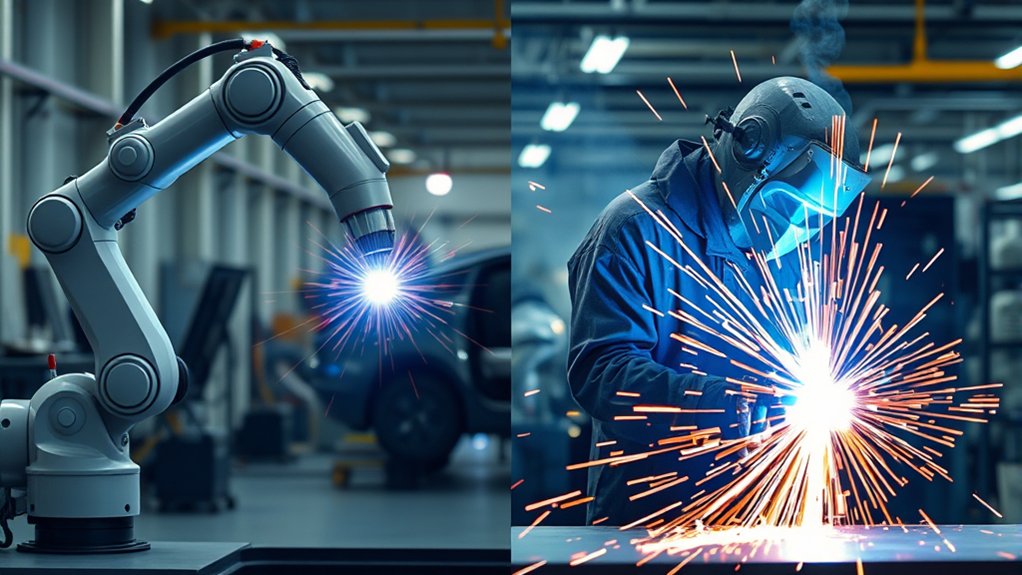
Robotic welding can deliver excellent repeatability because the robot follows the same path, angle, and timing every cycle. This helps reduce variation in high-volume work. It is especially useful for repeated spot welds, short arc welds on brackets, and body structure welds where the parts are clamped in a controlled fixture.
Manual welding can also produce excellent welds, but the quality depends on the welder and the conditions. Even skilled welders can be affected by fatigue, poor access, bad lighting, awkward body position, contaminated metal, or thin sheet metal that overheats quickly.
Consistency in Weld Quality
A robot is strong at consistency, but only inside a controlled process. If the joint gap changes, the part is not seated, the electrode wears, the torch contact tip shifts, or the program is not updated, weld quality can drop. Good robotic welding programs include fixture checks, tool center point checks, consumable replacement, sample inspection, and process monitoring.
Manual consistency comes from training, clean preparation, written weld procedures, supervision, and inspection. In repair work, the welder’s ability to spot and correct a problem can matter more than pure repeatability.
Human Skill Variability
Human variability is not always a weakness. It can be an advantage when the job changes. A manual welder can adjust to a gap, reposition the torch, add a tack, or change heat input. That is hard for a basic robot program unless the system has advanced sensing and adaptive controls.
The risk is that different welders may make different choices. Shops reduce this variation with training, procedure qualification, visual standards, test coupons, destructive testing where needed, and clear acceptance criteria.
Inspection and Defect Control
Both methods need inspection. Common weld defects include lack of fusion, undercut, burn-through, porosity, missed welds, poor spot weld nugget size, and excessive distortion. Robotic cells may use sensors and production monitoring, but that does not replace inspection. Manual work also needs visual checks, test welds, and documented repair procedures.
For safety-related auto body structures, do not judge weld quality by appearance alone. Follow the vehicle maker’s repair procedure, shop welding procedure, and any required inspection method for the material and joint.
Speed and Efficiency: Impacts on Production
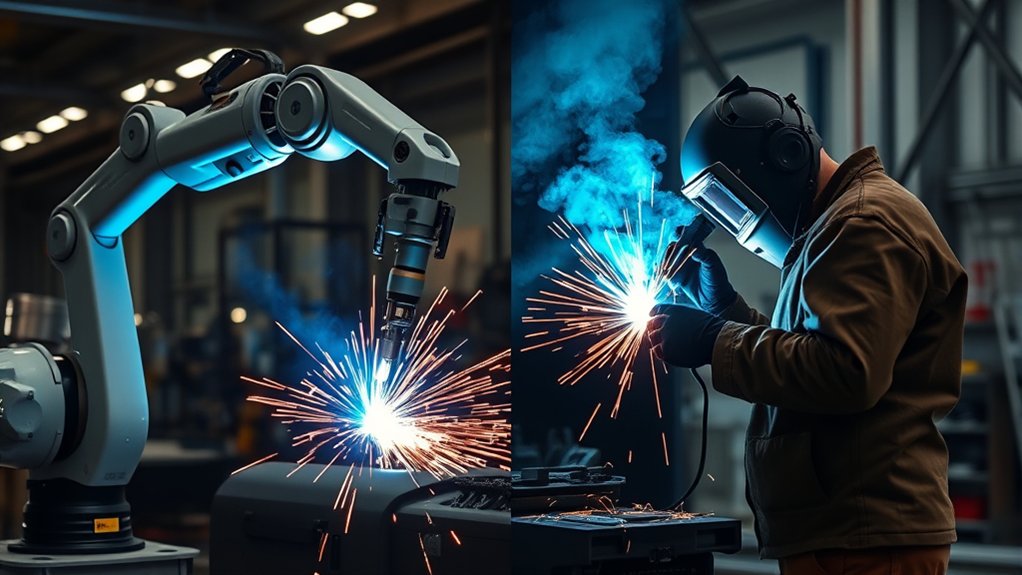
Robotic welding usually improves speed when the job is repetitive. The robot does not slow down from fatigue, does not need posture breaks, and can keep the same programmed sequence across shifts. It can also be paired with conveyors, turntables, fixtures, and part-handling equipment to reduce idle time.
Manual welding can be faster for one-off work because there is no robot program to build, test, and prove out. For a single repair bracket, patch panel, or custom body modification, a skilled welder may finish the work before a robot cell could be set up.
Robots win when the weld repeats. Welders win when the job changes.
The key is not maximum travel speed. The key is total cycle time per accepted part. That includes loading, clamping, welding, cooling, inspection, unloading, rework, and downtime. A robotic cell with poor fixtures may be slower than a manual station. A manual station with strong fixtures and trained welders may outperform a poorly planned robot investment.
Safety Considerations for Robotic and Manual Welding
Manual welding exposes workers directly to arc radiation, heat, sparks, metal fumes, gases, electrical hazards, noise, and fire risk. OSHA warns that welding fumes can contain harmful metal fume and gas by-products, and that prolonged exposure can cause serious health effects. Use proper PPE, local exhaust ventilation, fire control, and respiratory protection when needed.
Warning: Do not weld coated, painted, oily, or unknown metal without identifying the material and controlling fumes. Never weld in a confined space without proper ventilation, atmospheric testing, and a qualified safety plan.
Robotic welding can reduce direct exposure because the operator is not holding the torch inside the arc zone. However, a robot cell adds its own hazards. These include unexpected motion, pinch points, teach-mode exposure, stored energy, high current, hot parts, moving fixtures, and maintenance risks. Robot cells need guarding, interlocks, emergency stops, lockout procedures, risk assessment, and trained personnel.
The safest choice is not simply “robotic” or “manual.” The safest choice is the method with the right controls for the job.
When to Opt for Robotic vs. Manual Welding: Key Decision Factors
Choose robotic welding when your parts are consistent, your weld locations repeat, your fixture can hold the joint accurately, and your production volume is high enough to justify programming and tooling. This is common in body structure assembly, crossmembers, seat brackets, reinforcements, and repeatable subassemblies.
Choose manual welding when the work is varied, the joint access changes, the volume is low, or the job needs judgment. This is common in auto body repair, restoration, custom fabrication, prototype panels, and final rework after automated production.
| Question | If Yes | If No |
|---|---|---|
| Will the same weld repeat hundreds or thousands of times? | Consider robotic welding. | Manual welding may be more practical. |
| Can the part be clamped in the same position every time? | Robotics becomes easier to justify. | Fix the fixture first or use manual welding. |
| Does the joint design allow clear torch or spot gun access? | Robotic welding can be efficient. | Manual welding may be safer and cleaner. |
| Do you have programming and maintenance support? | Robotics is easier to sustain. | Manual welding or a simpler fixture may be better. |
| Is the job repair, restoration, or low-volume custom work? | Manual welding is usually the better fit. | Review robotic welding for repeatability and throughput. |
Products Worth Considering
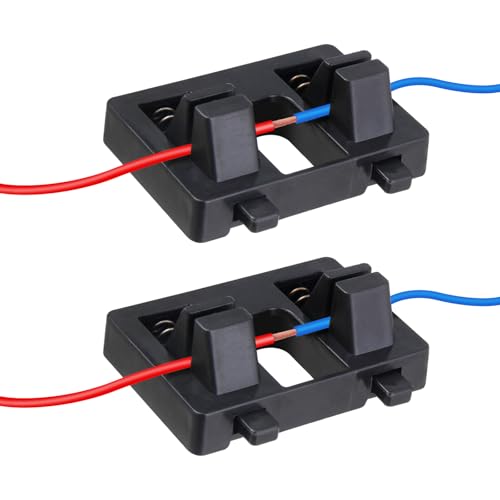
Steady Hands-Free Work – Hold wires, circuits, or small components securely with the stabilizing clamp, freeing both hands for precise soldering, welding, or detailed electronic repairs.

DESIGNED FOR 5/8" FIXTURE HOLES: Compatible with 5/8-inch (16mm) fixture holes found on most welding tables, providing fast, secure, and reliable clamping for welding and fabrication setups
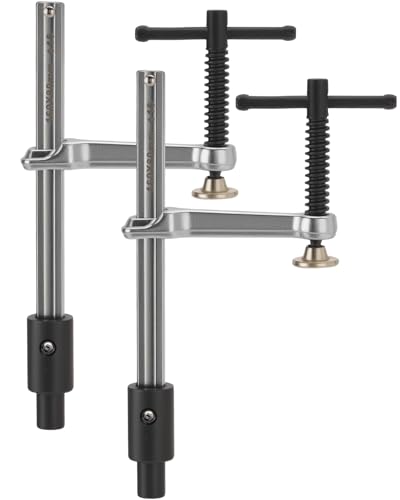
Dual-Pack Power & Efficiency: Double your workspace stability with this essential set of 2 welding table clamps. Specifically designed for standard 5/8-inch (16mm) holes, these welding clamps provide synchronized pressure to keep your frames and metal plates perfectly squared during intense heat.
Training Requirements for Manual vs. Robotic Welding
Training needs depend on the role. A manual production welder, collision repair welder, robotic operator, robot programmer, maintenance technician, and welding inspector all need different skills. Avoid judging training by a single number of weeks or months.
Manual Welding Skill Requirements
Manual welders need to understand joint preparation, fit-up, heat control, torch angle, travel speed, weld sequence, distortion control, PPE, fume control, and inspection basics. For auto body work, thin sheet metal adds a challenge because excess heat can warp panels or burn through the joint.
A beginner may learn simple tack or plug weld tasks quickly, but consistent production-quality or repair-approved welding takes practice, supervision, and procedure-based training.
Robotic Welding Skill Requirements
Robotic welding needs more than someone pressing cycle start. A strong team may include an operator, robot programmer, welding engineer or process lead, maintenance technician, fixture builder, and quality inspector. They need to understand weld parameters, robot path programming, tool center point checks, consumable wear, safety interlocks, sensors, and troubleshooting.
Robotics reduces some manual torch skill, but it increases the need for process discipline. If the team cannot maintain fixtures, programs, and inspection standards, the robot will not deliver its promised consistency.
Handling Unexpected Challenges in Welding
Unexpected problems are where manual welding often shines. A skilled welder can respond to gaps, dirty edges, thin metal, panel movement, or poor access immediately. They can pause, add a tack, change angle, or reduce heat to protect the panel.
Robots can handle variation when the cell is designed for it. Vision systems, touch sensing, seam tracking, adaptive controls, and good fixtures can help. But those features add cost and complexity. Without them, a robot expects the joint to be where the program says it is.
Pro Tip: Before buying a robot, measure your part variation. If gaps, flange location, and clamp repeatability are not controlled, invest in better fixtures and process checks before automation.
Best Applications for Robotic and Manual Welding in Auto Body
Robotic and manual welding are not enemies. In a strong auto body operation, each method handles the work it does best.
| Application Type | Best Method | Why |
|---|---|---|
| Body-in-white production | Robotic welding | High volume, repeatable joints, and controlled fixtures |
| Resistance spot welding on repeat flanges | Robotic welding | Consistent electrode position and cycle timing |
| Brackets and reinforcements | Robotic or manual | Robotic for production, manual for small runs or repair |
| Collision repair | Manual welding | Every vehicle and damage pattern can be different |
| Prototype body panels | Manual welding | Designs change before fixtures justify automation |
| Robot weld repair or touch-up | Manual welding | Human judgment is useful for isolated defects |
| High-mix, low-volume shop work | Manual or collaborative setup | Flexibility matters more than maximum throughput |
If your shop has steady volume and repeatable parts, robotic welding may lower the cost per accepted part over time. If your shop handles repairs, custom work, and changing jobs, manual welding will remain essential.
Why Many Shops Use Both Methods
The best answer is often a hybrid workflow. Robots can handle the repeatable welds that are easy to fixture and inspect. Manual welders can handle tack-up, first-article checks, repair welds, custom brackets, low-volume work, and final corrections. This approach uses automation without removing the value of skilled welders.
A hybrid setup also protects production. If a robot cell goes down, trained welders can help with containment, rework, or temporary support. If manual welders find repeated fit-up issues, the engineering team can improve the fixture or update the robotic program.
Frequently Asked Questions
How long does it take to train a robotic welder?
It depends on the role. A production operator may learn basic loading, safety checks, and cycle monitoring faster than a programmer or maintenance technician. Programming, troubleshooting, torch calibration, fixture checks, and weld process control require deeper training and supervised practice.
What maintenance is required for robotic welding systems?
Robotic welding systems need routine checks on contact tips, nozzles, liners, cables, torch alignment, spot welding electrodes, fixtures, clamps, sensors, safety devices, robot mastering, software, and fume extraction. Preventive maintenance is important because a small shift in torch position or part location can create repeated defects.
Can robotic welding handle complex shapes?
Yes, but only when the system is designed for the shape. Complex joints may need special fixtures, more robot axes, a positioner, seam tracking, vision, touch sensing, or offline programming. For one-off repairs or highly irregular parts, manual welding is often faster and more practical.
What industries benefit most from manual welding?
Manual welding is valuable in collision repair, custom automotive fabrication, restoration, motorsports, construction, maintenance, art fabrication, and prototype work. These jobs often involve changing designs, limited access, small batch sizes, and fit-up problems that require human judgment.
How do labor costs compare between robotic and manual welding?
Robotic welding usually has higher upfront cost but can reduce labor per part in steady production. Manual welding costs less to start but depends more on skilled labor every cycle. The better choice depends on volume, fixture repeatability, rework rate, downtime risk, and how often the job changes.
Is robotic welding always safer than manual welding?
No. Robotic welding can reduce direct exposure to arc radiation, heat, and fumes, but robot cells introduce motion, pinch, maintenance, and teach-mode hazards. Manual and robotic welding both need safety controls, ventilation, PPE, training, and inspection.
Conclusion
Robotic welding is the stronger choice for high-volume auto body production when parts repeat, fixtures are accurate, and the process is well controlled. Manual welding is the stronger choice for repair, rework, prototypes, short runs, and complex joints that need human judgment. The best production plan often uses both. Let robots handle stable, repeatable welds, and let skilled welders handle the work that changes, needs inspection judgment, or cannot be fixtured cleanly.
Sources
- International Federation of Robotics, World Robotics 2025 Executive Summary – current industrial robot installation data and automotive market context.
- OSHA Welding, Cutting, and Brazing – welding standards and hazard overview.
- OSHA Fact Sheet: Controlling Hazardous Fume and Gases during Welding – welding fume hazards and exposure control guidance.
- OSHA Technical Manual: Industrial Robot Systems and Industrial Robot System Safety – robot system components, hazards, and safety planning.
- Path Planning with Automatic Seam Extraction over Point Cloud Models for Robotic Arc Welding – research support for robotic seam detection and weld path generation.
- Online Programming System for Robotic Fillet Welding in Industry 4.0 – research support for programming and flexible robotic welding workflows.