You use stick welding in automotive work for frame, chassis, bracket, and other structural repairs, especially on thick, rusty, or dirty metal. It gives deep penetration, strong joints, and works well outdoors because the flux shields the arc from wind and moisture. It’s handy for collision repairs, crossmembers, suspension mounts, and reinforcements, but it’s slower and rougher than MIG on thin sheet metal. If you keep going, you’ll see where it fits best.
What Is Stick Welding Used for in Auto Repair?
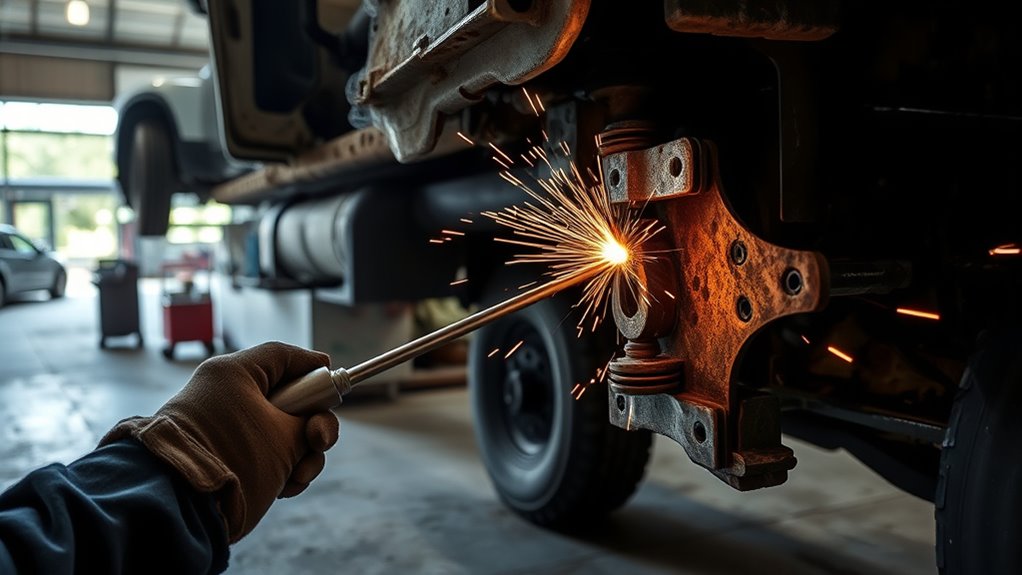
Stick welding is commonly used in auto repair for frame, structural, and fender work, especially when you need strong joints on thick metal after a collision.
You can use it to rebuild damaged sections, patch torn panels, and restore alignment without depending on spotless surfaces. Its arc cuts through light rust and dirt, so you keep moving instead of waiting on perfect prep.
The process gives deep penetration, which helps you lock in durable repairs that support vehicle safety and integrity. Additionally, flux core welding can be a complementary technique for repairs in challenging conditions.
For on-site jobs, you benefit from its portability and low equipment cost, making it a practical choice for cost-effective repairs.
If you train in these welding techniques, you’ll expand your options as a collision repair technician and handle common frame damage with more confidence.
Stick welding also fits outdoor work, giving you freedom to repair where the vehicle sits and keep productivity high.
Why Stick Welding Works on Frames and Chassis
You can use stick welding on frames and chassis because it drives deep into thicker metal and creates strong structural joints. It also lets you fuse replacement sections into damaged frame members with solid repair strength, even when surface prep isn’t perfect. Its flux shielding helps you weld outdoors in wind or moisture, so you’ve got more flexibility on real repair jobs. Additionally, using the correct electrode diameter ensures optimal penetration and weld quality for structural integrity.
Thick Metal Penetration
For heavy frame and chassis work, deep penetration is what makes a weld hold up under load. You use stick welding because its high heat drives deep fusion into thick steel, creating a secure bond where thinner processes can’t reach.
With the right penetration techniques, you can tie heavy-duty members together and get full contact through scale, rust, or light contamination. The flux helps burn through surface grime, so you’re not trapped by perfect prep.
You can weld flat, vertical, or overhead, which matters when frame geometry won’t cooperate. Minimal gear also frees you to repair chassis outdoors, on site, and on your terms.
That’s why stick welding stays practical when you need strong fusion in tough automotive steel, even in less-than-ideal conditions.
Frame Repair Strength
When a frame or chassis is damaged, stick welding is often the best choice because it drives deep penetration into thick steel and rebuilds joints that need to carry real vehicle loads.
You restore strength by concentrating heat where the crack or break needs full fusion, not just surface coverage. That depth helps you recover structural integrity in rails, crossmembers, and other load-bearing sections.
You can use different welding techniques to match the joint shape and position, which keeps repair work controlled and precise. The flux shield also helps protect the weld from contamination, so you can work on steel that isn’t perfectly clean.
For you, that means better joint integrity, safer repairs, and a tougher chassis that can keep doing its job.
Outdoor Repair Flexibility
Out in the field, stick welding stays practical for frame and chassis repair because the flux coating shields the arc from wind, letting you weld outdoors without losing protection. You can work in outdoor conditions with confidence and keep your repair techniques simple.
It drives deep penetration into thick steel, so you get strong joints on rails, crossmembers, and mounts. You don’t need perfect metal prep, either; it tolerates rust, scale, and oil better than many processes.
- Portable gear fits mobile work
- Rugged machines handle rough sites
- Welds in flat, vertical, or overhead positions
- Limited power access won’t stop you
That flexibility gives you freedom to fix older vehicles on-site and keep moving.
Stick Welding for Dirty or Rusty Auto Parts
When you’re repairing dirty or rusty auto parts, stick welding gives you solid rust tolerance because its flux helps burn through surface contaminants. You can work on metal coated with oil, dirt, or oxidation without needing the spotless prep MIG often demands. That makes your repairs more reliable, especially on older or accident-damaged parts that need strong, deep-penetrating welds. Additionally, stick welding allows for high deposition rates, making it efficient for quickly fixing larger sections of metal.
Products Worth Considering

Use with JOUNJIP Boot Tips (sold separately) and Plastic Welding Kit Set (sold separately) together

Compatible with X-One game controllers.
Rust Tolerance
Stick welding is a strong choice when you’re dealing with rusty or dirty auto parts, because its flux coating can burn through contamination and still produce a solid weld. You don’t need perfect sheetmetal prep, so you can keep moving with minimal surface preparation and targeted rust removal.
That makes it practical for old frames, brackets, and body panels.
- Burns through light rust
- Handles rough, uneven edges
- Works on thicker structural steel
- Delivers dependable repair strength
You can use it where MIG would demand cleaner metal, and you still get durable joints. For chassis work and other load-bearing repairs, that tolerance gives you freedom to fix worn parts without overprocessing the steel.
Surface Contaminants
Rust tolerance naturally leads into another big advantage: stick welding handles surface contaminants well, even on auto parts coated with rust, grime, or old paint. You can skip heavy surface preparation and still strike an arc that burns through impurities.
| Contaminant | Stick welding response |
|---|---|
| Rust | Flux cuts through it |
| Grime | Arc pushes through |
| Old paint | Burns off fast |
| Road film | Welds through it |
That freedom matters when you’re fixing frames, brackets, and collision-damaged panels. Compared with MIG or TIG, your welding techniques don’t demand spotless metal to start. You get a practical process for real-world repairs, where parts rarely come clean. The result is efficient restoration with less grinding, less downtime, and more control over rough, contaminated steel.
Repair Reliability
Because the flux coating burns through contamination, you can count on stick welding to make reliable repairs on dirty or rusty auto parts without needing perfect surface prep. You still need sound repair techniques, but the process forgives grime better than MIG or TIG. That means you can restore mobility and safety on compromised vehicles with less gatekeeping from surface quality.
- Deep penetration helps you lock in joint integrity on thicker steel.
- It’s well suited for frame repairs after collision damage.
- You can weld in awkward positions on-site.
- You get strong results even when rust or dirt remains.
When you need practical freedom from spotless metal, stick welding gives you a tough, dependable path to structural repair.
When Stick Welding Handles Thick Metal Best
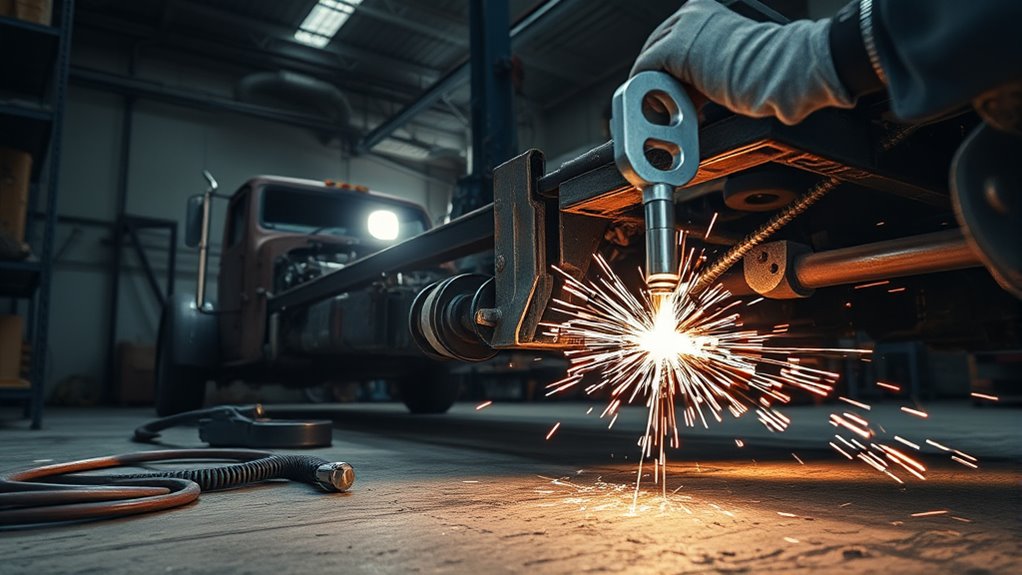
When you’re repairing thick automotive metal, stick welding often performs best on frames, brackets, and other structural parts that need deep penetration and high-strength joints.
For thick automotive metal, stick welding delivers deep penetration and strong joints on frames and structural parts.
You can rely on it when collision damage has opened gaps or distorted load-bearing areas, because the arc heat fuses thick metal cleanly and restores strength.
These welding techniques also tolerate rusty, oily, or painted surfaces better than many others, which matters when you’re working on older vehicles that haven’t been stripped perfectly.
Use it where durability counts: crossmembers, suspension mounts, and chassis reinforcements.
The welds you lay down can handle road shock, vibration, and repeated stress without failing easily.
If you need a repair that holds structure, not just appearance, stick welding gives you direct control and rugged results. Additionally, heat input management is crucial to prevent distortion and ensure strong welds in demanding conditions.
Products Worth Considering

➤【UPGRADE 2-IN-1 WELDER】- Breaking through the single-function limitations of welder machine 110v, upgrade 2-in-1 welder: Powerful MMA(Stick) & Precision Lift TIG.Powerful MMA welding effortlessly handles the vast majority of everyday welding needs; The built-in Lift TIG welding core, when paired with a dedicated welding torch (sold separately), empowers you to handle stainless steel and delicate components with precision, producing spatter-free arcs like a professional welder. This welding machine powers through rugged repairs and delicate artistic welds alike, value far exceeds that of a single-function device.
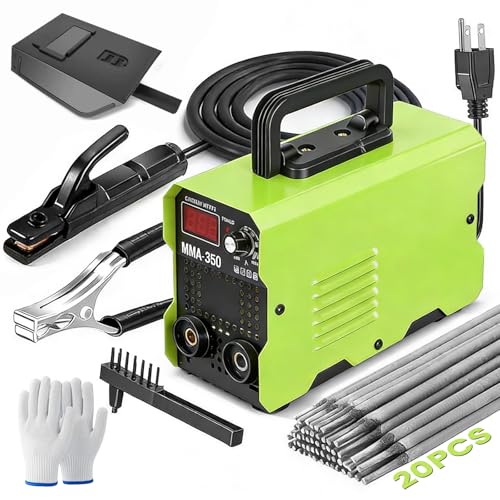
250Amp Upgraded IGBT Inverter Stick Welder (110V) : IGBT inverter tech with smart voltage regulator auto-matches current/voltage (manual adjust available), delivering strong arc force, deep penetration, minimal spatter, and smooth weld beads. Works with 1.6-2.5mm (1/16-1/8 inch) electrodes (AWS E6013/E6011/E7018/E308) for mild steel, stainless steel, cast iron. 60% duty cycle ensures pro-level results.

UL CERTIFIED - Our Plastic Welder, the factory, and the process have been tested, approved, and Certified by Underwriters Laboratories (UL). Safety is our number one priority
Stick Welding vs. MIG and TIG
Stick welding gives you the best edge on structural automotive repairs, while MIG and TIG each fit more specialized jobs. You’ll use these welding techniques based on material thickness, finish, and access.
For automotive applications, stick welding bites deeper into thick steel, so you can repair frames and other load-bearing parts with durable fusion. MIG works better on thin sheet metal because it lays cleaner beads with less spatter, which helps body panels look right.
TIG gives you tight control for aluminum and other precision work, but it demands more skill and patience.
- Stick: strongest penetration
- MIG: cleaner cosmetic welds
- TIG: precise aluminum control
- Choose by job, not habit
Because stick’s flux tolerates windy conditions, you can work where MIG struggles. That flexibility gives you freedom to fix what matters, when it matters, without waiting for perfect shop conditions.
Why Auto Repair Shops Use Stick Welding
Auto repair shops rely on stick welding for frame and structural repairs because it delivers strong penetration on thick steel and still holds up on rusty or contaminated surfaces. You can use it to restore collision-damaged frames, crossmembers, and other load-bearing parts without overcomplicating the job. Its portability lets you work on-site, in a bay, or outdoors when conditions aren’t ideal. Because the arc tolerates less-than-perfect surfaces, you don’t waste time chasing spotless metal on older vehicles. Stick welding also gives you flexibility in overhead, vertical, and flat positions, so you can match the repair to the vehicle’s geometry. For technicians, learning these repair techniques builds real shop value. You handle more structural work, adapt to different welding materials, and keep vehicles moving back into service with fewer barriers. Additionally, using E6011 rods can significantly enhance your ability to weld on rusty surfaces, making repairs even more efficient.
Stick Welding Limits in Automotive Work
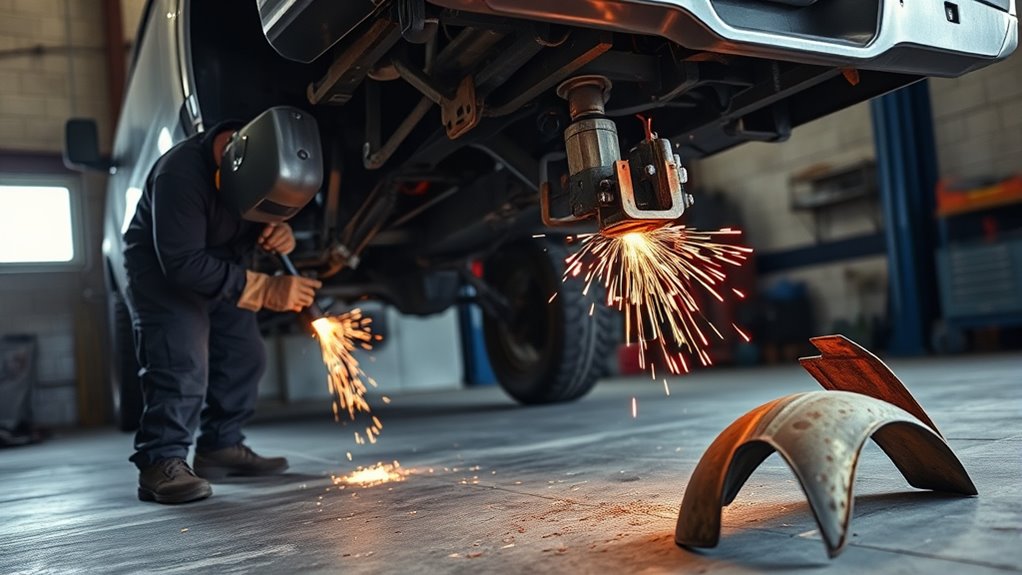
Although stick welding has clear strengths in automotive repair, you’ll run into limits fast in high-volume or detail-focused work. It’s slower than MIG, so your throughput drops in busy bays. You’ll also fight more spatter, which means extra cleanup and a rougher finish on visible panels. These stick welding disadvantages matter when customers expect clean results and fast turnaround.
- Thin sheet metal can burn through or warp easily.
- Tight frame areas are harder to reach with a stick rod.
- Precision bodywork becomes difficult when control matters most.
- Heavy-duty frame repairs fit better than cosmetic panels.
In modern cars, these automotive welding challenges make stick less practical for quick body repair. You can still use it where strength beats speed, but for thin, delicate, or aesthetic work, the process asks too much of you and gives too little freedom. Additionally, proper surface preparation is crucial to avoid issues like porosity in welds.
Beginner Skills for Automotive Stick Welding
For beginners, automotive stick welding starts with control, not speed. You use it on thicker steel when you need frame repair and collision-strength recovery. Focus first on stable arc formation, because heat control sets weld penetration and joint strength. Keep your arc distance steady; too long weakens the bead, and too short can stick the electrode.
Practice on scrap until your hands stay calm and your puddle stays readable. Learn how the arc starts, how heat moves, and how the metal responds. That discipline frees you from guesswork and lets you repair automotive steel with confidence and precision. Additionally, understanding joint preparation is crucial for achieving strong, clean welds.
| Skill | What you do |
|---|---|
| Electrode selection | Match type and size to the steel and thickness |
| Arc distance | Hold a consistent gap for even heat and weld shape |
| Safety gear | Wear gloves and a mask to block UV and fumes |
Frequently Asked Questions
Can Stick Welding Be Used on Vehicle Body Panels?
No, you shouldn’t use stick welding on vehicle body panels; it’s too hot and warps thin sheet metal. For vehicle repair, you’ll get cleaner results with MIG or TIG, and better control.
What Electrodes Work Best for Automotive Stick Welding?
For automotive stick welding, you’ll get best control with E6011, E6013, or E7018, like choosing the right gear for a climb. Your electrode selection depends on steel thickness, joints, and welding techniques.
Is Stick Welding Safe Near Fuel Lines?
No, you shouldn’t stick weld near fuel lines without strict fuel line precautions and welding safety. You’ve got to disconnect, drain, shield, and ventilate the area, then verify zero vapors before you strike an arc.
How Do You Prevent Warping During Stick Welds?
You prevent warping by controlling heat input: use short beads, skip-weld, clamp the work, and let it cool between passes. Good joint preparation fits pieces tightly, reducing distortion and helping you weld cleaner.
What Power Source Is Needed for Automotive Stick Welding?
You need a constant-current AC or DC stick welder, like a compact warhorse from the shop floor. Pair it with proper welding equipment and dial the right power settings, and you’ll weld confidently.
Conclusion
In automotive work, you use stick welding when you need strong, dependable welds on thick steel, frames, chassis, or dirty parts that other methods struggle with. It’s a practical tool when surface prep isn’t perfect and durability matters most. Compared with MIG or TIG, stick welding is less precise, but it’s tough and versatile. Think of it as a hammer in your welding toolbox: simple, rugged, and built for heavy repair work.