Choosing a welding process for an exhaust system is not only about bead appearance. The tubing material, wall thickness, joint fit, access, and whether the pipe is on or off the vehicle all affect the safest and most reliable choice. TIG usually gives the most precise control on custom stainless work, while MIG is often faster and easier for general mild-steel or stainless fabrication.
Quick Answer
TIG is usually the best welding process for thin stainless exhaust tubing because it gives precise control over amperage, filler metal, and bead placement. MIG is the practical choice for faster repairs and production work. Stick welding is usually a last resort for thicker steel sections because thin exhaust pipe burns through easily.
Key Takeaways
- Choose TIG for precise, clean welds on thin stainless tubing and custom exhaust parts.
- Choose MIG when speed, easier setup, and repeatable welds matter most.
- Use stick welding only on suitably thick steel when TIG or MIG is not practical.
- Match the filler metal, wire, shielding gas, and settings to the exact base metal.
- Remove rust, coatings, oil, and unsafe solvent residue before welding.
- Leak-test every joint with the engine off before performing any running check outdoors.
At a Glance
| Time Required | About 45 minutes to several hours, depending on removal, fit-up, and repair size |
| Difficulty | Intermediate; thin stainless TIG work is advanced |
| Tools Needed | Welder, matching filler or wire, shielding gas, PPE, cutting and deburring tools, clamps, and leak-test supplies |
| Cost | Varies by gas, filler, replacement tubing, and whether welding equipment is already available |
What’s in This Article
- What Welding Process Is Best for Exhaust Systems?
- Why TIG Welding Gives the Cleanest Exhaust Welds
- When MIG Welding Makes the Most Sense
- When Stick Welding Exhaust Pipes Makes Sense
- When You Should Not Weld an Exhaust Pipe
- How to Match the Welding Process to the Exhaust Metal
- How to Prep Exhaust Pipe for a Strong Weld
- How to Weld Exhaust Pipe Step by Step
- How to Avoid Burn-Through on Stainless Pipe
- How to Test Exhaust Welds for Leaks
- Frequently Asked Questions
- Conclusion
What Welding Process Is Best for Exhaust Systems?
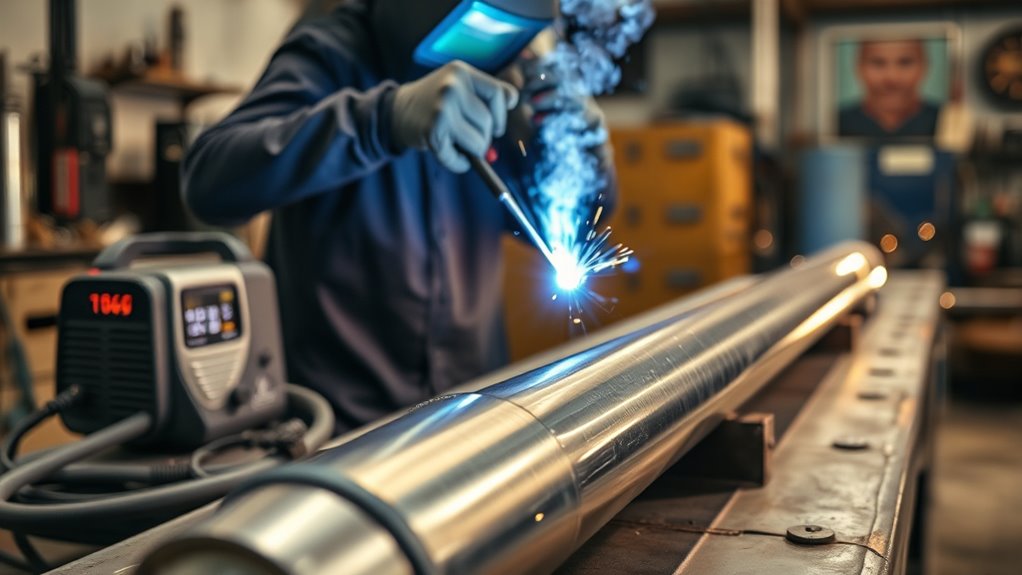
For most custom stainless exhaust systems, TIG is the best process when bead control, clean appearance, and access to the back of the joint matter. TIG lets you control amperage, torch movement, and filler addition separately. That makes it easier to manage a small weld puddle on thin tubing.
MIG is often the most practical option for general exhaust fabrication and repair. Its continuously fed wire supports faster travel and repeatable results. It can work on mild steel, aluminized steel after proper coating removal, and stainless steel when you use the correct wire and shielding gas.
Stick welding can join steel, but it is difficult to control on common exhaust tubing. Automotive exhaust tubing is often around 18 gauge or 16 gauge, approximately 0.049 or 0.065 inch wall, rather than the very thick sections used in structural work. MagnaFlow identifies those two gauges as common tubing thicknesses in exhaust-related applications.
The best process is the one that matches the metal and allows full fusion without burning away the pipe. Tight fit-up matters with every process because wide gaps force you to add heat and filler, which increases the risk of distortion and leaks.
Warning: Welding fumes, coatings, stainless-steel constituents, and zinc from welding galvanized steel can be hazardous. Use local exhaust ventilation when possible, keep your head out of the plume, wear suitable PPE, and follow the safety data for every coating and consumable.
Why TIG Welding Gives the Cleanest Exhaust Welds
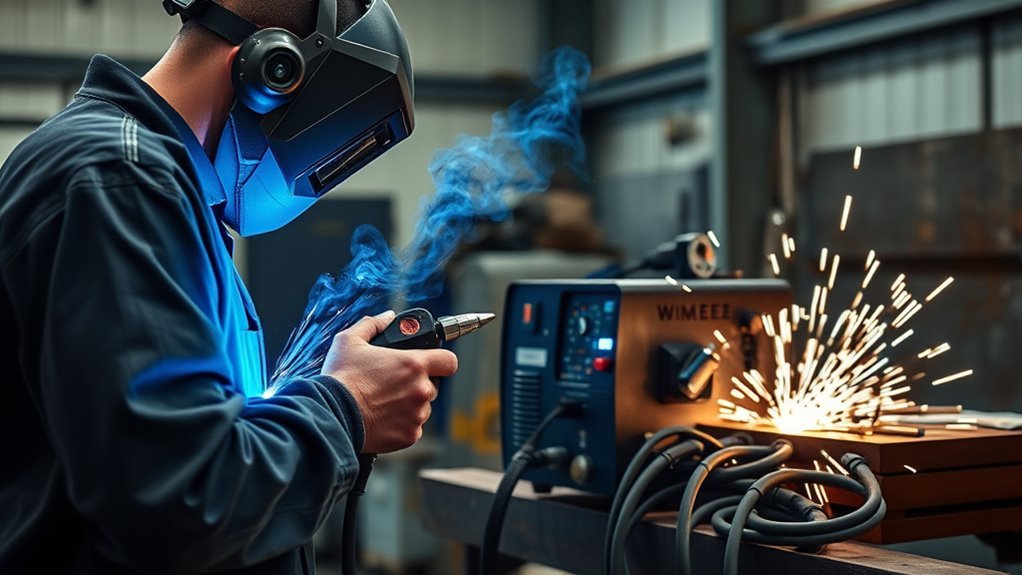
TIG welding uses a non-consumable tungsten electrode and a separate shielding-gas stream. The filler rod is added by hand only when needed. This setup gives you fine control over bead size and filler placement, which is why TIG is widely used for precise and appearance-sensitive work.
On stainless exhaust tubing, proper shielding protects the face of the weld from the atmosphere. Proper TIG shielding gas flow protects the face of the weld, while back purging the inside of the tube with argon helps protect the root from heavy oxidation, often called sugaring. The result is a cleaner internal surface and a joint that needs less grinding or cleanup.
TIG does not automatically create less distortion than every other process. It gives the operator finer heat control, but slow travel or repeated reheating can still put too much total heat into thin tubing. Miller’s current process guidance notes both TIG’s fine control and the importance of travel speed and total heat input on light-gauge material.
Use small, evenly spaced tacks, short weld segments, and a sequence that spreads heat around the tube. A foot pedal, fingertip control, or pulse function can help, but good fit-up and travel technique still matter more than a single machine setting.
TIG gives you finer control; it does not remove the need to manage total heat, travel speed, and joint fit.
When MIG Welding Makes the Most Sense
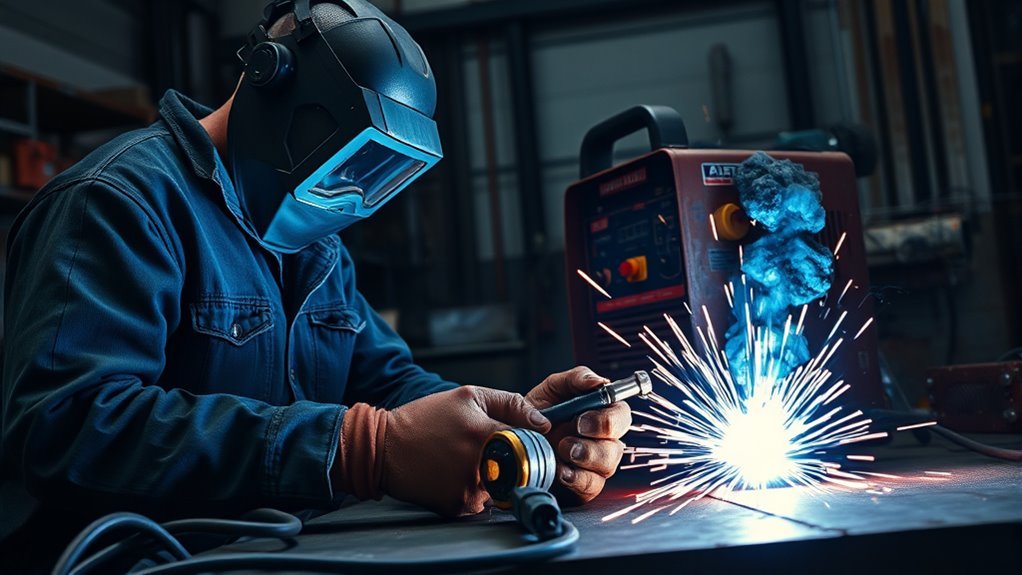
MIG welding makes sense when speed and simple operation matter. The wire feeds continuously, so you can tack and weld several exhaust joints without adding filler by hand. This helps in repair shops, production work, and home fabrication where repeatability matters more than a show-quality bead.
Short-circuit MIG can weld thin-gauge stainless when the machine, wire diameter, shielding gas, and settings are suitable. Lincoln Electric’s stainless MIG guidance stresses selecting the correct electrode and gas rather than treating every stainless setup the same.
Gas-shielded MIG usually produces less slag and cleanup than self-shielded flux core. Self-shielded flux core wire can be useful outdoors because wind can disrupt external shielding gas, but it often creates more spatter and can be harder to control on thin exhaust tubing.
Products Worth Considering

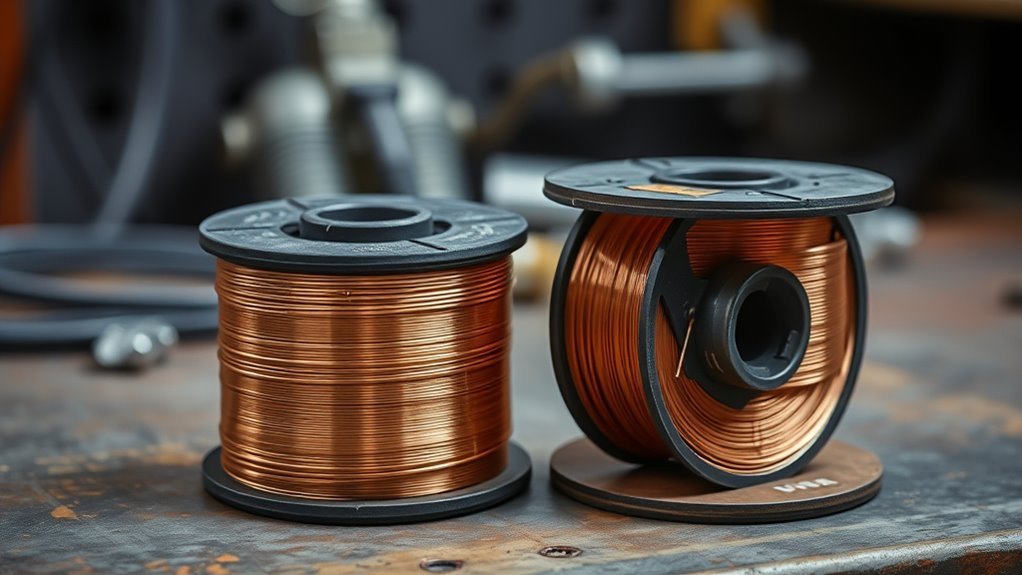
ER308L WIRE: A low-carbon stainless steel wire engineered to minimize intergranular carbide precipitation. This enhances corrosion resistance without the need for stabilizers, making it ideal for critical applications.

Premium Low Carbon Mig Wire: Achieve high-grade welding results with our ER308L stainless steel MIG wire. Featuring a low carbon content, it minimizes intergranular carbide precipitation, enhancing corrosion resistance without the need for stabilizers.
Fast Production Welding
MIG works well for fast exhaust production because the electrode and filler arrive through one gun. Once the machine is set, the operator can move from joint to joint with little interruption.
Consistent wire feed can support repeatable welds, but only when the contact tip, liner, drive-roll tension, gas coverage, and work connection are in good condition. A stable setup does not correct poor fit-up or contaminated metal.
Good for Thicker Tubing
MIG becomes easier to use as the material gets thicker, but most passenger-vehicle exhaust tubing is still thin compared with structural plate. Common 18-gauge and 16-gauge tubing needs short-circuit settings, careful travel, and a machine capable of stable low-output operation.
Do not copy a broad wall-thickness range from another project. Start with the chart inside the welder door or the wire manufacturer’s data, then test on scrap cut from the same tube. Adjust voltage and wire feed together until the bead wets into both edges without leaving a tall cold lap or opening a hole.
Simple Setup and Use
MIG is easier for many beginners because one hand controls the gun and the wire feeds automatically. You still need to set polarity, wire type, wire diameter, gas, voltage, and wire speed correctly.
Keep the gun angle and contact-tip-to-work distance steady. Erratic distance changes arc length, heat, and shielding coverage. Poor gas coverage can cause porosity, while excessive gas flow can create turbulence and draw air into the weld zone.
Pro Tip: Practice on scrap from the same pipe, using the same joint gap and position. A setting that works on flat sheet may behave differently around a round tube.
When Stick Welding Exhaust Pipes Makes Sense
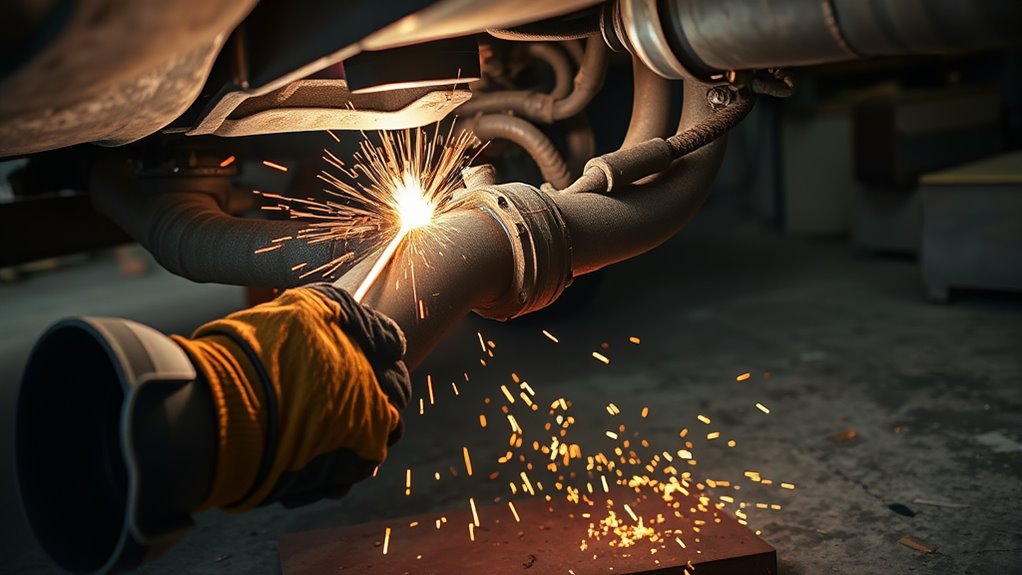
Stick welding is a limited-use option for exhaust work. It may be useful for a temporary field repair on a sufficiently thick steel flange, bracket, or heavy patch when MIG or TIG equipment is unavailable.
It is usually a poor choice for 18-gauge or 16-gauge tubing. The arc and electrode size make it easy to overheat the edge, leave slag inclusions, or create pinholes. A small-diameter electrode and low current may help, but they do not turn badly thinned pipe into sound metal.
Flux core welding techniques are often more practical outdoors, while stick welding may tolerate light mill scale or outdoor conditions better than TIG, but it does not make oil, grease, exhaust soot, paint, or heavy rust acceptable. Clean the joint to sound bare metal before welding. Contaminants can create fumes, porosity, lack of fusion, and fire hazards.
When the goal is a durable exhaust repair, replacing the damaged section and using MIG or TIG is usually more reliable than trying to bridge rust holes with stick electrode.
When You Should Not Weld an Exhaust Pipe
Do not weld a section that is paper-thin, heavily scaled, cracked across a broad area, or perforated by rust beyond the planned joint. The weld will only move the failure to the next weak spot. Cut back to solid metal or replace the affected pipe, muffler, flange, or converter assembly.
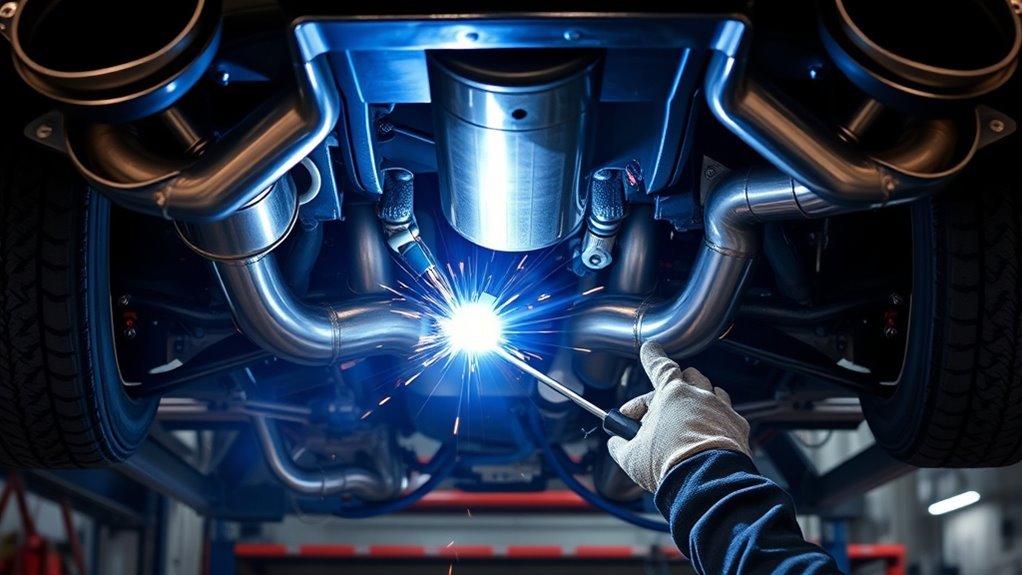
Remove the exhaust from the vehicle when practical. This improves access and keeps welding heat, sparks, and current away from fuel lines, brake lines, wiring, sensors, undercoating, carpet, and other combustible materials.
If the exhaust must be welded on the vehicle, support the vehicle with a rated lift or jack stands on solid ground. Never work under a vehicle held only by a jack. Keep a fire extinguisher close, assign a fire watch when needed, place the work clamp near the weld, and follow the exact vehicle service information for battery, hybrid, high-voltage, air-bag, and electronic-module precautions.
Note: Vehicle electrical precautions vary by model year and powertrain. Confirm the vehicle by VIN and use the correct factory service procedure before welding on an installed exhaust.
How to Match the Welding Process to the Exhaust Metal
- Mild steel: MIG is usually the easiest choice. TIG also works when appearance and control matter. Use matching filler and protect the finished joint from corrosion.
- Aluminized steel: Remove the coating from the weld zone to expose clean steel, then ventilate the area and weld it as mild steel. Do not breathe coating fumes.
- 409 stainless steel: This ferritic stainless grade is common in original-equipment exhaust parts. Confirm the alloy and use filler and gas recommended for that combination.
- 304 stainless steel: Common in aftermarket exhaust fabrication. TIG gives excellent control, while properly configured MIG can be faster.
- 316 stainless steel: Offers better resistance to many chloride environments than 304 because of its molybdenum content, but it is not automatically the best value for a normal road exhaust.
- 321 stainless steel: Used in some high-temperature motorsport and turbo applications. Use a compatible filler and a procedure suited to the service temperature.
Do not guess the alloy from color alone. Supplier markings, purchase records, part documentation, and material testing are more reliable. Mixing unknown stainless grades and filler can reduce corrosion performance or create a joint that behaves differently under repeated heating.
How to Prep Exhaust Pipe for a Strong Weld
Start by exposing sound, clean metal. Use a dedicated stainless-steel brush or clean abrasive for stainless parts so carbon-steel particles do not become embedded in the surface. Remove rust, paint, aluminized coating, oil, sealant, and exhaust deposits from the joint area.
Cut the pipe square with a tube saw, band saw, chain cutter, or carefully controlled cutoff wheel. Deburr the inside and outside edges. The two ends should meet evenly without a large gap or a step between them.
Wipe the cleaned joint with acetone, isopropyl alcohol, or another welding-safe cleaner recommended for the material. Let it evaporate completely before striking an arc. Wear clean gloves after the final cleaning.
Warning: Never weld metal that was cleaned with a chlorinated solvent unless the product manufacturer specifically confirms the process is safe and all residue and vapor are gone. CDC guidance warns that heating chlorinated hydrocarbons can produce phosgene, a highly toxic gas.
Align the pipe in its installed position before final welding. Check clearances around the body, suspension, driveshaft, fuel tank, wiring, and heat-sensitive parts. Mark the joint, remove the assembly when practical, then clamp it in a fixture so the alignment does not change.
- Clean to sound bare metal.
- Make square cuts and remove burrs.
- Set a tight, even joint gap.
- Clamp or fixture the parts.
- Tack in several places before completing the weld.
Clean prep supports better metal fusion on thin material and reduces the heat needed to fill gaps. It also improves the chance of a leak-free weld.
How to Set Up for Thin Exhaust Tubing
Thin tubing reacts quickly to heat. Confirm the wall thickness with calipers instead of judging it by outside diameter. Common exhaust tubing may be about 0.049 or 0.065 inch wall, but repaired factory sections can be thinner after corrosion.
For TIG, use DC electrode negative for steel and stainless, a small sharpened tungsten suited to the machine and current, 100% argon shielding gas, and a filler rod small enough for the joint. For stainless butt joints, set up an argon back purge when the root must remain clean.
For MIG, use the correct polarity, small wire, and the shielding gas recommended for the exact wire and metal. A reliable wire speed and voltage chart gives you a starting point, not a substitute for a scrap test. Stainless MIG gas is not automatically the same as a common mild-steel argon/CO2 mix, so follow the wire manufacturer’s data.
Begin with the welder’s chart, then test on scrap. The goal is a flat, fused bead with no undercut, cold lap, excessive reinforcement, or burn-through.
How to Weld Exhaust Pipe Step by Step
- Identify the metal and thickness. Confirm whether the pipe is mild steel, aluminized steel, 409 stainless, 304 stainless, or another alloy.
- Choose the process and consumables. Match the welder, filler or wire, polarity, and shielding gas to the base metal.
- Make the work area safe. Cool the exhaust, disconnect or isolate components only as directed by service information, remove combustibles, and provide ventilation.
- Cut back to sound metal. Do not try to weld over thin rust edges or large perforated areas.
- Clean, deburr, and fit the joint. Keep the gap small and even, then clamp the pipe in alignment.
- Tack around the tube. Place small tacks at several points and recheck fit before continuing.
- Weld in short sections. Move around the circumference to spread heat. Allow brief cooling pauses when needed.
- Inspect and leak-test. Check for pinholes, undercut, missed edges, and distortion before reinstalling the system.
Do not grind a sound weld only to make it look flat. Grinding can thin the bead and expose pinholes. Blend only where clearance or appearance requires it, and inspect the joint again afterward.
How to Avoid Burn-Through on Stainless Pipe
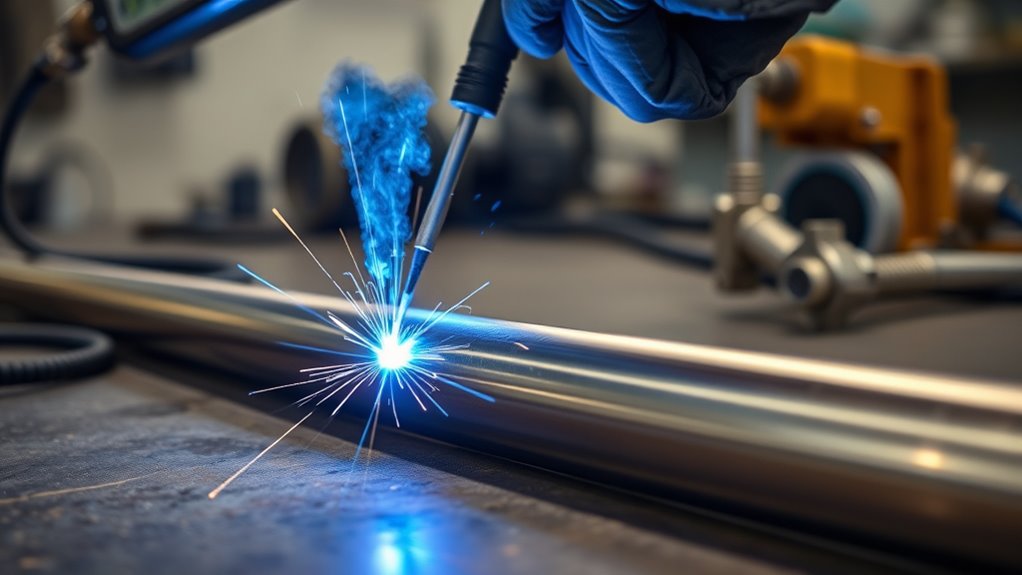
Burn-through happens when the pipe edge melts faster than you can support the puddle. Start with a tight joint, a low stable setting, and scrap material that matches the final tube.
- Use small tacks: place them around the tube so the joint cannot pull open as it heats.
- Keep the arc short: a long TIG arc spreads heat and weakens shielding.
- Move steadily: pausing in one spot overheats the edge.
- Add suitable filler: a small amount can bridge the joint and absorb heat, but too much creates a bulky bead.
- Back purge stainless: protect the root from heavy oxidation and keep a vent path so purge pressure does not disturb the puddle.
- Skip around the joint: weld short sections in different locations instead of completing one long pass.
For welded hangers or flange attachments, keep fillet weld sizing proportional to the thinner part instead of adding an oversized bead. If a hole starts, stop and let the area cool. Reduce heat, shorten arc time, and rebuild the edge with small tacks rather than holding the arc over the opening.
Common Exhaust Welding Problems and Fixes
- Pinholes: clean the joint again, check gas coverage, and repair each pore with a brief controlled weld.
- Porosity: look for drafts, leaks in the gas system, dirty metal, excessive gas flow, or a clogged nozzle.
- Cold lap or poor fusion: increase heat slightly, reduce travel speed, or correct the torch and gun angle.
- Excessive heat tint or sugaring: improve shielding, shorten arc time, and use a proper back purge on stainless.
- Warped alignment: add more balanced tacks, shorten weld segments, and let the assembly cool between sections.
- Repeated cracking: inspect hangers, flex joints, engine movement, and pipe stress instead of rewelding the same crack.
How to Test Exhaust Welds for Leaks
Let the weld cool, then inspect the full circumference under bright light. Look for pinholes, undercut, missed edges, cracks, or spots where the bead sits on top without blending into both sides.
The safest first leak test uses the engine off. Introduce low, regulated air or smoke into the exhaust without sealing the system into a dangerous pressure vessel. Brush soapy water over the weld and watch for growing bubbles, or look for smoke escaping from the joint.
Do not use oxygen for pressure testing. Keep pressure low, provide a relief path, and follow the test-equipment manufacturer’s instructions. Thin mufflers and converters are not designed for high test pressure.
A running check should be brief and performed outdoors or with approved exhaust extraction. Keep hands, clothing, and tools away from hot and moving parts. Listen for ticking or hissing and use a safe inspection method rather than touching the pipe.
After the first heat cycle, recheck the exhaust pipe welds and nearby hangers. Thermal expansion can reveal a small leak or a stressed alignment that was not obvious while the system was cold.
How to Choose TIG, MIG, or Stick for Your Build
- Choose TIG for thin stainless, turbo piping, visible custom work, and joints where precise filler control matters.
- Choose MIG for general repair, faster fabrication, mild steel, and correctly configured stainless work.
- Choose stick only for limited repairs on sufficiently thick steel parts when better-suited equipment is unavailable.
Also consider access, wind, available power, required finish, and your skill level. A clean MIG weld is better than a contaminated TIG weld, and a replacement section is better than any process applied to metal that is too thin to support a repair.
Products Worth Considering

E308LFC-O FLUX CORE WIRE: E308LFC-O is a stainless steel welding wire featuring flu core inside, which is used to stabilize the arc, improve the operating performance and play a protective role.

This solid wire REQUIRES a shielding gas
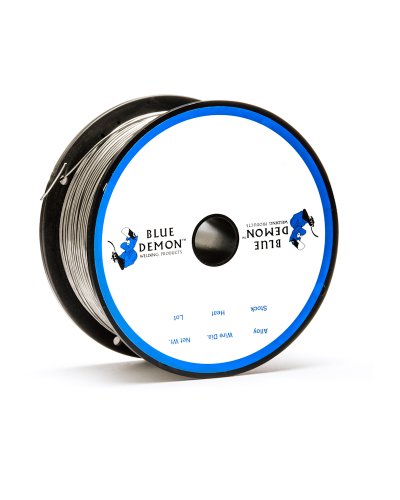
AWS classification E309LFC-O
Frequently Asked Questions
What Is the Best Welding Method for Exhaust?
TIG is usually best for precise work on thin stainless exhaust tubing. MIG is often the better practical choice for fast mild-steel repairs and repeat fabrication. The correct answer depends on the metal, thickness, joint access, and finish you need.
Is MIG or TIG Better for Exhaust?
TIG gives finer control over heat and filler placement, which helps on thin stainless and visible custom joints. MIG is faster and easier to repeat, making it practical for general exhaust repair and production work.
Is 304 or 316 Better for Exhaust?
304 stainless is common in aftermarket exhaust systems and offers a strong balance of corrosion resistance, availability, and cost. 316 has better resistance to many chloride environments, but it is not automatically necessary for a normal automotive exhaust. Match the grade to the service environment and the rest of the system.
What’s a Good Welding Setting for Exhaust?
There is no universal setting. Pipe thickness, alloy, wire or filler size, joint gap, position, and machine design all matter. Start with the welder or consumable manufacturer’s chart, test on matching scrap, and adjust until both edges fuse without burn-through.
Can You Weld Exhaust Pipe With Flux Core?
Yes, but self-shielded flux core is usually harder to control on thin exhaust tubing and creates slag and spatter. It is more useful for outdoor work on suitable steel thicknesses. Gas-shielded MIG or TIG is normally cleaner for common exhaust fabrication.
Do You Need to Back Purge a Stainless Exhaust?
Back purging is strongly recommended for full-penetration TIG welds when you want a clean stainless root. Argon displaces oxygen inside the tube and reduces heavy root oxidation. Keep a vent opening so purge pressure cannot push the puddle outward.
Should You Remove the Exhaust Before Welding?
Remove it when practical. Bench welding improves access and keeps sparks, heat, and welding current away from fuel lines, wiring, sensors, undercoating, and interior materials. If on-vehicle welding is unavoidable, follow the exact service manual and use proper lifting, fire, and electrical precautions.
Conclusion
TIG is usually the best process for thin stainless exhaust tubing when you need precise control and a clean finish. MIG is often the best practical choice for faster repair and fabrication. Stick welding belongs only in limited situations involving suitably thick steel.
Process choice cannot make up for rusted-out metal, poor fit-up, the wrong filler, or unsafe preparation. Cut back to sound material, match the consumables to the alloy, control heat with balanced tacks and short sections, and leak-test the completed joint before returning the vehicle to service.
Sources
- Miller — MIG vs. TIG Welding Equipment and Process — process control, heat input, and pacing
- Lincoln Electric — MIG Welding Stainless Steel — stainless wire, gas, and process setup
- OSHA — Welding, Cutting, and Brazing General Requirements — ventilation, fumes, fire prevention, and hot-work safety
- CDC/ATSDR — Phosgene Medical Management Guidelines — chlorinated-solvent decomposition near welding heat
- Nickel Institute — Nickel in Process Engineering — corrosion differences between 304 and 316 stainless steel
- MagnaFlow — Converter Tubing and Wall Thickness — common 16-gauge and 18-gauge exhaust tubing dimensions