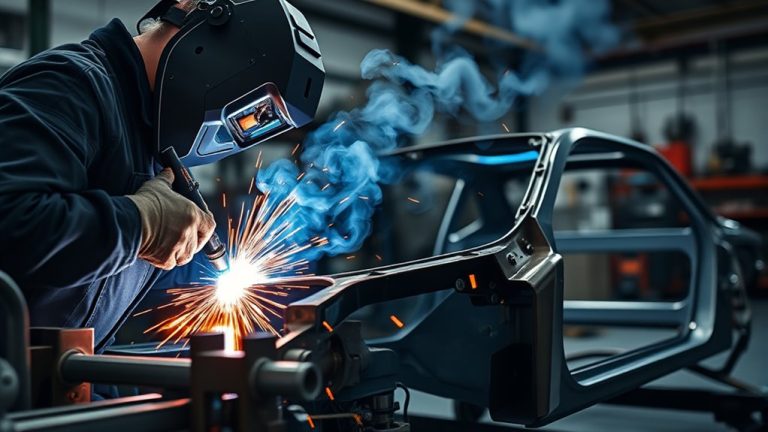
Automotive welding lets you join, repair, and fabricate vehicle metal using processes like MIG, TIG, spot, and laser welding. You’ll usually work with steel, aluminum, stainless, or galvanized panels, so you need the right filler, shielding gas, and heat control. MIG handles most auto repair fast, while TIG and spot welding suit precision or thin sheet work. Always wear PPE, ventilate well, and disconnect the battery. Keep going to see which method fits each job.
What Automotive Welding Includes
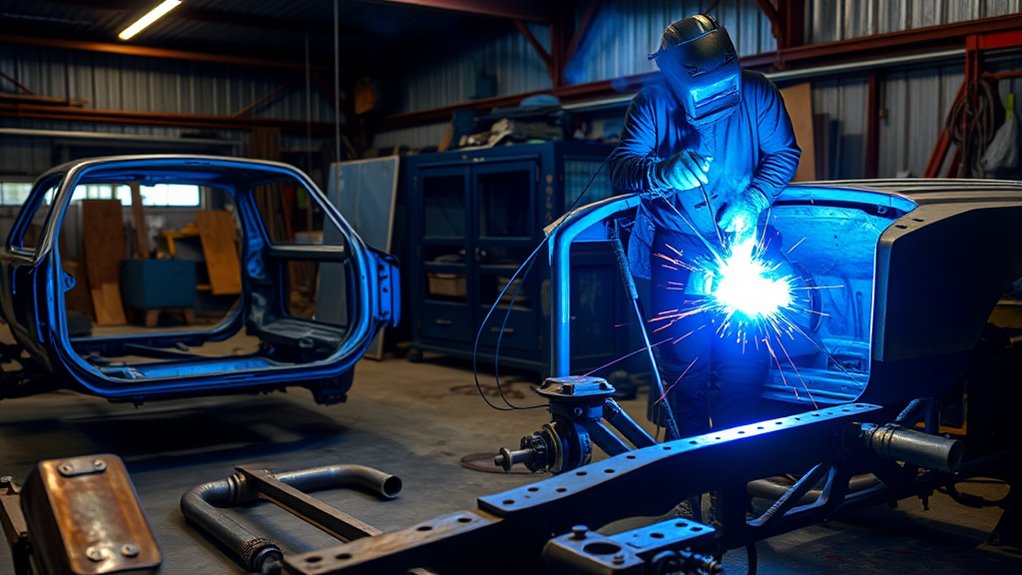
Automotive welding covers the core joining methods used in vehicle manufacturing and repair, including MIG, TIG, and resistance spot welding, each chosen for specific materials and joint requirements.
You use these welding techniques on advanced high-strength steels, aluminum alloys, and galvanized steel, so you need precise heat control and compatible filler choices.
In automotive applications, you balance speed, penetration, and appearance while meeting strict safety and quality standards.
You’ll see these processes in mass production, custom fabrication, and vintage restoration, where strong joints protect structure and finish.
Skilled work means handling thin sheet metal, complex geometry, and dissimilar materials without distortion or weakness.
Skilled welding demands control over thin sheet metal, complex shapes, and mixed materials without warping or weakness.
You also inspect fit-up, joint prep, and weld quality to keep the vehicle dependable and roadworthy.
When you master the process, you gain the freedom to build, repair, and restore with confidence. Additionally, understanding welding safety protocols is essential to ensure a secure working environment while welding.
Common Types of Automotive Welding
Common automotive welding falls into five practical categories: production, repair, custom fabrication, restoration, and general-purpose work.
In production, you’ll see high-volume assembly methods built for speed and repeatability, especially resistance spot welding.
In repair, you restore damaged structure and keep the vehicle within safety specs by matching the right welding techniques to the job.
Custom fabrication gives you freedom to build and modify parts for unique demands, but it asks for skill and careful fit-up.
Restoration work focuses on vintage vehicles, so you use period-accurate processes and automotive materials to protect historical integrity.
General-purpose welding covers MIG, TIG, and stick processes that you adapt to different thicknesses and metals. Understanding the differences in MIG welding advantages allows you to choose the process that serves the metal, the mission, and your own independence.
MIG Welding for Auto Repair
MIG welding is often the go-to process for auto repair because it gives you fast, versatile control on thin sheet metal and heavier sections alike, from 24-gauge panels up to 1/4-inch stock in carbon steel, stainless steel, and aluminum.
MIG welding offers fast, versatile control for auto repair, from thin sheet metal to 1/4-inch stock.
You feed wire continuously, and a 75/25 argon-CO2 shield keeps the puddle clean. These MIG advantages let you move quickly without giving up strength.
- Keep wire stickout at 1/4 to 3/8 inch.
- Use a push angle on thinner metal for a cleaner bead.
- Adjust voltage and amperage for flat, horizontal, vertical, and overhead work.
- Wear a helmet, gloves, and protective clothing every time.
When you practice welding techniques with steady hands and correct settings, you gain freedom to repair panels, brackets, and frame sections with confidence. Remember, maintaining proper settings is essential to prevent burn-through and ensure strong welds.
Stay aware of fumes and sparks, and let the process do the work.
When to Use TIG, Spot, and Laser Welding
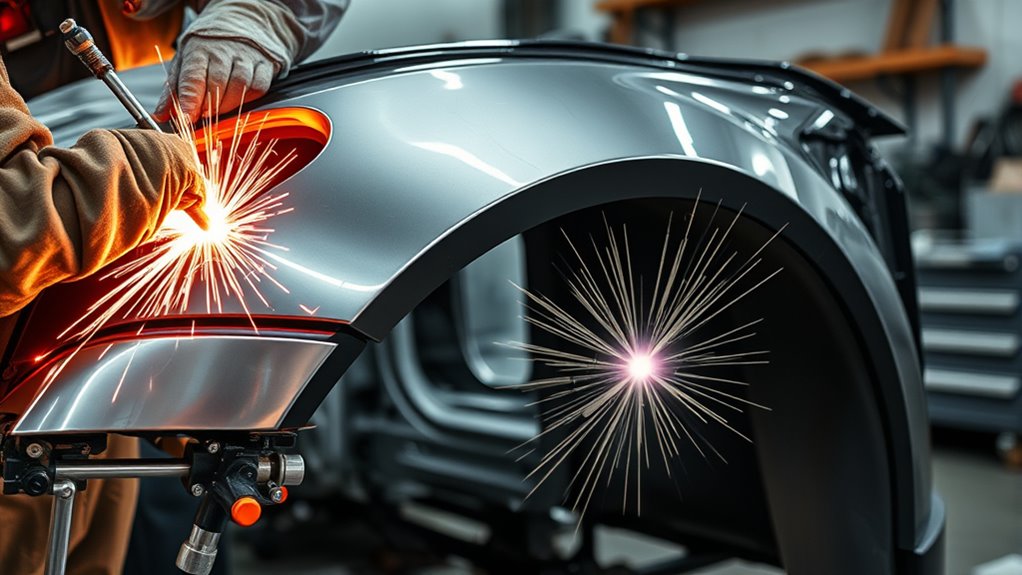
You’ll use TIG welding when you need precision on thin aluminum or stainless steel and want minimal distortion with a clean finish. Use spot welding for fast, repeatable assembly of overlapping sheet metal in high-volume body production. Choose laser welding for critical joints that need high speed, tight control, and a small heat-affected zone. Additionally, consider minimizing heat input to prevent distortion during the welding process.
TIG for Precision Work
For precision automotive work, TIG welding is often the best choice when you need clean, controlled welds on thin aluminum or stainless steel. You guide a non-consumable tungsten electrode, so you control the puddle, limit contamination, and protect weld quality.
That gives you real TIG advantages:
- Tight heat input on delicate panels
- Clean beads with minimal spatter
- Strong control over filler addition
- Better visibility for exact fit-up
Use TIG when you’re chasing detail, cosmetic finish, or repair accuracy on high-value parts.
Spot welding fits fast assembly, and laser welding suits rapid, deep-penetration structural work. If you want precision without surrendering control, TIG lets you shape the joint on your terms.
Spot Welding for Assembly
Spot welding is the go-to process for automotive assembly when you need to join overlapping thin sheet metal quickly and repeatably in high-volume production.
You clamp panels together, pass current through them, and create a localized weld with little heat spread. That’s one of the key spot welding benefits: speed, consistency, and low distortion.
Use it for body panels and other mass-produced joints where throughput matters more than cosmetic finesse.
But know the spot welding limitations: it’s best on thin, overlapping sheets, and it won’t suit every material or joint design.
When you need tighter control, cleaner appearance, or work on aluminum and stainless steel, TIG may fit better.
For complex structural needs, you’d evaluate laser welding too.
Laser Welding for Critical Joints
Laser welding becomes the better choice when a joint needs precision, speed, and minimal distortion, especially on thin materials where heat control is critical.
You get strong Joint Quality with focused energy and a small heat-affected zone, so adjacent parts stay stable.
Use these Precision Techniques when Material Selection includes high-strength steels, aluminum alloys, or complex shapes.
- You need tight tolerances and clean seams.
- You want better Heat Management than spot or TIG methods.
- You’re scaling production and need Automation Benefits.
- You’re handling specialized Welding Applications in structural zones.
Laser welding fits automated lines, delivering repeatable results and freeing you from rework.
It’s a practical choice when you want control, consistency, and efficient performance.
Common Automotive Metals and Materials
You’ll work most often with steel and aluminum, so you need to match your process to each metal’s strength, weight, and heat response.
Coated steels, like galvanized body panels, can release zinc fumes and affect weld quality, so you have to control ventilation and prep carefully.
Stainless steel shows up in exhaust and corrosion-critical parts, and it needs tighter heat control to keep welds clean and strong. Additionally, when cutting stainless steel, using nitrogen plasma gas can significantly enhance cut quality and precision.
Steel And Aluminum
Aluminum cuts mass and helps efficiency, but you’ll face aluminum challenges like fast heat flow and oxide buildup.
- Steel welds predictably with standard procedures.
- Aluminum needs clean surfaces and tight heat control.
- Too much heat can warp either metal.
- Good fit-up keeps joints strong and efficient.
If you want repair freedom, learn each metal’s thermal behavior before you strike an arc. Match your process to the material, or you’ll get weak joints, distortion, and wasted effort.
Coated And Stainless
Coated steel and stainless steel show up often in automotive work, but each demands a different welding approach. When you weld galvanized panels, watch for coated steel challenges: zinc burns off fast, can contaminate the joint, and demands clean prep, tight fit-up, and strong ventilation. Stainless resists corrosion, but it pulls heat differently, so you need stainless steel techniques that limit warping and preserve bead control.
| Material | Key Issue | Your Response |
|---|---|---|
| Coated steel | Zinc fumes | Grind, vent, adjust heat |
| Coated steel | Weld contamination | Clean edges thoroughly |
| Stainless steel | Heat distortion | Use lower heat, tack well |
| Stainless steel | Oxide control | Keep shielding gas steady |
| Both | Thickness range | Match process to gauge |
Choose settings to suit 24-gauge through 1/4-inch.
Why Thin Sheet Metal Is So Hard to Weld
Thin sheet metal is hard to weld because it responds to heat very quickly: the small thermal mass lets temperatures spike fast, which can cause warping, distortion, and even burn-through if heat isn’t tightly controlled.
You need tight heat management and disciplined welding parameters to keep the bead from overpowering the panel. Warping prevention starts with short welds, balanced sequence, and joint design that spreads stress instead of trapping it.
- Low voltage helps limit excess input.
- Faster travel speed cuts burn through risks.
- Beveling can improve penetration on thin joints.
- Dissimilar metals demand extra attention to thermal expansion.
When you weld thin sheet, every second matters. Too much heat pulls the metal, too little leaves weak fusion. Preheating materials, similar to cast iron welding techniques, can also help mitigate cracking risks during the welding process.
Because automotive panels often mix materials, you’ve got to match process settings to the part, not the other way around. Control the puddle, control the distortion, and you’ll keep the structure intact.
Essential Automotive Welding Skills
| Skill | What you do | Why it matters |
|---|---|---|
| Distortion control | Stagger welds | Reduces warping |
| Positions | Weld flat, horizontal, vertical | Improves access |
| Material control | Match technique to metal | Boosts quality |
Practice wire stickout and feed speed until your puddle stays consistent. You should also adapt to aluminum and high-strength steels, because each one responds differently to heat. Understanding flux core welding can help you develop skills that enhance your overall welding technique. Build repeatable habits, and you’ll gain the control needed to weld clean, accurate automotive structures with confidence and less dependence on guesswork.
Automotive Welding Safety Basics
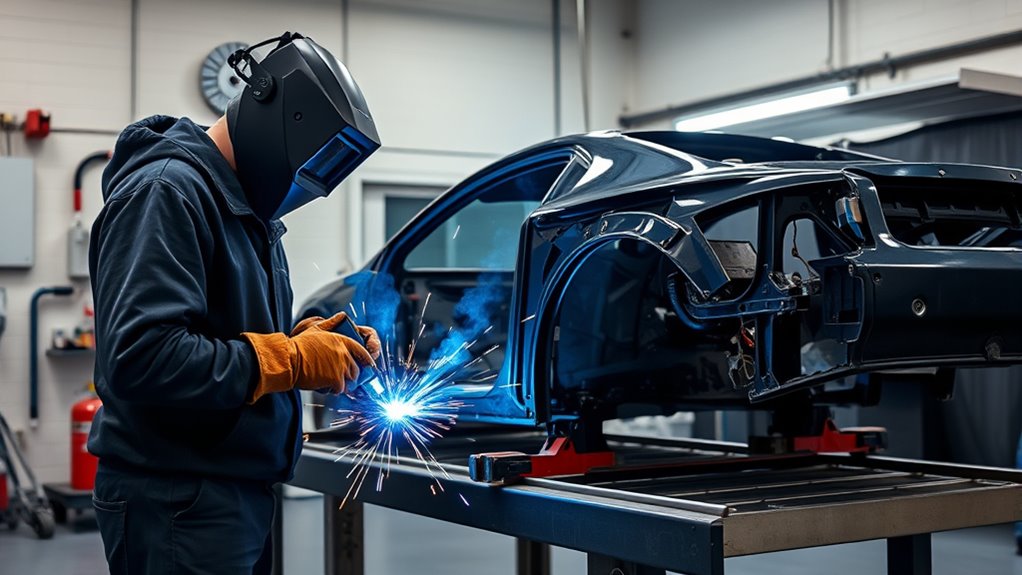
Before you weld, you need to wear proper PPE: a UV-rated helmet, gloves, and fire-resistant clothing. You also need to keep the work area ventilated, remove flammables, and keep a fire extinguisher close to control fumes and fire risk. Disconnect the vehicle’s negative battery terminal and verify solid grounding before you strike an arc to avoid electrical damage and shock. Additionally, ensure that your work area is free from combustibles to further minimize fire risks.
Protective Gear Essentials
Protective gear is your first line of defense in automotive welding, and you need the right equipment before striking an arc. Choose welding helmet features like automatic LCD shading so your eyes stay shielded from UV and infrared flash. Select glove materials built from sturdy leather for heat resistance and a firm tool grip.
- Wear a leather apron or heat-reflective jacket to block sparks.
- Use an FFP3 mask to reduce inhaling harmful welding fumes.
- Keep sleeves and cuffs tight so hot metal can’t slip in.
- Ground your setup properly to cut electrical risk.
When you gear up correctly, you work with more control, less fear, and greater freedom.
Fire And Fume Control
Good fire and fume control starts with a clean, well-ventilated workspace so toxic welding fumes from materials like galvanized steel and aluminum can disperse safely.
You should add fume extraction at the source whenever possible, because it removes harmful gases before they reach your breathing zone.
Keep flammable rags, solvents, and trim out of the area, and place a welding tarp under your work to catch sparks and molten spatter.
For fire safety, stage an extinguisher within reach and know how to use it before you strike an arc.
Set a fire watch during welding and for a short period after you stop, since hidden heat can reignite debris.
Build a simple emergency response plan so you can act fast and protect your freedom to work.
Vehicle Electrical Precautions
Even with the key off, a vehicle’s electrical system can still be damaged by welding current, so you should disconnect the negative battery terminal before you strike an arc. That step protects sensitive modules and keeps your welding techniques from sending surges through electrical systems.
Follow these safety protocols:
- Disconnect the battery.
- Ground the clamp close to the weld.
- Check wiring harnesses and modules.
- Use welding blankets over exposed components.
You need clear access, but stay away from ECUs, sensors, and harnesses. Map the vehicle’s electrical layout first, then weld with control and precision.
Good equipment maintenance matters too; inspect leads, clamps, and insulation before every job. When your gear is sound and your setup is isolated, you work freer, safer, and with less risk of costly damage.
Tools and Equipment You’ll Need
To handle automotive welding effectively, you’ll need a multi-process welder that can switch between steel and aluminum, plus specialty attachments like spot welding tools and a plasma cutter for more demanding cuts. Choose gear that supports your welding techniques and keeps equipment maintenance simple, so you can work cleanly and stay independent.
| Tool | Purpose | Why it matters |
|---|---|---|
| Calipers | Measure thickness | Guarantees accurate fit-up |
| Squares | Check alignment | Keeps joints true |
| 75/25 gas | Shield the arc | Produces cleaner welds |
| Auto-darkening helmet | Protect eyes | Improves visibility |
| Gloves and FR clothing | Block heat/sparks | Reduces injury risk |
Use quality wire with 75% argon and 25% CO2 for strong, clean beads. Wearing an auto-darkening helmet, gloves, and fire-resistant clothing protects yourself from UV light, heat, and sparks. With the right tools, you control the work instead of the work controlling you. Additionally, using 75/25 argon and CO2 mix enhances weld quality and minimizes oxidation for a better finish.
Career Paths in Automotive Welding
Automotive welding opens several career paths, so you can focus on the work that fits your skills and goals. You can enter manufacturing, collision repair, custom fabrication, or restoration welding, and each path rewards different strengths.
Production jobs often give you stable work because vehicle building and repair never stop. Entry-level roles let you build skill fast, then move into MIG, TIG, or laser welding for career advancement.
Production welding offers steady work, rapid skill growth, and a path to MIG, TIG, or laser specialization.
- Manufacturing welding for steady plant work
- Collision repair for fast-paced body shop service
- Custom fabrication for unique, high-value builds
- Restoration welding for classic vehicle preservation
If you earn industry certifications, you can boost your credibility and pay, especially in specialized shops. Additionally, understanding safety precautions is crucial to ensure a safe working environment while welding.
You’ll also need ongoing training, since materials and processes keep changing. Stay adaptable, keep learning, and you’ll expand your options without waiting for permission.
Frequently Asked Questions
How Do I Choose the Right Wire for Automotive Welding?
Choose wire types matching your metal: ER70S-6 for mild steel, stainless wire for stainless, and aluminum wire for aluminum. Match welding techniques, thickness, and shielding gas, then test feed and penetration for clean, strong repairs.
What Shielding Gas Works Best for Beginner Auto Repairs?
Use an argon mix, usually 75/25 argon-CO2, for beginner auto repairs; it gives stable arcs and cleaner welds. Set gas flow around 20–25 CFH, then adjust by listening for smooth coverage and minimal spatter.
How Do I Prevent Warping on Body Panels?
You prevent warping by stitching tiny welds, skipping around, and cooling often; think of a sun-baked hood buckling like foil. Keep panel alignment tight, control heat management, and let the metal rest.
Can I Weld Galvanized Steel Safely?
You can weld galvanized steel, but you shouldn’t inhale the fumes. Strip the coating first, use proper welding techniques, wear respiratory safety precautions, and ventilate aggressively so you protect your body and keep working freely.
How Do I Know if My Weld Penetration Is Strong Enough?
You know it’s strong when weld quality shows full fusion, uniform bead, and no root gaps; then you can verify with penetration testing. Cut, etch, or bend test samples, and you’ll confirm your weld’s strength.
Conclusion
Automotive welding brings your repair work together, from MIG and TIG to spot and laser methods. You’ll choose the right process by matching the metal, joint, and job. If you build solid skills, use the proper tools, and follow safety practices, you’ll keep every weld strong and clean. In this trade, your torch is the bridge between damaged parts and dependable performance. Keep learning, stay precise, and you’ll open real career doors.