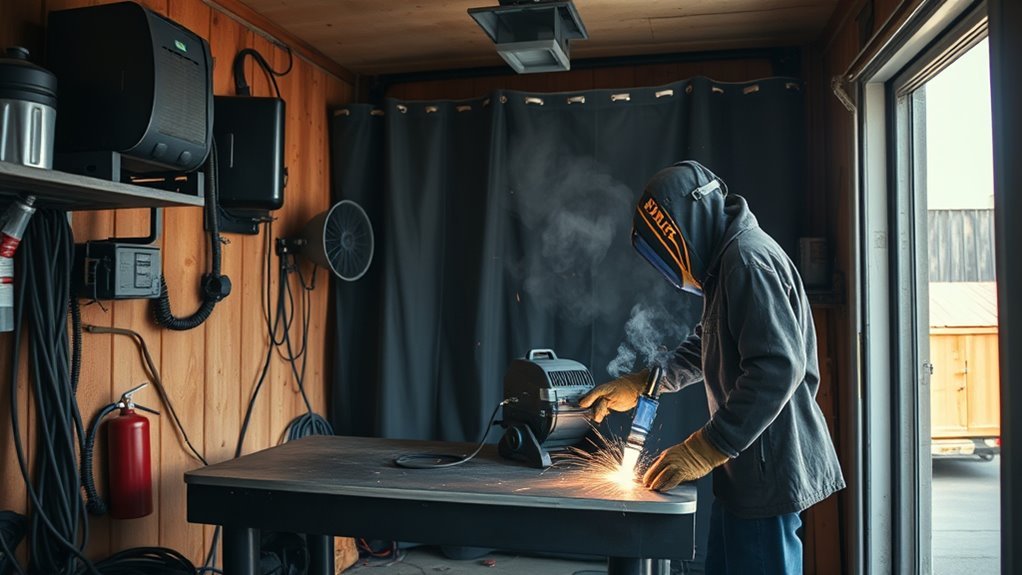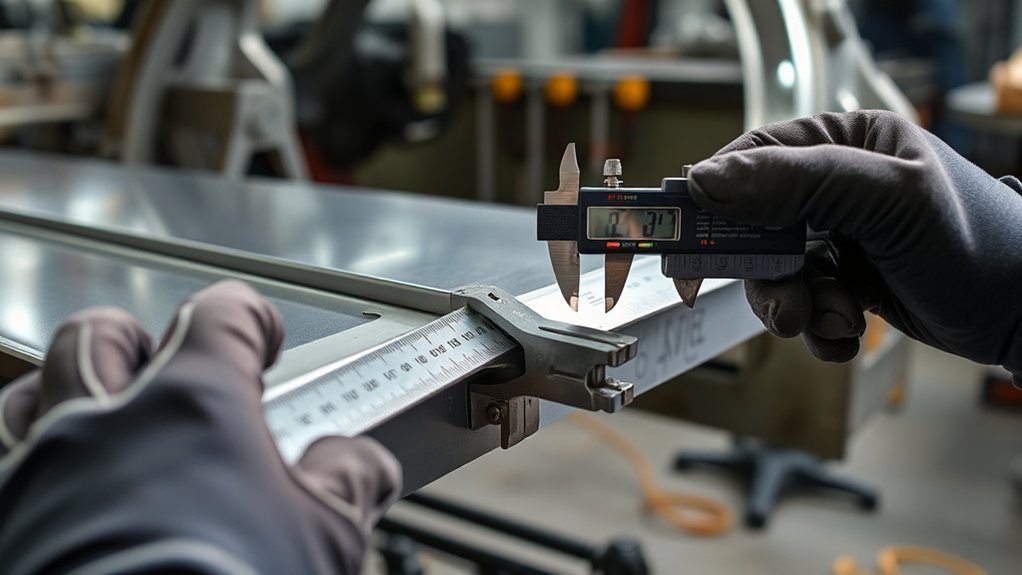
Before you weld an auto body panel, the gap must be even, the edges must sit flush, and the panel must still fit the surrounding parts. Start by aligning and clamping the panels so they cannot move. Then measure the opening with digital calipers, confirm tight clearances with feeler gauges or a panel gap gauge, and compare the readings to the vehicle’s OEM repair information. Recheck the seam before tack welding, because small fit-up errors are much easier to correct before heat locks the panel in place.
Quick Answer
To measure panel gaps before welding, dry-fit the panel, clamp it in its final position, hold digital calipers square to the seam, and measure at several points. Use feeler gauges or a panel gap gauge to confirm clearance, check flushness with a straightedge, mark tight or wide areas, then recheck before every tack weld.
Key Takeaways
- Use the OEM repair manual or build plan as the target, not a single universal gap size.
- Measure the seam in several spots, including both ends, corners, latch areas, and midspan.
- Check both gap width and flushness. A uniform gap still needs level panel faces.
- Correct tight, wide, tapered, high, or low areas before tack welding.
- After the first tacks, let the metal cool and measure again before adding more heat.
At a Glance
| Time Required | 20 to 60 minutes for dry-fit, measuring, marking, and rechecking before tack welding |
| Difficulty | Moderate; the measuring is simple, but the fit-up takes patience |
| Tools Needed | Digital calipers, feeler gauges or panel gap gauge, straightedge, panel clamps, masking tape, marker or layout dye, PPE |
| Cost | About $25 to $120 for basic measuring and clamping tools if you already own welding equipment |
Warning: Welding and cutting can create fire, burn, fume, UV, electrical, and sharp-edge hazards. Before any tack weld, remove nearby combustibles, keep suitable fire-extinguishing equipment ready, clean coatings from the weld area, use ventilation, wear welding PPE, and follow the vehicle service manual for battery and electronics precautions. OSHA’s welding guidance covers hot-work hazards, PPE, ventilation, and fire controls in more detail.
Check the OEM Spec or Build Target First
Before you measure a gap, decide what target you are measuring against. On a collision repair, use the current OEM repair manual for that exact year, make, model, and panel. On a custom or restoration build, use the approved build plan and keep the visual reveal consistent from one panel to the next.
This matters because an exterior body-panel gap is not always the same thing as a weld joint gap. A door-to-fender reveal, a butt-weld root opening, a lap joint, and a plug-weld flange all have different fit-up needs. If the repair procedure gives a weld method, sectioning location, adhesive requirement, squeeze-type resistance spot weld location, or flange preparation step, follow that procedure first.
For general hot-work safety, OSHA says welding, cutting, and brazing are covered under specific standards for general industry, maritime, and construction. You can review OSHA’s welding topic page here: OSHA Welding, Cutting, and Brazing.
Align and Clamp the Panels First
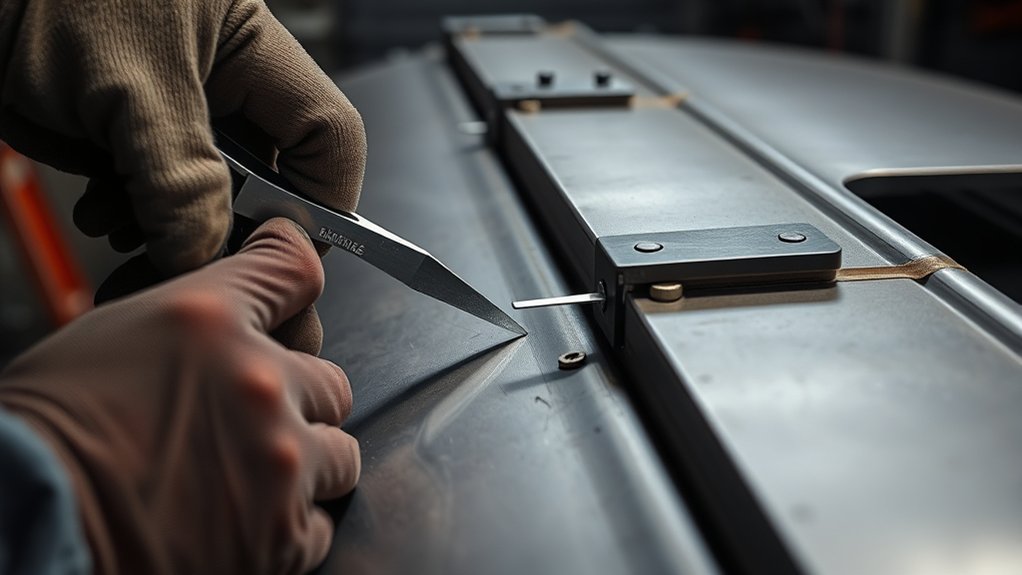
Start by aligning the panels so their edges sit in the final repair position before you measure anything. Install nearby bolts, hinges, latch parts, temporary screws, clecos, or panel clamps as needed so the panel cannot slide while you work. If the panel moves after the first measurement, the numbers are no longer useful.
Check the full seam from end to end. Look at the corners, body lines, latch edge, hinge edge, and any area that meets a weatherstrip. A gap that looks even in the center can still be tight at one corner or proud along one edge.
After each correction, double-check alignment and clamp pressure. A clamp that is too loose lets the panel creep. A clamp that is too tight can pull thin sheet metal out of shape. Wear proper protective clothing while you fit and weld, because sharp edges, grinding dust, sparks, and hot metal can injure you before the final weld even starts.
Pro Tip: Do a dry fit with the surrounding parts installed whenever possible. Doors, hoods, deck lids, fenders, weatherstrip, and latch hardware can all change how the gap looks once the panel is under real load.
Use Calipers and Feeler Gauges
Use two tools to lock down the gap: digital calipers for the visible width and feeler gauges or a panel gap gauge for exact clearance. Hold the caliper jaws square to the seam, not at an angle. If the tool is tilted, the reading can look wider than the real gap.
Measure the gap in the same direction each time. For a vertical seam, keep the calipers level and measure straight across the opening. For a horizontal seam, keep the tool vertical and measure straight up and down. Then slide the feeler gauge into the opening to confirm whether the clearance is tight, loose, or consistent.
Good measurements also depend on clean edges. Remove burrs, old seam sealer, paint buildup, weld spatter, and dirt from the measuring area. For weld joints, clean surface preparation also helps reduce contamination and supports proper proper fillet weld sizing where a fillet weld is part of the repair.
| Tool | Purpose |
|---|---|
| Digital calipers | Measure visible gap width from edge to edge |
| Feeler gauges | Confirm exact clearance in tight areas |
| Panel gap gauge | Check common body reveal sizes quickly |
| Straightedge or level | Check whether panel faces sit flush |
Products Worth Considering

【6 inch Digital Caliper Set】Experience accuracy with a measurement range of 0 - 6 inch (0 - 150mm), a resolution of 0.0005 inch/(1/128 inch)/0.01mm, and an impressive accuracy of 0.001 inch/0.02mm.Neoteck caliper ensures precise measurements for inside,outside,depth,and step dimensions,making it a reliable companion for your projects

[INCH/MM Conversion]: One button can quickly convert two measuring unit (INCH/MM). Measuring Range:0 - 150mm (6") / Resolution: 0.01mm (0.0005")/Accuracy: ±0.02mm (0.001")
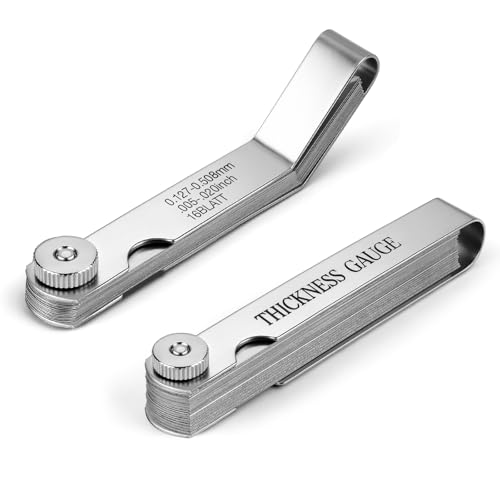
Precision Measurement: The straight feeler gauge measures 0.0008-0.04"/0.02-1mm, and the offset gauge covers 0.005-0.02"/0.127-0.508mm, making it great for a wide range of precision gap measurements
Choose the Right Gap Size
Once the seam is measured accurately, choose a gap size that matches the repair, not a generic number. For a collision repair, the safest answer is the OEM service procedure. For a custom body-panel reveal, the goal is usually a clean, even visual line that matches the surrounding panels. For a weld joint, the target depends on the metal thickness, joint type, welding process, and repair procedure.
Some custom builders use tight, even reveal gaps for modern vehicles and slightly larger visual gaps on older restorations, but those are appearance targets. They are not universal welding rules. If you are welding sheet metal, a large gap can burn back, distort, or require too much filler metal. If the gap is too tight where expansion is expected, the panel can bind after paint, weatherstrip, or heat movement.
Use digital calipers to confirm the width, then compare the readings from door to fender, hood to fender, deck lid to quarter panel, or any matching panel pair. If hinge clearance or latch movement demands more space, adjust the surrounding metal before welding. When needed, trim or add material so the opening stays even. For structural repairs, always confirm the gap and weld method against OEM body repair manuals.
Products Worth Considering

【Accurate Measuring Tools】: Aurdeayi digital caliper Measuring Range: 0 - 6 inch/ 0 - 150 mm; Accuracy: ±0.001 inch/ 0.02 mm and Resolution: 0.0005 inch/ 0.01 mm

Best Cost-effectiveness: We've crafted this plastic digital caliper with a singular focus – delivering unmatched value at an unbeatable price. While others chase high-precision innovations, we prioritize essential features that truly matter.

LARGE LCD SCREEN & GIFT: Premium digital caliper, the large and easy-to-read LCD display helps you get precise results quickly and easily, auto turn the vernier caliper on when you slide the rail and auto shut off after 5 minutes without using
Check Flushness at the Panel Edges

With the gap size set, verify that both panel edges sit flush. A seam can have the right gap and still be wrong if one edge is higher than the other. That step will show through filler, primer, and paint if you ignore it.
Place a straightedge or level across the joint and inspect the full length. If one side sits proud, adjust the panel, shim the mounting point, correct the flange, or lightly reshape the edge before welding. Use clamps to hold the panel in position while you confirm the even gap and the face alignment.
Keep the work area clear of combustibles while you check, grind, or weld. OSHA’s general welding requirements say movable fire hazards should be taken to a safe place, and if hazards cannot be moved, guards should be used to protect them. You can review the standard here: OSHA 29 CFR 1910.252. This is also the time to clear nearby flammable materials.
| Check | Good Result |
|---|---|
| Edge alignment | No step, overlap, or lifted edge |
| Straightedge test | Straightedge touches both panel faces evenly |
| Clamp hold | Panels stay still without oil-canning or twist |
| Final prep | Ready for marking, cleaning, and tack welding |
Measure Panel Gaps at Multiple Points
After you’ve confirmed that the edges sit flush, measure the gap at several points along the joint. Take readings at both ends, near corners, around body lines, at the latch area, near hinges, and through the middle of long spans. A long seam may need marks every 3 to 6 inches so you can see the pattern.
Hold the calipers at 90 degrees to the seam and write each value down in order. Do not rely on memory. A simple sequence like “top, upper-middle, center, lower-middle, bottom” makes it easier to spot a tapered gap. If the numbers drift wider or tighter in one direction, the panel may be twisted or pulled by a clamp.
Compare the readings against the straightedge check. A wide gap with level faces needs a different correction than a normal gap with one panel sitting high. Before welding, the metal should also be properly prepared so dirt, coatings, and moisture do not weaken the weld.
A panel gap is ready for tack welding only when the width, flushness, clamp hold, and surrounding-panel fit all check out at the same time.
Mark Trimming Areas Before Welding
Mark trimming areas before you weld so you know exactly where material needs to come off. Use masking tape on both the new panel and the existing panel, and keep the edge line visible. For fine work, use layout dye or a sharp marker so the trim line does not disappear while you handle the panel.
Measure each panel gap at 90 degrees after marking. If the tape or layout line changes how you see the edge, measure again before cutting. If you see uneven spots, mark only the area that needs correction. Do not grind the whole edge just because one corner is tight.
Before you cut, confirm that the panel is aligned correctly. Check the fit with the weatherstrip, latch, hinge, or adjacent panel installed when those parts affect the final position. The goal is a panel that fits after welding, not just a panel that looks good while it is loose on the bench.
Surface prep also matters when coatings are present. OSHA notes that welding surfaces should be cleaned of coatings that could create toxic exposure, such as paint or solvent residue. You can review OSHA’s welding fume guidance here: Controlling Hazardous Fume and Gases during Welding. This is especially important when doing surface preparation on coated or galvanized steel.
Fix Common Gap Problems Before Tack Welding
Do not tack weld a panel just because it is close. Correct the problem while the metal is still easy to move. Use small adjustments, then remeasure the same points. Big corrections made too late often create a new problem somewhere else.
| Problem | Likely Cause | Fix Before Welding |
|---|---|---|
| Gap is too tight | Panel edge is long, burr is present, or panel is shifted | Remove burrs, adjust clamps, or trim only the tight area |
| Gap is too wide | Over-trimming, panel pulled away, or wrong panel position | Reposition the panel, add metal if needed, or replace a poor patch edge |
| Gap tapers from top to bottom | Panel is rotated or hinge/latch alignment is off | Loosen clamps, square the panel, and recheck adjacent reveals |
| One edge sits high | Flange is bent, clamp pressure is uneven, or metal is crowned | Correct the flange, adjust clamp pressure, or lightly metal-finish the edge |
| Gap changes after clamping | Clamp is pulling thin metal out of shape | Use more support points and lighter, more even clamp pressure |
Recheck Panel Gaps Before Tack Welding

Before you tack weld, recheck every panel gap at 90 degrees to confirm the spacing is still even. Use digital calipers at the same marked points and compare the readings to your target. Check flushness again with a straightedge. If one edge is high or low, correct that before adding heat.
Check doors, hoods, deck lids, fenders, and adjacent panels with the weatherstrip installed when it affects the final fit. Open and close the panel if it is a moving part. A gap that looks good while static can rub once the hinge, latch, or seal loads the panel.
Mark both panels with masking tape to preserve the set position and give yourself a clear visual reference. Make small, controlled adjustments, then repeat the measurement cycle until each gap matches. This helps maintain proper joint fit-up before the first tack.
| Check | Action |
|---|---|
| 90-degree gap | Measure and compare at every marked point |
| Flushness | Adjust panel height before welding |
| Weatherstrip fit | Confirm seal pressure does not move the panel |
| Fire safety | Clear combustibles and keep fire-extinguishing equipment ready |
Measure Again After the First Tacks
The first tack welds can move thin sheet metal. Place small tacks according to the repair procedure, skip around the seam to spread heat, and let the metal cool. Do not run a long bead just because the initial fit looked good.
After the first few tacks, measure the same marked points again. If the gap has started to close, widen, or step, stop and correct the fit before adding more tacks. This is the last easy chance to fix the seam without cutting welds back out.
Note: If the repair procedure calls for plug welds, squeeze-type resistance spot welds, adhesive, or a specific sectioning joint, do not substitute a different weld style just to make the gap easier. Fit the panel to the required repair method.
Frequently Asked Questions
How do you measure a panel gap before welding?
Clamp the panel in its final position, hold digital calipers square to the seam, and measure the gap at several marked points. Then use a feeler gauge or panel gap gauge to confirm tight areas, check flushness with a straightedge, and compare the readings to the OEM spec or build target.
How big should a weld gap be?
There is no single correct weld gap for every auto body repair. The right gap depends on the vehicle, panel location, metal thickness, joint design, welding method, and OEM repair procedure. Use the service information first. For custom work, keep the gap even and test the fit on scrap metal before welding the real panel.
Can a panel gap be measured with a gap gauge?
Yes. A panel gap gauge is useful for quick checks on visible body gaps. For weld fit-up, use it with digital calipers and feeler gauges so you can confirm both the visual reveal and the exact clearance at tight points.
Can you weld a 1/4-inch gap on auto body sheet metal?
You should not weld a 1/4-inch gap directly on typical auto body sheet metal unless a specific qualified repair procedure says to do it. That gap is usually too wide and can cause burn-through, distortion, and a weak repair. Refit the panel, trim a cleaner edge, add metal, or make a new patch.
Should panels be perfectly flush before tack welding?
They should be as flush as the repair procedure and panel design require. A small mismatch may look minor before welding, but it can become obvious after grinding, filler, primer, and paint. Check flushness with a straightedge before the first tack and again after the first few tacks.
Should you measure panel gaps with weatherstrip installed?
Measure with weatherstrip installed when it affects the final panel position, seal pressure, or latch fit. Weatherstrip can push a door, hood, or deck lid slightly outward, so a panel that looks correct without the seal may shift after final assembly.
Conclusion
Good welding starts before the arc. Align the panel, clamp it securely, measure the gap with calipers, confirm tight areas with feeler gauges, and check flushness with a straightedge. Use the OEM repair manual or build plan as your target, then mark and correct tight, wide, high, or low areas before tack welding.
Take your time at this stage. Small fit-up errors can turn into distortion, extra filler work, poor sealing, or a visible panel mismatch after paint. Measure twice, tack lightly, let the metal cool, and measure again before you commit to the final weld.
Sources
- OSHA Welding, Cutting, and Brazing — overview of welding hazards, standards, and safety resources.
- OSHA 29 CFR 1910.252 General Requirements — hot-work fire prevention, combustible material, fire extinguisher, and fire watch requirements.
- OSHA Fact Sheet: Controlling Hazardous Fume and Gases during Welding — welding fume hazards, surface cleaning, ventilation, and exposure reduction.
- OSHA Welding Hazards and Solutions — PPE, UV radiation, metal fumes, burns, electrical shock, and other safety hazards.