Resistance welding is a fast metal-joining process that uses electric current, electrode force, and contact resistance to heat parts until they fuse. In automotive manufacturing, you’ll see it most often in resistance spot welding for body panels, seam welding for sealed parts, and projection welding for fasteners and brackets. It is valued because it is quick, repeatable, easy to automate, and usually does not need filler metal.
Quick Answer
Resistance welding joins metal by clamping parts between electrodes and passing a high current through the contact area. The resistance at the joint creates heat, forms a weld nugget or seam, and bonds the parts under pressure. Automakers use it mainly for fast, repeatable body and component assembly.
Key Takeaways
- Resistance welding uses current, force, and time to create heat at the metal-to-metal contact point.
- Spot welding is the main automotive use, especially in body-in-white assemblies and sheet-metal flanges.
- Seam welding creates continuous sealed joints for parts that need airtight or watertight seams.
- Weld quality depends on the full stack-up, including material, thickness, coating, surface condition, electrode shape, current, force, and hold time.
- Safety still matters because resistance welding can create pinch points, hot metal, spatter, fumes, electrical hazards, and crush risks.
What Is Resistance Welding?
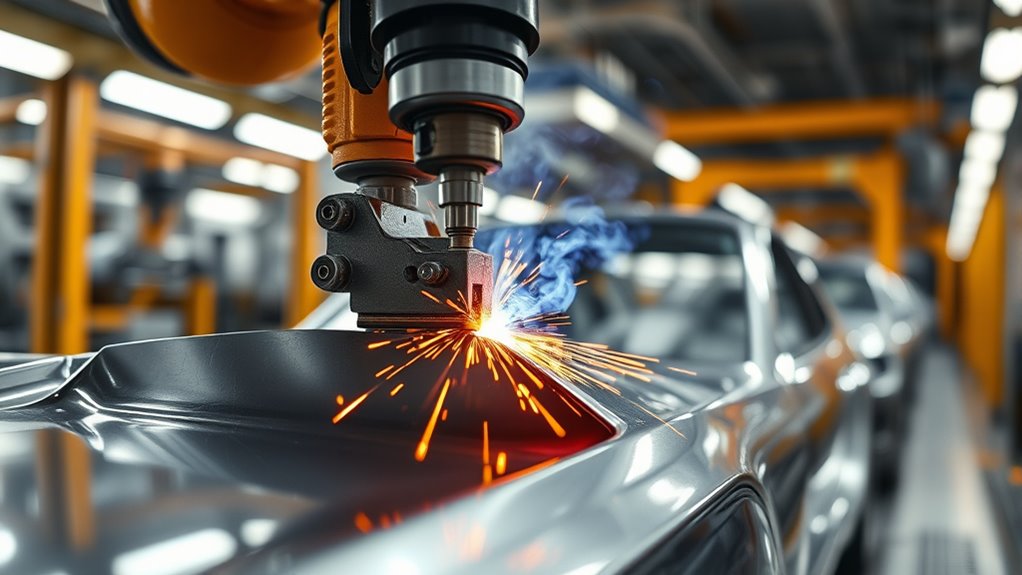
Resistance welding joins metal parts by pressing them together and sending electrical current through the joint area. The highest resistance is usually at the contact surfaces, so that area heats first. As the heat builds, the metal softens or melts locally and forms a bond while the electrodes keep pressure on the parts.
In automotive work, the process is common in body-in-white assemblies, brackets, reinforcements, seat structures, exhaust parts, battery-related structures, and sealed sheet-metal components. The most familiar version is resistance spot welding, where two electrode tips make one local weld point.
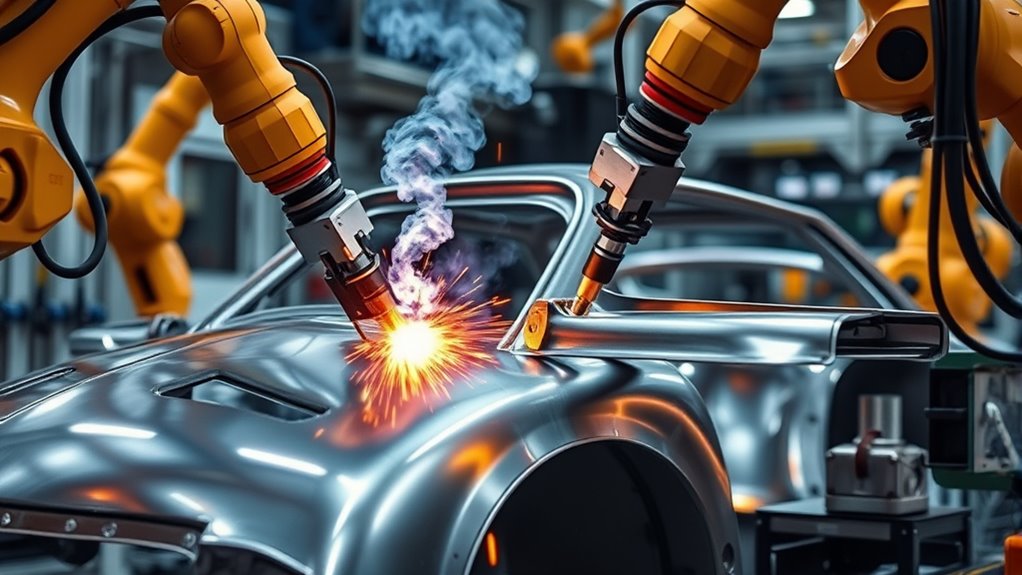
Because the process is easy to automate, it fits high-volume production. Robots can repeat the same weld locations, force, current, and timing with much tighter consistency than a manual process. That repeatability is one reason automakers rely on resistance welding when they need fast cycle times and controlled joint quality.
Note: Resistance welding is different from MIG, TIG, stick, and flux-core welding. It usually does not use a filler wire, filler rod, shielding gas, or open arc. The heat comes from electrical resistance at the joint.
How Resistance Welding Works
When you trigger a resistance weld, the machine clamps the workpieces between electrodes and sends a short, controlled current pulse through the stack. The current may be very high, often in the thousands to tens of thousands of amperes, depending on the material, thickness, coating, equipment, and weld schedule.
The joint heats because the parts resist the flow of electricity. In spot welding, that heat forms a small fused area called a weld nugget. After the current stops, the electrodes keep pressure on the joint while the nugget cools and solidifies.
The process works best when the machine, electrodes, material stack-up, and surface condition are matched. If the current is too low, the weld may be weak. If current or time is too high, the weld can overheat, spit molten metal, indent the sheet, or damage coatings.
Key Process Variables
| Current | Creates heat at the joint. Too little current gives weak fusion; too much can cause expulsion or burn-through. |
| Electrode Force | Holds the parts together and controls contact resistance. Too little force can cause spatter; too much can reduce heat at the interface. |
| Weld Time | Controls how long current flows. The goal is enough heat for fusion without overheating the sheet. |
| Hold Time | Keeps pressure on the weld after current stops so the nugget can solidify under compression. |
Main Types of Resistance Welding
The main resistance welding methods used around automotive and industrial production are spot welding, seam welding, projection welding, and flash or upset welding. They all use electrical resistance and pressure, but they apply heat and force in different ways.
Spot and Seam Welding
Spot welding joins overlapping sheets at individual points. Two electrode tips clamp the stack, current flows through the contact area, and a weld nugget forms between the sheets. This is the workhorse process for thin sheet-metal flanges in automotive bodies.
Seam welding uses rotating wheel electrodes instead of pointed electrode tips. The wheels roll along the joint and create a row of overlapping welds or a continuous seam. You choose seam welding when the part needs a long, sealed joint, such as certain tanks, containers, exhaust parts, or enclosed sheet-metal assemblies.
Projection, Flash, and Upset Welding
Projection welding uses raised features, embossments, or part geometry to focus current at specific points. It is useful for attaching nuts, studs, brackets, and small components to sheet metal because several welds can be made in one press cycle.
Flash welding and upset welding are resistance-butt processes. They are used when parts meet end-to-end rather than as overlapping sheets. Flash welding uses arcing and resistance heat before the parts are forced together. Upset welding brings prepared surfaces together under pressure and current until the joint reaches forging temperature.
These processes are less common than spot welding in visible car body panel work, but they matter in manufacturing because they can produce strong joints on parts with the right geometry and access.
Resistance Spot Welding in Cars
When you use resistance spot welding in cars, you pass high current through overlapping sheet metal to form a weld nugget in a very short cycle. Automakers use many spot welds across flanges, pillars, crossmembers, reinforcements, and closures to create a stiff vehicle shell.
Products Worth Considering


Fits Your Eastwood MIG 250 Welder and A2/24 Binzel Style Torch

Professional Dent Removal: VEVOR Stud Welder Dent Puller offers a fast and efficient solution for removing dents from car body, all while providing precise dent pulling and controlled force for a professional-grade dent repair every time.
Spot Welding Basics
Resistance spot welding works because the electrode tips focus current and force in one small area. The surface condition, coating, sheet thickness, electrode tip size, squeeze time, current, weld time, and hold time all affect the final nugget.
A good spot weld has enough nugget diameter and strength for the design load without excessive indentation, cracks, or expulsion. In production, weld schedules are qualified before use because the correct settings for low-carbon steel may not work for advanced high-strength steel or aluminum.
Car Body Assembly
In car body assembly, spot welding helps join multiple sheet-metal parts while maintaining structural integrity and crash performance. It is especially useful in body-in-white work because robots can place welds quickly and repeatably across long flanges.
Modern vehicles may use a mix of resistance welds, adhesive bonding, laser welding, mechanical fasteners, clinching, and rivets. Resistance spot welding remains valuable because it gives immediate mechanical attachment and works well with automated fixtures.
For aluminum and mixed-material stacks, the process window is tighter. Aluminum conducts heat quickly and has a tough oxide layer, so electrode condition, force, current profile, and surface preparation become more important.
Quality and Automation
Automated resistance spot welding keeps production fast, but it still needs strict quality control. The key quality target is usually the weld nugget, because nugget size and consistency affect joint strength.
Traditional checks can include peel testing, chisel testing, macro inspection, and destructive nugget measurement. These tests are useful, but they cannot be performed on every weld in high-volume production. That is why modern systems also use in-process data, such as current, voltage, force, displacement, and dynamic resistance curves.
Recent resistance spot welding research treats weld nugget behavior and process signals as key clues for quality control, especially when destructive testing is too slow for every production weld.
Research on dynamic resistance curves in automotive spot welding and model-based aluminum spot weld assessment shows why monitoring is becoming more important on modern production lines.
Resistance Seam Welding for Auto Parts
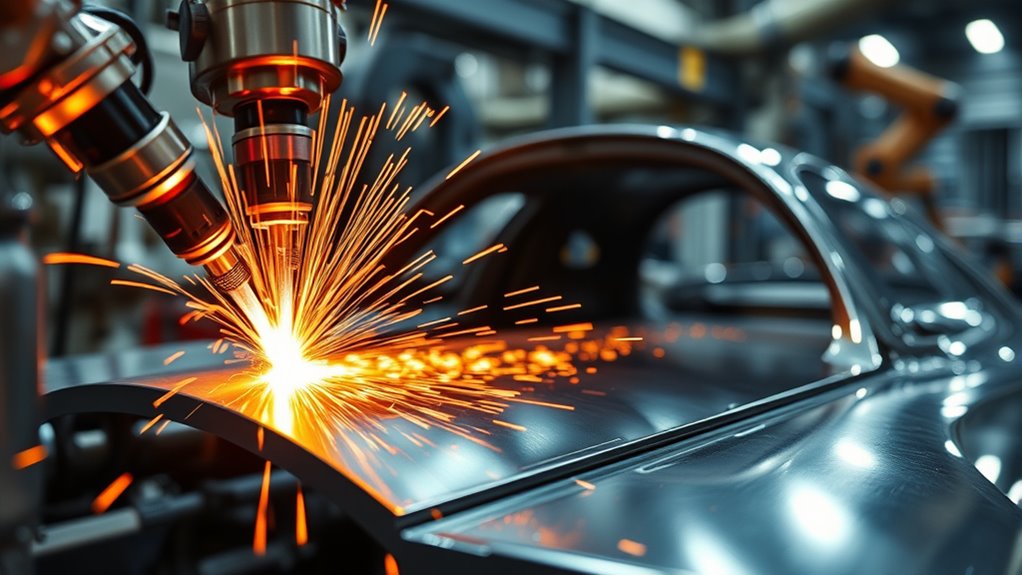
Resistance seam welding uses rotating wheel electrodes to form a continuous or nearly continuous weld along thin sheet-metal edges. You use it when a part needs a sealed joint rather than individual spots.
In automotive and industrial fabrication, seam welding can help produce leak-resistant joints on fuel-related components, containers, exhaust parts, and other thin sheet assemblies. The wheels apply force and current as the part moves, allowing the seam to form progressively along the joint.
Seam welding is useful because it combines speed with repeatability. It also limits the need for filler metal and can keep heat concentrated near the joint when the weld schedule is correct.
- Continuous welds help seal critical assemblies.
- Rotating electrodes support steady feed rates.
- Controlled heat helps protect thin sheet metal.
- Strong seams can reinforce formed components.
- Automation helps high-volume lines maintain repeatable throughput.
Products Worth Considering

PREMIUM FLAME RETARDANT (FR) FABRIC – This coat is made from ASTM D6413 compliant 9 oz. FR black cotton which prevents and extinguishes fire / flames. The fabric also has an anti-static coating for added longevity and protection.

FR Shirts Fabric: This flame-resistant shirt is crafted using flat-seam stitching and is knitted from 6 ounces of 100% flame-resistant cotton. This lightweight, high-visibility flame-resistant shirt is breathable, comfortable, and stand wear and tear.

【MATERIAL】- Made of high-quality fiber and copper material, corrosion-resistant, not easy to deform, owning a long service life.
Why Automakers Use Resistance Welding
Automakers use resistance welding because it is fast, repeatable, and well suited to sheet-metal production. Once the weld schedule and fixtures are qualified, robots can make thousands of similar welds with controlled force, current, and timing.
That speed matters in body-in-white assembly, where many panels and reinforcements must be joined before paint, trim, powertrain, and final assembly. Resistance welding also helps reduce added materials because many joints do not require filler metal, screws, or separate rivets.
Fast Assembly Lines
Resistance welding helps automakers keep fast assembly lines moving because spot welds are made in short cycles. Robots can repeat weld paths, fixture positions, and weld schedules with consistent timing.
- Rapid weld cycles keep stations moving.
- Automation supports stable production flow.
- Repeatable weld placement reduces variation.
- No filler metal is needed for most standard spot welds.
- Controlled schedules help reduce scrap and rework.
Strong Body Joints
| Benefit | Effect | Result |
|---|---|---|
| Short weld cycle | Fast sheet-metal joining | Higher throughput |
| Localized heat | Less heat spread than many fusion processes | Better control on thin panels |
| Automation-ready setup | Consistent force, current, and location | Repeatable joint quality |
Resistance welding does not make a vehicle strong by itself. The final strength depends on joint design, weld spacing, material grade, adhesive use, corrosion protection, and validated repair or production procedures. When all of those are controlled, resistance welds help create a rigid, durable body structure.
Best Materials for Resistance Welding
In automotive body assembly, the most common resistance-weldable materials include low-carbon steels, high-strength steels, advanced high-strength steels, aluminum alloys, and coated steels. Each material behaves differently under current and pressure.
Low-carbon steel is usually the easiest to resistance weld because it has a broad process window and predictable heat response. High-strength and advanced high-strength steels can also be welded, but they need tighter control of current, force, and time to protect strength and avoid brittle or undersized welds.
Aluminum alloys can be resistance welded, but they conduct heat quickly and may need higher current, careful electrode management, and cleaner surfaces. Research on aluminum spot welding continues because nugget formation, heat flow, and strength can be harder to control than with mild steel.
Coated steels, including galvanized sheet, need special attention because coatings affect contact resistance, heat generation, electrode wear, and surface condition. A validated weld schedule should account for the coating rather than treating it like bare steel.
Pro Tip: Do not copy a weld schedule from one material stack to another. A setting that works on bare mild steel may fail on galvanized steel, advanced high-strength steel, or aluminum.
- Low-carbon steel: broad weldability and common body-panel use.
- High-strength steel: strong joints when the weld schedule is qualified.
- Advanced high-strength steel: needs careful parameter control and inspection.
- Aluminum alloys: fast heat flow and tighter electrode control.
- Coated steels: coating thickness and surface condition affect weld quality.
Current, Pressure, and Time: What Controls Weld Quality
Weld quality in resistance welding depends on how you balance current, pressure, and time. These variables work together, so changing one affects the others.
Current creates the heat. Pressure holds the parts together and controls contact resistance. Weld time determines how long the heat builds. Hold time keeps the joint compressed while the weld cools. If any variable is wrong, the weld may be too small, too hot, cracked, deeply indented, or inconsistent.
You also have to adjust for material compatibility. Conductivity, coating, sheet thickness, and part geometry change how each stack-up absorbs heat. That means you should not rely on one fixed schedule for every joint.
Modern automotive resistance welding often uses monitoring data to catch variation. Systems may track current, voltage, force, displacement, electrode movement, or dynamic resistance. These signals help identify worn electrodes, poor fit-up, coating changes, or unstable welds before they create a large batch of defects.
Common Resistance Welding Challenges
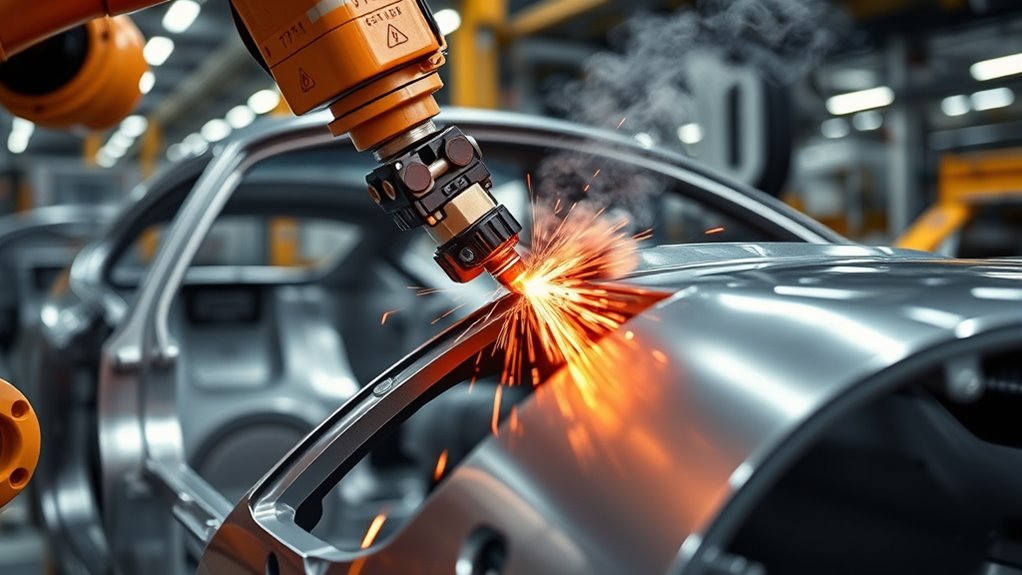
Even with tight control, resistance welding brings practical challenges that can affect consistency in automotive production. The most common problems come from poor surface condition, bad fit-up, electrode wear, coating buildup, incorrect weld schedules, or changing material thickness.
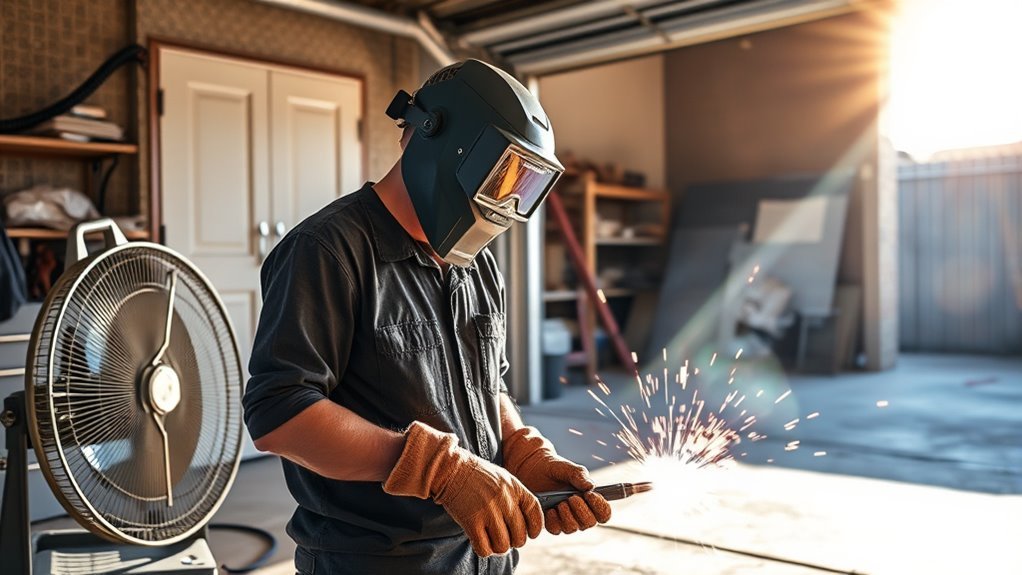
Warning: Resistance welding equipment can create electrical hazards, hot metal, spatter, pinch points, and crush injuries. Use guards, eye protection, gloves, training, and lockout procedures required by your shop and equipment manufacturer.
- Expulsion: molten metal is forced out of the joint, often from too much heat or too little force.
- Undersized nugget: the weld does not grow enough to meet strength requirements.
- Deep indentation: electrode force, heat, or tip condition marks the sheet too heavily.
- Electrode wear: tip shape changes, current density drops, and weld quality drifts.
- Coating pickup: zinc or other coatings build up on electrode tips and change heat flow.
- Poor fit-up: gaps between sheets reduce contact and make weld size inconsistent.
Advanced monitoring helps, but it does not replace good setup. You still need clean parts, proper clamping, maintained electrodes, qualified weld schedules, and regular inspection.
Safety and Inspection Checklist
Resistance welding may look cleaner than arc welding, but it is not risk-free. OSHA notes that welding, cutting, and brazing work can involve hazards such as fumes, burns, eye injury, electrical shock, cuts, and crushed fingers or toes. You should treat resistance welding equipment as industrial machinery, not as a simple hand tool.
- Confirm the machine is grounded and maintained according to the manufacturer’s instructions.
- Keep hands clear of electrode tips, clamps, fixtures, and moving guns.
- Wear eye protection for spatter and hot particles.
- Use gloves and protective clothing suitable for hot metal handling.
- Use ventilation when coatings, oils, or residues could create fumes.
- Keep electrode tips dressed, aligned, and cooled as required.
- Inspect welds for expulsion, cracks, indentation, poor location, and missing spots.
- Follow approved weld schedules and OEM repair procedures for vehicle work.
For general welding hazard guidance, review the OSHA welding, cutting, and brazing hazards page.
When Resistance Welding Is Not the Best Choice
Resistance welding is powerful, but it is not the right answer for every joint. It needs access for electrodes, enough electrical conductivity, proper part fit-up, and a material stack that can be heated and compressed in a controlled way.
You may need a different joining method when the part is too thick for the machine, when only one side is accessible, when the surface is heavily contaminated, when the materials are not compatible with the available weld schedule, or when the joint needs a long structural bead instead of individual spots.
In modern vehicles, resistance welding often works alongside structural adhesives, laser welding, rivets, clinching, and mechanical fasteners. The best method depends on material, crash requirements, corrosion protection, production speed, serviceability, and OEM repair rules.
Future Trends in Resistance Welding
As automotive plants adopt more sensors and advanced control systems, resistance welding is moving toward tighter process optimization and better in-process quality checks. The goal is not only to make welds faster, but to catch variation sooner.
| Trend | Impact |
|---|---|
| Real-time monitoring | Helps detect variation from fit-up, current, force, electrode wear, or coating changes. |
| Model-based quality control | Uses process data to estimate weld behavior when destructive testing is impractical for every weld. |
| Better electrode materials and cooling | Extends tip life and stabilizes heat flow in high-volume production. |
| Material-specific weld schedules | Improves results on advanced high-strength steel, aluminum, and coated sheet metal. |
These advances matter because vehicle bodies now use more mixed materials, higher-strength steels, and lightweight alloys. As the stack-ups become more complex, resistance welding needs better feedback, tighter control, and more careful validation.
Frequently Asked Questions
How is resistance welding used in automotive manufacturing?
Automakers use resistance welding mainly to join sheet-metal body parts, brackets, reinforcements, fasteners, and sealed components. Spot welding is the most common method for body-in-white assemblies, while seam welding is used where a longer sealed joint is needed.
What is the main drawback of resistance welding?
The main drawback is that weld quality depends heavily on surface condition, electrode access, material thickness, coating, electrode wear, and a validated weld schedule. Poor fit-up or worn tips can quickly lead to weak or inconsistent welds.
What are the four basic types of resistance welds?
The four common resistance welding types are spot welding, seam welding, projection welding, and flash welding. Upset welding is also part of the resistance-butt welding family and is often discussed with flash welding because both join parts end-to-end.
Does resistance welding need filler metal or shielding gas?
Most resistance welding does not need filler metal or shielding gas. The joint forms from the base metals themselves as current heats the contact area and electrode force holds the parts together.
Can aluminum be resistance welded in cars?
Yes, aluminum can be resistance welded, but it is more demanding than mild steel. It conducts heat quickly, often needs higher current, and requires careful control of electrode condition, surface preparation, force, and timing.
Conclusion
Resistance welding gives automotive manufacturers a fast, repeatable way to join sheet metal and related components. The process works by using electric current, pressure, and contact resistance to form a local weld nugget or seam without filler metal. That makes it especially useful for automated spot welding, seam welding, and projection welding on high-volume production lines.
The key is control. Strong welds depend on the right current, force, time, electrode condition, surface preparation, and material-specific schedule. As vehicles use more advanced high-strength steel, aluminum, coatings, and mixed joining methods, resistance welding will keep evolving through better monitoring, smarter controls, and tighter quality checks.
Sources
- OSHA Welding, Cutting, and Brazing Hazards and Solutions — backs general welding hazard and PPE guidance.
- Improved Training Strategies for Physics-Informed Neural Networks Using Real Experimental Data in Aluminum Spot Welding — backs aluminum spot welding and model-based quality-control trends.
- Functional Clustering Methods for Resistance Spot Welding Process Data in the Automotive Industry — backs dynamic resistance curve monitoring and process-data quality control.
- Influence of Process Parameters on Resistance Spot Welding of Advanced High Strength Complex Phase Steels — backs material-specific parameter control for AHSS.
- Quantifying Structure-Property Relationships During Resistance Spot Welding of an Aluminum 6061-T6 Joint — backs aluminum weld microstructure and strength considerations.