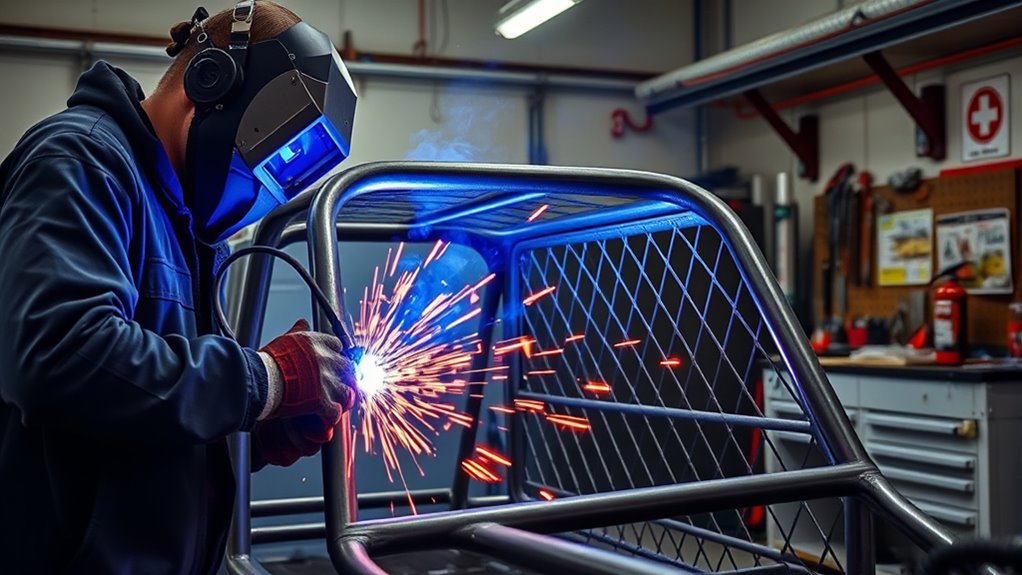
An automotive roll cage is a life-safety structure, not just a collection of strong-looking tubes. A safe result depends on the current rulebook, an approved design, traceable tubing, correct driver clearance, tight joints, complete weld access, controlled heat, and inspection before paint or track use.
Quick Answer
To weld an automotive roll cage safely, start with the current rulebook for the exact class and vehicle. Use approved tubing, position the cage around the seated driver, notch every joint tightly, tack the complete structure, make continuous fully fused welds with a qualified process, and arrange inspection before paint or track use.
Key Takeaways
- Use the current rulebook and obtain a pre-build review before buying or bending tubing.
- Design the cage around the seated, helmeted driver, seat, harness, steering wheel, and safe exit path.
- Use only permitted tubing with known material, diameter, and wall thickness.
- Tack the full cage first, then complete every required joint around its full circumference.
- Protect fuel lines, electronics, upholstery, glass, and hidden areas from current, heat, and sparks.
- Inspect the cage before grinding, coating, padding, or painting it.
At a Glance
| Time Required | Several days to several weeks, depending on design, interior removal, fabrication access, inspection, and required corrections. |
| Difficulty | Advanced, safety-critical fabrication. It is not a suitable first welding project. |
| Tools Needed | Approved cage design, tube bender, tubing notcher, measuring tools, angle finder, clamps, deburring tools, suitable welder, matching consumables, ventilation, fire protection, and full PPE. |
| Cost | Varies widely by vehicle, tubing, cage complexity, inspection requirements, and whether a qualified cage builder performs the work. |
What’s in This Article
- Why Roll Cage Design Comes Before Welding
- Before You Begin: Check the Rules and Driver Fit
- Choose Approved Tubing, Tools, and Welding Equipment
- Prepare the Vehicle and Work Area
- Measure, Notch, Fit, and Tack the Main Hoop
- Fit the Remaining Bars and Create Sound Load Paths
- Set the Welder and Validate Practice Joints
- Weld the Cage in a Controlled Sequence
- Common Roll Cage Welding Defects and Corrections
- Follow Current Racing Rules and Inspection Requirements
- Inspect the Cage Before Paint
- Complete the Occupant Safety System
- Welding Safety Measures
- Improve Your Roll Cage Welding Skills
- Frequently Asked Questions
- Conclusion
- Sources
Warning: A competition roll cage should not be your first structural welding project. An attractive bead does not prove penetration, material compatibility, or crashworthiness. Have the design and completed cage reviewed by the sanctioning body, track inspector, or an experienced professional cage builder.
Why Roll Cage Design Comes Before Welding
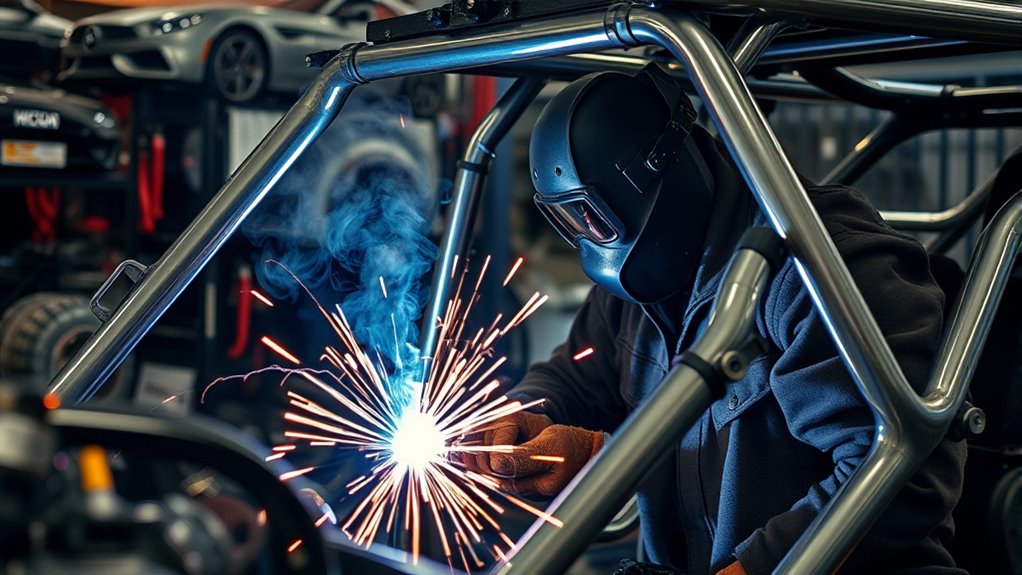
A roll cage helps preserve space around the occupants during a rollover or severe impact. Its performance depends on the complete structure, including the main hoop, front or halo structure, braces, door bars, mounting points, gussets, welds, and the vehicle areas carrying those loads.
You cannot judge a cage by tube diameter or bead appearance alone. A tube may meet a material specification but still be installed in the wrong location, connected to a weak panel, bent too tightly, or positioned where the driver can strike it.
A roll cage is a complete load path. Its weakest tube, joint, attachment, or unprotected occupant-contact area can limit the safety of the entire system.
Start with the rulebook used by the event, track, and class. NHRA, SCCA, NASA, FIA-based organizations, off-road groups, drifting organizations, and local tracks can use different requirements. The current SCCA General Competition Rules, for example, are updated during the year, while NHRA competitors must refer to the applicable current-year rulebook and class regulations.
Ask a technical inspector to review your proposed tubing, mounting points, bar layout, door protection, and welding process before fabrication. A short pre-build review can prevent expensive changes after the cage has been welded.
Before You Begin: Check the Rules and Driver Fit
A safe cage must fit the vehicle and the occupant. Complete the seating and driver-position plan before finalizing the tube layout.
Confirm the exact rules
- Identify the sanctioning body, class, expected elapsed time or performance level, and track-specific requirements.
- Use the current rulebook, technical bulletins, class supplements, and approved diagrams.
- Confirm permitted tubing material, outside diameter, wall thickness, mounting method, number of attachment points, door-bar design, gussets, padding, and inspection requirements.
- Ask whether chassis certification, inspection holes, material documentation, or periodic reinspection will be required.
- Do not assume a cage accepted by one organization will automatically pass another organization’s inspection.
Set the occupant position
Install or mock up the final seat, seat mounts, steering wheel, pedals, helmet, restraint system, and any head-and-neck restraint before locating the main hoop and upper tubes. Check the driver in the normal seated position, not while sitting unusually low or leaning forward.
Verify these points:
- Helmet clearance below and inside the protected cage envelope.
- Clearance between the helmet, arms, legs, and possible contact areas.
- Access to the steering wheel, controls, window net, door release, and emergency electrical controls.
- A practical exit route with the driver wearing normal racing equipment.
- Correct locations for the seat, harness bar, shoulder belts, lap belts, and anti-submarine belts according to their manufacturers and the rulebook.
- Protection of any tube the driver could contact during normal movement or a crash.
Note: Street use creates a different occupant environment because the driver may not wear a helmet or racing restraint. A cage in a dual-purpose car needs professional review for head-contact risk, airbags, seat-belt operation, visibility, and emergency exit access.
Decide whether to hire a professional builder
You should strongly consider a professional cage builder when you lack experience with tube bending, out-of-position welding, structural fit-up, alloy tubing, thin-wall joints, vehicle load paths, or motorsport inspection requirements.
Practice can improve technique, but a competition cage is not the place to discover whether your overhead welds have full fusion.
Choose Approved Tubing, Tools, and Welding Equipment
Products Worth Considering

High-Quality Steel Construction: Manufactured from 1020 DOM (Drawn Over Mandrel) steel for reliable strength and uniform wall thickness.

Precise Fit for 1-3/4" Od Tubing: these weld in taco gussets feature a formed radiused profile designed for 1-3/4 inch OD steel tubing; The close-fitting shape helps reduce large gaps during fit-up and makes positioning easier at tube junctions for roll cages, tube chassis and custom welding fabrication

PREMIUM CHROMOLY STEEL: Manufactured from high-strength 4130 chromoly steel tubing for superior durability and performance in demanding automotive applications
Use permitted and traceable tubing
Buy tubing from a supplier that can identify its material, outside diameter, nominal wall thickness, manufacturing method, and applicable specification. Keep invoices, mill certificates, and product markings when the rulebook or inspector may require proof.
Depending on the rules, permitted materials may include seamless or drawn-over-mandrel mild steel, 4130 alloy steel, T45, or another specifically listed material. Do not substitute exhaust tubing, unknown scrap, deeply corroded tubing, or a material that merely has similar outside dimensions.
Inspect every length before fabrication. Reject tubing with:
- Dents, deep scratches, severe corrosion, cracks, or flattened areas.
- Unknown material or wall thickness.
- Crimped, wrinkled, or visibly failed bends.
- Damage close to a planned bend, notch, or highly loaded joint.
- Dimensions outside the accepted tolerance for the rulebook or design.
Do not mix alloy and mild-steel cage components unless the applicable rule specifically permits the combination and the approved design addresses the joint.
Select the welding process for the material and rules
Gas metal arc welding, commonly called MIG, and gas tungsten arc welding, commonly called TIG, are both used in motorsport fabrication. The correct choice depends on the tubing material, wall thickness, permitted process, joint access, filler metal, shielding gas, and the welder’s demonstrated skill.
A machine model, wire diameter, or gas mixture does not prove that the procedure is suitable. Use the machine manufacturer’s chart only as a starting point, then validate the complete setup on matching practice joints.
| Material or Situation | What to Confirm |
| DOM or seamless mild-steel tubing | Permitted process, matching filler, adequate output, shielding gas, transfer mode, and successful practice joints in every required position. |
| 4130, T45, or another alloy | Rulebook restrictions, approved filler and process, material condition, heat-control procedure, and accepted industry practice. |
| Flux-cored welding | Whether the process is allowed, whether the consumable suits the tubing, and whether slag removal and inspection are practical around every joint. |
| Uncertain process or filler | Stop and obtain written guidance from the rulebook, engineer, qualified cage builder, or technical inspector. |
Gather fabrication and safety equipment
- Rule-compliant cage drawing or approved kit instructions.
- Tube bender with the correct die and centerline radius.
- Rigid tubing notcher, hole saws, cutting lubricant, and replacement arbors.
- Tape measure, angle finder, straightedge, level, plumb line, markers, and templates.
- Clamps, temporary braces, magnets used away from the active arc, and stable supports.
- Deburring tools, files, wire brushes, and dedicated clean abrasives.
- A suitable welder, correct polarity, shielding gas, regulator, flowmeter, filler, and spare consumables.
- Welding helmet, safety glasses, flame-resistant clothing, welding gloves, hearing protection, and suitable footwear.
- Local exhaust ventilation, welding curtains, fire-resistant blankets, and an appropriate fire extinguisher.
Prepare the Vehicle and Work Area
Roll-cage work places the arc close to upholstery, seam sealer, wiring, fuel lines, brake lines, glass, paint, and enclosed body cavities. Inspect both sides of every planned cut and weld location before work begins.
Strip and protect the interior
- Remove the seats, carpet, trim, insulation, headliner, and other combustible materials near the work.
- Remove seam sealer, paint, undercoating, rust, oil, and plating from the weld zone without thinning the parent metal.
- Move or shield wiring harnesses, fuel lines, brake lines, hoses, electronic modules, glass, and finished panels.
- Open or inspect nearby cavities where sparks could collect.
- Keep fuel containers, aerosols, solvents, and batteries away from the hot-work zone.
Protect the vehicle’s electrical system
Turn the ignition off and follow the vehicle manufacturer’s welding and battery-disconnection procedure. General welder-manufacturer guidance includes disconnecting both battery cables and placing the work clamp on clean metal as close to the weld as practical. The Miller equipment manual lists both precautions for welding on vehicles.
Do not let welding current find a path through bearings, hinges, wiring, control modules, or other components. Never attach the work clamp to a remote painted panel merely because it is easier to reach.
Warning: Hybrid and electric vehicles contain high-voltage systems that can remain energized after the 12-volt battery is disconnected. Do not weld on one without the model-specific service procedure, proper isolation equipment, and high-voltage training.
Control fumes and fire hazards
Use local exhaust ventilation to pull fumes away from your breathing zone without disturbing the shielding gas. Remove coatings far enough from the joint that the arc will not heat them. Welding fumes can contain different metals and gases depending on the base material, filler, coating, and process, so one respirator or filter is not suitable for every job.
The OSHA welding requirements address ventilation, fire prevention, and hot-work precautions. The CDC/NIOSH welding-fume guidance explains why exposure should be controlled.
Keep an extinguisher within reach and assign a fire watch when sparks can enter hidden or combustible areas. Continue checking the vehicle after welding because insulation, seam sealer, dust, and trim can smolder without an immediate visible flame.
Measure, Notch, Fit, and Tack the Main Hoop
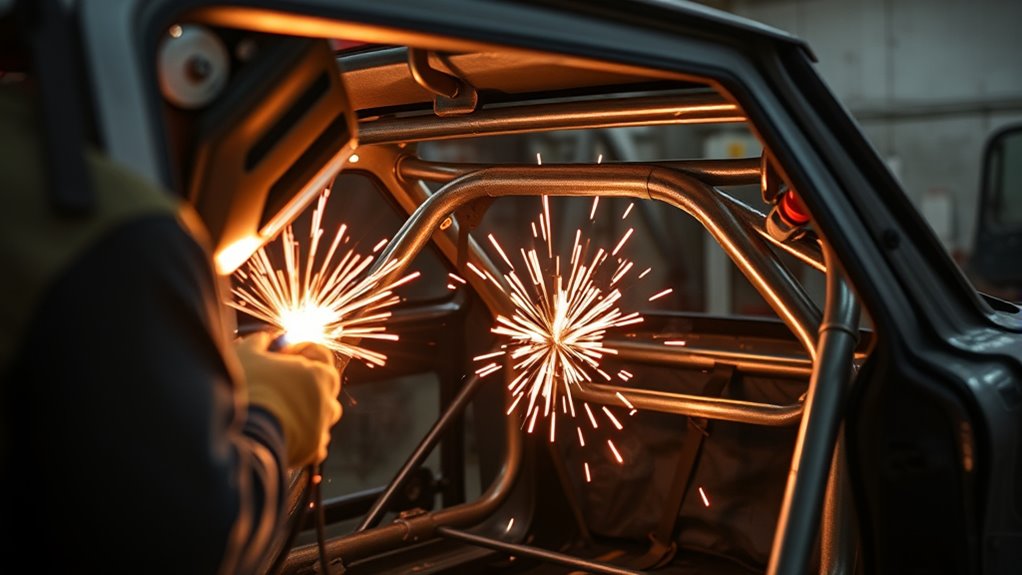
The main hoop establishes the position of many other cage tubes. Measure it around the final driver position and approved mounting locations rather than fitting it wherever installation is easiest.
- Mark the approved mounting points: Confirm the exact plate, floor, outrigger, rocker, or frame locations shown by the design and rulebook.
- Set the seat and driver reference: Check the seated driver with the normal helmet and restraint equipment.
- Measure the hoop: Keep it as close to the roof and body structure as the rules, installation access, and occupant clearance allow.
- Bend without damaging the tube: Use the correct die and bend radius. Reject bends with flattening, wrinkling, cracking, or wall failure outside the allowed limits.
- Trim the lower ends: Make both ends sit fully on the approved mounting surfaces without rocking.
- Support the hoop: Use temporary braces or a rigid fixture to hold it square and at the correct height.
- Check the vehicle centerline: Measure from fixed chassis references rather than relying only on trim panels or the roof skin.
- Tack the hoop: Add small, sound tacks only after the height, alignment, helmet clearance, and mounting positions are confirmed.
Do not fill a poor tube fit with an oversized weld. If a notch produces an excessive or irregular gap, recut the tube or replace it. The accepted fit-up tolerance must come from the approved procedure or inspector.
Pro Tip: Mark each tube’s orientation and joint number before removing it for final cleaning. A symmetrical-looking tube can fit differently after it is rotated.
Fit the Remaining Bars and Create Sound Load Paths
After the main hoop is stable, fit the remaining required tubes in the order that gives you the best access and keeps the structure aligned.
Fit the halo, front legs, braces, and door protection
- Position the halo or front hoop according to the approved design.
- Fit the A-pillar or front-down tubes while checking dashboard, door, pedal, and steering clearance.
- Add rear braces at the required angle and mounting points.
- Fit the door bars or side-intrusion structure without blocking required driver exit.
- Position the harness bar only after confirming the seat and restraint manufacturer’s requirements.
- Add required diagonal, roof, windshield, dash, or gusset tubes.
- Tack the complete cage and recheck every measurement before finish welding.
Each notch should contact the mating tube evenly around the joint. A tight joint supports stable tacking, better puddle control, and consistent fusion.
Use mounting plates and connectors as part of the load path
Mounting plates are not interchangeable pieces of thick steel. Their material, thickness, area, shape, location, and attachment method must match the rulebook and the vehicle construction.
A unibody car may need a different attachment strategy from a body-on-frame vehicle. Frame connectors, outriggers, rocker structures, floor plates, and gussets must work together rather than create a stiff local patch attached to weak surrounding sheet metal.
Do not cut a fixed amount from a floor, rail, torque box, or structural panel based on a general online instruction. Follow the exact kit, drawing, engineering document, and inspector-approved procedure for that vehicle.
Gussets can improve load distribution when correctly designed, but they do not automatically repair an incomplete weld, unsuitable tube, weak mounting point, or poor cage geometry.
Note: Some builders create temporary access through the floor so the cage can be lowered for roof-side welding. Use that method only when the rulebook and approved repair plan allow it. Do not cut structural panels without confirming how they will be restored.
Set the Welder and Validate Practice Joints
Practice on the same tubing material, wall thickness, joint style, fit-up, filler, shielding gas, and welding position used on the cage. Flat plate does not reproduce the heat flow or torch access of a notched tube joint.
- Confirm the process and polarity: Match them to the consumable and approved procedure.
- Check the machine capacity: Make sure the input power, duty cycle, output range, and lead condition suit the job.
- Prepare matching tube joints: Include flat, vertical, overhead, and awkward positions.
- Start with the manufacturer’s chart: Treat it as an initial setting, not a final qualification.
- Adjust on scrap: Look for stable arc behavior, controlled puddle size, smooth tie-in, and complete fusion without burn-through.
- Inspect and test the samples: Cut, section, bend, or otherwise evaluate practice joints under qualified guidance rather than relying only on the bead face.
- Record the successful setup: Note machine controls, filler, gas flow, torch setup, and joint preparation.
Clean the joint immediately before welding. Remove oxide, oil, marker residue, cutting lubricant, paint, coating, and loose abrasive debris. Keep stainless-steel cleaning tools separate when cross-contamination could affect the material.
Products Worth Considering

Features: the surface is highly polished, and the edge is smooth without roughness.
STAINLESS STEEL MATERIAL: Made with the exceptional workmanship and stainless steel materials, our soil probes are finely machined for smooth, easy sampling, and long-lasting durability

Tube rack: round holes, alphanumeric positions for easy identification. Stainless steel, resistant to corrosion and autoclavable at 121℃.
Weld the Cage in a Controlled Sequence
Tack the complete cage before finish welding unless the approved build sequence says otherwise. Check symmetry, door operation, seat position, helmet clearance, tube contact, and mounting alignment after tacking.
Plan access before starting
You must be able to see and control the puddle around every required joint. Do not blindly drag the torch around a hidden roof-side connection. Reposition the cage, vehicle, seat, dashboard components, or removable panels as permitted so you can make and inspect the weld.
Use short sections to manage distortion
You may divide a joint into shorter sections and move between separated areas of the cage to reduce concentrated heat. However, the finished required joint must still be continuous around its full circumference unless the applicable rule explicitly permits another connection.
The common “one-third at a time” approach describes a welding sequence. It does not mean that one-third of the joint can remain unwelded.
Maintain control throughout the weld
- Place the work clamp on clean metal close to the active weld.
- Use a stable body position that allows smooth travel before starting the arc.
- Keep the electrode or tungsten extension, torch angle, arc length, and travel speed consistent with the process.
- Pause and reposition before losing sight of the puddle.
- Blend starts and stops without leaving an unfilled crater.
- Remove defective tacks instead of burying them beneath the finished weld.
- Allow crowded areas to cool naturally when excess heat could distort the structure.
- Do not use water or compressed air to force rapid cooling unless an approved procedure specifically requires it.
After each group of welds, recheck alignment and inspect nearby materials for heat damage or fire.
Common Roll Cage Welding Defects and Corrections
Do not cover a defect with another bead and hope it disappears. Identify the cause, remove the unacceptable area using an approved method, restore the joint preparation, and reweld only after correcting the underlying problem.
| Visible Problem | Possible Causes | Safe Response |
| Gap between notched tubes | Wrong notch angle, incorrect length, tube movement, or poor template. | Recut or replace the tube. Do not bridge an excessive gap with weld metal. |
| Cold lap or lack of fusion | Low heat, high travel speed, poor torch angle, long extension, contamination, or poor access. | Stop, remove the defective weld to sound metal, improve access and settings, then reweld and reinspect. |
| Porosity | Oil, rust, coating, moisture, gas loss, drafts, leaks, or excessive extension. | Correct the contamination or gas problem, remove the affected weld, and repeat the inspection. |
| Undercut | Excess heat, long arc, poor angle, excessive travel speed, or incorrect manipulation. | Have the area assessed against the applicable acceptance criteria and repair it using an approved procedure. |
| Burn-through | Excess heat, slow travel, oversized gap, or incorrect wall-thickness assumption. | Stop and obtain qualified repair guidance. Do not casually fill a large hole in safety-critical tubing. |
| Crater crack | Abrupt arc termination or an unfilled crater. | Remove the crack completely, refill the termination correctly, and inspect the surrounding area. |
| Missed roof-side section | Poor build sequence or inaccessible joint. | Restore safe access. Do not cover or paint the joint until it is completely welded and accepted. |
| Arc strike outside the joint | Poor starting control or accidental contact. | Have it evaluated and repaired as required. Do not hide the area with paint or filler. |
Material-selection errors
Do not replace specified tubing with a cheaper material because the outside diameter appears correct. Material grade, manufacturing method, wall thickness, heat treatment, bend quality, and traceability can all affect acceptance.
Keep different materials clearly identified throughout cutting and fitting. Once short offcuts are mixed together, visual identification may not be reliable.
Inadequate penetration and hidden defects
A smooth bead face does not prove fusion at the root. Validate the procedure on practice joints and have critical work inspected by someone qualified to judge the applicable acceptance criteria.
Where the rulebook, inspector, or repair procedure requires more than visual inspection, nondestructive methods such as liquid penetrant or magnetic-particle testing should be performed by qualified personnel using the correct procedure for the material.
Follow Current Racing Rules and Inspection Requirements
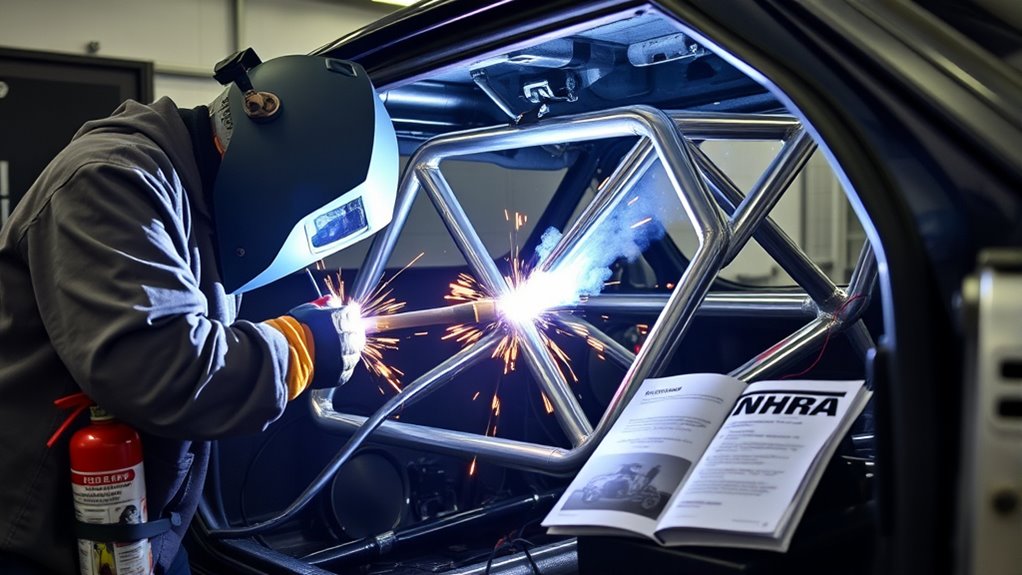
Rules may change between seasons, and different classes within the same organization can use different cage requirements. Use the current rulebook and any technical amendments in force on the inspection date.
For NHRA competition, consult the applicable current-year rulebook, general regulations, class section, and track technical staff. The NHRA Summit Racing Series guidelines repeatedly direct competitors to the current rulebook for applicable requirements.
Before final welding, verify:
| Item | Required Check |
| Tubing | Material, manufacturing method, outside diameter, wall thickness, bend quality, and inspection-hole requirements. |
| Cage layout | Main hoop, front structure, braces, diagonals, door protection, roof bars, and prohibited tube locations. |
| Mounting | Number of points, plate size and thickness, chassis location, welding or bolting method, and backing requirements. |
| Welding | Permitted process, complete joint access, continuous required welds, material-specific procedure, and acceptance criteria. |
| Occupant protection | Helmet clearance, seat and harness installation, padding, window net, driver containment, and exit access. |
| Certification | Required inspector, certification label, documentation, renewal period, and reinspection triggers. |
Do not rely on an isolated dimension copied from a forum, video, old rulebook, or unrelated class. Ask the inspector to identify the exact section that controls the build.
Inspect the Cage Before Paint
Clean the joints enough to expose their full surface, but do not grind them merely to create a smooth cosmetic finish. Grinding can remove weld metal, reduce effective throat size, create new undercut, or hide the original condition.
Perform a complete visual inspection
- Use strong lighting: Inspect the full circumference of every tube joint.
- Check bead continuity: Look for missed areas, abrupt stops, open craters, and incomplete roof-side welds.
- Check fusion and profile: Look for cold lap, poor tie-in, excessive convexity, undercut, or inconsistent bead width.
- Check surface condition: Look for cracks, visible porosity, inclusions, arc strikes, burn-through, and overheated or damaged tubing.
- Check the structure: Reconfirm alignment, tube clearance, mounting plates, braces, seat position, door operation, and driver exit.
- Obtain professional review: Have the required inspector or experienced cage builder examine the unpainted work.
Repair defects correctly
Do not weld directly over a crack, pore cluster, cold-lapped bead, or contaminated joint. Remove the unacceptable area to sound metal without excessively thinning the tube, restore the joint geometry, correct the cause, and reweld under an approved repair procedure.
A gusset or cover plate does not automatically make a defective weld acceptable. The inspector or engineer should approve any structural repair before it is concealed.
Document the completed work
Keep records of the tubing source, material certificates, rulebook edition, drawings, photographs, practice-joint results, inspection findings, repairs, and certification. Photograph difficult joints before trim, padding, paint, or interior panels block the view.
Arrange reinspection after a significant crash, visible deformation, corrosion, fire, structural modification, cut tube, repaired weld, or rule change that affects the cage.
Complete the Occupant Safety System
The cage is only one part of the occupant-protection system. Complete the seat, restraint, padding, net, and driver-clearance installation according to the current rules and each component manufacturer’s instructions.
Install proper cage padding
Use rule-compliant energy-absorbing padding on every tube within possible occupant-contact areas. Soft decorative foam or household pipe insulation may not provide the required impact performance or flame resistance.
SFI Specification 45.1 establishes impact-attenuation and flame-resistance tests for roll-cage padding. Install the correct padding orientation and secure it so it remains attached during competition.
Check the seat and harness installation
- Use an approved seat and mounts that match the rules and vehicle structure.
- Keep shoulder, lap, and anti-submarine belt routing within the restraint manufacturer’s permitted geometry.
- Do not place the harness bar by appearance alone.
- Make sure belt hardware cannot rub against sharp tube ends, tabs, or seat brackets.
- Confirm that the driver can release the belts, net, steering wheel, and door without assistance.
- Recheck helmet and limb clearance after all padding and interior components are installed.
Welding Safety Measures
Roll-cage work combines arc radiation, hot metal, fumes, electrical current, compressed gas, grinding debris, confined access, and fire hazards inside a vehicle.
- Wear complete PPE: Use a welding helmet with the correct shade, safety glasses, flame-resistant clothing, gloves, hearing protection, and suitable footwear.
- Use ventilation: Capture fumes near the source and keep them out of your breathing zone without pulling shielding gas away from the arc.
- Remove coatings: Clean paint, galvanizing, plating, seam sealer, undercoating, and contamination from areas affected by heat.
- Control fire hazards: Remove combustibles, protect hidden cavities, keep an extinguisher nearby, and use a fire watch when needed.
- Protect cylinders: Secure shielding-gas cylinders upright, protect valves, inspect hoses, and close the valve when the system is unattended.
- Inspect equipment: Check leads, connectors, gun or torch parts, work clamp, regulator, hoses, and power cords.
- Protect other people: Use welding curtains and prevent bystanders from viewing the arc.
- Use grinder-rated accessories: Match every disc, wheel, guard, and attachment to the grinder speed and intended operation.
- Check after hot work: Inspect both sides of panels and revisit the vehicle after welding to find delayed smoke or heat.
Warning: Never weld, grind, or cut where fuel vapor may be present. A drained fuel tank can still contain an explosive vapor mixture. Follow the vehicle and facility hot-work procedure before working near any fuel-system component.
Improve Your Roll Cage Welding Skills
Practice regularly
Build repeated tube-to-tube practice joints using the same material and wall thickness as the planned cage. Practice in the positions you will face inside the vehicle, including overhead, vertical, restricted-view, and one-handed access.
Change one variable at a time. Record the results so you can connect bead shape and penetration with voltage, current, wire speed, travel speed, torch angle, joint gap, gas coverage, and body position.
Do not practice only until the bead looks smooth. Section or mechanically test sample joints under qualified guidance so you can examine fusion below the surface.
Seek expert guidance
Ask an experienced cage builder, welding instructor, certified inspector, or motorsport technical official to review your practice joints. Specific feedback about starts, stops, sidewall fusion, crater filling, torch access, and fit-up will help more than general comments about appearance.
Record short videos of your hand position and travel when it is safe to do so. Review them away from the welding area to find sudden speed changes, excessive wrist movement, and positions that block your view of the puddle.
Frequently Asked Questions
What kind of welding is used for automotive roll cages?
MIG and TIG are both used for roll-cage fabrication. The permitted process depends on the tubing material, wall thickness, sanctioning-body rules, filler, joint access, and welder qualification. Do not choose a process only because it is faster or already available in your garage.
What is the golden rule when welding a roll cage?
Do not trust appearance alone. Use the approved material and design, create tight joints, validate the process on matching samples, maintain complete access, finish every required weld, and inspect the cage before it is painted or used.
Can welding fumes shorten a welder’s life?
Repeated exposure to welding fumes, gases, ultraviolet radiation, noise, and heat can contribute to serious health problems. Control exposure with local exhaust ventilation, clean base metal, suitable PPE, safe work practices, and properly selected respiratory protection when the hazard assessment requires it.
Should I disconnect the battery before welding on a vehicle?
Follow the vehicle manufacturer’s service procedure. General welding-equipment guidance recommends disconnecting both battery cables and placing the work clamp close to the weld. Battery disconnection does not replace protection for sensitive modules, fuel systems, or hybrid and electric-vehicle high-voltage equipment.
Can a beginner weld a roll cage?
A beginner can practice tube joints, but a cage that protects occupants should not be a first structural project. Build and test matching practice joints, receive qualified feedback, and use a professional builder when you cannot consistently produce acceptable welds in every required position.
Do I need to follow NHRA rules for a street car roll cage?
You need the applicable NHRA rules when the vehicle will compete in an NHRA class or at a track enforcing those rules. A street-only or dual-purpose vehicle still needs a recognized design and professional review for head-contact risk, airbags, seat belts, visibility, and emergency exit access.
Do roll cage welds need to go around the full tube?
Required welded tube joints generally need continuous welds around the full circumference unless the applicable rulebook specifically permits another connection. Short segments may be used as a sequence to manage heat, but every required section must be completed and inspected.
Should roll cage welds be ground smooth?
Do not grind structural cage welds merely to improve their appearance. Grinding can remove effective weld metal or hide the original condition. Dress or remove a weld only when an approved repair procedure requires it, then have the repaired area reinspected.
Can I use flux-core wire for a roll cage?
Only when the current rulebook, tubing material, consumable classification, approved procedure, and inspector allow it. Slag, smoke, limited access, and inspection difficulty can make flux-cored welding unsuitable for some cage applications.
Safety Disclaimer: This article provides general educational information. It is not an approved cage design, welding procedure specification, engineering calculation, inspection certificate, or substitute for the current rulebook. Use a qualified cage builder and the required motorsport inspector for any structure intended to protect occupants.
Conclusion
Safely welding an automotive roll cage starts long before the arc is struck. Confirm the current rules, design the structure around the seated driver, use traceable tubing, protect the vehicle, and create tight joints with complete welding access.
Validate the process on matching tube joints and complete each required weld around the full connection while controlling distortion. Inspect every joint before paint, then finish the seat, harness, padding, and driver-containment system as one coordinated safety package.
Do not use the cage in competition until the required technical inspector or an experienced professional cage builder has accepted the design and workmanship.
Sources
- National Hot Rod Association: National Championship Guidelines — supports the requirement to use the applicable current-year NHRA rulebook.
- Sports Car Club of America: Cars and Rules — provides access to the current SCCA General Competition Rules.
- SCCA Race Experience Vehicle Requirements — supports tubing, cage-layout, padding, full-penetration, and continuous-weld guidance.
- OSHA 1910.252: Welding, Cutting, and Brazing — supports ventilation, PPE, and general hot-work precautions.
- CDC/NIOSH: Welding Fumes and Manganese — supports welding-fume exposure and control guidance.
- SFI Specification 45.1: Roll Cage Padding — supports energy-absorbing padding and secure-retention guidance.