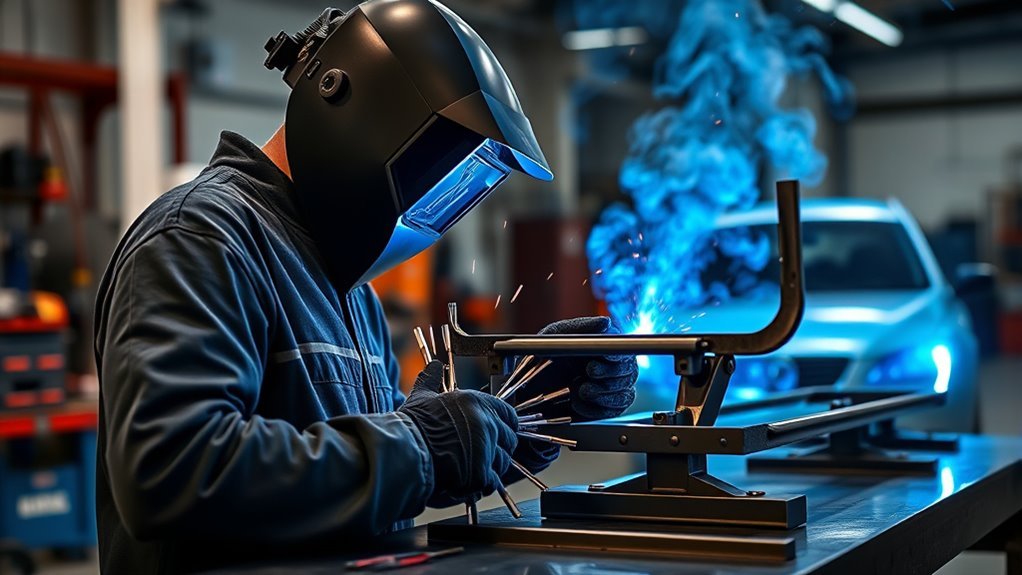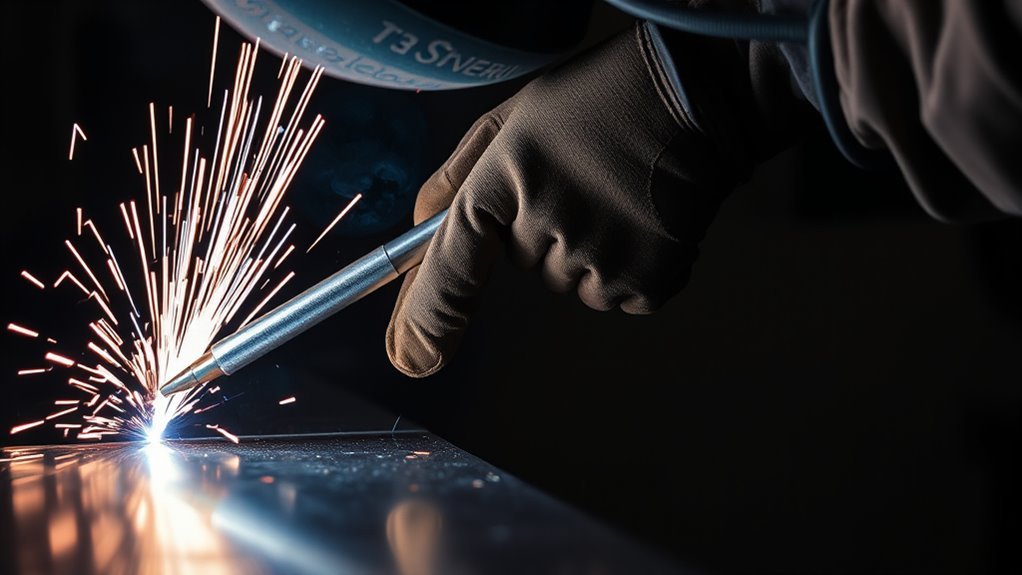
To weld in the horizontal position, set the joint securely, clean the metal, choose the right stick electrode, and keep a short, steady arc. For most horizontal fillet welds, hold the rod about 45 degrees into the joint with a slight upward bias so the weld pool does not sag. Use a whip-and-pause motion only with fast-freeze rods like E6010 or E6011. With E7018, use a steady drag or small weave instead.
Quick Answer
Horizontal welding works best when you clean the joint, clamp it firmly, use the correct electrode, keep a short arc, and aim slightly upward to fight gravity. Run E6010 or E6011 with a whip-and-pause motion, but run E7018 with a steady drag or small weave for smoother control.
Key Takeaways
- Horizontal welding usually means a 2F fillet weld or a 2G groove weld, not a flat-position weld.
- For a horizontal fillet weld, start with a 45-degree work angle and tilt slightly upward if the puddle sags.
- Use E6010/E6011 for fast-freeze control and E7018 for low-hydrogen strength when the job calls for it.
- Keep the arc short, clean slag between passes, and watch the upper toe for undercut or lack of fusion.
- Wear proper PPE, use ventilation, and follow the electrode maker’s settings or the job’s welding procedure.
At a Glance
| Time Required | 15-30 minutes for setup and practice beads; longer for multi-pass welds |
| Difficulty | Intermediate for beginners because gravity pulls the puddle down |
| Tools Needed | SMAW welder, electrode holder, work clamp, welding rods, chipping hammer, wire brush, clamps, PPE, and ventilation |
| Cost | Low if you already own a welder; practice steel and rods are the main consumables |
Warning: Arc welding can burn skin, damage eyes, start fires, create fumes, and shock you. Wear a welding helmet, gloves, jacket, safety glasses, and boots. Keep combustibles away, use ventilation, check your cables, and never weld on a closed or dirty container.
Understanding Horizontal Welding Techniques
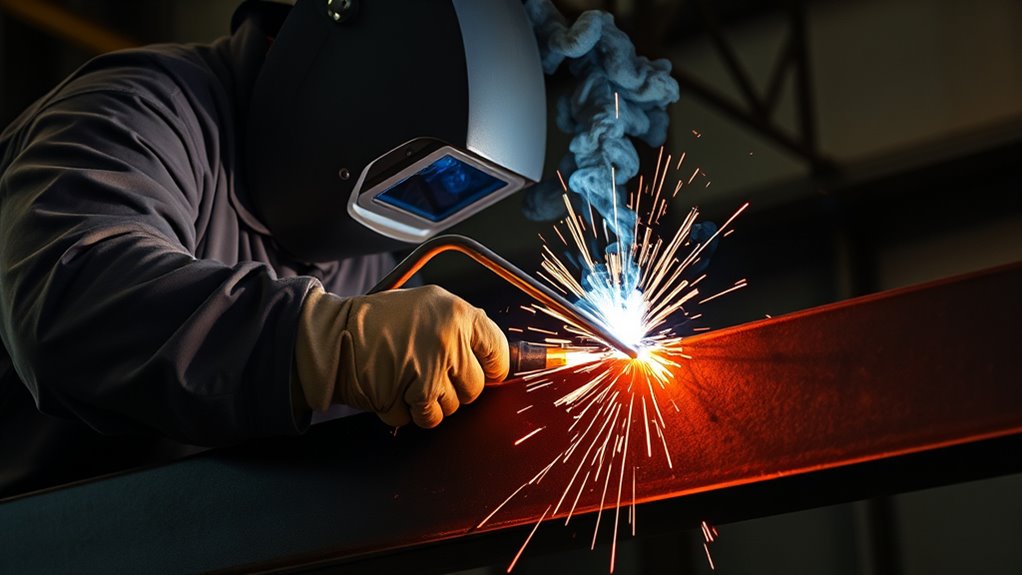
In welding position terms, horizontal welding is not the same as flat welding. In flat welding, gravity helps the puddle sit in the joint. In horizontal welding, the joint runs side to side, and the molten metal wants to sag toward the lower edge.
You will usually see two common horizontal positions:
- 2F horizontal fillet weld: A fillet weld on a T-joint, lap joint, or inside corner where the weld runs horizontally.
- 2G horizontal groove weld: A groove or butt weld where the weld axis is horizontal, often on a vertical plate face.
The main challenge is puddle control. You need enough heat to fuse both pieces, but not so much heat that the puddle rolls down, undercuts the upper toe, or leaves slag trapped along the lower edge.
The goal in horizontal welding is simple: keep the puddle small, hot, and supported long enough to tie into both sides of the joint.
For stick welding, that means you should use a short arc, a steady travel speed, and a rod angle that directs heat into the joint instead of letting the puddle pile up on the lower plate. Watch the back edge of the weld pool, not just the bright arc.
Also watch for lack of fusion, especially at the upper toe of a horizontal weld. If the top edge looks cold, straight, or rolled over, slow down slightly, tighten the arc, and aim more heat into that upper edge.
Preparing the Workpiece for Effective Welding
Good horizontal welds start before you strike an arc. Clean metal, tight fit-up, and solid clamping make the puddle easier to control.
Start by removing paint, rust, oil, grease, moisture, mill scale, and heavy dirt from the weld area. Clean at least 1/2 inch on both sides of the joint. Contaminants can cause porosity, slag pockets, and weak fusion. If you are practicing on scrap, grind it until you can see bright metal.
Next, fit the joint correctly:
- For a 2F fillet weld: Hold the pieces tight at about 90 degrees unless the drawing or project calls for another angle.
- For a 2G groove weld: Check the bevel, root opening, and backing according to the job requirements.
- For practice beads: Use flat, clean plate and mark straight guide lines with soapstone.
Use clamps or fixtures so the work cannot shift as it heats. Heat movement is one reason practice welds look good at the start but drift near the end.
Note: If the joint has a gap, do not just turn up the amperage. A wide gap can make the puddle sag faster. Tack the joint, correct the fit-up, and use smaller passes if needed.
If you are welding over flux residue or dirty metal, clean between passes with a chipping hammer and wire brush. This matters even more in the horizontal position because slag can slide into the lower toe and get trapped under the next pass.
How to Set Up Your Welding Equipment Right
Set up your welding equipment before you start so you are not fighting the machine while the puddle is moving.
For stick welding, your basic setup includes a constant-current power source, electrode holder, work clamp, welding leads, electrode, PPE, and fume control. The Welding Institute lists the core manual metal arc equipment as the power source, electrode holder and cables, welder protection, and fume extraction. TWI
Before welding, check these points:
- Work clamp: Clamp directly to clean metal, close to the weld when possible.
- Cables: Spread coiled cable out so it does not overheat.
- Rod holder: Make sure it grips the electrode tightly.
- Polarity: Match the rod package. Many E7018 rods run on DCEP or AC, while many E6010 rods need DCEP.
- Amperage: Start near the middle of the rod maker’s range, then adjust after a short test bead.
- PPE: Use a welding helmet with the right filter shade, gloves, jacket, and safety glasses.
- Ventilation: Keep fumes moving away from your breathing zone.
OSHA says arc welding equipment should be selected for safe application, and workers operating it should be properly instructed and qualified. OSHA also says connections should be checked before operations, with the work lead firmly attached to the work. OSHA 1910.254
For a 1/8-inch stick electrode, many welders start around 90-120 amps depending on the rod type, machine, joint, and steel thickness. That is only a starting point. If the rod sticks and the bead sits high, you may be too cold. If the puddle runs down, the arc digs hard, or the upper toe undercuts, you may be too hot or moving too slowly.
For more detail on matching heat to steel thickness, review your machine manual and the electrode packaging. You can also compare your settings with a stick welding amperage guide.
Products Worth Considering

【200Amp Power for Home Repairs & DIY】 This 110V stick welder Adjustable Current: 20-200A. Easily weld metal materials with 0.06-0.2 inch thickness, such as cast iron, mild steel, etc. For stainless steel, use E308L-16 rods only. Includes 20 welding rods right out of the box, so you can start your first project immediately.

💪200A POWER & PORTABLE DESIGN: Weld metals up to 1/4" thick (0.06-0.2") including stainless steel, alloy steel, carbon steel, and copper. Compact size (8.6x4.1x5.5") and ultra-lightweight (5 lbs) with shoulder strap make it easy to carry for jobs anywhere – high altitude, indoors, or outdoors. Enjoy extended welding sessions without overheating, backed by a solid 60% duty cycle for professional results.

3lb Portable Power – 250A in a Lunchbox-Sized Unit Don't let the lunchbox size fool you — this 250A IGBT stick welder delivers surprisingly strong arc performance for its weight. At just 3 lbs (machine only; 7.7 lbs with full accessory kit), it's a portable arc welder you can plug into a standard 110V outlet. The complete starter kit includes 20 welding rods, gloves, brush, electrode holder, and earth clamp — everything needed to start welding right out of the box. Designed for beginners, hobbyists, and DIY home repairers.
Selecting the Right Electrode for Your Project
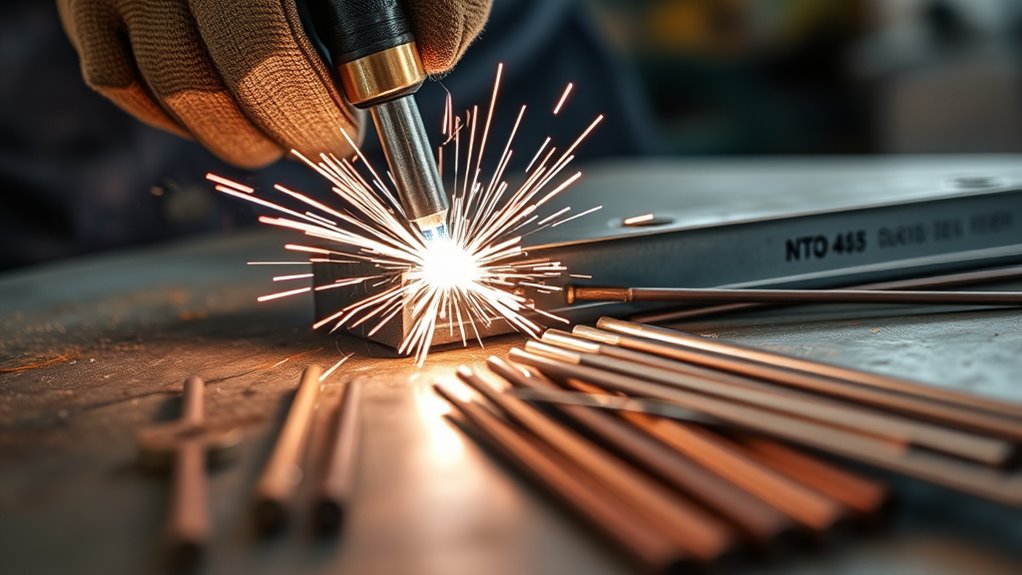
Choosing the right electrode affects how the puddle freezes, how much slag you handle, how smooth the bead looks, and how strong the weld can be. There is no single best rod for every horizontal weld.
| Electrode | Best Use in Horizontal Welding | Technique Tip |
|---|---|---|
| E6010 | Deep penetration, fast-freeze work, root passes, rusty or less-than-perfect steel when allowed | Use a tight arc and whip-and-pause motion; often DCEP only |
| E6011 | Similar to E6010 but often more AC-friendly | Use a controlled whip and avoid making the keyhole too large |
| E6013 | Light fabrication, clean steel, thinner material, smoother beginner practice | Use a steady drag or very small weave; clean slag well |
| E7018 | Low-hydrogen structural work when clean metal and proper storage are required | Use a short arc, steady travel, and stringers or a small weave; do not use a long whip |
| E7024 | Flat and horizontal fillet welds with high deposition on suitable thicker steel | Use a drag technique and let the rod deposit metal; not for all-position work |
Always match the electrode to the base metal, joint design, position, and required weld strength. If the project follows a welding procedure specification, use that procedure rather than guessing.
Check the flux coating before you weld. TWI notes that weld quality relies on consistent electrode performance and that the flux coating should not be chipped, cracked, or damp. TWI
Pro Tip: Run a 3-inch test bead on scrap from the same material before welding the real part. If the bead is convex, cold, or hard to restart, adjust your amperage, arc length, or rod angle before moving on.
Products Worth Considering

High-deposition efficiency for flat and horizontal fillet welding.


High-deposition efficiency for flat and horizontal fillet welding.
Mastering the Upward Bias Technique
The original mistake many beginners make is pointing the rod too flat into the joint. In the horizontal position, gravity pulls the molten metal down. A slight upward bias helps you keep heat on the upper toe and prevents the lower side from getting too heavy.
For a horizontal fillet weld, start with this setup:
- Work angle: About 45 degrees into the corner of a 90-degree joint.
- Upward bias: Tilt the rod slightly toward the upper plate if the puddle wants to sag.
- Travel angle: About 5-15 degrees in the direction of travel for a drag rod like E7018, or a controlled push-pull rhythm for E6010/E6011.
- Arc length: Keep it short, about the diameter of the electrode core or less for many rods.
For E6010 or E6011, the whip-and-pause pattern can help the puddle freeze before it sags. Move forward slightly, then return to the leading edge of the puddle so it fills and ties in. Do not whip so far forward that you lose shielding or leave a ropey bead.
For E7018, use a steady drag or a small side-to-side weave. Keep the arc tight. Let the slag trail behind the puddle. If you whip E7018 too much, you can trap slag, lose smooth fusion, or create an uneven bead.
Achieving the Ideal Electrode Angle
The ideal electrode angle depends on the joint and rod. Use the angles below as starting points, then adjust based on what the puddle shows you.
- 2F fillet weld: Start near 45 degrees into the joint. Raise the rod slightly if the weld piles up on the lower plate.
- 2G groove weld: Keep the rod close to perpendicular to the plate face, then use a small upward angle to support the puddle.
- Lap joint: Aim enough heat into the lower plate while still washing into the top edge.
- Multi-pass weld: Change the angle for each pass so you tie into the previous bead and the toe of the weld.
Do not chase the puddle with a long arc. A long arc increases spatter, makes the puddle less stable, and can leave undercut. If your rod sticks, raise amperage slightly or improve your start. If your puddle becomes too fluid, shorten the arc, move faster, or lower amperage.
Maintaining the correct arc length is one of the simplest ways to improve horizontal weld quality.
Controlling the Weld Puddle With Precision
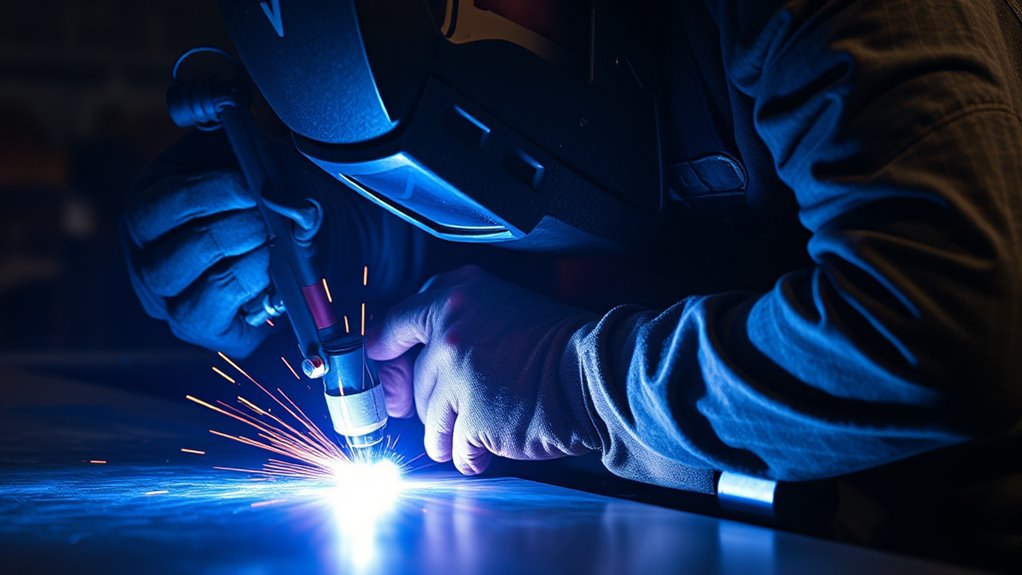
To control the weld puddle, focus on puddle size, toe tie-in, and slag position. The puddle should stay small enough to freeze quickly but wide enough to fuse both sides of the joint.
Upward Electrode Angle
A slight upward electrode angle helps support the molten metal. In a fillet weld, the upper toe is where many horizontal welds fail. If you move too fast or point too low, the upper edge can look washed over without true fusion.
Watch for these signs:
- Puddle rolls down: Lower amperage slightly, travel faster, or use a smaller pass.
- Upper toe undercuts: Aim more heat at the upper edge and reduce travel speed a little.
- Lower toe gets bulky: Keep the rod tighter and do not dwell too long on the lower side.
- Slag runs ahead: Tighten the arc and adjust rod angle so slag stays behind the puddle.
Whipping Motion Technique
The whipping motion technique is useful with fast-freeze electrodes such as E6010 and E6011. These rods dig and freeze quickly, so a small whip-and-pause helps control penetration and bead shape.
Use this pattern:
- Strike the arc and form a small puddle.
- Move forward slightly to open the leading edge.
- Return to the front of the puddle and pause just long enough to fill it.
- Repeat with an even rhythm.
Do not use a wide whip with E7018. With E7018, the smoother choice is a short arc, steady travel, and a small weave only when you need bead width.
| Technique | Use It When | Avoid It When |
|---|---|---|
| Whip-and-pause | Running E6010 or E6011 and needing fast-freeze control | Running E7018 or when slag starts getting trapped |
| Stringer bead | You need clean fusion, low heat input, and narrow passes | The weld size requires wider fill passes |
| Small weave | You need to tie into both toes on a wider pass | The puddle is already sagging or overheating |
Step-by-Step Horizontal Welding Process
Use this sequence for a basic horizontal stick weld on mild steel. Adjust it for the rod, joint, material, and welding procedure.
Step 1: Clean and Clamp the Joint
Grind or brush the weld area until it is clean. Clamp the work so it cannot move. Add tack welds at both ends and at the middle if the piece is long.
Step 2: Set Your Machine
Set polarity and amperage based on the electrode package. For a 1/8-inch rod, make a short test bead near the middle of the recommended range. Adjust after you see the bead shape.
Step 3: Strike the Arc
Strike the arc in the weld area or on a run-on tab if the job allows one. Avoid random arc strikes outside the weld zone because they can leave hard spots or small defects.
Step 4: Hold the Puddle
Keep the arc short. Watch the edges of the puddle. The upper edge should wash in, and the lower edge should not bulge or drip.
Step 5: Travel at a Steady Speed
Move steadily along the joint. If using E6010 or E6011, keep the whip motion small and regular. If using E7018, drag smoothly and let the slag trail behind the puddle.
Step 6: Fill the Crater
Before breaking the arc, pause briefly or backstep slightly to fill the crater. A deep crater can crack as it cools.
Step 7: Chip, Brush, and Inspect
Remove slag fully before the next pass. Look for undercut, slag lines, cold lap, porosity, and uneven bead width. Fix the cause before adding more weld metal.
How to Overcome Common Welding Challenges?
Most horizontal welding problems come from too much heat, poor angle, long arc length, dirty metal, or moving at the wrong speed.
| Problem | Likely Cause | Fix |
|---|---|---|
| Sagging puddle | Too hot, too slow, or pass is too large | Lower amperage, move faster, or make smaller stringer passes |
| Upper toe undercut | Too much heat at the edge or travel speed too fast | Shorten arc, slow slightly, and aim more into the upper toe |
| Slag inclusion | Slag ran ahead, poor cleaning, or wrong rod angle | Keep slag behind puddle and clean fully between passes |
| Porosity | Dirty metal, damp electrode, long arc, or poor shielding | Clean metal, use dry rods, and tighten arc length |
| Rod sticking | Amperage too low or arc start too slow | Raise amperage slightly and strike with a smooth scratch or tap |
| Excess spatter | Long arc, wrong polarity, too much current, or arc blow | Shorten arc, confirm polarity, lower amperage, and reposition work clamp |
If you are welding thicker material, stay within the recommended amperage range for the steel thickness, rod size, and joint design. More amperage is not always better in the horizontal position because gravity makes an overheated puddle harder to hold.
Ways to Improve Your Welding Skills
You improve horizontal welding by practicing one variable at a time. Do not change amperage, rod angle, and travel speed all at once. Change one thing, run another bead, then compare the result.
Practice Regularly
Use short practice drills so you can see progress quickly:
- Bead-on-plate drill: Run straight horizontal beads across clean plate and keep the width even.
- 2F fillet drill: Weld a T-joint and focus on equal leg size.
- Upper-toe drill: Aim slightly into the upper edge and check for undercut after cleaning.
- Restart drill: Stop, chip the crater, restart, and blend the next bead smoothly.
- Multi-pass drill: Run a root pass, clean it, then add cover passes without trapping slag.
Take notes after each bead. Write down the rod, diameter, amperage, polarity, angle, and what the finished weld looked like. This helps you build repeatable settings instead of guessing every time.
Analyze Your Results
After each weld, chip and brush it clean. Then inspect it under good light. Look for:
- Even bead width from start to finish
- Smooth tie-in at both toes
- No undercut along the upper edge
- No slag trapped between passes
- No pinholes or surface porosity
- A crater that is filled, not hollow
If possible, cut and etch practice coupons so you can see penetration and fusion. A weld can look smooth on top and still lack fusion inside.
Advanced Techniques for Horizontal Welding
Once you can run a clean single pass, start working on multi-pass control. Horizontal welds often need several smaller passes instead of one oversized bead.
For a larger fillet weld, try this pattern:
- Run a root pass that fuses both pieces.
- Clean all slag from the root pass.
- Add a second pass that ties into the lower toe and root bead.
- Add a third pass that ties into the upper toe and previous bead.
- Clean and inspect the final profile.
Overlapping weld beads can be useful in multi-pass welding, but do not treat “50% overlap” as a universal rule. The right overlap depends on bead size, joint design, and the required weld profile. Size fillet welds according to the project requirements and avoid oversizing beyond what the joint needs. For more context, review how weld size relates to the thinner plate.
You can also improve horizontal welds by controlling heat between passes. If the joint gets too hot, the puddle may sag even when your settings were right at the start. Let the piece cool when needed, especially on short practice coupons.
Safety Checks Before You Weld
Do not skip safety just because the weld is small. OSHA requires proper eye and face protection when workers are exposed to flying particles, molten metal, and harmful light radiation. OSHA also gives filter shade guidance by process and current. OSHA 1910.133
Before welding, check the area:
- Remove paper, sawdust, fuel, rags, aerosol cans, and other combustibles.
- Keep a fire extinguisher nearby.
- Use welding screens if others are nearby.
- Use ventilation or fume extraction.
- Keep leads out of walkways.
- Do not weld in wet gloves, wet clothing, or standing water.
- Disconnect the machine before changing leads or repairing equipment.
OSHA states that movable fire hazards should be taken to a safe place, and if they cannot be moved, guards should be used to confine heat, sparks, and slag. OSHA 1910.252
Ventilation also matters. TWI recommends fume removal with mechanical ventilation that moves fresh air from the welder’s face toward the work, ideally with local exhaust near the weld area. TWI
Frequently Asked Questions
What welding position is horizontal?
The horizontal welding position is usually a 2F fillet weld or a 2G groove weld. In both cases, the weld runs side to side, and gravity pulls the molten puddle toward the lower edge. That is why angle, arc length, and travel speed matter so much.
Can you run 7018 horizontally?
Yes, you can run E7018 horizontally if the rod, machine, and procedure allow it. Keep a short arc, use the correct polarity, and run stringer beads or a small weave. Do not use a long whip motion with E7018 because it can trap slag and make the bead uneven.
What is the hardest position to weld in?
Overhead welding is often considered the hardest because the weld pool, sparks, and slag are above you. Horizontal welding is easier than overhead, but it is harder than flat welding because the puddle can sag down the joint.
What is the primary challenge when welding in the horizontal position?
The main challenge is controlling the molten puddle. You need enough heat to fuse the joint, but not so much that the metal sags, undercuts the upper toe, or traps slag along the lower edge.
Should you push or drag when horizontal stick welding?
With stick welding, many rods are dragged with a short arc. E7018 is usually dragged or run with a small weave. E6010 and E6011 can use a controlled whip-and-pause motion. Always follow the electrode manufacturer’s directions.
Why does my horizontal weld sag?
A sagging horizontal weld usually means the puddle is too large or too hot. Lower the amperage slightly, move faster, shorten the arc, use a smaller pass, or choose an electrode that freezes faster.
Conclusion
Mastering horizontal welding comes down to clean prep, correct setup, rod-specific technique, and steady puddle control. Start with a secure joint, use the right electrode, keep the arc short, and aim enough heat into the upper toe so the weld does not sag or undercut. Practice on scrap, inspect every bead, and adjust one setting at a time. With enough consistent practice, you will build cleaner 2F and 2G welds with stronger fusion and better control.
Sources
- OSHA 1910.252, Welding, Cutting and Brazing General Requirements — supports fire prevention, PPE, and welding safety precautions.
- OSHA 1910.254, Arc Welding and Cutting — supports arc welding equipment setup, safe operation, and connection checks.
- OSHA 1910.133, Eye and Face Protection — supports welding helmet and filter shade guidance.
- TWI, Equipment for Manual Metal Arc Welding — supports SMAW equipment, electrode care, cable setup, and fume extraction guidance.